
Sales training in the UK typically costs anywhere from £300 to £500 per person for a one-day open course, £1,000 to £5,000 per person for bespoke in-person programmes, and £2,995 to £8,500 for fully customised packages combining coaching and consultancy. Whatever quote lands on your desk, treat it as a starting point, not the full picture, because implementation time, manager reinforcement, and lost selling hours usually add far more to the real cost than the headline fee suggests. This guide breaks down every format, hidden cost, and budgeting step you need before you sign anything.
TL;DR:
- Customised on-site programmes with diagnosis and follow-up usually cost between £1,000 and £5,000 per person, depending on scope and duration.
- Opportunity costs and manager reinforcement can significantly increase the total expense, adding thousands to the initial fee.
- Quote breakdowns should include curriculum design, trainer credentials, travel, materials, platform access, and post-training support for clarity.
- The true cost often exceeds the headline figure by 50% or more once implementation, opportunity, and reinforcement are factored in.
- Budgeting should encompass all direct costs along with opportunity and productivity impacts to accurately assess ROI.
Table of Contents
- How much does sales training cost by format?
- What actually drives the price on a training quote?
- What is the true total cost of sales training?
- How do you budget for sales training and compare quotes properly?
- How do you measure ROI from sales training?
- Ahead of Sales: real-world pricing profiles and what you get
- Author perspective: training is an ongoing investment, not an event
- How Ahead of Sales can help with your budget
- Sources
How much does sales training cost by format?
The format you choose changes the maths more than almost anything else. A one-day workshop and a bespoke six-month coaching programme aren’t really the same product wearing different price tags. They solve different problems, and the price reflects that.
Open one-day and short courses sit at the accessible end. UK providers commonly advertise fees between £290 and £495 per person for generic skills sessions, and trade coverage puts specific examples on record: one provider charges £349 plus VAT for a one-day advanced selling skills course and £495 plus VAT for a two-day essential course. These fees usually cover the trainer, standard materials, and a shared room with other companies’ delegates. What they rarely include is any follow-up, so the skills taught on the day tend to fade fast without reinforcement.
Instructor-led online and blended programmes offer more flexibility per pound spent. Industry benchmarking places instructor-led online training at £300 to £1,500 per person, depending on how much customisation and coaching time is built in. The advantage here is scale: you can train a distributed sales team without flight costs or hotel bills, and sessions can be recorded for onboarding future hires.
Bespoke on-site multi-day programmes are where customisation drives the price up significantly. The same benchmarking source lists in-person classroom training at £1,000 to £5,000 per person, and that range widens further once you factor in trainer travel, venue hire, and bespoke curriculum design built around your product, your buyer personas, and your actual objection patterns. Programmes that begin with a proper skills-gap diagnosis rather than a generic template tend to sit toward the top of that range, and for good reason: they’re solving your specific problem, not a textbook one.
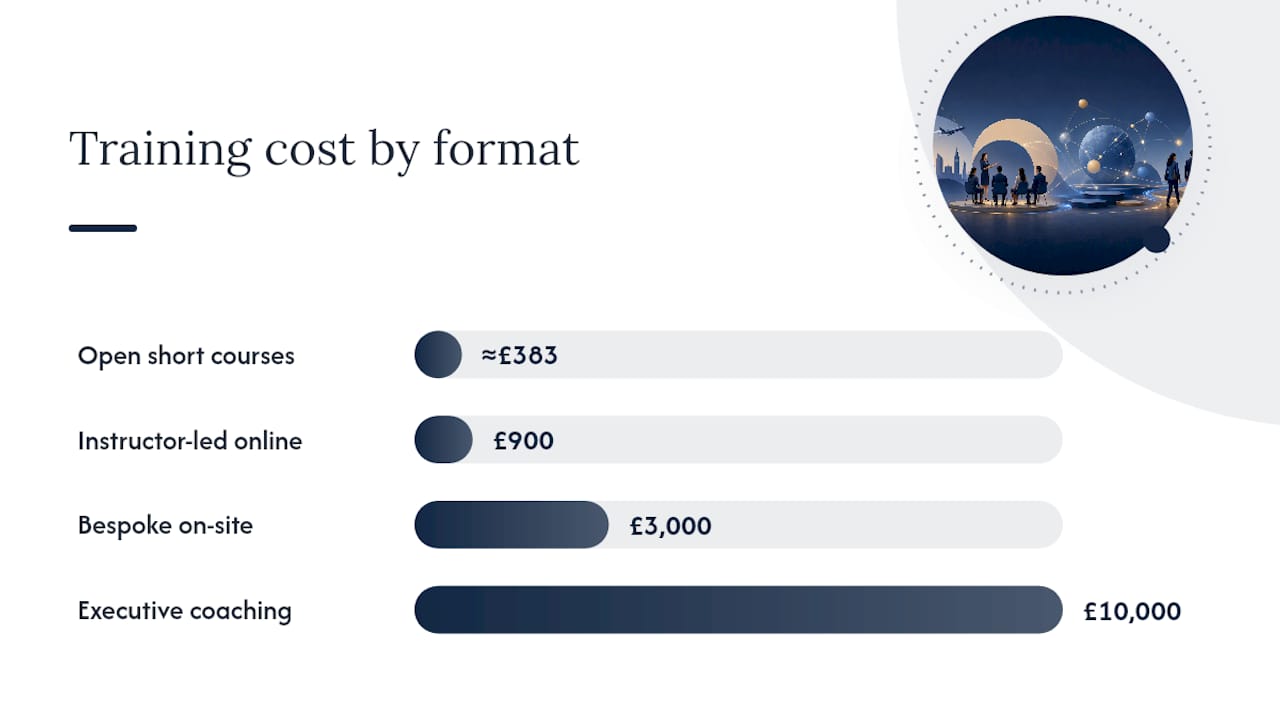
One-to-one executive coaching and high-end customised packages occupy the top tier. Market analysis notes that highly customised corporate coaching initiatives can exceed £10,000 per person when they combine 1:1 sessions, ongoing consultancy, and measurement infrastructure over several months. This is the format that suits senior sales leaders, founders selling their own pipeline, or teams where a single missed quarter costs more than the training itself.
A few practical notes on the numbers above:
- Most UK B2B training quotes exclude VAT, so add 20% to any headline figure before comparing providers.
- Per-person pricing generally drops as cohort size increases but only up to a point. Beyond roughly 12 to 15 delegates, quality tends to suffer regardless of the discount.
- Licensing fees for ongoing access to e-learning platforms or diagnostic tools are sometimes bundled, sometimes billed separately. Always ask which.
What actually drives the price on a training quote?
Two quotes with identical day-rates can produce wildly different totals, and the gap almost always comes down to what’s actually included rather than any padding on the trainer’s fee.
A typical quote breaks down into several components: custom curriculum design, trainer day-rate or time, travel and subsistence, materials and workbooks, any software or diagnostic licences, and follow-up coaching. Providers that itemise these separately are worth taking more seriously than ones quoting a single lump sum, because a lump sum makes it impossible to know what you’re actually paying for reinforcement versus delivery.
Cohort size and the participant-to-trainer ratio matter more than most buyers expect. A trainer working with four senior account executives on live deal coaching commands a different rate than one running a lecture-style session for forty. Smaller cohorts cost more per person because the trainer’s attention is the product, not the slide deck.
Trainer credentials and experience shift the price too, sometimes by a wide margin. A trainer with a genuine track record of building quota-carrying sales teams, rather than someone delivering a licensed off-the-shelf course, will charge accordingly. That premium is often justified when the training touches complex B2B selling, technical products, or long sales cycles where generic advice simply doesn’t transfer.
Finally, ask whether implementation and measurement are itemised. A programme that ends with a workshop and no follow-up plan is structurally different from one that includes KPI tracking, manager coaching guides, and a scheduled reinforcement session at 30 or 60 days. The second option costs more upfront and tends to deliver more, because behaviour change rarely survives a single training day untouched.
Pro Tip: When comparing quotes, ask each provider for a line-by-line breakdown and whether they offer any outcome-linked guarantee. A provider confident in its methodology should have no issue itemising fees or discussing what “success” looks like in measurable terms.
Key components to request in every quote:
- Base delivery fee (per person or per programme)
- VAT treatment
- Travel and venue costs, if applicable
- Materials, licences, and platform access
- Follow-up coaching or reinforcement sessions
- Measurement and reporting support
What is the true total cost of sales training?
The invoice is only one line in the real budget. Practitioner guidance repeatedly warns that hidden costs, opportunity cost, implementation time, and manager reinforcement, often materially increase the effective cost of training well beyond the number a provider first quotes you.
A workable Total Cost of Ownership (TCO) calculation includes five line items:
- Direct programme fee — the quoted cost from the provider, plus VAT.
- Implementation hours — time your team spends scheduling, preparing materials, and briefing the trainer on your product and pipeline.
- Opportunity cost — revenue lost while reps are in the room instead of on the phone or in meetings.
- Productivity dip — the temporary drop in output that follows most training as reps adjust their approach before it beds in.
- Reinforcement and refresher costs — follow-up coaching, manager time spent reinforcing new habits, and any refresher sessions scheduled months later.
Here’s a worked example for a hypothetical UK SME with eight sales reps running a two-day bespoke on-site programme:
- Direct fee: 8 reps × £1,800 average per person = £14,400 plus VAT
- Implementation: roughly 20 hours of manager and admin time at an internal cost of £35/hour = £700
- Opportunity cost: two days off the floor per rep, conservatively valued at £400/day in lost pipeline activity = £6,400
- Reinforcement: one half-day follow-up session at £2,000
That takes a headline £14,400 fee to a realistic TCO closer to £23,500, before VAT. Industry commentary consistently flags opportunity cost and manager reinforcement time as the two most under-budgeted items in any training plan, which is exactly why so many programmes look affordable on paper and expensive in hindsight.
How do you budget for sales training and compare quotes properly?
Budgeting well means asking the right questions before you request pricing, not after you’ve received three incompatible quotes and no way to tell which represents better value.
Request these line items from every provider you’re considering:
- Base fee, split by per-person or fixed-programme pricing
- VAT status
- Travel, accommodation, and venue costs
- Materials, workbooks, and platform licences
- Follow-up coaching or reinforcement sessions
- Measurement and reporting support, including who owns the data
Then ask these five questions directly:
- What specific KPIs does this programme aim to move, and over what timeframe?
- How is success measured after the programme ends, not just on the final day?
- What reinforcement is built in, and is it priced separately or bundled?
- Do you offer any outcome-linked guarantee, and what does that actually cover?
- Can you provide a reference client with a comparable team size or sector?
Per-person pricing suits smaller cohorts or phased roll-outs where headcount might change. Fixed-fee models work better for larger, stable teams where the provider can plan delivery around a known group size, and they often work out cheaper per head once you cross ten or so participants.
Watch for red flags: opaque all-in pricing with no breakdown, no measurement plan beyond a satisfaction survey, or guarantees that sound too clean given how many variables affect sales performance. A genuine skills-gap assessment at the start of a programme is a strong sign the provider is diagnosing your actual problem rather than delivering a template.
How do you measure ROI from sales training?
Justifying training spend to a finance director means moving beyond “the team enjoyed the session” and into numbers that hold up under scrutiny.
Track these KPIs before, during, and after any programme:
- Quota attainment rate across the team
- Win rate on qualified opportunities
- Average deal value
- Ramp time for new hires
- Rep retention over the following 12 months
Establish a baseline for each metric for at least one full sales cycle before training starts. Where possible, roll out training in phases, or hold back a small control group, so you can attribute improvement to the programme rather than to seasonal demand or a lucky quarter.
A conservative ROI model looks at the cost calculated in your TCO worksheet against the value of even a modest lift in win rate or deal size. Industry analysis notes that continuous training tied to measurable KPIs, with reinforcement built in, converts investment into tangible results far more reliably than one-off workshops judged purely on attendee feedback. Tools that track visibility and reporting, such as Prescy, can help managers keep KPI dashboards current without building a bespoke reporting system from scratch.
Ahead of Sales: real-world pricing profiles and what you get
Ahead of Sales structures its packages around the buyer, not a fixed template. Team-based bespoke coaching and consultancy engagements for businesses with roughly 50 to 1,000 staff start from £4,500 to £8,500, combining 1:1 coaching, in-person or online skills training, and follow-up support designed to hit quarterly targets rather than deliver a single memorable day. Solo service businesses and consultants get a separate sales acceleration track, priced from £2,995 to £5,995, built for founders selling their own pipeline without a full sales team behind them.
Every package folds in the reinforcement and measurement elements that generic one-day courses typically leave out, which is exactly where most training budgets quietly balloon after the invoice is paid. If you want a tailored quote against your own team size and targets, the sales training services page outlines package structures and buyer fit in more detail.
Author perspective: training is an ongoing investment, not an event
If there’s one thing worth remembering from everything above, it’s this: the fee on a quote and the real cost of sales training are rarely the same number, and businesses that budget for the invoice alone are the ones who end up disappointed six months later.
My honest recommendation is to favour reinforced programmes over one-off workshops every time, even when the headline price looks higher. Pilot with a small cohort, measure against baseline KPIs, then scale what actually moves the numbers. And when you build the budget spreadsheet, put manager reinforcement time on it as a real line item, not an afterthought. It’s usually the difference between training that sticks and training that fades by month two.
— Jerry
How Ahead of Sales can help with your budget
Most training providers quote you a day rate and leave the reinforcement, measurement, and follow-up coaching to you. Ahead of Sales builds those elements into the package from the outset, so the figure you agree to is closer to your actual cost, not a headline that grows once implementation begins.
Team packages for businesses run from moderate to higher price brackets and combine bespoke 1:1 coaching with structured training aimed at consistent quarterly target attainment. Solo service business owners can access sales acceleration packages built for founders who need pipeline results without hiring a full sales function. Whether you’re weighing a bespoke programme against an open course, or want to see how the numbers stack up against your own headcount and targets, the sales training UK page sets out package structures clearly. Request a tailored quote or book a short budget call to get figures specific to your team, not a generic bracket.
9 Responses