
The most effective remote sales training is not a webinar or a recorded workshop; it is a remote-native behaviour system that combines spaced microlearning, deliberate practice through role-play and AI simulation, in-flow reinforcement and regular live coaching. If you’re building or buying a programme, start with a short needs assessment, then pilot it with one cohort before rolling it out further.
TL;DR:
- Effective remote sales training requires a systemic approach that includes spaced microlearning, deliberate practice, in-flow reinforcement, and live coaching, not just webinars.
- Building an in-house or vendor program should start with a needs assessment, role-based curriculum design, phased onboarding, regular practice, and continuous measurement of both activity and outcome metrics.
- Blended delivery methods combining short live sessions with asynchronous practice, supported by tools like LMS, CRM, conversation intelligence, and AI role-play platforms, optimize scalability and engagement.
- Structured onboarding and micro-practice routines are crucial for new hires’ retention, with emphasis on weekly call shadowing, micro-goals, and manager-led feedback in the first 90 days.
- KPIs such as module completion, call quality, win rate, and deal velocity, tracked regularly, demonstrate training efficacy and justify ongoing investment.
Table of Contents
- What does remote sales training actually cover?
- How do you build a remote sales training programme step by step?
- Which delivery formats and tools work best for remote teams?
- How should you onboard and ramp remote sales hires?
- What practice methods actually build selling skill?
- What KPIs prove remote sales training is working?
- How Aheadofsales maps to this framework
- Why remote training can outperform the in-person version
- Ready to build a remote sales training programme that sticks?
- Sources
- FAQ
What does remote sales training actually cover?
Most structured programmes are built around a handful of core modules, whether delivered by an internal training team or bought in from a specialist provider. The good ones don’t just port an in-person deck onto Zoom; they rebuild the content for a screen-based, often asynchronous, audience.
Typical modules include:
- Transition from in-person to virtual selling — adapting body language, pacing and pitch for a camera rather than a room.
- Video selling technique — framing, eye contact, screen-share discipline, and reading a prospect’s engagement without physical cues.
- Virtual rapport building — opening conversations that don’t feel scripted when there’s no handshake or shared coffee.
- Discovery and needs analysis online — asking sharper questions when you can’t read a room the way you would in person.
- Objection handling and closing remotely — managing silence, hesitation and multitasking prospects on a call.
Course landing pages for short, live remote programmes commonly bundle these same themes into a single day, moving from transition to online selling through trust-building and objection handling. The expected outcomes are consistent across providers: shorter ramp time for new starters, more consistent messaging across a distributed team, stronger rapport scores on recorded calls, and, over a couple of quarters, improved win rates.
Attendee profiles vary by level. Entry-level courses assume no prior formal sales training and focus on fundamentals. Mid-level programmes assume reps already carry a quota and want to sharpen a specific weak point, commonly objection handling or discovery. Manager-level tracks add coaching skill, because a manager who can’t coach a rep through a lost deal will struggle to scale a remote team at all.
How do you build a remote sales training programme step by step?
A five-step framework keeps the design process from turning into an unstructured pile of content nobody finishes. It mirrors the structure recommended in guidance on designing sales skills development for remote teams, and it works whether you’re building a programme in-house or evaluating a vendor’s syllabus.
- Run a needs assessment. Pull win rate, ramp time and call quality data from your CRM, survey reps on where they feel weakest, and ask managers where deals actually stall. Don’t skip the manager interviews; reps often misjudge their own gaps.
- Design the curriculum around roles, not seniority. An SDR needs different reinforcement to an account executive closing six-figure deals. Sequence content into short modules rather than one long course, since spacing learning across sessions improves retention far more than a single concentrated block, a finding well established in the spacing effect literature.
- Plan onboarding in phases. Set explicit 30/60/90-day milestones rather than a vague “get up to speed” expectation.
- Set a practice and coaching cadence. Decide how often reps role-play, how often a manager reviews a call, and where AI-driven role-play fills the gaps between live sessions.
- Measure and iterate. Track leading indicators weekly and lagging indicators monthly, then adjust the curriculum based on what the data actually shows, not what felt useful to build.
Pro Tip: Build the measurement plan before you build the curriculum. If you don’t know what “working” looks like in numbers, you’ll spend months polishing content nobody can prove is helping.
Which delivery formats and tools work best for remote teams?
Live instructor-led sessions still matter for anything nuanced, like handling a tricky live objection or coaching tone of voice, but they don’t scale well and they’re easy to schedule around rather than absorb. Asynchronous microlearning scales beautifully and respects time zones, but it needs accountability built in or completion rates quietly collapse. Blended cohorts, mixing short live sessions with async practice between them, tend to get the balance right, a pattern echoed in guidance on remote sales training best practices.
Tool choice matters as much as content design. Four categories do the heavy lifting:
- Learning management systems (LMS) to sequence modules and track completion.
- CRM integrations so training nudges appear where reps already work, not in a separate app they forget to open.
- Conversation intelligence tools to review real call recordings against a coaching rubric.
- AI role-play platforms to give reps unlimited, judgement-free practice reps between live sessions.
Before signing off on any vendor or tool stack, check interoperability with your existing CRM, whether reporting maps to the KPIs your leadership actually asks about, how strong the built-in practice features are, and whether the interface is simple enough that a busy rep will actually use it without a nudge from their manager.
How should you onboard and ramp remote sales hires?
A phased ramp schedule beats a loose “shadow for two weeks and figure it out” approach every time. Structured onboarding correlates with meaningfully better retention over multi-year periods, according to best-practice guidance on remote sales onboarding, which is reason enough to formalise the first ninety days properly.
- Week one: product and process fundamentals, plus one recorded shadow call per day to build pattern recognition before the new hire touches a live prospect.
- Weeks two to four: daily micro-practice, roughly 15 to 20 minutes, paired with two 30-minute live practice sessions each week, a cadence backed by practical scaffolds for remote sales ramp.
- Months two and three: live deals with close manager shadowing, tapering to independent ownership as call quality scores stabilise.
Managers carry three recurring jobs through this window: shadowing calls, holding consistent weekly one-to-ones rather than ad hoc check-ins, and reviewing recorded calls for specific, actionable feedback rather than general encouragement. Micro-goals and daily practice quotas keep new hires focused without tipping into cognitive overload, which is the fastest way to burn out an otherwise promising new starter. A structured remote sales team management checklist helps managers keep this cadence consistent across a wider team rather than relying on memory.
What practice methods actually build selling skill?
Deliberate, spaced practice beats a single intensive workshop, and the evidence for that isn’t marginal. Recording an in-person session and emailing it out is one of the least effective ways to change behaviour; a genuine remote-native behaviour system needs practice built into its structure, not bolted on afterwards.
Three practice formats do most of the work:
- Peer role-play, structured with a script, a rubric and a rotating partner, so reps get comfortable practising with colleagues rather than only ever performing live.
- Manager coaching one-to-ones, ideally weekly, focused on one specific skill gap rather than a general performance review.
- AI role-play, useful for repetition and confidence-building once fundamentals are in place, since it removes the practice bottleneck that limits how much a busy manager can personally coach.
The order matters. Introduce AI simulation after a rep understands the basic framework, then use it for volume, with human feedback layered on top rather than replacing it entirely. Embedding micro-practice nudges directly into the CRM, a two-minute drill triggered before a discovery call, for instance, keeps skill-building inside the flow of a normal working day rather than treating it as a separate chore.
Pro Tip: Cap peer role-play sessions at 15 minutes. Longer sessions feel productive but usually drift into chat rather than deliberate rehearsal.
What KPIs prove remote sales training is working?
Leading indicators tell you whether the programme is being used; lagging indicators tell you whether it’s working. Track both, because a course with perfect completion rates and no change in win rate has failed regardless of how polished the content looks.
- Leading indicators: module completion rate, weekly practice frequency, and conversation quality scores from recorded calls.
- Lagging indicators: time to first sale, win rate, deal velocity, and average deal value.
Well-designed remote training, paired with continuous measurement, has been linked to gains such as 19% more deals closed and 10% shorter sales cycles in guidance on remote sales skills development. Report leading indicators weekly to keep managers accountable for adoption, and review lagging indicators monthly against a baseline set before the programme started, since that comparison is what actually justifies the budget to stakeholders. A structured ROI toolkit helps turn this into a case leadership can act on rather than a spreadsheet nobody revisits.
How Aheadofsales maps to this framework
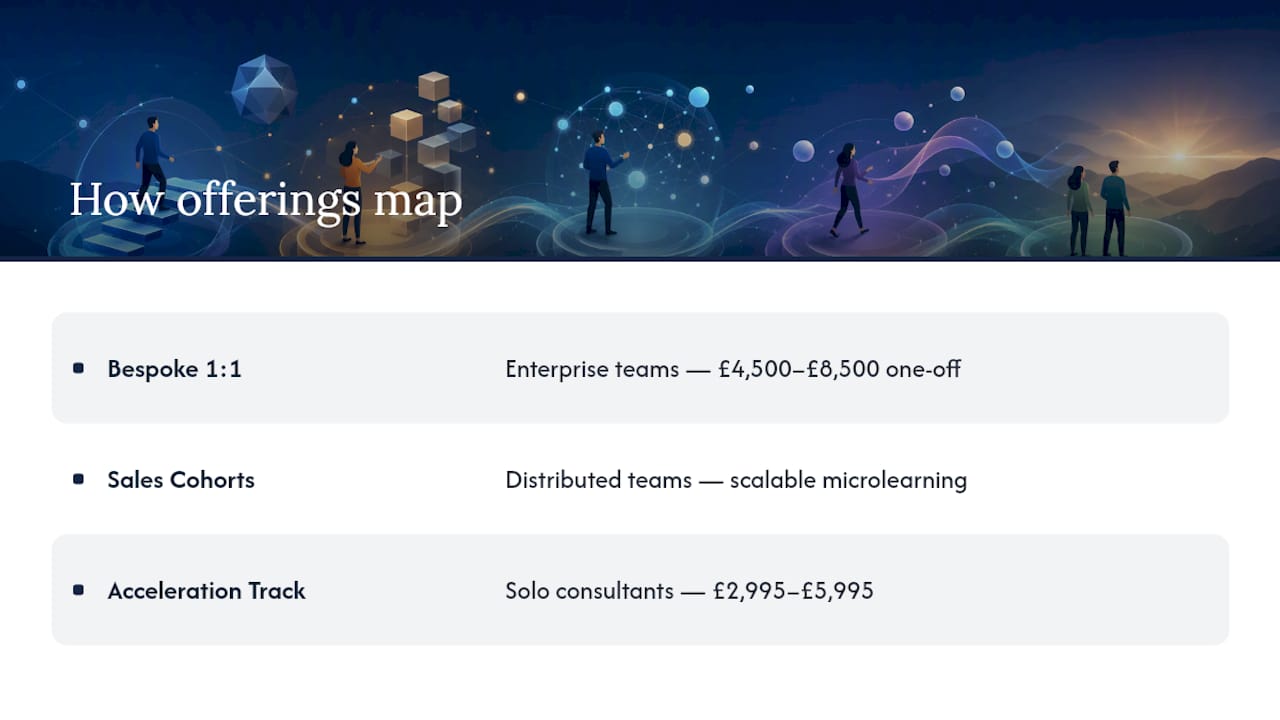
Different products suit different points on this framework. Bespoke 1:1 coaching, priced between £4,500 and £8,500 as a one-off engagement, suits enterprise teams needing the manager-coaching cadence and phased onboarding described above. Sales Training Cohorts deliver the scalable, spaced-microlearning structure for teams that need consistent messaging across a distributed group. For solo consultants and service business owners, the sales acceleration track, priced between £2,995 and £5,995, condenses the same practice-and-measurement logic into a leaner format. Full details on packages and delivery sit on the sales training overview.
Why remote training can outperform the in-person version
Remote isn’t a compromise if the system is built properly. Spacing, private practice and in-flow reinforcement are genuinely easier to engineer at a distance than in a single room for a single day, which is exactly why a well-built remote-native programme, rather than a recorded lecture, tends to move ramp time and call quality faster than most managers expect.
— Jerry
Ready to build a remote sales training programme that sticks?
Most remote training fails not because the content is wrong, but because it’s delivered as a one-off event instead of a system with spacing, practice and coaching built in. Some providers offer alternatives to generic, off-the-shelf course libraries by combining bespoke 1:1 coaching with structured cohort training and consultancy, built around a five-step framework rather than a static curriculum.
If you manage a growing team, start with the sales training cohorts page to see current course structures, or review pricing for bespoke coaching and consultancy packages if you need something built entirely around your team’s gaps. Solo consultants and service business founders can look at the sales coaching programme built specifically for that stage. Whichever route fits, the sensible first step is a short discovery call to map your current ramp time and win rate against where they should be, then decide whether a cohort or a bespoke engagement gets you there faster.
Sources
- Remote Sales Training: Build a System, Not a Recording
- Remote sales training: Best practices and guide
FAQ
How do you get into remote sales with no experience?
Start with a fundamentals-level course covering discovery, objection handling and virtual rapport, then pair it with daily role-play practice. Most entry-level remote sales training programmes assume no prior formal experience but expect willingness to practise consistently.
What are the 4 C’s in sales?
Definitions vary by source, but a commonly used version covers Clarity, Confidence, Connection and Consistency, the qualities remote reps need most since they lack physical presence to compensate for weaknesses in any of them.
What is the best online sales training programme?
The strongest programmes combine spaced microlearning, live coaching and role-play practice rather than a single recorded course. Aheadofsales structures its cohort and bespoke coaching offers around exactly this model.
What are the 7 stages of sales?
The commonly cited stages are prospecting, preparation, approach, presentation, handling objections, closing and follow-up. Remote training typically adapts each stage for virtual delivery, particularly approach and objection handling, where reading a prospect is harder without physical cues.
How much does remote sales training cost?
Pricing depends on format: Aheadofsales’ bespoke coaching and consultancy packages range from £4,500 to £8,500, while its solo sales acceleration track runs from £2,995 to £5,995. Current pricing for other packages is available on the Aheadofsales website.