
A guaranteed sales growth programme is a structured coaching, training or consultancy engagement that ties payment or continuation to measurable sales outcomes, usually agreed KPIs rather than a blanket promise. The word “guaranteed” is only credible when it rests on a documented baseline, a defined pilot and clear attribution. Treat any claim without those three elements with real caution.
TL;DR:
- Solo consultants and service founders can choose a £2,995 to £5,995 accelerator; bespoke team coaching costs £4,500 to £8,500 as a one time engagement.
- Require documented starting metrics, written KPI definitions, and a paid pilot with success criteria; providers should explain how they separate results from market changes.
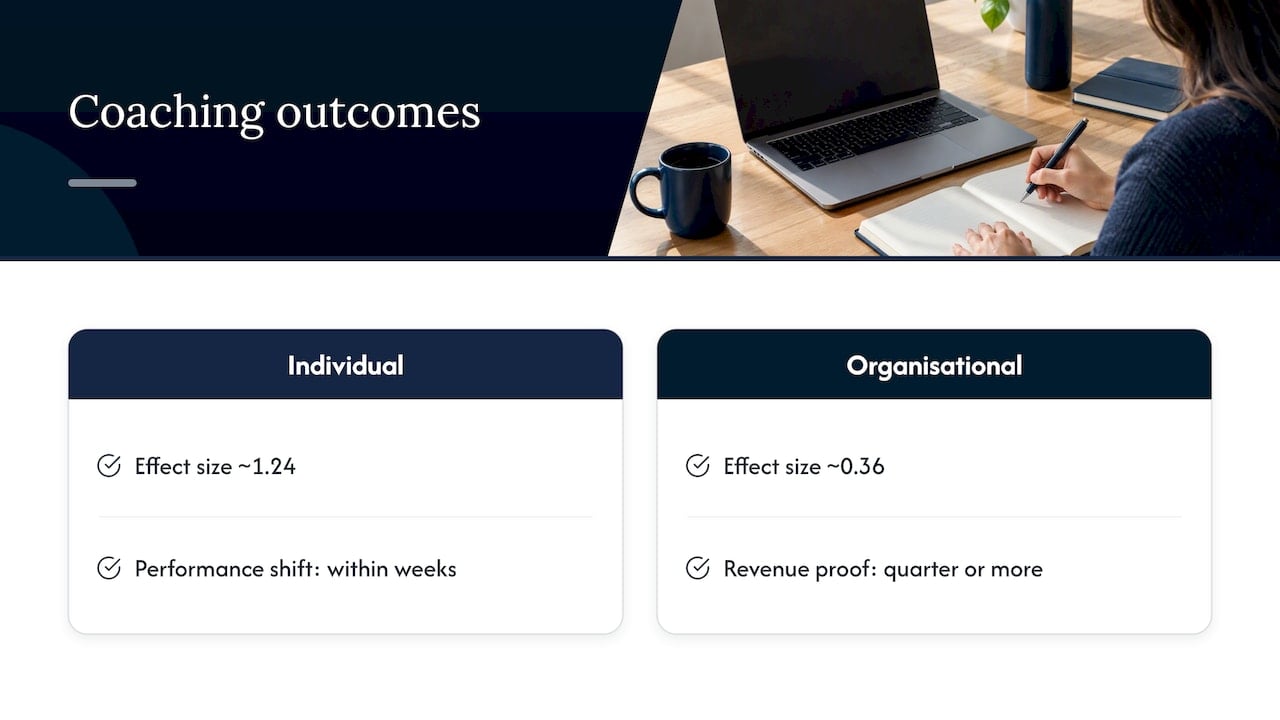
- Workplace coaching has stronger individual than organizational effects, about 1.24 versus 0.36; company revenue usually needs a quarter or longer of measurement.
- A pilot lasting four to twelve weeks can reveal process gains before revenue shifts; name an internal owner to reinforce coaching after the engagement.
Table of Contents
- Programme formats, who they suit, and what they typically cost
- Core components of a credible guaranteed programme
- What the evidence says about coaching outcomes and realistic timeframes
- How to verify a guarantee before you commit
- Launching and embedding a programme to hit quarterly targets
- How we structure guarantees at Ahead of Sales
- Our take: guarantees are only as good as the measurement behind them
- Choosing the right Ahead of Sales package and starting your pilot
- FAQ
- Sources
Programme formats, who they suit, and what they typically cost
Most programmes fall into four shapes: bespoke 1:1 coaching, cohort-based team training, blended coaching-plus-consultancy packages, and fractional sales director arrangements where an experienced leader works inside the business part time. Each suits a different stage of growth, and the right fit depends more on team size and complexity than on budget alone.
Businesses with 50 to 1,000 staff, particularly those with a dedicated sales leader already in post, often benefit from blended coaching and consultancy, since there’s enough structure in place to embed new habits quickly. Solo service founders and consultants usually do better with a focused acceleration track that fits around client work rather than a full team programme.
Pricing bands vary with scope:
- Bespoke team coaching and consultancy packages typically run from £4,500 to £8,500 as a one-off engagement, covering coaching hours, workshops and follow-up support.
- Solo acceleration tracks for consultants and service business owners sit between £2,995 and £5,995 one-off.
- Ongoing cohort membership, such as The Sage Collective, is priced at £990 per month.
Expect a pilot phase of around four to twelve weeks before firm-level results become visible, with short-term wins (better call quality, tighter pipeline hygiene) appearing faster than company-wide revenue change, which usually takes a full quarter or more to confirm.
Core components of a credible guaranteed programme
A guarantee only means something when the mechanics behind it are specific. Vague promises of “more sales” without a measurement plan are marketing, not a commitment.
- Baseline measurement and agreed KPIs: pipeline velocity, win rate, average deal size and churn are recorded before the programme starts, so improvement can be checked against a real starting point.
- Bespoke 1:1 coaching with deliberate practice: coaching that includes roleplay, feedback and repetition tends to shift behaviour faster than lecture-style training, a pattern consistent with research on training delivery features.
- Follow-up reinforcement owned inside the business: skills fade without internal accountability, so someone on the client side needs to own embedding the change after the coach leaves the room.
- Systems alignment: CRM data, reporting dashboards and automation need to match the KPIs being tracked, otherwise results can’t be verified.
- A pilot or paid trial: a short, scoped test run reduces risk for both sides and gives both parties real data before committing to a longer programme.
Pro Tip: Ask any provider to show you exactly how they’ll measure your baseline before you sign anything, not after the programme starts.
Coaching that includes deliberate practice and structured feedback consistently shows stronger behavioural change than group training alone, which is why the best programmes build repetition into every session rather than treating coaching as a one-off pep talk.
What the evidence says about coaching outcomes and realistic timeframes
The research on workplace coaching is genuinely encouraging, but it’s worth reading the detail rather than the headline. A widely cited meta-analysis of workplace coaching found a medium positive effect on organisational outcomes and a much larger effect at the individual level.
A meta-analysis of workplace coaching found an overall organisational effect size of around 0.36, with individual-level results closer to 1.24, meaning coaching tends to change what a person does far more reliably, and far faster, than it changes a whole company’s numbers. That gap matters: a sales leader’s performance can shift within weeks, while the business-wide revenue line takes longer to catch up.
The Help to Grow: Management final evaluation, a UK government-backed programme evaluation, found similar patterns. Participants reported genuine benefits, better cashflow management, improved staff retention and stronger planning habits, but the short evaluation window did not detect statistically significant firm-level growth. A separate Frontiers meta-analysis on coaching outcomes reached a comparable conclusion: coaching works, but studies often under-report the method used, making it harder to say which specific technique drove which result.
The practical takeaway for sales leaders: expect process improvements and individual skill gains within the first month or two, and treat firm-level revenue growth as something that needs a full quarter or more of consistent measurement before you can call it proven.
How to verify a guarantee before you commit
Before signing anything, ask the provider to put the following on the table.
- Documented baseline data and written KPI definitions, not a verbal promise to “track progress”.
- A pilot design that specifies scope, sample size, duration and the exact success metrics, along with its cost.
- A clear explanation of how they’ll attribute growth to the programme rather than to seasonality, pricing changes or a new product launch.
- The coach’s background and who inside your business will own embedding the change once the engagement ends.
Pro Tip: If a provider can’t tell you how they’ll prove the growth came from their work rather than from something else happening in your market, that’s a guarantee worth questioning.
Watch for warning signs: a guarantee with no defined baseline, no pilot option, or payment terms structured to avoid any measurable milestone. A credible provider will welcome a paid pilot, because it protects their reputation as much as your budget. Our own sales consultancy process is built around exactly this kind of staged verification, baseline first, pilot second, scale-up only once the numbers hold up.
Launching and embedding a programme to hit quarterly targets
Hitting a guaranteed quarterly target isn’t about one big push, it’s about sequencing the work correctly from day one.
- Set baselines and agree KPIs with named owners and a fixed reporting cadence.
- Run a paid pilot with a defined sample (a team, a region or a product line), a set duration and clear measurement criteria.
- Put governance in place: weekly or fortnightly pipeline reviews, a coaching cadence, and regular stakeholder updates.
- Embed the skills through field coaching, roleplay, CRM task discipline and incentives that reward the right behaviours, not just closed deals.
- Measure, iterate, and set Go/No-go criteria before deciding whether to scale the programme company-wide.
| Phase | Typical duration | Main output |
|---|---|---|
| Baseline and KPI setup | 1 to 2 weeks | Documented starting metrics |
| Paid pilot | 4 weeks | Verified early results |
| Governance and embedding | Ongoing, quarterly review | Sustained habit change |
| Scale-up decision | End of pilot | Go/No-go call |
For a longer-range plan that extends beyond the pilot, our step-by-step growth guide walks through the full-year view.
How we structure guarantees at Ahead of Sales
We built our approach around the same principle this guide has set out: baseline first, then a measurable commitment. Every engagement starts with agreed KPIs, pipeline velocity, win rate and deal size among them, and runs through a pilot structure with weekly governance before we scale to a full programme. Our sales team coaching techniques page sets out the deliberate-practice methods we use to make that change stick.
Our take: guarantees are only as good as the measurement behind them
The conventional wisdom treats “guaranteed sales growth” as a marketing claim to be either trusted or dismissed. We think that’s the wrong frame entirely. The real question isn’t whether a guarantee exists, it’s whether the provider can show you a baseline, a pilot and an attribution method before you pay a deposit.
What’s overrated here is the headline percentage. A 50% growth figure means little without knowing the starting point, the market conditions and how long the measurement window runs. What’s underrated is the pilot itself: a well-scoped, paid pilot does more to de-risk a buying decision than any amount of sales copy, because it forces both sides to agree on what “working” actually looks like before real money is committed.
If you take one thing from this guide, prioritise the measurement conversation over the guarantee itself. Ask what gets tracked, who tracks it, and how long before the result counts. Everything else follows from getting that right.
— Jerry
Choosing the right Ahead of Sales package and starting your pilot
The package that fits depends on where you’re standing. Growth-minded teams of 50 to 1,000 staff usually start with our Sales Training Cohorts, which blend group training with individual coaching. Solo consultants and service founders tend to fit better with the solo sales accelerator, priced to match a smaller operation. Businesses needing senior leadership input without a full-time hire often start with our Fractional Sales Director service instead.
- Sales Training Cohorts: team-based coaching and workshops for growing organisations.
- Solo sales accelerator: a focused track for consultants and solo service businesses.
- Fractional Sales Director: part-time senior leadership for businesses not ready for a full-time hire.
The first step is always a needs analysis followed by a scoped paid pilot, typically the first 60 to 90 days, during which we set baselines, agree KPIs and run focused coaching before any decision to scale. If you’re ready to see what a verified, measurable programme looks like in practice, get in touch through Aheadofsales and we’ll talk through what the first 90 days could look like for your team.
FAQ
What is the 3-3-3 rule in sales?
The 3-3-3 rule isn’t a formally defined industry standard, and definitions vary depending on who’s using it. In practice, it’s commonly used informally to describe breaking a sales goal into three-part structures, such as three key accounts, three outreach touches and three follow-ups, though no single authoritative version exists.
What are the 5 C’s of sales?
The 5 C’s of sales also varies by source, with different trainers listing different combinations such as customer, company, competitors, collaborators and climate. There’s no single government or academic standard behind the term, so treat any specific list as one trainer’s framework rather than an industry-wide rule.
What are some effective sales promotion programs?
Effective programmes combine structured coaching with clear measurement, such as sales acceleration approaches that align people, process and technology to shorten sales cycles and track deal velocity and win rate. Retention and account expansion are also commonly highlighted as faster, lower-cost routes to revenue than new customer acquisition alone, so consider practical retention tools like those offered by Zcoder’s customer acquisition and retention strategy.
What is the 30-60-90 rule in sales?
The 30-60-90 rule refers to a structured plan often used for onboarding new sales hires or launching an initiative, broken into three phases, each with its own goals. It’s a planning framework rather than a guaranteed outcome, and its specific milestones vary by business and role.
How long before a guaranteed sales growth programme shows results?
Individual skill and process improvements, such as better pipeline hygiene, often appear within the first few weeks, consistent with the stronger individual-level coaching effects found in the workplace coaching meta-analysis. Firm-level revenue growth generally needs a full quarter or more of measurement before it can be confirmed, in line with the longer follow-up window the Help to Grow: Management evaluation found necessary.
Sources
- The effectiveness of workplace coaching: a meta-analysis of learning and performance outcomes from coaching
- Workplace coaching: a meta-analysis and recommendations for advancing the science of coaching
- Help to Grow: Management phase 1 — final evaluation report
- What is sales acceleration? | IBM