
TL;DR:
- Building a sales system relies on defining a precise target audience, setting clear exit criteria, and focusing on one improvement area per cycle. Effective pipeline management, deal size strategies, and customer retention tactics drive sustainable revenue growth, while regular review and focus prevent stalled opportunities. Signal-based prospecting and aligned sales and marketing efforts significantly enhance overall sales performance.
Sales growth step by step is a structured, repeatable process that converts defined customer profiles, pipeline data, and disciplined sales motions into measurable revenue increases. Most business owners treat sales as a collection of individual activities. The ones who grow consistently treat it as a system. That distinction matters more in 2026 than it ever has. This guide walks you through every stage of that system, from setting your foundations and building a repeatable process, to accelerating deal size, retaining customers, and troubleshooting when momentum stalls. Each step is grounded in data, not theory.
What do you need before starting a sales growth plan?
Every downstream sales decision depends on your Ideal Customer Profile (ICP). A poorly defined ICP dilutes outreach effectiveness and lowers conversion rates across every stage of your pipeline. Before you write a single email or book a single call, document who you are selling to with precision: industry, company size, job title, budget range, and the specific problem your offer solves.
Once your ICP is clear, work backwards from your revenue goal using pipeline math. If you need £500,000 in new revenue and your average deal value is £25,000, you need 20 closed deals. If your close rate is 25%, you need 80 qualified opportunities. If 30% of your outreach converts to a qualified opportunity, you need to contact roughly 267 prospects. That calculation tells you exactly how much activity your team needs to generate, and it removes the guesswork from target setting.
Your technology stack should support the process, not complicate it. Three categories of tools cover the essentials:
- CRM (such as HubSpot or Salesforce): tracks every deal, contact, and activity in one place
- Data enrichment (such as Apollo or Cognism): keeps your prospect data accurate and up to date
- Outreach sequencing (such as Outreach or Lemlist): automates follow-up while preserving personalisation
Pro Tip: Start with the minimum viable sales stack. One CRM, one data source, and one sequencing tool is enough to build a repeatable process. Adding more tools before your process is proven creates complexity without results.
You can find a broader set of proven sales strategies that complement this foundation if you want to go deeper on the strategic layer before moving to execution.
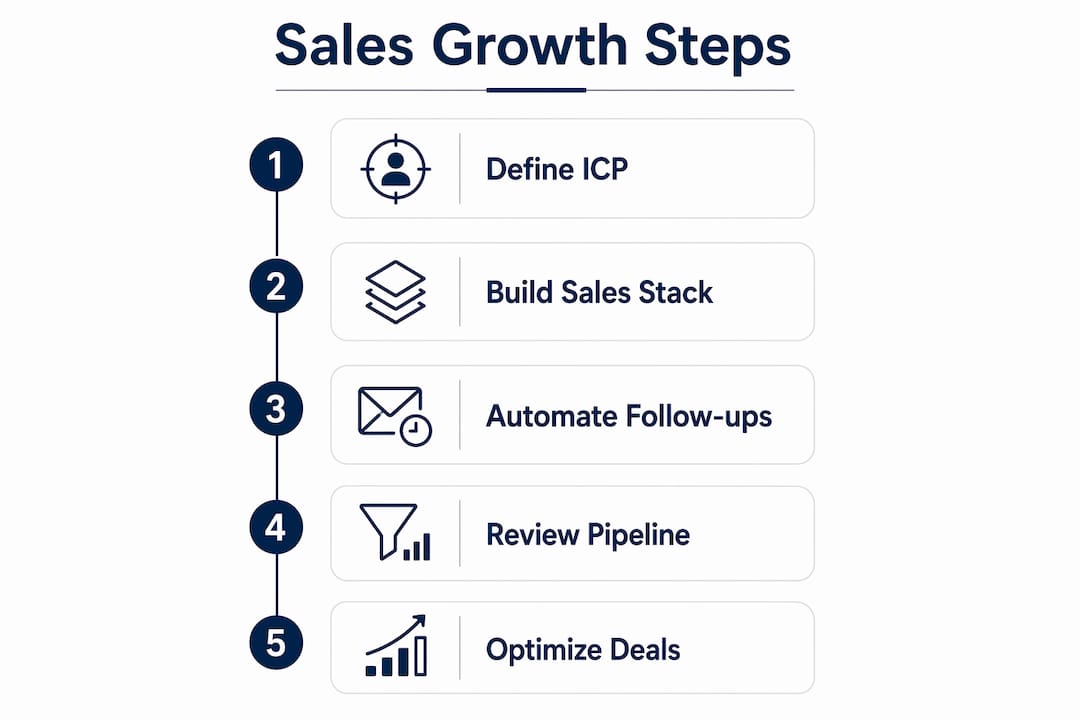
How to build a repeatable sales process for growth
A repeatable sales process has six stages, each with a clear exit criterion that a deal must meet before moving forward. Those stages are: prospecting, outreach, discovery, demo, proposal, and close. Documented exit criteria at every stage prevent time waste on deals that lack real momentum. Without them, your pipeline fills with activity that never converts.
Here is how each stage works in practice:
- Prospecting: Identify accounts that match your ICP. Use signal-based prospecting to prioritise outreach when buying intent is highest, for example when a company has just raised funding, hired a new sales director, or expanded into a new market. Signal-based prospecting achieves 2–4x higher reply rates and 30–40% shorter sales cycles than traditional static list methods.
- Outreach: Run a multichannel sequence combining email, LinkedIn, and phone. A typical sequence runs over 10–14 days with 6–8 touchpoints. Personalise the first and last touchpoints. Automate the middle ones.
- Discovery: Ask questions that uncover the prospect’s real problem, budget, decision-making process, and timeline. A discovery call with no clear exit criterion is just a conversation. The exit criterion here is a confirmed problem that your offer solves and a named decision-maker.
- Demo: Show only what is relevant to the problem uncovered in discovery. Generic demos lose deals. The exit criterion is a prospect who can articulate the value they would receive.
- Proposal: Send a proposal that maps directly to the prospect’s stated priorities. Include clear pricing and a specific next step. The exit criterion is a scheduled follow-up call, not a sent document.
- Close: Confirm the decision, handle final objections, and agree a start date. The exit criterion is a signed agreement or purchase order.
Pro Tip: Automate your follow-up sequences and CRM stage updates, but write your first outreach email and your proposal cover note personally. Automation handles volume. Personalisation wins deals.
Review your pipeline metrics every week. Track conversion rate between each stage, average deal age, and the number of deals that have not moved in 14 days. Those stalled deals need immediate attention or removal from the pipeline.

How to optimise deal size and velocity to accelerate sales growth
Increasing average deal value and reducing cycle time are the two fastest levers for revenue growth that do not require more leads. Strategic account planning with dedicated big-deal teams increases deal sizes by 30–50% while reducing cycle time. That is a significant return on a structural change that costs nothing except focus.
Three methods increase average deal value reliably:
- Bundling: Group complementary products or services into a single package. Buyers perceive bundled offers as higher value and the decision becomes simpler.
- Upselling: Introduce a higher-tier option during the proposal stage, after you have confirmed the prospect’s budget. Timing matters here. Upsell too early and you lose trust.
- Smart add-ons: Offer implementation support, training, or priority access as paid additions. These increase revenue per deal and reduce churn because customers who invest more tend to engage more.
Multi-thread selling is the most underused technique for reducing cycle time. Most sales reps build a relationship with one contact and hope that person can close the deal internally. Multi-thread selling means engaging three or more stakeholders in the same account simultaneously: the economic buyer, the technical evaluator, and the end user. When all three are aligned, deals close faster and with less friction.
Speed to lead is a critical and often overlooked velocity driver. Responding to an inbound lead within 5 minutes increases conversion rates up to 8x compared to a 30-minute response. That single process change, building a real-time lead alert and response protocol, can materially change your close rate without changing anything else. You can explore more business development tactics that support faster deal velocity if this is a priority area for your team.
What steps drive sustainable revenue growth through retention?
Retention is the most efficient growth engine available to any business. Expansion revenue from existing customers closes at 60–70% compared to 20–25% for new logos. That gap in close rate means your existing customer base is worth three times more effort per deal than your new business pipeline.
Practical retention tactics that compound over time include:
- Next-step offers: At the point of delivery or onboarding, introduce the logical next product or service. Customers are most receptive immediately after a positive experience.
- Proactive account management: Schedule a quarterly business review with every active account. Use it to surface new problems your offer can solve, not just to check satisfaction.
- Simple follow-up sequences: A three-email sequence at 30, 60, and 90 days post-purchase keeps your brand present without being intrusive.
Businesses that align sales and marketing experience 32% higher annual revenue growth on average. Alignment means shared pipeline reviews, joint account planning, and agreed definitions of what constitutes a qualified lead. When marketing generates leads that sales does not recognise as qualified, both teams waste time and blame each other. A shared ICP definition and a weekly pipeline review fixes that.
Pro Tip: Monitor data signals on your existing customers: new hires in their team, funding announcements, or product launches. These signals indicate growth and buying intent. Time your expansion conversation to coincide with a signal, and your close rate on upsells increases significantly.
For a detailed walkthrough of the revenue acceleration side of this, the revenue growth guide from Aheadofsales covers the compounding mechanics in depth.
How to troubleshoot your sales growth plan when it stalls
Most sales growth plans stall for one of three reasons: an overly broad ICP that sends reps chasing the wrong prospects, pipeline decay caused by missing exit criteria, or “zombie” deals that consume attention without ever closing. Each problem has a direct fix.
“Attempting to improve all growth levers simultaneously leads to fractured focus and burnout. Focus on one sprint cycle lever per 30-day period: conversion, retention, or margin. One focused sprint delivers more measurable progress than three months of scattered effort.”
Zombie deals are the most damaging because they are invisible. A deal that has not moved in 21 days and has no scheduled next step is not a pipeline asset. It is a distraction. Remove it, or set a hard deadline: if there is no response within five business days, the deal is closed as lost and the prospect re-enters a nurture sequence.
Quarterly reviews are not optional. Every 90 days, revisit your ICP, your pipeline conversion rates, and your average deal value. Markets shift. Buyer priorities change. A quarterly review catches drift before it becomes a crisis. Use real-time CRM data to identify exactly where deals are stalling in your pipeline, then fix that one stage before touching anything else.
Small improvements compound significantly. A 10% improvement in conversion rate at each of six pipeline stages does not produce 60% more revenue. It produces a multiple of that, because each improvement builds on the one before it. That is the mathematical case for patience and precision in stepwise sales improvement.
Key takeaways
Sustainable sales growth requires a documented system with clear exit criteria, a precise ICP, and a disciplined focus on one improvement lever per sprint cycle.
| Point | Details |
|---|---|
| Define your ICP first | Every outreach and pipeline decision depends on a precise, documented Ideal Customer Profile. |
| Use pipeline math | Work backwards from your revenue goal to calculate the exact activity volume your team needs. |
| Enforce exit criteria | Documented stage exit criteria eliminate zombie deals and keep your pipeline focused on real opportunities. |
| Prioritise retention | Existing customers close at 60–70% versus 20–25% for new logos, making expansion the highest-efficiency growth lever. |
| Sprint on one lever | Focus each 30-day cycle on conversion, retention, or margin to avoid burnout and generate measurable progress. |
What I have learned about sales growth as a system
The biggest mistake I see business owners make is treating sales growth as a motivation problem. They hire more reps, run more campaigns, and push harder on activity. When results do not improve, they assume the team is not trying hard enough. The real issue is almost always structural.
Sales growth is a system. When you define your ICP precisely, build exit criteria into every pipeline stage, and focus your team on one improvement lever per sprint, results become predictable. That predictability is what separates businesses that grow consistently from those that have a good quarter followed by a difficult one.
Signal-based selling is the single biggest shift I would encourage any sales leader to make in 2026. Reaching out to a prospect the week they announce a new hire or a funding round is not luck. It is a process. And it produces significantly higher reply rates than cold outreach to a static list.
The teams that win are the ones that measure, review, and adapt every 90 days without exception. The market will always change. Your system needs to change with it. Persistence with measurement is not a soft skill. It is your competitive advantage.
— Jerry
How Aheadofsales supports your sales growth plan
Knowing the steps is one thing. Executing them consistently, with a team that has competing priorities and a pipeline that needs managing daily, is another challenge entirely.
Aheadofsales works with businesses of 50–1,000 staff to implement exactly the kind of structured, repeatable sales system described in this guide. The work covers ICP definition, pipeline architecture, sales motion design, and the coaching that makes it stick quarter after quarter. For solo service businesses, the sales acceleration packages start from £2,995 and are built for fast implementation. For teams, sales training services start from £4,500 and include bespoke 1:1 coaching alongside group training. If you want your team hitting target every quarter, that is exactly what Aheadofsales is built to deliver.
FAQ
What is a sales growth step-by-step process?
A sales growth step-by-step process is a documented system that moves prospects through defined pipeline stages, each with clear exit criteria, from ICP-matched prospecting through to close and retention.
How long does it take to see results from a stepwise sales plan?
Most teams see measurable pipeline improvements within the first 30-day sprint when they focus on a single lever such as conversion rate or lead response time.
What is signal-based prospecting?
Signal-based prospecting prioritises outreach when a prospect shows buying intent, such as a new hire, funding round, or product launch, producing 2–4x higher reply rates than static list outreach.
Why does sales and marketing alignment matter for revenue growth?
Businesses that align sales and marketing on ICP definitions and pipeline reviews experience 32% higher annual revenue growth on average, because both teams work from the same qualified lead standard.
What is a zombie deal in a sales pipeline?
A zombie deal is an opportunity that has not progressed in 21 or more days and has no scheduled next step. It consumes rep attention without generating revenue and should be closed as lost or moved to a nurture sequence.