
Convert a pilot to a paid rollout by designing it to prove measurable business impact, isolating that impact from everything else happening in the business, and presenting a clear commercial offer backed by a micro-level ROI report. That sequence, borrowed from established ROI Methodology practice and supported by peer-reviewed evidence on managerial coaching, is what gets a training pilot past finance and procurement. Ahead of Sales builds its pilots around exactly this structure.
TL;DR:
- Most pilots should last six to ten weeks with a 60 to 90 day follow-up to accurately measure behaviour and revenue impact.
- Use a comparison group, baseline data, and clear success thresholds such as ROI above 100% or a BCR above 2:1 to ensure credible evaluation.
- Isolate the pilot’s effect by employing control groups, before-and-after comparisons, or difference-in-differences analysis to verify true impact.
- Incorporate detailed cost accounting and a micro-level ROI report to enable transparent decision-making and prompt commercial approval.
- Scale the program quickly after validation by locking in phased contracts, manager enablement, ongoing measurement, and clear change management strategies.
Table of Contents
- What to measure: key metrics and the ROI evaluation framework
- Designing a pilot that proves value: objectives, scope and success criteria
- Running the pilot and collecting credible data
- Analyse, isolate and monetise impact (how to calculate ROI and BCR)
- Decision checklist: stakeholder buy-in, procurement and commercial levers
- From decision to rollout: practical steps to convert and scale the programme
- Change management strategies to support organisational adoption during rollout
- Common challenges and pitfalls in transitioning from pilot to paid rollout and how to address them
- Best practices for integrating pilot feedback into paid program design and delivery
- Contractual and budget considerations when moving from pilot to paid rollout
- Timeline planning and milestone setting for pilot to full implementation conversion
- Author perspective and Ahead of Sales’ approach
- How Ahead of Sales helps (CTA) — pilot to paid pathway
- Sources
- FAQ
What to measure: key metrics and the ROI evaluation framework
Most pilots fail to convert not because the training didn’t work, but because nobody measured the right things in the right order. The ROI Methodology breaks evaluation into four levels: reaction (did people like it), learning (did they absorb it), behaviour (did they apply it) and impact (did it move the business). Levels 1 and 2 tell you whether the programme was delivered well. Levels 3 and 4 are what finance and procurement actually care about, because they connect training to revenue.
In practice, that means tracking:
- Completion rates and assessment scores from the training itself
- Coaching observation ratings from line managers watching reps in live calls
- CRM-level events: opportunities created, win rate, average deal size
- Ramp time for new hires and retention of trained staff
A reduction in ramp time converts directly into revenue. If a pilot cuts average ramp time by a meaningful number of weeks and your average rep closes a typical monthly value once ramped, those extra productive weeks are worth a significant revenue gain per rep, before you even touch win rate or deal size.
Peer-reviewed research shows that managerial coaching skill predicts sales goal attainment across teams, which is why Level 3 behaviour metrics deserve as much weight as Level 4 outcomes in a pilot report.
Designing a pilot that proves value: objectives, scope and success criteria
A pilot built to convert starts with the end in mind. Then collect baseline data on both before training begins. Without a baseline, you have no way to prove anything moved.
- Set the pilot scope: one team, one region, or one product line, large enough to be statistically meaningful but small enough to run in 6 to 10 weeks.
- Choose a comparison group where possible, a matched team that doesn’t receive the training, so you can separate the pilot’s effect from market movement or seasonality.
- Agree explicit, business-oriented success thresholds in advance (for example, “ROI above 100% and a BCR above 2:1 triggers the rollout conversation”) rather than leaving the bar vague.
- Build the follow-up window into the contract from day one, typically 60 to 90 days post-delivery, so behaviour and impact data has time to show up.
Pro Tip: Write the success criteria and the rollout trigger into the pilot agreement itself, so the conversation about paid rollout starts the day results come in, not weeks later.
Running the pilot and collecting credible data
Data collected sloppily is data procurement will dismiss, no matter how good the result looks. Assign someone specific, often a sales operations lead or the commissioning manager, to own data collection before the pilot starts, not after.
- Collect Levels 1 and 2 during delivery itself: post-session surveys and knowledge assessments while the training is fresh.
- Collect Levels 3 and 4 after the intervention, using manager observation logs, coaching notes and CRM exports pulled at the same intervals every time.
- Schedule three clear windows, baseline, interim and post, and log every cost (trainer time, participant hours, materials, venue or platform) as it happens rather than reconstructing it later.
- Pair the numbers with a handful of qualitative notes, a manager’s comment, a rep’s account of a deal won using the new approach, because stakeholders remember a story alongside a figure.
Field research backs this approach: an 11-week trial across 19 stores found that a self-efficacy focused training intervention produced measurable unit-level sales growth when compared against a control group that didn’t receive it, which is the same logic a well-run pilot should apply at a smaller scale.
Analyse, isolate and monetise impact (how to calculate ROI and BCR)
This is the step most pilots skip, and the one that decides whether the paid rollout happens. Isolating the pilot’s effect means answering one question cleanly: how much of this change is actually down to the training, rather than a new product launch, a market upswing or a change in leadership?
Three isolation methods work well for a commercial pilot:
- A matched control group that didn’t receive the training, compared against the pilot group over the same period
- A before and after comparison within the same team, adjusted for any known external factors
- Difference-in-differences analysis when both a control group and a clear baseline exist
Once isolated, convert the impact into money. List every fully loaded cost: design and development, delivery (trainer or coach time), participant time away from selling, management overhead and the evaluation itself. Then apply the standard formulae:
ROI (%) = (Monetary benefits − Fully loaded costs) ÷ Fully loaded costs × 100
BCR = Monetary benefits ÷ Fully loaded costs
A micro-level ROI report that lays out assumptions, isolation method and monetisation logic in one document is what the ROI Methodology recommends handing to decision-makers, because it gives finance something they can interrogate rather than take on faith.
Decision checklist: stakeholder buy-in, procurement and commercial levers
Three different people need three different things before they’ll approve a rollout, and conflating them slows everything down.
- Finance wants the monetised ROI and BCR, with costs and assumptions stated plainly.
- Procurement wants contracting terms: scope, duration, exit clauses and how pricing scales.
- The sales leader wants an operational rollout plan showing how the pilot result reproduces across every team, not just the one that got the most attention.
Commercial models that speed up approval include phased rollouts (team by team, with payment tied to each phase), outcome-based fees linked to agreed KPIs, and scaling discounts for committing to a full-year programme upfront. Our sales consultancy services page outlines how these phased engagements typically work.
Pro Tip: Bring the micro-level ROI report to the table alongside a phased contract proposal with named KPIs and a knowledge-transfer clause for line managers. It answers the “what happens if it doesn’t scale” objection before anyone asks it.
From decision to rollout: practical steps to convert and scale the programme
Once the pilot has cleared its success thresholds, momentum matters more than perfection. Move quickly from approval to signed contract, because enthusiasm fades and budget cycles close.
- Get the contract signed, then immediately schedule delivery resources, trainers, coaches or consultants, against the agreed phasing.
- Communicate the result to participants and stakeholders in plain terms before the next phase starts, so everyone understands why the programme is expanding.
- Build manager enablement into the rollout from day one: coaching only sticks when line managers embed it into weekly routines rather than treating it as a one-off event.
- Run refresher measurement at fixed intervals, typically each quarter, using the same instruments as the pilot so results stay comparable.
- Keep a dedicated evaluation budget in the rollout, not just the pilot, so you can prove the result holds at scale rather than assuming it will.
A rollout that drops measurement after the pilot usually loses the evidence trail that justified the spend in the first place.
Change management strategies to support organisational adoption during rollout
A pilot proves the training works. Adoption at scale proves the organisation can absorb it, and that’s a different problem. The biggest failure point in rollout isn’t the content, it’s that line managers and reps outside the pilot group never bought into why the change was happening.
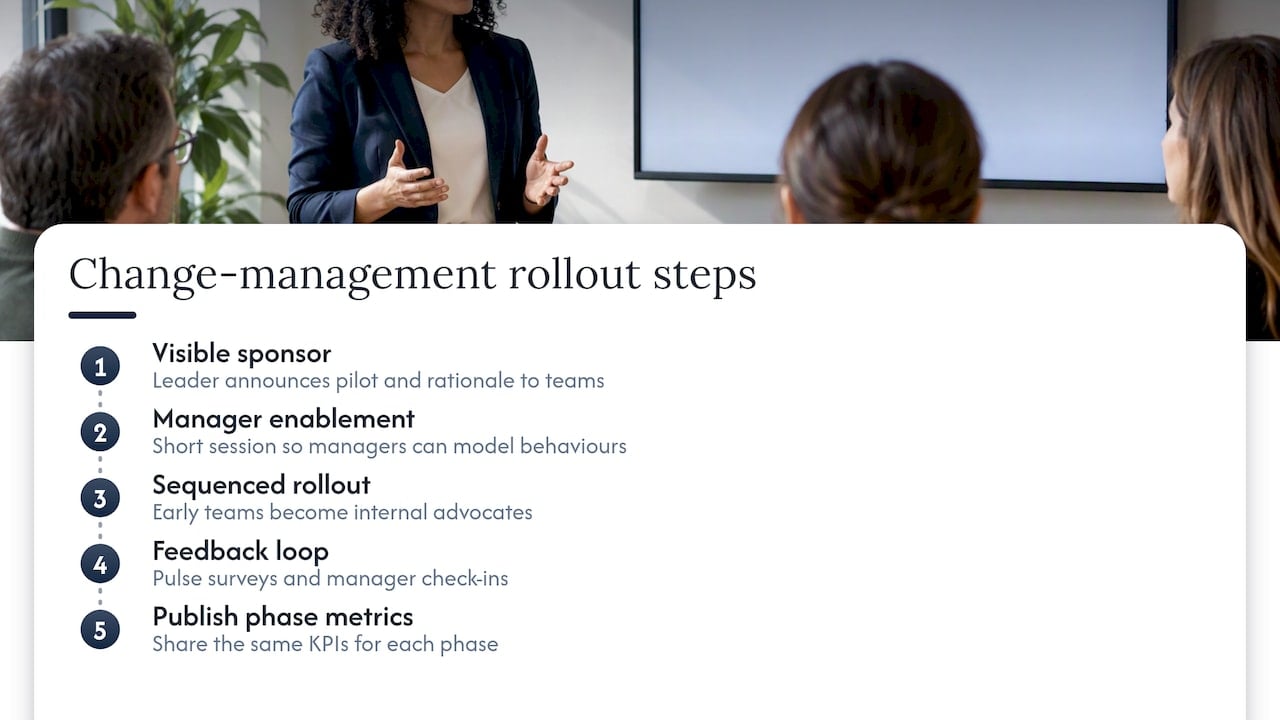
Start by naming a visible sponsor, usually the commissioning sales leader, who communicates the pilot result and the rollout rationale directly to every team, not through a cascade that loses detail at each level. Pair that with a short enablement session for managers before their teams start training, so managers can answer questions and model the new behaviours themselves rather than being surprised by them.
Sequence the rollout rather than launching everywhere at once. Teams who go first become internal advocates, and their results (not just the pilot’s) become the proof point for teams who go later. Build in a feedback loop, brief pulse surveys or manager check-ins, so friction gets caught and fixed within weeks rather than discovered at the next quarterly review.
Resistance usually shows up as scepticism about whether the pilot result will generalise. Address it directly by publishing the same metrics for each rollout phase that you published for the pilot, so sceptics can see the pattern repeating rather than taking it on faith.
Common challenges and pitfalls in transitioning from pilot to paid rollout and how to address them
The most common failure is treating the pilot as a one-off success story rather than a repeatable system. If nobody wrote down the measurement method, the cost categories or the isolation technique used in the pilot, the rollout team ends up guessing, and the numbers stop being comparable.
A second pitfall is scope creep during negotiation. Procurement or finance asks for a broader rollout than the pilot tested, more teams, more regions, a shorter timeline, and the commercial terms get agreed before anyone checks whether the original evidence supports that scale. Hold the line: offer a phased expansion instead, with the first phase mirroring the pilot’s conditions as closely as possible.
A third is losing manager buy-in between pilot and rollout, especially when months pass between the pilot result and contract signature. Keep managers engaged with short updates during the gap, even a one-page summary of where the proposal stands, so the pilot’s champions don’t go cold.
Budget mismatches cause friction too: a pilot costing a few thousand pounds often needs to scale into a rollout costing many times that, and surprises on price kill momentum. Share indicative rollout pricing early, even in rough terms, so the commercial conversation starts before the final proposal lands.
Best practices for integrating pilot feedback into paid program design and delivery
Pilot feedback is only useful if it changes the next version of the programme, rather than getting filed away once the contract is signed. Review every piece of qualitative feedback, manager comments, rep objections, assessment gaps, alongside the quantitative result, because the two often point to different fixes.
If completion rates were strong but behaviour change was patchy, the content probably needs more practical rehearsal time rather than more theory. If reps liked the training but managers struggled to reinforce it, the rollout needs a manager coaching module before it needs more rep-facing content. Build a short list of three or four specific adjustments from the pilot, rather than a long list that dilutes focus.
Keep the core measurement framework identical between pilot and rollout, same instruments, same timing, same cost categories, so results stay comparable even as content improves. Where the pilot used a matched comparison group, consider keeping a smaller comparison group running during the first rollout phase too, as an early warning system if results start to drift from the pilot baseline.
Contractual and budget considerations when moving from pilot to paid rollout
The commercial terms that worked for a pilot rarely transfer directly to a rollout, and treating them as interchangeable creates problems later. A pilot is usually a fixed, one-off cost designed to de-risk a decision. A rollout contract needs to account for ongoing delivery, refresher training, manager coaching and repeated measurement, which changes both the price and the structure.
Build the contract around the phases you’ve already planned, with payment tied to delivery of each phase rather than one lump sum upfront. Include a knowledge-transfer clause so internal teams gain the capability to sustain the programme once external delivery ends, which matters to procurement teams assessing long-term value. Specify the KPIs from the pilot’s success criteria directly in the contract, so there’s no ambiguity about what “working” means at each checkpoint.
Budget for evaluation itself as a line item, not an afterthought. A rollout that skips ongoing measurement to save cost usually ends up unable to prove it’s still working past the first quarter, which weakens the case for renewal. Our sales training cost overview breaks down how fixed-fee, team-based engagements are typically structured for exactly this kind of phased commitment.
Timeline planning and milestone setting for pilot to full implementation conversion
A realistic timeline keeps momentum without rushing the evidence. Most pilots need 6 to 10 weeks of delivery, followed by a 60 to 90 day follow-up window before behaviour and impact data is solid enough to report. Trying to compress that window to speed up a sale usually produces numbers too thin to defend.
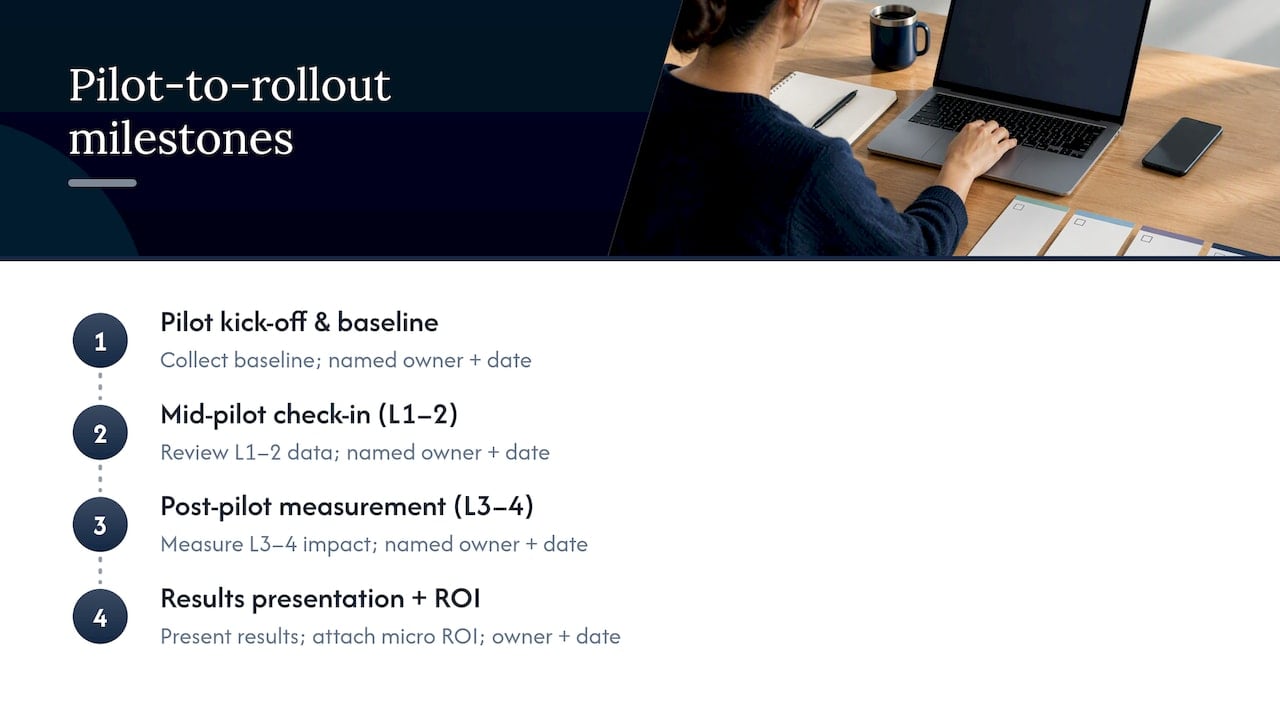
Set four milestones from the start: pilot kick-off and baseline collection, mid-pilot check-in on Level 1 and 2 data, post-pilot follow-up measurement at Level 3 and 4, and a formal results presentation with the micro-level ROI report attached. Each milestone should have a named owner and a date, not a vague “we’ll check in.”
Once the rollout decision is made, plan the first phase to start within weeks of contract signature, not months, while the pilot result is still fresh in stakeholders’ minds. Partner research on 90-day conversion strategies for B2B teams offers a useful structure for thinking about short, milestone-driven windows that apply equally well to training rollouts as to other commercial conversions.
Author perspective and Ahead of Sales’ approach
In my experience, a paid pilot is the single best mechanism for de-risking a training purchase, because money changes behaviour on both sides. When a client pays, even a modest amount, for a pilot, they engage with the data properly instead of treating the exercise as a free trial to be politely ignored.
Demand a micro-level ROI report before you sign off on any full rollout. It’s the difference between hoping the training worked and knowing it did.
— Jerry
How Ahead of Sales helps (CTA) — pilot to paid pathway

If you’ve read this far, you’re probably weighing whether to commission a pilot at all, or how to structure one that actually converts. Ahead of Sales runs paid pilots deliberately, because a contract with real money attached is what makes a guarantee worth testing rather than just promising. Our team packages run from several thousand pounds for bespoke coaching and consultancy engagements, and solo consultants or service founders can access a sales acceleration track priced in a range typical for such offerings. These packages are built to produce the baseline, measurement and ROI reporting this guide describes, not bolted on afterwards.
- Bespoke 1:1 coaching paired with traditional training, scoped to your team size and sector
- A measurement plan agreed before delivery starts, so the pilot produces a result you can take to procurement
- A phased commercial structure designed to convert cleanly into a full rollout once results land
Visit Ahead of Sales to request a pilot proposal and see which package fits your team.
Sources
- Sales training — ROI Methodology excerpt (TD sample PDF)
- Does coaching matter? A multilevel model linking managerial coaching skill and frequency to sales goal attainment
FAQ
How long should a sales training pilot run before converting to paid?
Most credible pilots run 6 to 10 weeks of delivery followed by a 60 to 90 day follow-up window, because behaviour and revenue impact take time to show up in CRM data. Shortening this window to speed up a sale usually weakens the evidence procurement needs to approve a rollout.
What’s the difference between ROI and BCR in a pilot report?
ROI expresses net monetary benefit as a percentage of cost: benefits minus costs, divided by costs. BCR simply divides benefits by costs, giving a ratio like 2:1, and both figures typically appear together in a micro-level ROI report so finance can read the result either way.
Does Ahead of Sales offer a paid pilot before a full rollout?
Yes, Ahead of Sales structures engagements as paid pilots deliberately, with team packages offered as bespoke coaching at published prices and a solo acceleration track with set fees. Pricing a pilot properly is part of how guarantees get tested honestly rather than promised casually.
Why does manager coaching skill matter more than coaching frequency?
Research across 136 sales teams found that managers’ coaching skill predicted annual sales goal attainment, while coaching frequency without skill sometimes hurt results. That’s why a pilot should measure manager skill directly rather than just counting how often coaching happens.
What should a pilot’s success criteria include before it starts?
Success criteria should set a specific ROI or BCR threshold, a behaviour-level target (such as a named selling technique used consistently) and a defined follow-up window, all agreed before delivery begins. Writing these into the pilot agreement upfront avoids disputes over what “success” means once results arrive.