
A founder-led sales transition works when you hand over a repeatable process, not just your calendar. Hire when your diary is the bottleneck, write down how you actually win deals, bring in a senior closer before a manager, and step back in stages while you still watch the numbers.
I see the same pattern in UK service firms and SaaS companies. The founder has closed everything for years, the pipeline is healthy, and then a first sales hire arrives and revenue wobbles. That wobble is avoidable. This guide covers the timing, the order of hires, the playbook, and the handover, with the figures I can source and the mistakes I would rather you skipped.
TL;DR
- Hire when your own capacity is what stops you winning deals, not when you hit a headline revenue number. Recent benchmarks suggest founders close around 20 to 30 deals personally first.
- Your first sales hire should usually be a senior closer, not a sales manager.
- Write the playbook before the job advert: ideal customer, discovery questions, objections, pricing logic, follow-up rhythm.
- Step back in stages (shadow, co-sell, observe, review), and keep a weekly look at the pipeline.
- If you cannot do this alone, a fractional sales director or 1:1 coaching covers the gap without a full-time salary.
Table of Contents
- What a founder-led sales transition actually involves
- When to make the move
- Who to hire first: producer before manager
- Build the playbook before you advertise the job
- Make follow-up consistent
- Step back in stages
- Why management quality matters
- Common mistakes
- Our perspective
- How we can help
- FAQ
- Sources
What a founder-led sales transition actually involves
Founder-led sales means you are personally involved in prospecting, discovery, proposals and closing. It is powerful because it is personal: you know the product, you carry the vision, and buyers feel it.
The transition is moving that success from your head into a system other people can run. Industry analysis describes the failure mode clearly: a founder expects a new hire to copy their “founder magic” without giving them the framework behind it. The same source reports that many B2B start-ups see revenue growth stall or shrink in the six to nine months after hiring their first sales team, and puts that down to poorly managed handovers rather than inevitability.
So the job is not “find someone to take my calls”. It is to turn intuition into stages, data and habits.
When to make the move
Most founders ask whether there is a revenue number that signals readiness. The honest answer is that there is no reliable one.
The H1 2026 founder-led sales benchmark from Causo says founders now commonly close the first 20 to 30 deals personally before the first Account Executive (AE) arrives, and that the window is stretching rather than shrinking, partly because Series A companies are around 20% smaller than in 2020. Their guidance is to use your calendar as the signal, rather than a milestone such as $1M ARR (roughly £750,000 to £800,000 at recent exchange rates, though I would not anchor on it anyway).
In practice I look for four signs:
- You are losing or delaying deals purely because you cannot get to them quickly enough.
- You can describe, in plain words, why your best customers buy and why lost ones did not.
- You have closed enough deals to see a pattern (the 20 to 30 range is a sensible reference point, not a rule).
- Selling is crowding out the work only you can do as CEO.
If you are missing number 2, hiring early will not fix it. A new person simply inherits the confusion.
A note for solo and small service businesses
Not every founder is heading for a big team. If you run a consultancy or coaching practice at around £10k a month, “transition” may mean selling less of the ad-hoc, relationship-driven work and building a simple, repeatable offer and sales conversation, perhaps with a part-time closer or a fractional lead. The principles below still apply, just at a smaller scale.
Who to hire first: producer before manager
The most common mistake is hiring a VP of Sales to fix a pipeline problem. The CRO Report argues that early on you need a senior individual contributor who can close, and that a manager hired too soon spends time building reports rather than winning deals, which can set a company back a year or more.
That matches what I see. A manager needs a team, a playbook and data to manage. If you have none of those, you have hired a very expensive observer.
| Stage | Who you need | What they do |
|---|---|---|
| Pre-pattern | You | Close deals, learn objections, record what works |
| First hire | Senior closer (founding AE) | Takes real deals, tests the playbook, gives feedback |
| Second and third hires | More closers, possibly an SDR | Add capacity, prove the process works without you |
| Team of around six or seven AEs | Sales manager or director | Coaching, forecasting, hiring, pipeline discipline |
The span of control figure in the last row comes from the Causo benchmarks, which cite six to seven AEs per manager. Treat it as a guide, not a law.
What a realistic ramp looks like
The same benchmark data puts first-AE ramp time at about three months in teams of 20 or fewer reps, stretching to four or five months as teams grow. If someone is not productive within a quarter, it often points to a playbook that was never properly written down. That is a useful diagnostic: slow ramp is usually your problem before it is theirs.
Build the playbook before you advertise the job
Before a single job description goes out, translate how you sell into something a stranger can follow. The SaaStr guide to this transition makes the same point from the SaaS side. In my own work, the playbook covers these things:
- Ideal customer and trigger events. Who buys, why now, and who never should.
- Discovery questions. The five or six you always ask, and what the answers tell you.
- Objection handling. Your real objections, in the buyers’ words, with the answers that have worked.
- Pricing and negotiation boundaries. What can move, what cannot, and who approves.
- Stages and exit criteria. What has to be true for a deal to move from one stage to the next.
- Follow-up rhythm. A set cadence so no lead goes cold.
The same GTM AI analysis describes the shift as replacing intuition with CRM data, lead scoring and structured sales stages. You do not need a heavy system. A tidy CRM with clear stages beats a sophisticated one nobody updates.
Record your own calls
The fastest playbook I know is built from your actual calls. Listen to ten recent ones (wins and losses) and note the first questions, the moment the buyer leaned in, and where you lost them. You will find habits you did not know you had. That is the “magic”, and it can be taught once it is visible.
Make follow-up consistent
Founders often win because they follow up relentlessly without thinking about it. New hires rarely do. Agree a simple rule everyone uses, such as a fixed number of touches across email, phone and LinkedIn within a set number of days, and write it into the playbook.
Inbound enquiries are the other leak. If calls, WhatsApp messages and web forms land on whoever happens to be free, response times slip just as you step back. Some UK service businesses use an AI front desk such as DeskAgent to answer enquiries around the clock, qualify them and pass on a clear summary, which keeps lead momentum while the human team settles in. Whatever you use, decide who owns each lead from the first minute.
Step back in stages
Nobody should vanish the day the offer letter is signed. The Marlborough Street Partners piece and the other sources above agree on one theme: this is a transition, not a handover. This is the sequence I use with clients.
- Weeks 1 to 2: shadow. The new hire sits in on your calls and reads your proposals.
- Weeks 3 to 6: co-sell. You open the call, they lead discovery, you close together.
- Weeks 7 to 10: they lead, you watch. You join only for larger or strategic deals and give feedback straight afterwards.
- From week 11: they own it. You review the pipeline weekly and join at their request or at agreed deal values.
These timings are my own working pattern, not a published standard. Adjust them to your sales cycle: a six-week cycle and a six-month cycle need very different pacing.
Keep your hand on the numbers
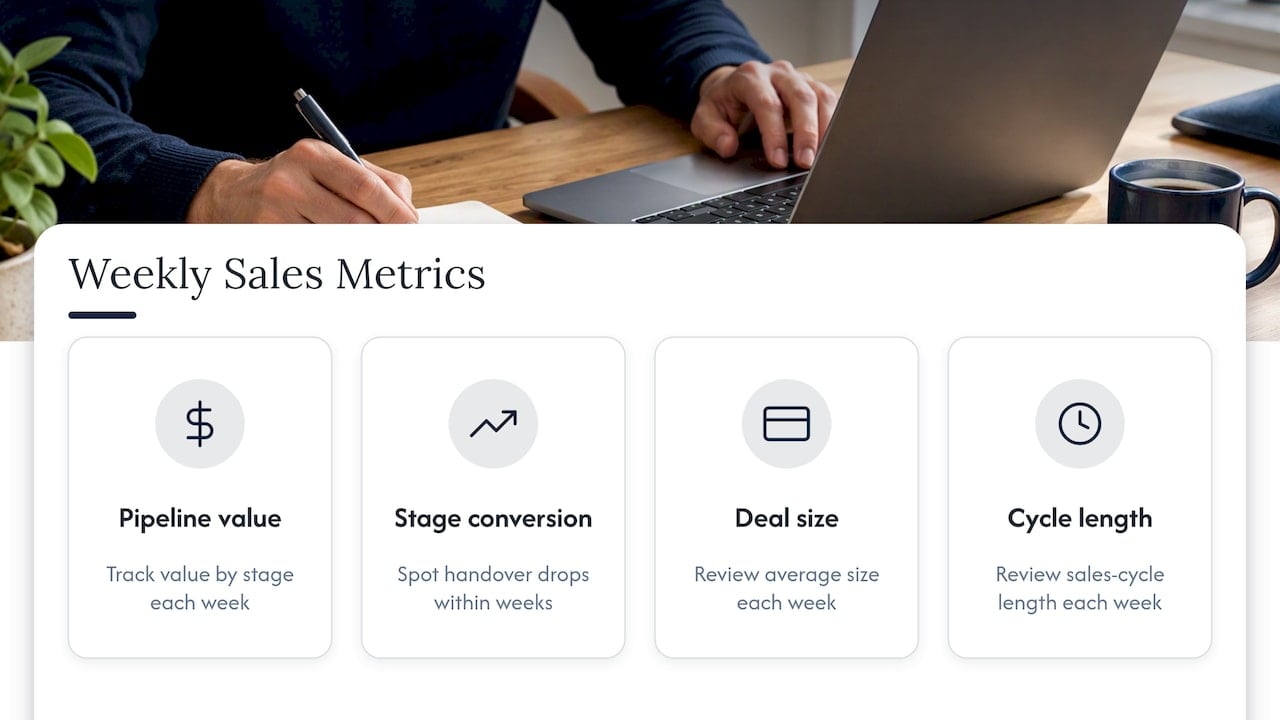
Stepping back from calls does not mean stepping back from sales. Keep a weekly view of pipeline value by stage, conversion between stages, average deal size and cycle length. If conversion drops after the handover, you will see it within weeks and can coach, rather than discovering it at quarter end.
Why management quality matters
Government research makes a broader point worth remembering. The evidence annex behind the Backing Your Business plan draws on the ONS Management and Expectations Survey and links better management practices to higher productivity, with a 0.1-point rise in management scores associated with a 9.6% productivity increase. That is a correlation across firms, not a promise for any one business, but it supports the idea that how you manage a sales team matters as much as who is in it.
Common mistakes
- Hiring for the title. A VP on day one, with no team and no playbook.
- Hiring a clone. You do not need someone who sells like you. You need someone who can sell your offer well in their own style, within your process.
- Disappearing. The fastest route to a dip is leaving the new hire alone with your hardest accounts.
- Expecting instant results. Allow for a ramp of a few months and judge activity and conversion before revenue.
- No coaching. A hire without regular call review will drift back to whatever they did before.
Our perspective
At Ahead of Sales, we work with growth-minded businesses and solo founders across the UK, and the pattern is consistent: the transition fails less on talent than on translation. Founders know exactly how to sell and have never had to explain it.
That is why we combine bespoke 1:1 coaching with team training and consultancy rather than offering one on its own. Coaching helps the founder articulate what they do and let go of the deals that no longer need them. Training gives the team the skills and the objection handling. Consultancy builds the structure: stages, targets and reporting that make quarterly targets realistic.
Our view is that you should aim for a team that hits target every quarter without needing you in every room. Letting go feels risky, but staying as the bottleneck is riskier. Be patient with the ramp, be strict about the process, and be generous with feedback.
— Jerry
How we can help
If you would like support through the handover, there are a few routes depending on your size:
- Fractional sales director. Senior leadership a few days a week while you work out whether you need a full-time hire. See our fractional sales director service.
- Team coaching and consultancy. Bespoke engagements for businesses with roughly 50 to 1,000 staff, from £4,500 to £8,500 one-off. Details are on our sales training cost page.
- Solo sales acceleration. For solo service businesses and consultants, from £2,995 to £5,995 one-off, on the same page. The sales coaching programme explains how it works.
If you are scaling a team, our guide on how to scale a sales team for consistent UK growth is a good next read, and for software businesses there is sales training for SaaS.
FAQ
What is founder-led sales?
Founder-led sales is when the founder personally runs the selling: finding prospects, running discovery, shaping proposals and closing. It is normal in the early stages because founders learn what customers want fastest by speaking to them directly.
When should a founder stop leading sales?
There is no universal revenue milestone. Recent benchmark data suggests closing 20 to 30 deals yourself first, then hiring when your capacity is what is limiting growth. Even then, most founders stay involved in key deals for a while.
Should my first sales hire be a manager?
Usually not. A senior closer who can take real deals and test your playbook is a safer first hire, because a manager needs a team and process to manage. A manager or director becomes useful once you have several sellers and consistent data.
How long until a new sales hire is productive?
Benchmarks put ramp time for a first AE at roughly three months in smaller teams, and four to five months as teams grow. If someone is still struggling after a full quarter, check the playbook and onboarding before blaming the person.
Can a solo business owner do this without a full team?
Yes. Solo consultants and coaches can build a repeatable sales conversation and offer, then add a part-time closer or fractional support when demand outgrows their diary. The aim is the same: a process that does not rely only on you.
Sources
- CRO Report: Founder-Led Sales to VP Sales
- GTM AI: From founder-led to team-led sales
- SaaStr: How to Transition from Founder-Led Sales
- Marlborough Street Partners: Transitioning from Founder-led Sales to Scale
- GOV.UK: Backing your business evidence annex