
For ongoing sales coaching, we favour pay-for-access retainers for senior advisory and fractional work, and a blended value-based model for team coaching. A practical starting rule: price the retainer at a fraction of the monetised value you expect to create each month, with a sensible floor beneath it. The sections below cover the two retainer models, package structure, pricing steps, billing terms, onboarding, KPIs, common mistakes, and how we apply all of this ourselves.
TL;DR:
- Use pay for access for senior advisory and fractional roles, pay for work for fixed coaching, and blend scheduled sessions with manager access for teams.
- Use client revenue or margin figures to estimate monthly value, capture 10% to 20%, and keep a minimum fee when the formula misses delivery costs.
- Record CRM access and a written baseline in the first week, deliver a visible quick win within sixty days, and review agreed KPIs quarterly.
- Bill monthly in advance, set cancellation notice at thirty days, and review agreed KPIs against the onboarding baseline each quarter.
- UK businesses may agree to payment periods of 60 days, but overdue invoices can incur statutory interest at 8% above the base rate.
Table of Contents
- Pay-for-work vs pay-for-access: which fits which coaching situation
- Package components: scope, sessions, access and reporting
- Step-by-step pricing: value-based, blended and practical calculation examples
- Invoicing, payment terms and late-payment practicalities
- How to pitch a retainer and onboard the client for success
- Which KPIs, reporting cadence and contract clauses show value and reduce disputes
- Frequent retainer errors and concise corrective actions
- Ahead of Sales’ approach and author credentials
- An honest view on running retainers well
- How we can help you build a retainer that holds up
- FAQ
- Sources
Pay-for-work vs pay-for-access: which fits which coaching situation
Every sales coaching retainer sits on one of two foundations. Pay-for-work means the client buys a defined block of deliverables: a set number of coaching sessions, a training programme, specific materials. Pay-for-access means the client buys your availability and judgement, whether or not they use every hour on the clock.
The distinction matters because it shapes what the client expects when they renew. A pay-for-work client counts sessions delivered. A pay-for-access client counts whether their sales director could reach you before a tricky board meeting, or whether a rep got unstuck before a big pitch.
Different coaching situations suit different models:
- One-to-one acceleration for a single rep or founder tends to work well as pay-for-work, with a fixed cadence of sessions and clear milestones.
- Team coaching across a sales floor often works best blended: a core programme of sessions (pay-for-work) wrapped in a retainer that also covers manager check-ins and ad hoc troubleshooting (pay-for-access).
- Senior advisory, such as coaching a VP of Sales through a restructure, suits pay-for-access almost exclusively. The client is buying a sounding board on demand, not a syllabus.
- Fractional sales director work is pay-for-access by definition: the client is buying a seat at the table for a fixed number of days, with the right to call on you between sessions.
The mistake we see most often is blending both value propositions inside a single package without separating them. A client who has paid for twelve defined sessions will start asking why you charge extra for the emergency call that falls outside session eleven. A client who has paid for access will feel short-changed if you treat every interaction as a billable unit.
The fix is to pick one primary value proposition per package and build the other in as a clearly labelled extra. If your core offer is pay-for-work, state explicitly how much “between-session access” is included, if any. If your core offer is pay-for-access, state how many structured sessions sit inside that access, so the client knows what they are entitled to book.
For our own fractional sales director engagements, access is the product: a fixed number of days a month plus the ability to reach us when a deal is at risk. For team coaching cohorts, the core is a defined programme of sessions, with a smaller access allowance wrapped around it so managers are not left waiting for the next scheduled call when something urgent comes up.
Package components: scope, sessions, access and reporting
A retainer package only works if the client and your delivery team can clearly understand and agree on what is included when the components are named explicitly.
A clear package description needs:
- Scope: which parts of the sales function the retainer covers (prospecting, objection handling, pipeline reviews, leadership coaching).
- Session cadence: how many sessions per month, their length, and whether they are one-to-one, group, or manager-led.
- Access: whether the client can reach you outside scheduled sessions, and through what channel (phone, messaging, email), with a response-time expectation.
- Reporting: what gets reported, to whom, and how often.
- Exclusions: what sits outside the retainer, such as new hire onboarding or a full sales process redesign, so scope creep has a named boundary.
Writing the description in two or three sentences, rather than a long specification document, keeps it usable: a one-line scope statement, a one-line cadence and access statement, and a one-line reporting statement. Clients buy retainers they can explain back to their own boss in one breath.
A few sample outlines illustrate how this scales with client size. A solo consultant or service business owner might buy a retainer built around a small number of one-to-one sessions per month, WhatsApp access for quick questions, and a short written summary after each session, aligned to our own sales coaching programme for solo operators. A 10 to 30 person sales team might buy a retainer combining two manager coaching sessions a month, one team workshop, and a monthly written pipeline review. A mid-sized sales organisation typically needs a tiered retainer: senior leadership coaching, a rolling programme of frontline training, and a quarterly business review with the leadership team, closer to the scope covered by our sales training services.
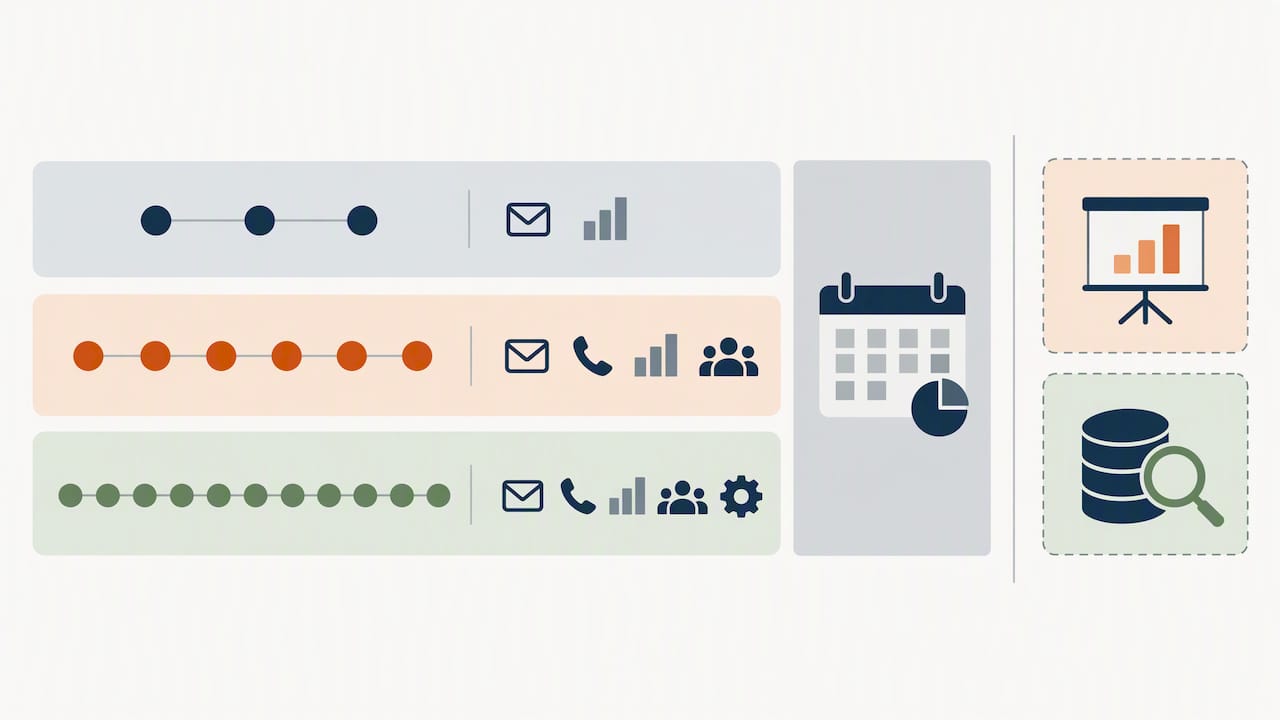
Tiering works best when the tiers differ in access and depth rather than simply in hours. A lower tier might offer monthly check-ins with email access; a higher tier might add weekly sessions, direct phone access, and a dedicated quarterly strategy day. Add-ons (a one-off negotiation workshop, a CRM audit) sit outside the core retainer and are priced separately, so the retainer itself stays simple to renew.
Pro Tip: Write the package description so a client could read it aloud to their finance director in under thirty seconds; if it takes longer, the scope is not tight enough yet.
Step-by-step pricing: value-based, blended and practical calculation examples
Hourly pricing punishes you for getting faster and rewards you for being slow. Fixed-rate pricing ignores how much the engagement is actually worth to the client. Value-based pricing ties your fee to the outcome you help create, which is why it tends to produce stronger retainers for ongoing sales coaching than either alternative, particularly once a client has seen a first result and understands what improved performance is worth to them.
A repeatable pricing method looks like this:
- Estimate the uplift: what revenue or margin improvement is realistically achievable from better coaching, given the client’s current pipeline and conversion rates.
- Monetise it: convert that uplift into a monthly or annual pound figure using the client’s own numbers, not industry averages.
- Apply a capture multiplier: price the retainer at a fraction of that monetised value, commonly somewhere between 10 and 20%, so the client keeps the majority of the gain.
- Set a floor: define a minimum monthly fee below which the engagement is not viable for you to run properly, regardless of the uplift calculation.
- Build tiers: structure two or three price points around access level and session volume, so clients can self-select without a bespoke negotiation every time.
Here is a worked example for a solo coach. Say a solo sales consultant typically closes £8,000 a month in new business. If coaching realistically lifts their close rate enough to add one extra £8,000 deal every two months, that is £4,000 of monthly uplift. At a modest capture rate, the retainer would be set accordingly, which likely falls below a sensible floor for a bespoke one-to-one service, so the floor becomes the binding constraint rather than the uplift calculation. This is exactly why solo-operator pricing tends to be set as a package band rather than a pure percentage: our own sales acceleration packages for solo service businesses run from £2,995 to £5,995 one-off, reflecting a floor built around delivery cost rather than a strict multiplier.
A second worked example for a 50 to 200 person sales team: say the team currently closes £2 million a year, and better-coached managers typically lift conversion enough to add £300,000 of annual revenue, or £25,000 a month. At a modest capture rate, the retainer would be set accordingly. In practice, team engagements of this size are usually sold as a one-off bespoke package rather than a pure monthly percentage, which is why our own team-based coaching and consultancy engagements are priced from £4,500 to £8,500 one-off, scoped to the specific team size and goals rather than purely by formula.
A 2024 peer-reviewed study on managerial coaching found that coaching effectiveness depends on matching frequency to team maturity and coaching skill, not on hours delivered alone. That matters for pricing: a retainer sold purely on session count encourages clients to judge value by volume, when the evidence points the other way. Price and package around skill and structure, and let hours be a secondary detail.
For a fuller sense of how coaching retainers are typically priced across different client sizes, our own pricing guide for coaching packages sets out sample bands.
Invoicing, payment terms and late-payment practicalities
How you bill a retainer affects your cashflow as much as the price itself. Monthly billing in advance is the standard for ongoing coaching: it matches cash coming in to work going out, and it gives you an early warning if a client’s finance team starts dragging its feet. Quarterly billing reduces your admin but increases your exposure if a client churns partway through the quarter. A deposit taken before the first session, commonly one month’s fee, reduces the risk of starting delivery before payment is confirmed.
Contracts should include a handful of clauses as standard:
- Notice period for cancellation, typically 30 days, so neither side is caught out.
- Renewal terms, stating whether the retainer rolls over automatically or requires a fresh agreement.
- Scope change process, so a client adding a new division to the retainer triggers a price conversation rather than silent scope creep.
- Cancellation and refund terms for any prepaid period.
- Deposit terms, including what happens to the deposit if the engagement ends early.
Payment terms deserve explicit attention because UK commercial contracts allow considerable flexibility, and that flexibility can work against you if left unaddressed. Businesses may agree payment terms longer than 30 days, and a 60-day payment period is common by agreement between UK businesses, but statutory protections still apply once a payment is genuinely late. Late payments attract statutory interest of 8% above the Bank of England base rate, plus fixed debt recovery charges of £40, £70 or £100 depending on the size of the debt. Stating these terms in your contract, rather than relying on the statutory default, makes the consequence of late payment clear to the client before it becomes a dispute.
Statutory protections exist for suppliers even where parties have agreed a longer payment period by contract.
A non-legislative common framework for late payment policy also exists to keep commercial payment timescales broadly consistent, which is useful context if a client pushes for unusually long terms. Direct debit or card-on-file arrangements reduce the admin of chasing monthly invoices and lower the risk of a payment quietly slipping by a week or two without anyone noticing.
How to pitch a retainer and onboard the client for success
The easiest point to propose a retainer is at the natural end of a project, when the result is fresh in the client’s mind. A simple version: “We’ve hit the goals we set for this programme. The pattern we usually see is that gains fade without ongoing reinforcement, so here’s what an ongoing retainer would look like to protect what we’ve built.” That framing ties the retainer to a result the client has already seen, rather than asking them to imagine a future benefit.
Onboarding in the first ninety days sets the tone for the whole retainer:
- Days 1 to 30: agree goals, record a measurable baseline (conversion rate, average deal size, pipeline coverage), and map out who the key stakeholders are.
- Days 31 to 60: deliver at least one visible quick win, such as fixing a weak point in the sales process that the baseline revealed.
- Days 61 to 90: hold the first formal review against the baseline, and confirm the governance rhythm (monthly or quarterly) for the rest of the engagement.
Client commitments should be agreed up front rather than assumed. These typically include read access to the CRM so progress can be measured independently, protected time with frontline managers so coaching is not constantly rescheduled, and clarity on who holds decision rights over changes to the sales process.
Pro Tip: Ask for CRM access and a written baseline in the first week, before the first coaching session happens; without a baseline, nobody can agree later whether the retainer worked.
The first quarter is where most retainers are won or lost on perceived value, which is why a documented quick win inside the first sixty days matters more than a perfect long-term plan.
Which KPIs, reporting cadence and contract clauses show value and reduce disputes
A retainer survives renewal when the client can point to a number that moved. Leading indicators (coaching session attendance, time spent on key sales activities, manager-led coaching frequency) show whether the work is happening. Lagging indicators (win rate, average deal size, sales cycle length, quota attainment) show whether it is working.
Useful items for a monthly or quarterly dashboard include:
- Win rate against the baseline recorded at onboarding.
- Average deal size and whether coaching has shifted it.
- Sales cycle length, particularly where objection handling was a focus area.
- Quota attainment across the coached team or individual.
- Coaching attendance and engagement, as a leading indicator of whether the lagging numbers will move.
Reporting cadence should match the governance rhythm agreed during onboarding: a short written update monthly, and a fuller review quarterly that revisits the original goals.
Contracts benefit from a handful of clauses built around these review points: a defined review date each quarter where either side can raise concerns, light-touch service-level expectations for response times on the access portion of the retainer, and a named exit trigger, such as two consecutive quarters of no measurable movement on the agreed KPIs, that gives both sides a clean, non-adversarial point to end the engagement. For a deeper look at the kind of KPI frameworks used in coaching relationships more broadly, this executive coaching selection and measurement guide is a useful reference point.
Performance-based fees need care. Tying a meaningful part of the fee to a single metric, such as closed revenue, can push a coach towards short-term pressure tactics rather than durable skill-building. Where a performance element is used, keeping it a modest proportion of the total fee, alongside a solid base retainer, avoids that distortion.
Frequent retainer errors and concise corrective actions
Several mistakes show up repeatedly in sales coaching retainers, and most are fixable before they cause real damage.
- Unclear value proposition: a retainer that does not say what it protects or improves invites renewal doubt. Fix it by naming the specific metric the retainer is meant to move, in writing, from day one.
- Pricing by hours alone: hourly pricing rewards slow delivery and ignores outcome. Fix it by moving towards the value-based method and tiering described earlier, even if hours still inform your internal capacity planning.
- Mixing pay-for-work and pay-for-access in one package: this creates confusion about what is included. Fix it by choosing one primary value proposition and clearly labelling the other as a defined extra.
- Weak exit clauses: vague cancellation terms create awkward conversations exactly when a client is already unhappy. Fix it with a clear notice period and a named exit trigger agreed up front.
- No baseline measurement: without a recorded starting point, nobody can agree whether the retainer delivered anything. Fix it by capturing baseline numbers in the first week of onboarding.
Watch for early warning signs that a retainer is at risk: sessions being rescheduled repeatedly, reports going unread, or a client contact who stops attending reviews. Each of these tends to show up well before a cancellation notice does, which gives you time to raise the governance conversation first.
Ahead of Sales’ approach and author credentials
We built our own retainer model around the same principle this guide sets out: price and structure around value, not hours.
For solo service businesses and consultants, our sales coaching programme is built specifically for one-person and small operations rather than adapted from a team product, with pricing and coaching structured to match the pace of a solo business rather than a large sales floor.
I have spent my career working directly with sales teams and leaders on the packaging and pricing questions this article covers, which is the perspective behind the pricing method and the examples above. The worked numbers in this guide, and the package ranges referenced, draw on the pricing we actually use: our team-based coaching and consultancy engagements run from £4,500 to £8,500 one-off, and our solo accelerator packages run from £2,995 to £5,995 one-off. Readers weighing up whether a bespoke package or a lighter touch retainer suits their situation can see the fuller range of options on our main services page.
An honest view on running retainers well
Pay-for-access wins for senior and fractional work because clients who have reached a certain level do not want another training programme, they want someone reliable to call when a deal wobbles. Value capture pricing wins everywhere else because it forces an honest conversation about what the coaching is actually worth, rather than hiding behind a day rate that nobody really believes in.
If I had to prioritise one thing when designing a retainer, it would be the baseline. Every dispute I have seen about whether a coaching retainer “worked” traces back to nobody agreeing, in writing, what the starting point was. Get that number down before the first session, and most of the rest of the structure falls into place behind it.
If you are weighing up how to package your own retainer, we are happy to talk it through.
— Jerry
How we can help you build a retainer that holds up
If you recognise the packaging problems covered above, whether that is a solo consultancy outgrowing ad hoc hourly billing, a growing sales team that needs a structured coaching rhythm, or a business that needs senior sales leadership without a full-time hire, we can help you design a retainer that fits.

- Solo consultants and service business founders typically fit our sales acceleration track, priced from £2,995 to £5,995 one-off.
- Growing sales teams of roughly 50 to 1,000 staff with a genuine growth target typically fit our team-based coaching and consultancy engagements, priced from £4,500 to £8,500 one-off.
- Businesses that need ongoing senior sales leadership without a full-time hire typically fit our fractional sales director service, priced on request.
Each engagement starts with a conversation about where your sales performance actually stands today, not a generic proposal. If any of the packages above sound close to what you need, the next step is to get in touch through our main site and talk through what a retainer built around your own numbers would look like.
FAQ
What is the difference between pay-for-work and pay-for-access coaching?
Pay-for-work means the client buys a defined set of deliverables, such as a fixed number of sessions. Pay-for-access means the client buys ongoing availability and judgement, which suits senior advisory or fractional arrangements better than a rigid session count.
How much should a sales coaching retainer cost?
A practical starting rule is to price the retainer at a modest fraction of the monthly value the coaching is expected to create, with a minimum floor to cover delivery cost. Our own packages, as a reference point, run from £2,995 to £5,995 one-off for solo operators and £4,500 to £8,500 one-off for team engagements, depending on scope.
How long should a sales coaching retainer contract run?
Most retainers run on a rolling monthly or quarterly basis with a defined notice period, commonly 30 days, rather than a long fixed term. A quarterly review point works well as a natural renewal or exit trigger.
What payment terms are normal for a coaching retainer in a commercial contract?
Monthly billing in advance is standard, though business-to-business agreements can set longer terms, with a 60-day period common by agreement. Once a payment genuinely falls overdue, statutory interest and fixed recovery charges can apply regardless of the agreed term.
What KPIs best show that a sales coaching retainer is working?
A mix of leading indicators, such as coaching attendance and activity levels, and lagging indicators, such as win rate and average deal size measured against an agreed baseline, gives the clearest picture. Reviewing these against the original baseline each quarter is more reliable than judging value from session count alone.
Sources
- Late commercial payments: statutory interest and debt recovery
- Managerial coaching effectiveness and mechanisms (2024)