
The fastest way to improve a sales team is to stop asking reps to report and start asking them to reason. Swap CRM-status questions (“Where’s that deal at?”) for judgement-building ones (“What would have to be true for this to close by Friday?”), and run them through a short weekly GROW loop. Do this consistently for six to twelve weeks and you should see it show up in conversion rates, not just in nicer conversations.
TL;DR:
- Using judgment-building questions like “what would have to be true for this to close” helps reps identify risks early and improve conversion rates faster.
- Coaching effectiveness relies on adaptability, involvement, and rapport, emphasizing reading CRM data beforehand and focusing on reasoning during live sessions.
- Structured weekly GROW model sessions of 25 to 30 minutes, combined with monthly deep dives, reinforce learning and accountability through concrete commitments.
- Diagnose performance gaps by skill, will, knowledge, or system issues before coaching, to avoid fixing systemic problems with individual questions.
- Tracking stage-to-stage conversion rates, commitment follow-through, and conversation insights provides early indicators of coaching success, with results typically visible within six to twelve weeks.
Table of Contents
- Sales coaching questions organised by the job you’re doing
- Why judgement-building questions actually change behaviour
- How to run a coaching session: GROW applied to sales
- Choosing the right questions: skill, will, knowledge, or system?
- Measuring coaching effectiveness: leading indicators to track
- Practical tips and pitfalls in real coaching sessions
- How this approach plays out in real coaching rooms
- Sources
- FAQ
Sales coaching questions organised by the job you’re doing
Different coaching moments call for different questions. A rep stuck on a stalled enterprise deal needs something very different from a new starter who hasn’t taken a live call yet. Below is a working bank organised by the four situations you’ll hit most often as a manager.
Deal coaching (when a specific opportunity needs unsticking):
- What would have to be true for this deal to close by the date you’ve forecast?
- If this deal died today, what would the autopsy say killed it?
- Who else in that business would feel the pain if this problem stayed unsolved?
- What’s the one objection you haven’t heard yet that would worry you most?
- What did the buyer do in that last call that you didn’t expect?
Performance recovery (for a rep missing numbers):
- Which part of your pipeline would you fix first if you could only fix one?
- What’s different about the deals you’re winning versus the ones stalling at proposal stage?
- What’s one thing you did on your best call this month that you haven’t repeated since?
Ramping new reps (skill and knowledge gaps):
- Walk me through how you’d handle a “we’re happy with our current supplier” objection right now.
- What part of the pitch do you feel least confident delivering, and why?
- If a prospect asked you our pricing rationale cold, what would you say?
Top-performer development (stretch and retention):
- What would it take for you to hit 130% of target rather than 100%?
- What’s a skill you haven’t had the chance to use here that you’d like to?
- If you were coaching the rest of the team on one thing, what would it be?
Use deal coaching questions inside pipeline reviews, not one-to-ones. Save performance recovery questions for private sessions where a rep can be honest without an audience. Whichever question you ask, follow it with “and what else?” One answer is usually the rehearsed one. The second and third answers are where the real diagnosis sits.
Why judgement-building questions actually change behaviour
A status question pulls a fact out of someone’s memory. A judgement question forces them to reason through a scenario, which is a fundamentally different cognitive task, and it’s why reps who get asked “what would have to be true for this to close?” tend to spot risks they’d otherwise miss until it was too late.
The research backs this up beyond intuition. A validated effective sales coaching (ESC) scale identifies three dimensions that separate coaching that works from coaching that doesn’t: adaptability, involvement, and rapport. Managers who adapt their questions to the specific rep and deal, stay genuinely involved rather than skimming CRM notes beforehand, and build enough rapport for reps to answer honestly, get measurably better sales outcomes. A related study on managerial coaching and sales performance found this coaching skill links directly to results, not just to how sessions feel.
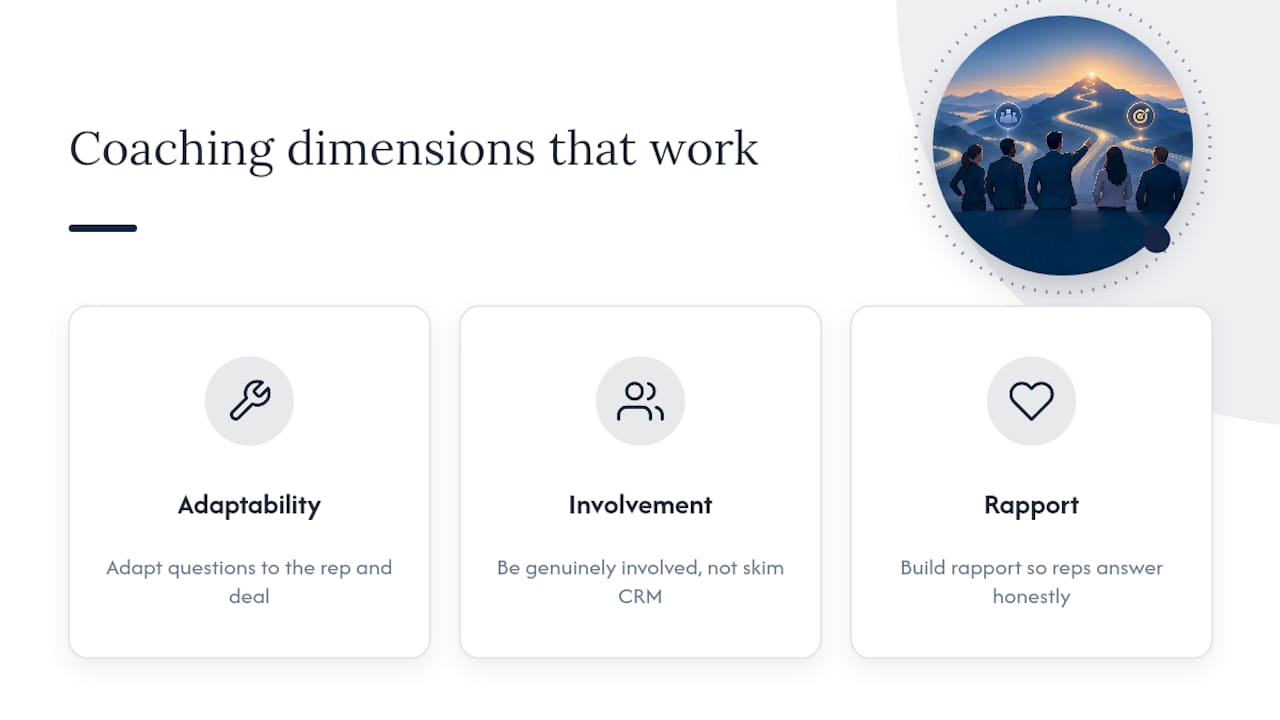
The practical implication: read the CRM before the session, not during it. Then spend the live minutes on reasoning, not reporting.
How to run a coaching session: GROW applied to sales
The GROW model gives structure to what would otherwise drift into a chat about the weather. Four phases, each with its own question type:
- Goal (3-5 minutes): “What does a genuinely good outcome from this call look like?” / “What are you trying to move forward this week?”
- Reality (10 minutes): “What actually happened on that call?” / “What did the recording show that surprised you?” / “Where’s the gap between what you planned and what happened?”
- Options (7-8 minutes): “What are three different ways you could approach this objection?” / “What would you try if failure wasn’t a risk?”
- Will (5 minutes): “Which option will you commit to, and by when?” / “How will I know you’ve done it without asking?”
Run this as a tight 25 to 30-minute weekly session focused on one deal or one skill. Add a monthly 60-minute deep-dive that looks across several calls rather than one. Use call recordings for the Reality phase so the conversation is anchored to evidence rather than memory, which is a habit good sales coaching playbooks consistently recommend.
Cadence and structure only:
- Weekly: 25 to 30 minutes, one deal or one skill, recording review plus GROW loop.
- Monthly: 60 minutes, pattern review across multiple calls, role-play practice.
- Every session: log the Will commitment somewhere visible and open next week’s session by checking it.
Choosing the right questions: skill, will, knowledge, or system?
Not every performance gap is a coaching problem. Asking sharper questions won’t fix a rep who’s missing target because your pricing tool is broken or because they’ve quietly disengaged. Diagnose before you coach:
- Skill gap: they don’t know how to do it yet. Use ramping and skill-check questions, pair with role-play.
- Will gap: they know how but aren’t motivated to do it. Use performance recovery and stretch questions, and be honest that this might be a management conversation, not just a coaching one.
- Knowledge gap: they lack product, market, or competitor information. This needs training or a resource, not more questions.
- System gap: the CRM, pricing process, or lead flow is broken. Coaching a rep through a broken system just teaches them to work around dysfunction.
If three different reps hit the same wall in the same place, that’s a red flag for a system problem, not three individual coaching failures.
Measuring coaching effectiveness: leading indicators to track
Coaching that works shows up in numbers before it shows up in revenue. Track these leading indicators rather than waiting for the quarterly result:
- Stage-to-stage conversion rates, particularly at the stage you’ve been coaching on.
- The ratio of judgement questions to status questions in call recordings.
- Commitment follow-through: how many Will actions from last week’s session actually happened.
- Multi-threading: how many contacts per account reps are engaging, not just the primary buyer.
Structured, regular coaching produces measurable improvements in win rate and ramp time in practitioner reporting, though the timetable matters: give it six to twelve weeks before judging whether it’s working, and revisit your diagnosis if nothing has shifted by then.
Practical tips and pitfalls in real coaching sessions
The biggest failure mode isn’t asking the wrong question. It’s answering it yourself before the rep gets the chance.
- Listen more than you talk, and let silence sit rather than filling it with your own suggestion.
- Ask “and what else?” at least twice before moving on; the third answer is usually the honest one.
- Follow answers two layers deep rather than covering five topics shallowly in one session.
- Use role-play to convert an insight into a rehearsed behaviour, not just a nice conversation.
- Log commitments somewhere the whole team can see, and open every session by checking last week’s.
Pro Tip: Resist the urge to jump in with the answer the moment a rep pauses. That silence is where they’re doing the actual thinking, and interrupting it is the single most common way managers turn a coaching session back into a lecture.
How this approach plays out in real coaching rooms
Structured, question-led coaching consistently outperforms the “let’s catch up” style of one-to-one, because it forces reasoning rather than reassurance. Teams that adopt a weekly rhythm tend to notice the shift within a handful of sessions: reps start volunteering the “what if” scenarios themselves before the manager even asks.
That’s the real marker of progress. Not better answers to your questions, but reps who’ve internalised the questions enough to ask themselves.
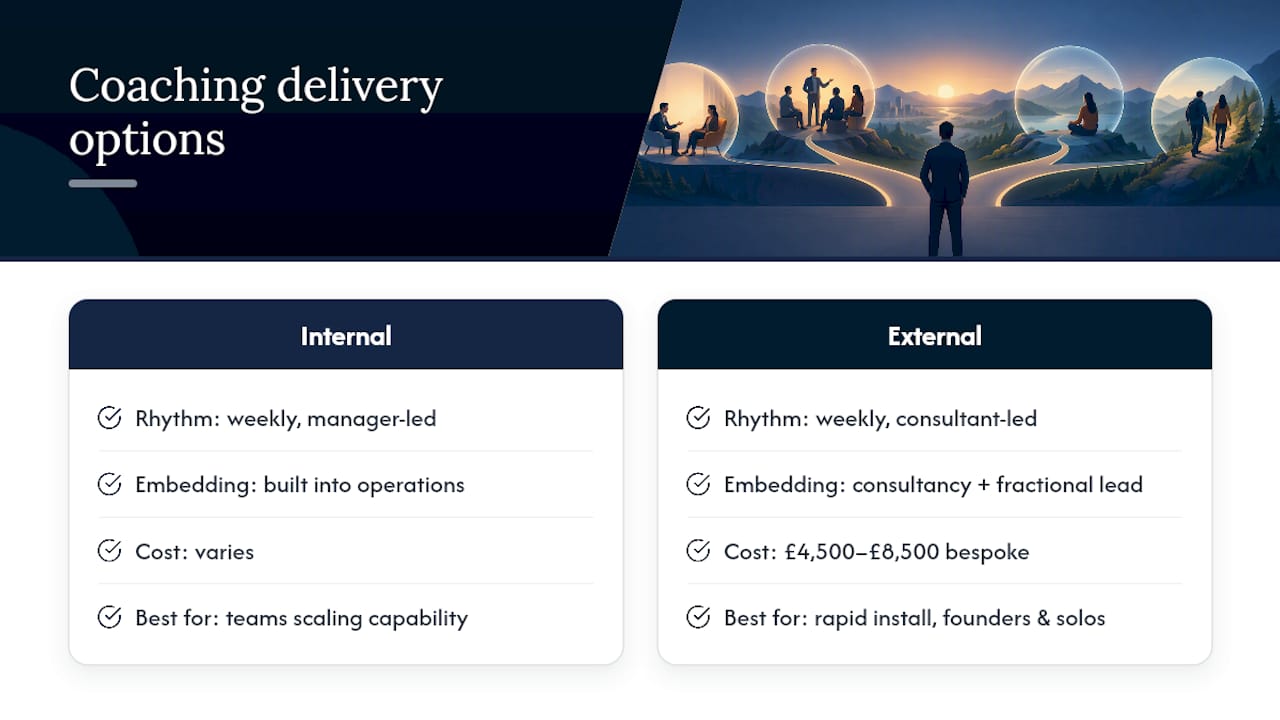
Ahead of Sales builds this rhythm directly into its bespoke coaching and training engagements, pairing structured GROW-based sessions with the consultancy and fractional leadership support to keep it embedded rather than treated as a one-off intervention. If you’re weighing whether to build this internally or bring in support to install it properly, the sales training cost guide breaks down what fully customised coaching and consultancy packages, and team-based bespoke engagements priced between £4,500 and £8,500, typically involve. Solo consultants and service-business founders have their own track, built around the same principle: coaching should be a rhythm, not an occasional favour.
— Jerry
Sources
For deeper grounding, the ESC scale study and the related managerial coaching and sales performance research cover the academic case for adaptability, involvement, and rapport. Harvard Business Review’s piece on behaviours that drive successful salespeople and HubSpot’s sales coaching playbook give practical grounding for question design and cadence. For consultative questioning technique specifically, see consultative selling techniques for real revenue growth.
FAQ
What are the 7 coaching questions?
There’s no single fixed list of seven, but most coaching frameworks converge on questions covering goal clarity, current reality, obstacles, options, resources, commitment, and follow-up accountability. These map closely onto the GROW model’s four phases, expanded slightly to separate obstacles from options.
What are the 5 C’s of sales?
Definitions vary by source, but a common version covers Curiosity, Confidence, Clarity, Connection, and Commitment as the traits or behaviours strong salespeople display. It’s worth treating this as a rough mnemonic rather than a rigid framework, since practitioners use different variants.
What is the 3-3-3 rule in sales?
The 3-3-3 rule isn’t a standardised industry term with one fixed definition; it’s used informally in different ways across sales content, often relating to prospecting cadence or call structure. Treat any specific version you encounter as one practitioner’s shorthand rather than an established standard.
What are the best questions to ask during a coaching session?
The strongest questions force reasoning rather than recall, such as “what would have to be true for this deal to close?” or “what’s different about the deals you’re winning?” Organise them by purpose, deal coaching, performance recovery, ramping, or top-performer development, and always follow up with “and what else?” to get past the rehearsed first answer.
How often should sales coaching sessions happen?
A weekly session of 25 to 30 minutes focused on one deal or skill, paired with a monthly 60-minute deep-dive across multiple calls, is a practical cadence recommended in sales coaching playbooks. Give the rhythm six to twelve weeks before judging its impact on conversion and win rate.