
To sell consulting services, stop pitching what you do and start qualifying, diagnosing and proposing around a problem the client already wants solved. Consulting is bought on trust, so the sale is a short sequence of honest conversations: find the right buyer, understand the issue, agree the scope, then put a clear fee against a clear outcome. Below is the process I use with the consultants, coaches and service founders we work with, including how to price, how to pitch retainers and what to do when a proposal goes quiet.
TL;DR
- Consulting is an intangible, trust-based purchase, so the sale is won in the diagnosis conversation, not the pitch.
- Qualify hard: decision-maker access, urgency, ability to pay and fit with your ideal client.
- Never propose while the scope is vague. Define deliverables, exclusions and a change process first.
- Price for profit, and sell outcomes and retainers once a client has seen your work.
- Treat sales as a pipeline you manage weekly, with fast follow-up at every stage.
Table of Contents
- Why selling consulting is different from selling a product
- The consulting sales process, stage by stage
- Stage one: promotion that attracts the right buyers
- Stage two: prospecting and qualifying
- Stage three: the diagnostic conversation
- Stage four: scoping and pricing the proposal
- Stage five: pitching the proposal
- How to sell consulting retainers
- How to sell high-ticket services
- Stage six: follow-up and pipeline management
- Our perspective: what we see consultants get wrong
- Getting help with your consulting sales
- FAQ
- Sources
Why selling consulting is different from selling a product
A buyer of software can see a demo. A buyer of consulting cannot see anything before they sign. They are paying for your judgement, and they have to decide whether you are the right person without being able to test it. That is why the sale rests on confidence in you, and why a slick deck rarely closes anything on its own.
Three things follow from that.
First, the buyer is managing risk, not shopping for features. A managing director hiring a consultant worries about wasted budget, wasted time and looking foolish internally. Your job is to make the decision feel safe.
Second, the sale and the delivery blur together. The way you listen on the first call is the first sample of the work. Clients judge your thinking from your questions long before they read a proposal.
Third, every engagement is at least partly bespoke. That makes price comparison harder, which is useful to you, but it also means a vague offer sounds like a vague consultant.
I learned this the slow way. Early on, I would talk about my methodology for twenty minutes, then wonder why a perfectly friendly prospect went silent. They did not need my methodology. They needed to hear their own problem described accurately.
The consulting sales process, stage by stage
CMCE’s UK consultancy guide describes selling consultancy as a staged process of promotion, prospection, proposition design and pitching, and calls the pipeline “leaky” because not every prospect becomes a proposal or a sale. That matches what we see. You are not trying to stop the leaks, only to know where they happen.
Here is how I would turn those stages into a working process for a service business.
| Stage | What you are doing | What “done” looks like |
|---|---|---|
| Promotion | Making the right people aware of you | Inbound enquiries and warm introductions from your target market |
| Prospection | Starting and qualifying conversations | A short call that confirms fit, budget and urgency |
| Proposition design | Diagnosing and shaping the offer | A written scope the client has helped to shape |
| Pitching | Presenting fee, scope and next step | A decision, a revision or a clear no |
| Follow-up | Keeping momentum | A signed engagement or a date to speak again |
If you want to see how this maps onto a visual pipeline, our guide to sales pipeline stages walks through each stage and the numbers worth tracking, and our piece on how to build a sales pipeline that closes deals goes deeper on set-up.
Stage one: promotion that attracts the right buyers
Most consultants promote too widely. “Business owners who want to grow” is not a market. A clear definition of who you serve and which problem you fix makes every later step easier, from your LinkedIn headline to your first call.
Write a one-sentence positioning statement in this shape: I help [specific type of business] to [specific result] when [specific situation]. For example: “I help UK professional services firms with 20 to 100 staff to build a repeatable new-business process after the founder stops doing all the selling.” That sentence tells a buyer in seconds whether to keep reading.
Pick two or three channels and stay in them: referrals from accountants and lawyers, specific LinkedIn posts about problems you see, and local events where your buyer is in the room. Consistency beats volume.
Stage two: prospecting and qualifying
Not every enquiry deserves a proposal. CMCE advises setting qualification criteria so you can decide whether an opportunity merits more of your time, because not every expression of interest or tender is worth chasing.
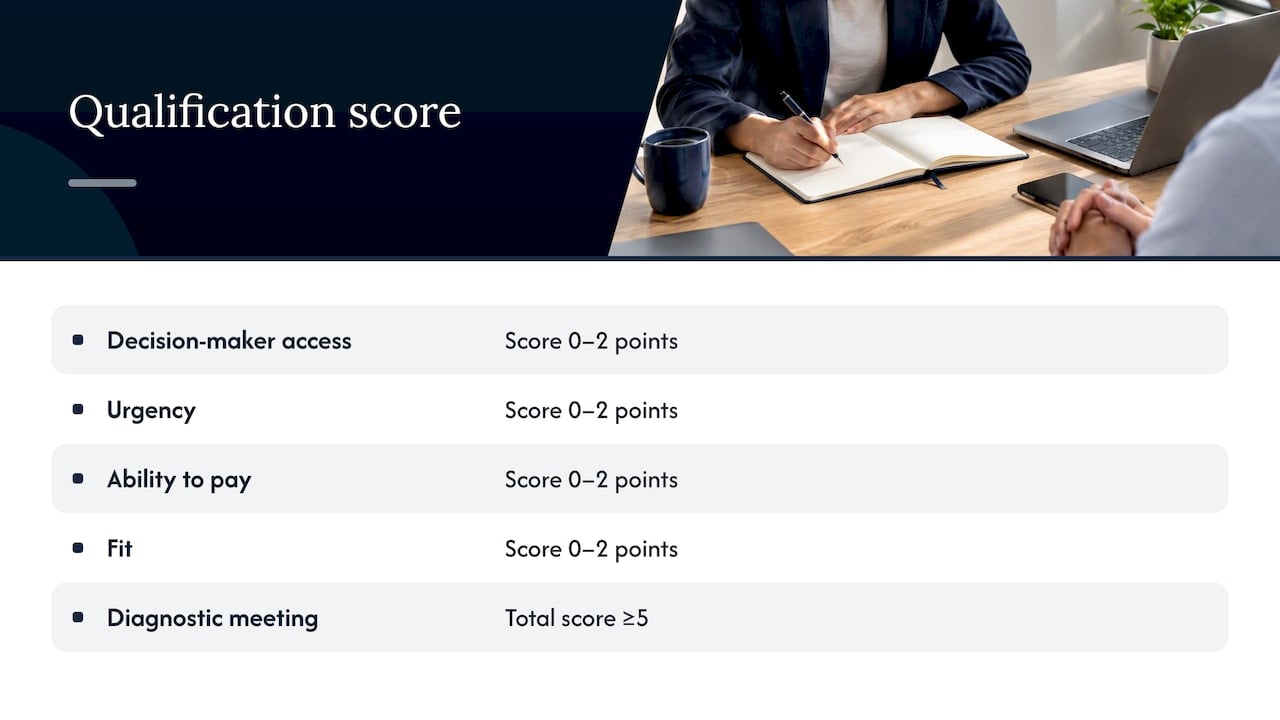
IR Global’s guidance on building a professional-services sales process suggests qualification should test four things: access to a decision-maker, urgency, ability to pay, and fit with your target-client definition. It also recommends a prospect questionnaire and a qualification call before you invest in an opportunity. I would use exactly those four tests as a checklist.
Decision-maker. Can you speak to the person who signs? If the contact is a gatekeeper, ask early how decisions are made and who else should join the next call.
Urgency. What happens if they do nothing for six months? If the honest answer is “nothing”, the project will drift.
Ability to pay. You do not need to be awkward about this. Ask: “Have you set aside budget for this, or would we be working that out together?” You can usually tell from the answer.
Fit. Would you be proud to have this client in your portfolio? Is the problem one you solve well? A poor-fit client costs more than a lost sale.
A simple scoring approach works well: give each test a score of 0 to 2 and only book a diagnostic meeting when the total is at least five. You will say no to more people, but you will spend your time on the ones who can actually buy.
Stage three: the diagnostic conversation
This is where consulting is actually sold. CMCE’s advice is to listen carefully, become genuinely curious about the client’s problem, add value to their thinking, and understand the issue and its context before you shape any proposition. I would underline the last part: before you shape the proposition.
A good diagnostic meeting follows a rhythm:
- Context. What is the business, and what has changed recently?
- Problem. What is not working, and how do they know?
- Impact. What is it costing in revenue, time or morale?
- History. What have they already tried?
- Outcome. What would success look like in 6 to 12 months?
- Decision. Who else needs to be involved, and what is the timeline?
Take notes and repeat back what you heard in their own words. When a client says “Yes, exactly that”, you have earned the right to propose. This is consultative selling, and if you want a step-by-step version, see our consultative selling step by step guide and the advantages of consultative selling for business leaders.
Stage four: scoping and pricing the proposal
The most common mistake is writing a proposal too early. IR Global says a consultant should not propose while the statement of work is still vague; a proposal should define scope and the associated fees.
The UK Cabinet Office’s Consultancy Playbook is written for government buyers, but it shows what a large, careful client expects to see. It recommends scoping work through explicit deliverables, inclusions, exclusions, assumptions, dependencies, a timetable and a change process. If you sell to mid-sized or larger businesses, expect a procurement-minded reader to look for the same things.
Choosing a pricing model
The same playbook sets out when each model fits:
| Model | Best when | Watch out for |
|---|---|---|
| Time and materials | Uncertainty is high and scope will change | Clients feel the meter running |
| Fixed price | Scope is mature and well understood | Scope creep eats your margin |
| Outcome-linked | Results are measurable, with agreed baselines and dependencies | Disputes over what caused the result |
The Playbook says outcome-linked pricing should be used only where results are measurable and baselines and dependencies are agreed. For most solo consultants, a fixed fee for a defined phase is the sweet spot: simple for the client and predictable for you.
Price for profit, then communicate value
ICAEW advises pricing work for profit whether fees are based on time, a fixed fee or performance, and describes anything else as unsustainable beyond the short term. That is written for accountancy practices, but the principle holds for any adviser. If you discount to win, you are borrowing from your future capacity.
ICAEW’s case study on advisory pricing pitfalls, published on 12 June 2023, identifies scope creep as a major pitfall and recommends defining exactly what is in scope so it is clear what is outside it. Write an “out of scope” line into every proposal. It protects the client as much as you.
What a good proposal contains
Keep it to two to four pages. Include:
- The problem, in the client’s words
- The outcome you are working towards
- Deliverables and what is excluded
- Timeline and the client’s responsibilities
- The fee, payment schedule and how long the price is valid
- How changes to scope will be handled and priced
For the last items, GOV.UK’s guidance on buying consultancy for schools is a useful benchmark of buyer expectations: cost proposals should state the payment model, pricing breakdown, included expenses, fee-validity period and the process for changes that could create additional fees. A simple-fee basis means agreed work, agreed deliverables and a fixed price, with extra fees possible for work outside the original agreement.
Stage five: pitching the proposal
Never email a proposal and hope. Send it after agreeing a short call to walk through it, ideally within 48 hours of the diagnostic while the conversation is fresh. Start with the problem and the outcome, then the approach, and only then the fee. Pause after you state the price. Silence is not rejection; it is the client thinking.
If you offer options, offer three at most: a focused starting phase, the recommended engagement, and a fuller version. Giving a choice shifts the question from “whether” to “which”, and the middle option is usually the one you would recommend anyway.
Handle price objections as questions: ask what number they had in mind and what they would need to see to feel confident. Often the fix is a smaller first phase, not a lower price.
How to sell consulting retainers
Retainers give a consultant stable income and give the client ongoing access to your thinking. They are easiest to sell after a project, when the client has seen your work and the next problem is already visible.
Make the retainer concrete, not “availability”:
- A fixed number of strategy sessions per month
- A set response window for questions
- A recurring deliverable, such as a monthly pipeline review
- A named quarterly review of results
ICAEW notes in its pricing guidance that a modular approach can justify fees, highlight the ongoing role and move the pricing conversation from cost to value. Modules also let a client start small and add more, which is a gentle way to build a retainer.
How to sell high-ticket services
High-ticket consulting is not a different skill, it is the same process with more rigour. Buyers spending several thousand pounds want a clearer diagnosis, a named outcome, evidence that you have done it before and a lower sense of risk. In practice:
- Qualify harder, because the cost of a wasted proposal is higher.
- Involve more than one stakeholder; larger decisions are rarely made by one person.
- Offer a paid diagnostic or discovery phase so the client can sample your thinking.
- Show a clear return on the fee, using the client’s own numbers from the diagnostic.
Stage six: follow-up and pipeline management
CMCE’s advice is to treat sales as pipeline management: respond quickly, keep enough potential opportunities at every stage, and notice where more effort is needed. Do not wait to feel short of work before you prospect again. The consultants who struggle are usually the ones who stop selling the week a project starts.
A weekly 30-minute pipeline review is enough. For each opportunity ask: what is the next step, who owns it and by when? Track four numbers monthly: enquiries, qualified calls, proposals sent and proposals won. Within a quarter you will see which stage is leaking.
For a proposal that has gone quiet, follow up in three steps over about two weeks: a short note offering to answer questions, a useful insight related to their problem, and a polite close-out message that asks whether the timing has changed. For more on improving each stage, read our sales pipeline optimisation guide.
Our perspective: what we see consultants get wrong
We work with business owners, service founders and solo consultants across the UK, and the same patterns appear again and again.
The first is selling too early. Consultants are generous and keen to help, so they start solving on the first call and give away the diagnosis for free. The cure is a clear structure: listen on call one, diagnose properly, then propose.
The second is hiding the price. Avoiding the money conversation makes it harder, not easier. When we publish our own ranges (team engagements from £4,500 to £8,500, and solo sales acceleration tracks from £2,995 to £5,995), buyers arrive already calibrated, and the conversations we have are about fit and outcomes rather than shock.
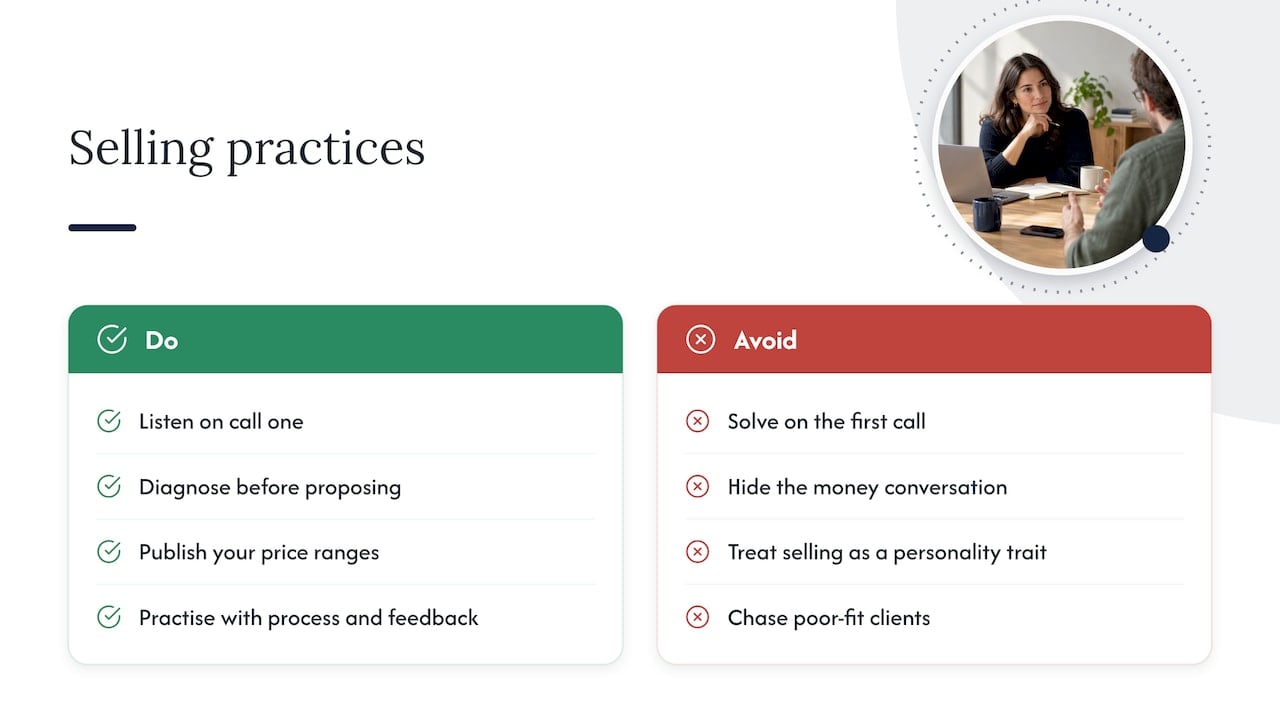
The third is treating selling as a personality trait. It is a skill, and it improves with a process, practice and feedback. Quiet, thoughtful consultants are often excellent at it because they listen. Combining 1:1 coaching with structured training is how we help people make that shift without turning into someone they are not.
If I could give one piece of advice, it is to be patient with the process and ruthless with qualification. Good clients are worth the wait, and a poor-fit client is expensive however large the invoice.
— Jerry
Getting help with your consulting sales
If you would rather build this with support, we run bespoke 1:1 coaching combined with consultancy for teams and for solo service businesses. Team engagements cost £4,500 to £8,500 one-off, and the solo service business and consultant sales acceleration track is £2,995 to £5,995 one-off. Our sales coaching programme for solo operators is designed for consultants who want a repeatable way to win clients, and our Sage Collective is £990 per month.
If you lead a sales team inside a consultancy or service firm and need hands-on leadership rather than training, our fractional sales director service is the next step to look at.
FAQ
What is the best way to sell consulting services?
Qualify the prospect, run a proper diagnostic conversation, agree the scope in writing and only then present a fixed-fee proposal. Consulting is bought on trust, so listening well and describing the client’s problem accurately matters more than describing your methods.
How do I price a consulting proposal?
Choose the model that matches the uncertainty: time and materials when the scope is likely to change, fixed price when it is well understood, and outcome-linked pricing only when results can be measured against agreed baselines. Price for profit, and state exactly what is in and out of scope.
How many stages should a consulting sales process have?
CMCE describes four: promotion, prospection, proposition design and pitching. Adding explicit qualification and follow-up steps, as in the table above, makes the process easier to manage and measure.
When should I offer a retainer?
Usually after a successful project, when the client has seen results and the next problem is already visible. Define what the retainer includes, such as sessions, a recurring deliverable and a quarterly review, so the value is clear.
How do I follow up on a proposal that has gone quiet?
Follow up within a couple of days, then again after about a week with something useful, and close the loop politely after two weeks. Keep each message short and ask a clear question about timing.
Sources
- CMCE: Starting a consultancy business, selling your services
- IR Global: Building a sales process to suit your firm and clients
- Cabinet Office: The Consultancy Playbook, September 2022
- ICAEW: Fees and charge-out rates
- ICAEW: Advisory pricing pitfalls and how to avoid them
- ICAEW: Effective pricing strategies
- GOV.UK: Buying for schools, consultancy