
TL;DR:
- A sales pipeline is a structured framework that tracks prospects through stages from initial contact to closed deal, enabling real-time revenue forecasting. Building an effective pipeline requires analyzing your sales data, defining a precise Ideal Customer Profile, and establishing clear, buyer-verified exit criteria for each stage. Regular maintenance and management are essential to keep the pipeline accurate, trustworthy, and aligned with business goals.
A sales pipeline is a structured framework that maps every prospect through defined stages from first contact to closed deal, giving your sales team a clear, real-time view of where revenue is coming from and when it will land. Unlike a vague list of leads, a well-managed pipeline connects daily sales activity to monthly forecasting, quarterly targets, and long-term growth. Tools like Salesforce and Outreach are built specifically to support this process, tracking deal values, conversion rates, and sales cycle length in one place. Get the pipeline right and you get predictable revenue. Get it wrong and you get a spreadsheet full of wishful thinking.

How to build a sales pipeline: the foundations you need first
Before you design a single pipeline stage, you need to know what your current sales data is telling you. Outreach recommends starting with a thorough analysis of your existing sales data and Ideal Customer Profile (ICP) definition, so that every stage you build is targeted at the right prospects from day one. Skipping this step is the single most common reason pipelines fail to reflect reality.
Pull your key metrics first. You want to know your average win rate, your typical sales cycle length, the number of new leads entering the pipeline each month, and where deals most commonly stall or drop off. These numbers tell you where your process has gaps before you build anything new.
Once you have the data, define your ICP with precision. This means going beyond job title and company size. You want to identify the specific triggers that cause your best clients to buy, the decision-makers involved, and the objections that consistently appear. A tightly defined ICP means your pipeline only contains deals worth pursuing.
Set measurable goals that connect to business objectives. If your business needs to grow revenue by 50% this year, work backwards from that figure using your win rate and average deal value to calculate exactly how many qualified opportunities you need in the pipeline at any given time.
- Analyse win rate, cycle length, and lead volume before designing stages
- Define your ICP based on buyer triggers and decision-maker patterns, not just demographics
- Set pipeline entry criteria so only qualified prospects enter the active pipeline
- Choose a CRM (Salesforce, HubSpot, or Pipedrive are widely used options) before you build, not after
Pro Tip: If you do not yet have 12 months of clean CRM data, interview your five most recent closed-won clients and five closed-lost prospects. The patterns you find will be more useful than any template.
What are the right stages for your sales pipeline?
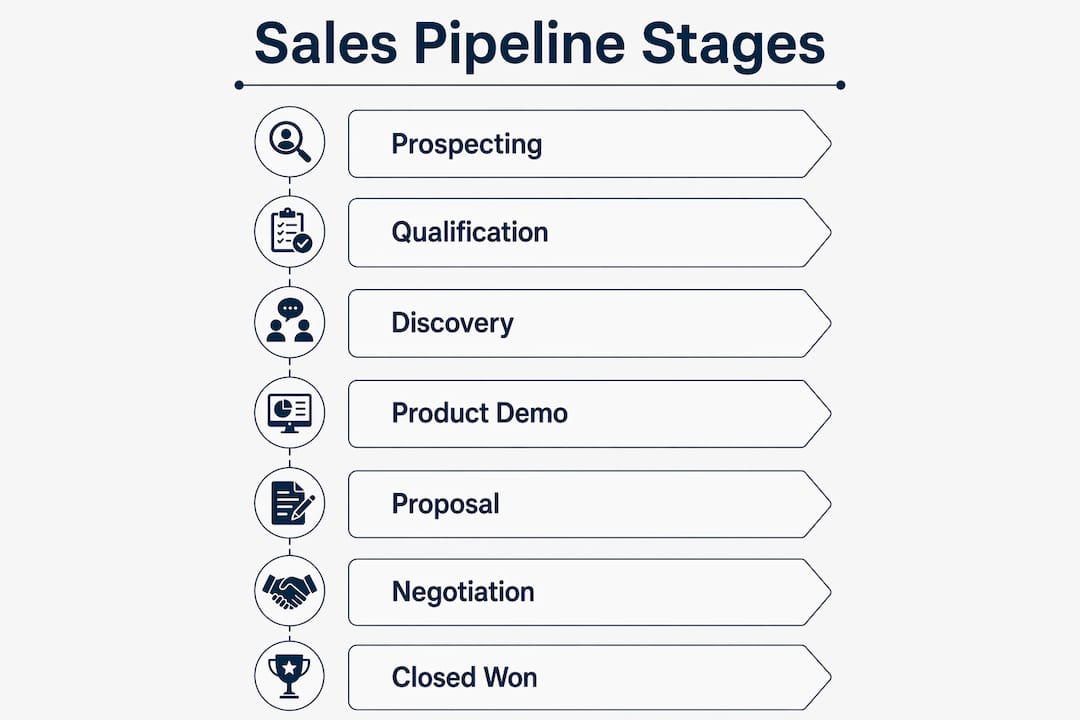
A sales pipeline typically contains between five and seven stages, running from prospecting through to closed won or closed lost. Zendesk emphasises that these stages must align with how your buyers actually make decisions, not how your sales team prefers to work. That distinction matters more than most sales leaders realise.
Think of your pipeline as a GPS for your sales reps. As Zendesk notes, a well-structured pipeline guides reps on the next best action based precisely on where each prospect sits in their buying journey. Without that structure, reps default to gut feel, and gut feel does not scale.
The standard stages most B2B businesses use are: prospecting, qualification, initial contact or discovery, product demonstration or presentation, proposal and negotiation, and closed won or closed lost. Your industry may require additional stages. A professional services firm might add a scoping or contracting stage. A SaaS business might include a free trial stage. The key is that each stage reflects a genuine shift in buyer commitment, not just a shift in sales rep activity.
The most important discipline here is setting exit criteria for each stage. Monday.com advises that exit criteria must be based on verifiable buyer milestones, not on what the sales rep has done. A deal does not move from “discovery” to “proposal” because the rep sent a follow-up email. It moves because the buyer has confirmed budget, authority, and a genuine need.
| Stage | Exit criteria (buyer-verified) |
|---|---|
| Prospecting | Prospect matches ICP and has been identified as a viable target |
| Qualification | Budget, authority, need, and timeline confirmed by the buyer |
| Discovery/contact | Buyer has articulated specific pain points and agreed to next steps |
| Proposal/negotiation | Proposal sent and buyer has provided substantive feedback or counter |
| Closed won/lost | Contract signed or formal decision communicated by buyer |
Pro Tip: Review your stage names with your sales team before finalising them. If a rep cannot explain in one sentence what needs to happen for a deal to move to the next stage, the criteria are not clear enough.
How do you keep a sales pipeline accurate and healthy?
A pipeline filled with stale deals is worse than an empty one. It creates false confidence, distorts forecasting, and wastes the time of your entire sales team. Salesforce highlights that effective pipeline management means tracking specific activities per stage rather than simply monitoring deal values sitting in a column.
The most effective discipline is a hard qualification gate at the entry point of your active pipeline. SyncGTM recommends moving unqualified leads directly into a nurture sequence rather than allowing them to inflate the active pipeline. This keeps your pipeline lean, targeted, and trustworthy.
Here is a practical weekly pipeline hygiene process that works:
- Flag every deal with no recorded activity in the past 30 days and contact the prospect directly before the week ends.
- Move any deal where the buyer has gone silent for 45 or more days into a nurture sequence and remove it from the active pipeline.
- Review stage assignments for every deal in the top three stages and verify that exit criteria have genuinely been met.
- Update close date estimates based on actual buyer engagement, not on original assumptions.
- Record the outcome of every client-facing conversation in your CRM the same day it happens.
Monthly, you should review the overall shape of your pipeline. A healthy pipeline has a wide top (plenty of early-stage prospects) and a progressively narrower bottom (fewer, more qualified deals approaching close). If your pipeline is wide at the bottom and narrow at the top, you have a prospecting problem. If it is wide throughout, you have a qualification problem.
Teamwork advocates combining weekly deal-level reviews with monthly pipeline health checks that involve both sales and delivery teams. This cross-functional approach surfaces capacity issues before they become missed deadlines or over-promised delivery timelines.
Stat to know: Poor qualification and stale deals are the primary cause of pipeline failure in B2B sales. Governance through qualification gates and regular purging transforms a pipeline from a wishful list into a dependable revenue system.
How to use your pipeline for accurate sales forecasting
A well-built pipeline is your most reliable forecasting tool, but only if the data inside it is clean. Fairview states that reliable forecasting requires deal value, close date, stage assignment, historical conversion rates, and sales cycle length as core inputs. Remove any one of those and your forecast becomes an estimate at best.
The most misunderstood concept in pipeline forecasting is coverage ratio. Most sales leaders default to a 3x pipeline coverage target, meaning they want three times their revenue target sitting in the pipeline. Fairview warns that this universal multiple is misleading. The correct approach is to calculate your coverage target as 1 divided by your historical win rate. If you close 25% of qualified opportunities, you need 4x coverage, not 3x. If you close 40%, you need 2.5x. Using the wrong multiple gives you false confidence or unnecessary panic.
For practical forecasting, segment your pipeline into three categories: committed deals (high probability, close date within 30 days), likely deals (strong engagement, close date within 60 days), and pipeline deals (early stage, close date beyond 60 days). Weight each category by your historical conversion rate for that stage and you have a forecast grounded in evidence rather than optimism.
Connect your forecast to resource planning. If your pipeline shows three large proposals likely to close in the same month, your delivery team needs to know now, not after contracts are signed. This is where sales pipeline management becomes a business-wide discipline rather than a sales-only concern.
Pro Tip: Run your forecast from the bottom of the pipeline upwards, starting with committed deals. This prevents the common mistake of inflating projections by counting early-stage deals at full value.
For a deeper look at how to forecast sales revenue with pipeline data, the Aheadofsales resource covers the methodology in practical detail.
Key takeaways
A sales pipeline only delivers reliable revenue when it combines precise stage design, hard qualification gates, and data-driven forecasting based on your actual win rate.
| Point | Details |
|---|---|
| Start with data and ICP | Analyse win rates and define your Ideal Customer Profile before designing any pipeline stages. |
| Use buyer-verified exit criteria | Stage progression must be based on verifiable buyer milestones, not sales rep activity. |
| Practise weekly pipeline hygiene | Purge stale deals every week and move unqualified leads to nurture to keep the pipeline accurate. |
| Calculate coverage from win rate | Divide 1 by your historical win rate to find the correct pipeline coverage target for your business. |
| Connect pipeline to delivery | Share forecast data with delivery teams monthly to align capacity with expected revenue. |
What I have learned from building pipelines across dozens of sales teams
The most consistent mistake I see is sales leaders treating pipeline building as a one-time project rather than an ongoing discipline. They spend two weeks designing beautiful stage names in their CRM, run a training session, and then check back six months later to find the pipeline stuffed with deals that have not moved in three months and close dates that were copied forward automatically.
The second mistake is confusing pipeline management with forecasting. Salesforce is clear that these are distinct activities. Managing the pipeline means improving the quality and movement of deals through each stage. Forecasting means using that clean data to predict future revenue. You cannot forecast accurately from a poorly managed pipeline, no matter how sophisticated your CRM reports are.
What actually works, in my experience, is making pipeline review a non-negotiable weekly ritual with a fixed agenda. Not a free-form conversation about which deals feel good, but a structured review of stage movement, exit criteria compliance, and next actions. When sales reps know they will be asked to justify every deal’s stage assignment every week, they stop moving deals forward prematurely.
I also think the complexity of a pipeline is often inversely related to how well it gets used. A seven-stage pipeline with clear exit criteria beats a twelve-stage pipeline that nobody fully understands. Keep it simple enough that every rep can explain the whole process from memory. For a practical breakdown of how to structure each stage, the Aheadofsales guide to pipeline stages for 2026 is worth reading alongside this article.
— Jerry
Build your pipeline with expert support from Aheadofsales
Building a sales pipeline that genuinely drives 50% year-on-year growth requires more than a CRM and a template. It requires the right qualification skills, consistent coaching, and a sales process that your team actually follows under pressure. Aheadofsales works with businesses of 50 to 1,000 staff to design, implement, and embed sales pipelines that hit target every quarter. From CRM discipline and qualification training to forecasting accuracy and pipeline review cadences, the sales training programmes are built around your specific sales environment, not a generic framework. If you are serious about turning your pipeline into a predictable revenue engine, this is where to start.
FAQ
What is a sales pipeline?
A sales pipeline is a visual framework that tracks prospects through defined stages from initial contact to closed deal. It gives sales teams and business leaders a real-time view of deal volume, value, and expected close dates.
What does sales pipeline management mean?
Sales pipeline management is the ongoing process of monitoring, qualifying, and progressing deals through each pipeline stage using defined criteria and regular review cadences. It is distinct from forecasting; management improves deal quality, while forecasting uses that clean data to predict revenue.
How many stages should a sales pipeline have?
Most B2B sales pipelines work best with five to seven stages, from prospecting through to closed won or closed lost. The exact number depends on your sales cycle complexity and industry, but each stage must have a clear, buyer-verified exit criterion.
How do I calculate the right pipeline coverage ratio?
Divide 1 by your historical win rate to find your required coverage multiple. If your win rate is 25%, you need 4x pipeline coverage. Applying a flat 3x multiple regardless of win rate produces unreliable forecasts.
How often should I review my sales pipeline?
Deal-level reviews should happen weekly, focusing on stage movement and next actions. A broader pipeline health check involving both sales and delivery teams should happen monthly to align capacity with forecast revenue.