
Pipeline hygiene is the habit of keeping every open deal in your CRM true: the right stage, a realistic close date, a current value, an agreed next step and a named owner. Do it weekly and your forecast stops being a guess. Skip it and your pipeline fills with deals that nobody is working, which makes the total look healthy while the quarter quietly slips.
In this guide I’ll cover what pipeline hygiene is (and what it is not), how to spot a bloated pipeline, the rules worth writing down, a 60-minute weekly review, and how to clean up a messy pipeline without throwing away useful history. I’ll also share how we get sales teams to keep doing it once the clean-up is over.
TL;DR
- Pipeline hygiene is about open deals: stage, close date, amount, next step and owner must all be accurate and evidenced.
- Bloat looks like a thin top of pipeline and a heap of deals parked in the middle, usually caused by loose qualification.
- Write a one-page standard, enforce it with required fields and automatic flags, and review exceptions every week.
- Clean up by closing deals with a reason, not by deleting them, so you keep the learning.
- Hygiene sticks when managers coach to it. A tool alone will not do it.
Table of Contents
- What pipeline hygiene actually means
- Why a dirty pipeline costs you more than tidiness
- How to recognise pipeline bloat
- The rules worth writing down
- A 60-minute weekly pipeline review
- How to clean up a pipeline without losing useful information
- Making hygiene stick: training and coaching
- Our perspective
- Where we can help
- FAQ
- Sources
What pipeline hygiene actually means
Most definitions agree on the core. AskElephant describes it as keeping each CRM deal accurate, up to date and correctly staged, covering close dates, deal values, contact names, stage progression and next steps. The same source links stale stages and out-of-date close dates to unreliable forecasts, which is the reason any sales director should care.
Here is the distinction I find most useful in practice. CRM data quality work deals with record problems such as duplicates, inconsistent formatting and missing fields. Pipeline hygiene focuses on deal-specific factors: is this opportunity at the stage we say it is, and will it really close when we say it will?
Both matter, and they overlap. If you want the wider data-maintenance side, these CRM data hygiene steps are a good companion to what follows. This article stays with the deals themselves.
Hygiene, health and management are three different jobs
It helps to keep three ideas apart. Revspire’s framing is a tidy one: hygiene asks whether the records are true and current; health is what those records reveal about coverage, movement and conversion; management is what you do about it.
Why does this matter? Because teams often jump to management (“we need more leads”) before checking hygiene. If the records are wrong, the health readings are wrong, and every decision built on them is shaky.
Why a dirty pipeline costs you more than tidiness
A pipeline full of stale deals does three kinds of damage.
It wrecks the forecast. A deal sitting at “proposal sent” for four months, with a close date that has been pushed three times, still counts towards coverage. Your number looks fine until the quarter ends.
It hides where reps should spend time. When forty deals look equally alive, a rep naturally chases the friendliest contact, not the most winnable deal.
It erodes trust. Once a finance director or board has been burned by a missed forecast, every future number is discounted. Rebuilding that credibility takes far longer than a weekly review.
The scale of the problem in the UK is worth knowing. Research by Validity, cited in a 2026 guide to UK sales pipelines, found that 76% of UK B2B organisations have CRM data that is less than 50% accurate. If that describes your CRM, your pipeline report is telling you a story that is half fiction.
How to recognise pipeline bloat
Bloat is what happens when deals go in easily and never leave. ZoomInfo’s pipeline health guide describes the pattern well: few early-stage deals and a pile parked in the middle, usually because qualification is loose or reps avoid advancing or disqualifying stuck deals.
The same guide describes a healthy pipeline as one with enough right-fit coverage, predictable deal movement and conversion, clean records, and contact coverage beyond a single relationship.
Here are the signs I look for when a new client shows me their CRM:
- Close dates in the past on open deals.
- The same close date (usually the last day of the month) on half the pipeline.
- Deals with no logged activity for longer than your normal sales cycle.
- Deals with one contact only, and no meeting with a budget holder.
- Stage “probabilities” that nobody can justify.
- A closed-lost list with the reason “no decision” or nothing at all.
A useful shape check comes from HubSpot’s Jeff Hoffman, who argues a healthy pipeline often looks more like a champagne glass than a traditional funnel: a sharp drop at initial qualification, then strong conversion after it. If your middle stages are wide and nothing is coming out of the bottom, you have bloat, not a healthy pipeline.
The rules worth writing down
Hygiene fails when it lives in people’s heads. ORM’s guidance on standards says the rules should specify what every open opportunity must contain and how long it may remain without movement. That is the whole job of a one-page standard.
Here is the version I’d put in front of a team of ten reps.
| Rule | What it says | Why it matters |
|---|---|---|
| Stage exit criteria | A deal moves on only when written evidence exists (for example, a meeting held with the decision maker) | Stops optimistic stage jumping |
| Close date | Based on something the buyer stated or documented, not the rep’s hope | Makes the forecast testable |
| Next step | Dated, specific and agreed with the buyer | A deal with no agreed next step is not a live deal |
| Owner | One named person per deal | No orphans after reps leave or accounts change hands |
| Age limit | A maximum time per stage before the deal is flagged | Surfaces stuck deals early |
| Closed-lost reason | Chosen from a short, consistent list | Gives you data to improve qualification |
The first four items line up with the minimum checklist Sammy Altman suggests: documented stage exit criteria, weekly updated close dates, consistent closed-lost reasons and service levels for lead follow-up.
If your stages themselves are fuzzy, fix that first. Our guides to sales pipeline stages and B2B sales pipeline stages show how to define stages by buyer behaviour rather than seller activity. You cannot keep a pipeline clean if “qualified” means something different to every rep.
Complete is not the same as true
One trap catches teams who rely on required fields alone. Chief makes the point that a complete record can still be unreliable if it holds stale dates, unsupported probabilities or a next step the buyer never agreed to. So inspect evidence and update history, not just whether boxes are filled.
Here’s a quick example. A rep logs “send revised proposal, Friday” as the next step. The buyer never asked for a revision. The field is full, the date is valid, and the deal is still fiction. A manager asking “where did the buyer ask for this?” catches it in ten seconds.
A 60-minute weekly pipeline review
Frequency matters more than perfection. Salesforce recommends regular pipeline reviews and tracking qualified-lead volume, conversion rate, deal age and pipeline coverage. I’d make it weekly for a team, with the rep doing a ten-minute tidy beforehand.
- Reps update before the meeting (10 minutes each). Close dates, amounts, next steps. Anything they cannot justify gets moved back a stage or closed.
- Manager runs the exceptions report (10 minutes). Past-due close dates, no activity beyond the age limit, no next step, single-threaded deals.
- Test the commit deals (25 minutes). INSIDEA’s playbook calls this a cadence of inspection: pressure-test commit deals against evidence such as confirmed buyer next steps, rather than rolling up rep numbers. If a commit cannot survive that, it was never a commit.
- Decide on actions (10 minutes). Every flagged deal gets one of three outcomes: advance with a dated action, move back, or close with a reason.
- Note the pattern (5 minutes). If the same rep or the same stage keeps producing exceptions, that is a coaching topic, not a data problem.
A word on language: listen for adjectives. “It’s looking strong” is not evidence. “The finance director confirmed budget on Tuesday and asked for contract terms” is.
Measures to watch
Keep the dashboard short: qualified opportunities created per week, stage-to-stage conversion, average deal age by stage, pipeline coverage against target, and the share of open deals with an in-date next step. Pay attention to a specific diagnostic from Sammy Altman: if pipeline creation and progression look steady but revenue is still missed, the likely culprit is cycle time, with friction such as procurement or security reviews, not lead volume. That saves you from buying leads you don’t need.
How to clean up a pipeline without losing useful information
This is where teams get nervous. Nobody wants to delete a deal that might wake up in March. The answer is simple: you almost never need to delete anything. You need to move deals to the right place and record why.
Here is the approach I use with clients. It is my own working method rather than an industry standard, so adapt it to your CRM.
Step 1: Export a snapshot first. Before you change anything, export all open deals to a spreadsheet. This is your safety net, and it is also a record of how inflated things were, which is a powerful thing to show leadership.
Step 2: Sort by last real buyer activity. Real means the buyer replied, attended or signed something. Your own emails and sequences do not count.
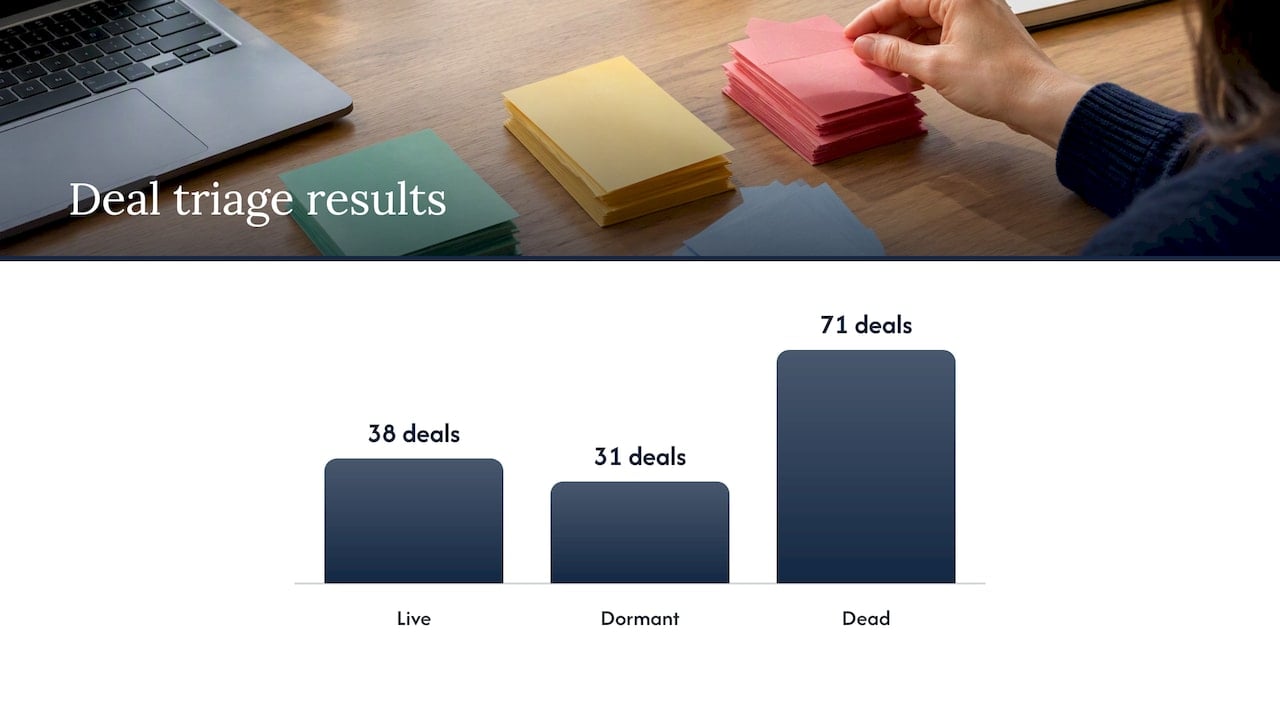
Step 3: Triage into three groups.
- Live: buyer activity within your normal cycle and an agreed next step. Fix the fields and keep them.
- Dormant: no buyer activity beyond your age limit, but a genuine reason to come back (a budget cycle, a project on hold). Move to a nurture stage or a “revisit” status with a dated reminder, and take them out of the forecast.
- Dead: no response, no reason, no date. Close as lost.
Step 4: Close with a reason, never a blank. Use a short list: no budget, no decision, lost to competitor, went with in-house, bad fit, no response. Add a free-text line with what the buyer last said. This is the information you were afraid of losing, and now it is searchable.
Step 5: Keep the notes, contacts and history. Closing a deal does not delete the contact. If you want a rule of thumb: the opportunity leaves the pipeline, the relationship stays in the CRM.
Step 6: Re-baseline and tell people. Your pipeline total will drop, often sharply. Warn the board or leadership beforehand, so a smaller, truer number is read as progress. If you want the next step after that, our pipeline optimisation guide covers how to rebuild coverage with right-fit prospects.
A short worked example. A services firm with eleven reps found 140 open deals worth £2.1 million on paper. After triage, 38 were live, 31 dormant and 71 dead. The live pipeline was worth far less than £2.1 million, but the forecast based on it became something the managing director could plan hiring against. (This is an illustrative example of the method, not a client result.)
Making hygiene stick: training and coaching
Most pipeline clean-ups last about six weeks. Then reps drift back to old habits, because nothing in their day rewards accurate records. The fix is a combination of simple systems and manager behaviour.
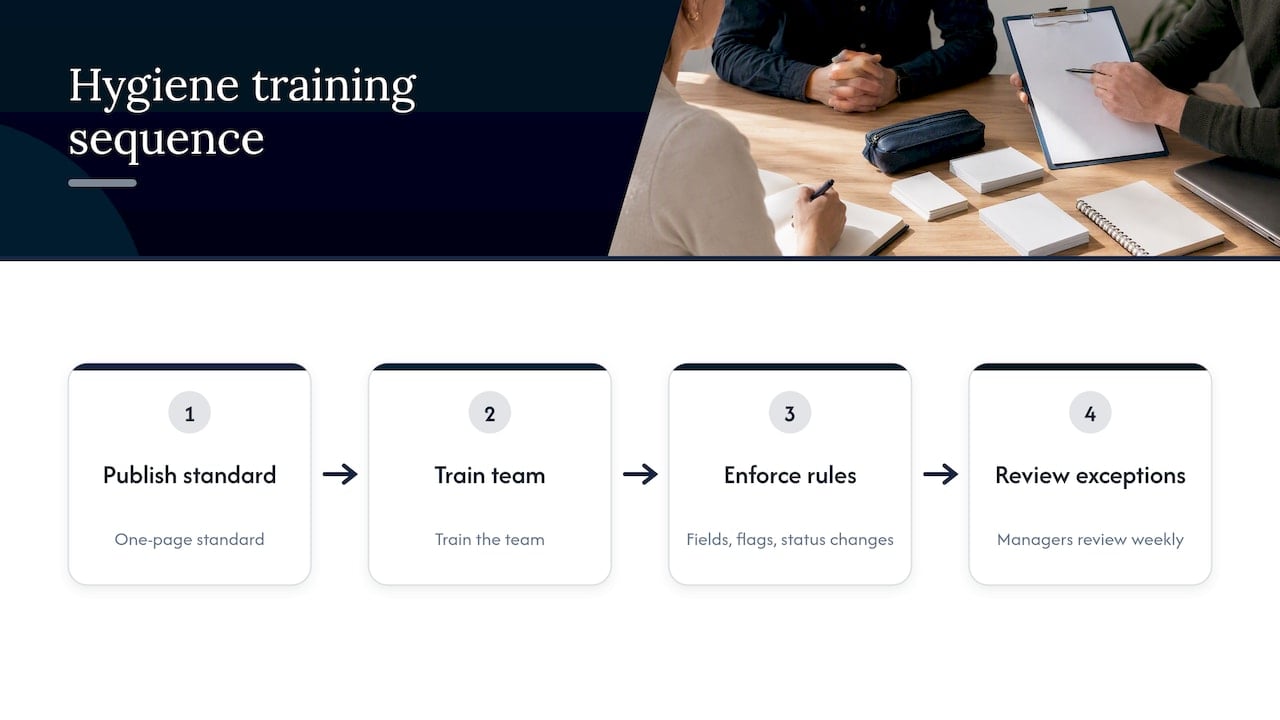
The ORM guidance sets out a workable sequence: publish a one-page standard, train the team on it, enforce it with required fields, automated flags and status changes, and have managers review exceptions weekly. I would add two things from experience.
Make the manager the owner of the standard. When hygiene is “an admin thing” delegated to sales ops, reps treat it as admin. When the sales manager opens every one-to-one with the pipeline and asks evidence questions, it becomes part of selling. Our piece on sales management coaching and the guide to sales team coaching techniques show how to build that into your weekly rhythm.
Teach the why, not just the rules. Reps keep deals alive because disqualifying feels like failure. Training on qualification and objection handling gives them the confidence to say “this isn’t going anywhere” early, and to ask for a decision date without fear. A rep who is comfortable having a direct conversation with a buyer has far less need to keep a ghost deal on the board.
If a particular rep keeps producing exceptions, a structured plan works better than repeated reminders. Our 30-60-90 plan for underperforming reps is a good starting point.
Our perspective
We see pipeline hygiene as a selling-skills issue that happens to show up in a CRM. In our work with UK sales teams and founder-led businesses, a messy pipeline is rarely a software problem. It is the visible result of three behaviours: loose qualification, weak next-step conversations and managers who inspect numbers rather than evidence.
That is why we combine one-to-one coaching with consultancy and team training. The consultancy side fixes the system: stages, exit criteria, the one-page standard, the review cadence. The coaching side fixes the habits, so reps qualify harder at the start, ask buyers for commitments, and close out what is dead without taking it personally.
Our view is that a smaller, honest pipeline beats a big, comforting one every time. A team that knows its true coverage can set realistic targets and hit them each quarter. A team working from an inflated number is always surprised at the end of the quarter, and nobody enjoys that conversation.
— Jerry
Where we can help
If your pipeline report no longer matches reality, the quickest route is usually a short diagnostic of your stages, rules and review rhythm, followed by coaching so the new habits hold. Our team-based bespoke coaching and consultancy engagements are priced at £4,500 to £8,500 one-off, and our sales acceleration track for solo service businesses and consultants runs from £2,995 to £5,995 one-off. You can see how they work on our sales training cost page.

If you would rather start with a sales leader in your corner part-time, our fractional sales director service can own the review cadence and the forecast while you build the team.
FAQ
What is the difference between pipeline hygiene and CRM hygiene?
CRM hygiene covers the wider data estate: duplicates, formatting, missing fields and contact completeness. Pipeline hygiene is narrower and more commercial: whether each open deal has the right stage, a realistic close date, a current amount, an agreed next step and an owner. You need both, but pipeline hygiene is what your forecast depends on.
How often should I review my pipeline?
Weekly is the standard I recommend for teams, with reps updating their own deals before the meeting. A monthly clean-up alone lets bad data pile up for weeks and still shape forecasts. Founders working alone can do the same in 30 minutes every Friday.
What does a healthy sales pipeline look like?
It has enough right-fit opportunities at every stage, predictable movement and conversion between stages, records you can trust, and more than one contact on important deals. A thin top with a fat, motionless middle is the classic sign of bloat.
Should I delete old deals when cleaning up my pipeline?
No. Close them as lost with a consistent reason and a note on what the buyer last said, or move genuinely dormant ones to a revisit status with a dated reminder. That removes them from the forecast while keeping the history and the contact.
Can sales training help with pipeline hygiene?
Yes, because most hygiene failures start with behaviour: loose qualification, avoiding disqualification and vague next steps. Training on qualification and buyer conversations, plus manager coaching on weekly reviews, changes those habits in a way that a CRM setting cannot.
Sources
- What Is Pipeline Hygiene? | AskElephant
- CRM Data Quality Tools and Pipeline Hygiene Tools, Compared
- CRM Data Hygiene: 5 Steps to Stop Recurring Cleanups
- Pipeline Hygiene: Rules, Weekly Checklist and Metrics
- How to Build a Consistent Sales Pipeline for Your UK Business
- Sales Pipeline Health: How to Measure It and Rescue At-Risk Pipelines
- 5 Questions to Assess Sales Pipeline Health
- How to Set Pipeline Hygiene Standards | ORM
- Pipeline Generation Strategy: From Unpredictable to Forecastable
- Pipeline Hygiene | Chief
- What is a Sales Pipeline? | Salesforce
- Sales Pipeline and Forecasting Playbook | INSIDEA