
TL;DR:
- Optimizing the B2B sales pipeline improves conversion rates and revenue by fixing leaks rather than increasing leads.
- It involves defining buyer-centric stages with clear exit criteria, maintaining data hygiene, and regularly reviewing deal progress.
- Sustained success depends on team discipline, cultural discipline, and balancing human judgment with AI tools.
B2B sales pipeline optimisation is the practice of systematically refining your sales process using data and defined stages to increase win rates, shorten sales cycles, and grow revenue. Average B2B teams convert only 20–25% of qualified opportunities, yet organisations with formal, buyer-centric processes achieve 18% higher revenue growth. That gap is not a talent problem. It is a process problem, and it is entirely fixable. This guide gives you a practical framework for diagnosing leaks, fixing the right things in the right order, and building a pipeline that performs consistently in 2026.
What does B2B sales pipeline optimisation actually involve?
Pipeline optimisation is not about adding more leads to the top of your funnel. It is about making every stage of your existing process work harder. The industry term you will encounter most often is “pipeline management,” which covers the architecture, metrics, and review cadences that keep deals moving. Optimisation goes one step further: it applies data to identify where value is leaking and then fixes those specific points.
The core components of a well-built pipeline are straightforward. You need clearly defined stages, objective exit criteria for each stage, and a coverage ratio that gives you a realistic forecast. Get those three things right and everything else becomes measurable.
How many pipeline stages should you have?
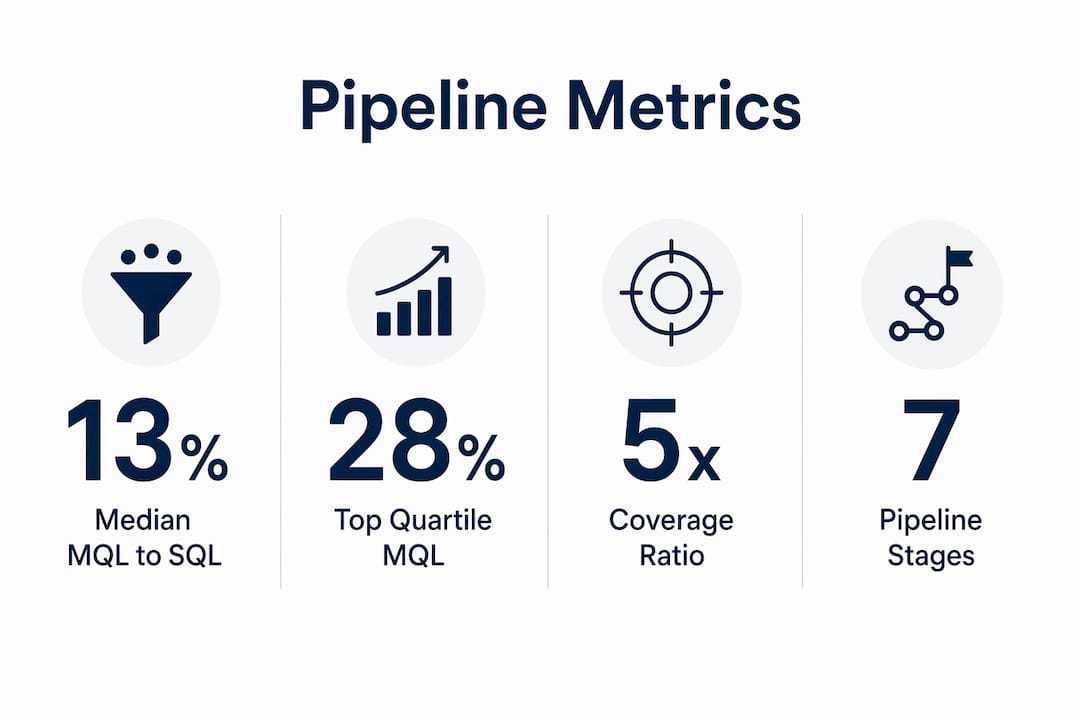
An optimised pipeline has 5–7 stages, aligned to buyer actions rather than internal seller tasks. That distinction matters enormously. A stage called “Proposal Sent” tells you what the seller did. A stage called “Proposal Reviewed by Economic Buyer” tells you where the buyer is. The second version gives you real insight into deal progress.
Each stage must have hard exit criteria. “Feels good” is not an exit criterion. “Economic buyer has confirmed budget and agreed to a decision date” is. Without objective criteria, your pipeline becomes a collection of wishful thinking rather than a reliable forecast.
Pipeline coverage ratio and velocity
A healthy pipeline carries 3x–5x coverage relative to your revenue target, adjusted for your win rate and expected slippage. If your target is £500,000 and your win rate is 25%, you need at least £2,000,000 in qualified pipeline. Pipeline velocity, which measures how quickly deals move through stages, is equally important. Improving velocity by reducing your sales cycle by 15–25% has a direct and immediate impact on quarterly revenue.

Pipeline hygiene rounds out the foundation. Remove stalled deals after a defined time-in-stage limit. Keep contact data current. Log discovery notes consistently. These are not administrative tasks. They are the inputs that make every other metric trustworthy.
| Metric | Healthy benchmark | What it tells you |
|---|---|---|
| Pipeline coverage ratio | 3x–5x revenue target | Whether you have enough qualified deals to hit target |
| Win rate on qualified opps | 20–25% | Baseline conversion efficiency |
| Sales cycle length | Varies by segment | Speed of revenue generation |
| Stage conversion rate | Benchmarked per stage | Where deals are leaking |
How do you identify the leak points in your B2B sales funnel?
Most sales leaders assume they have a volume problem when they actually have a conversion problem. Mapping conversion rates at every stage transition takes roughly 30 minutes and immediately shows you where value is escaping. You do not need a complex analytics platform to start. A spreadsheet with deal counts at each stage transition is enough to reveal the pattern.
The three heaviest leak points in most B2B funnels are MQL to SQL conversion, meeting to proposal, and proposal to negotiation. Each has a different root cause and a different fix.
MQL to SQL: the most expensive leak
Median MQL to SQL conversion sits at 13%, while top-quartile teams achieve 28%. That 15-point gap represents a massive difference in revenue output from the same marketing spend. The fix is almost always tighter qualification, not more leads. Applying a structured framework such as MEDDIC (Metrics, Economic Buyer, Decision Criteria, Decision Process, Identify Pain, Champion) at the SQL gate removes the guesswork and stops your team from chasing deals that were never going to close.
Meeting to proposal and proposal to negotiation
Deals stall between meeting and proposal when discovery is shallow. Your rep leaves the call without understanding the economic buyer’s real priority, so the proposal lands without resonance. Adding a structured discovery notes field to your CRM lifts SQL conversions by 8–12 percentage points within a single quarter. That is one of the highest-ROI changes you can make.
Proposal to negotiation stalls happen when you have a single contact inside the account. Multi-threading deals by building relationships with two or more stakeholders doubles close rates. Equipping your internal champion with a business case they can present upwards removes the stall risk almost entirely.
| Stage transition | Median conversion | Top-quartile conversion |
|---|---|---|
| MQL to SQL | 13% | 28% |
| Meeting to proposal | Varies | Significantly higher with structured discovery |
| Proposal to close | Varies | Significantly higher with multi-threading |
Pro Tip: Run your 30-minute conversion mapping exercise at the start of each quarter. The stage with the biggest drop-off is your highest-priority fix, not the stage that feels most uncomfortable to address.
Step-by-step tactics for improving your sales pipeline
Execution follows a clear sequence. Skipping the foundation to implement tools first is the most common and costly mistake sales teams make. Tools amplify what already exists. If your process is broken, a CRM or AI tool will simply automate the broken process faster.
Foundation first: weeks 1–4
- Sharpen your Ideal Customer Profile (ICP). Define the firmographic, technographic, and behavioural attributes of your best-fit customers. Remove any lead source or segment that consistently underperforms on win rate.
- Clean and enrich your CRM data. Audit contact records, remove duplicates, and fill gaps in company size, industry, and decision-maker role. Bad data produces bad forecasts.
- Tighten your qualification gates. Implement MEDDIC or a comparable framework at the SQL stage. Train your team to disqualify early and without guilt.
- Rewrite your stage definitions. Replace seller-task labels with buyer-action labels. Add hard exit criteria to every stage.
Process improvements: weeks 5–12
- Introduce a structured discovery call framework. Cover pain, priority, budget, timeline, and decision process on every first call.
- Build multi-threading into your deal strategy from the first meeting. Identify the economic buyer, the champion, and the technical evaluator within the first two weeks of a deal.
- Align sales and marketing on shared pipeline definitions. Teams with aligned definitions close 38% more deals and generate over 200% more revenue from marketing activity.
- Establish a review cadence for your pipeline: weekly deal inspections for active opportunities, monthly health metrics reviews, and quarterly strategy recalibration sessions.
Tooling and AI augmentation: weeks 12 onwards
Advanced pipeline management in 2026 combines MEDDIC qualification gates, AI conversation intelligence, and weighted coverage ratios. AI tools that flag deal risk signals, identify missing stakeholders, or surface coaching moments are genuinely useful. They work best when your foundation is solid. Invest in tooling only after your stages, criteria, and qualification process are working consistently.
Pro Tip: Before purchasing any sales technology, run a 90-day manual version of the process it promises to automate. If the manual version does not improve results, the tool will not either.
What are the most common pipeline optimisation mistakes?
The mistakes that undermine pipeline programmes are predictable. Knowing them in advance saves you months of wasted effort.
- Chasing volume over conversion. Adding more leads to a leaking pipeline increases cost without improving revenue. Fix conversion rates first, then scale volume.
- Advancing deals without meeting exit criteria. Reps move deals forward to avoid difficult conversations. This inflates your pipeline and destroys forecast accuracy.
- Ignoring data hygiene. A pipeline full of stale deals is worse than a small, clean one. Stale data produces false confidence and missed targets.
- Skipping the review cadence. Weekly deal inspections are not optional. They are the mechanism that catches problems before they become quarter-end crises.
“Without hard stage time limits, deals linger in the pipeline long after they have effectively died. Time-in-stage caps trigger management reviews and force honest conversations about deal health. That discipline is what separates predictable revenue from perpetual forecasting anxiety.”
The “happy ears” problem deserves specific attention. This is where a rep hears positive signals from a prospect and interprets them as buying intent, even when no concrete next step has been agreed. Setting a maximum time-in-stage for every deal, typically 14–21 days depending on your average sales cycle, forces a management conversation before the deal quietly dies. You can find a detailed breakdown of pipeline stage design that addresses this directly.
Key takeaways
Effective B2B sales pipeline optimisation requires fixing conversion rates at specific leak points before adding volume or implementing new tools.
| Point | Details |
|---|---|
| Fix conversion before volume | Tighten qualification and discovery quality before scaling lead generation. |
| Use 5–7 buyer-centric stages | Define stages by buyer actions with hard exit criteria, not seller tasks. |
| Target the MQL-to-SQL gap | Closing the gap between 13% median and 28% top-quartile conversion is the highest-ROI fix. |
| Align sales and marketing | Shared pipeline definitions increase closed deals by 38% and amplify marketing returns. |
| Build review cadences | Weekly, monthly, and quarterly reviews prevent forecast decay and catch stalled deals early. |
My take on what actually makes pipeline optimisation stick
I have worked with enough sales teams to know that pipeline optimisation programmes fail for one reason above all others: they are treated as a project rather than a discipline. A team runs a pipeline audit, rewrites their stage definitions, and sees a short-term improvement. Then the old habits creep back in, the review cadences get skipped when things get busy, and six months later the pipeline looks exactly as it did before.
The teams that sustain improvement are the ones that treat pipeline health as a cultural norm, not a quarterly initiative. That means managers who ask hard questions in every deal review, not just at quarter-end. It means reps who disqualify without embarrassment because they know a clean pipeline is more valuable than a full one. And it means leadership that measures conversion rates and velocity alongside revenue, so the leading indicators are visible before the lagging ones become a problem.
The balance between human judgement and AI-powered tools is genuinely important here. AI can surface deal risk signals and flag missing stakeholders faster than any manager. But it cannot replace the quality of a well-trained rep who asks the right discovery questions and builds genuine trust with a buying committee. The B2B sales process is still fundamentally human. Technology makes good execution more visible. It does not substitute for it.
If you are serious about sustainable pipeline performance, start with the discipline. The tools will follow naturally once the foundation is worth building on.
— Jerry
How Aheadofsales supports your pipeline performance
Aheadofsales works with businesses of 50–1,000 staff to build the kind of pipeline discipline that produces consistent quarterly results. The work goes beyond theory.
The sales training programmes cover pipeline management, qualification frameworks, and structured discovery in practical, coached sessions that change rep behaviour rather than just awareness. For businesses that need a deeper intervention, the sales consultancy service includes a full pipeline audit, stage redesign, and a 90-day implementation plan. Packages start from £4,500, and every engagement is built around your specific pipeline architecture and growth targets. If you want your team hitting target every quarter, this is where to start.
FAQ
What is B2B sales pipeline optimisation?
B2B sales pipeline optimisation is the process of using data and defined stage criteria to improve conversion rates, shorten sales cycles, and increase revenue predictability across every stage of the sales process.
How many stages should a B2B sales pipeline have?
An optimised B2B pipeline has 5–7 stages, each defined by buyer actions rather than seller tasks, with objective exit criteria at every transition.
What is a healthy pipeline coverage ratio?
A healthy coverage ratio is 3x–5x your revenue target, calculated using your win rate adjusted for expected slippage, to give an accurate forecast.
Where do most B2B pipelines lose the most value?
The MQL to SQL transition is typically the highest-loss stage, with median conversion at 13% versus 28% for top-quartile teams. Tighter qualification and structured discovery are the primary fixes.
How often should you review your sales pipeline?
Pipeline reviews should follow three cadences: weekly deal inspections for active opportunities, monthly health metrics reviews, and quarterly strategy recalibrations to keep the process aligned with market conditions.