
Sales training improves how your people sell. Sales consultancy improves the system they sell within: who you target, how your pipeline works, how your offer is priced and how performance is measured. If the system works but your team executes badly, buy training. If the system is broken, buy consultancy first. If both are weak, which is more common than most owners admit, you need the two working together.
I have sat on both sides of this conversation many times, and the mistake I see most often is a business paying for a workshop when what it really needed was a hard look at its pipeline. This guide will help you avoid that.
TL;DR
- Training builds skills (discovery, objection handling, closing) in people who already have a working process to follow.
- Consultancy diagnoses and redesigns the system: target customer, pipeline, messaging, pricing, targets and reporting.
- Training on top of a broken system wastes budget, so diagnose before you buy.
- A one-off workshop rarely sticks. Spaced learning, coaching and follow-up are what change results.
- Our packages blend 1:1 coaching, training and consultancy, from £2,995 for solo service businesses and from £4,500 for teams.
Table of Contents
- What each one actually is
- The quick comparison
- When consultancy should come first
- When training is the right answer
- Where a fractional sales director fits
- How to decide: five questions
- Why the best results come from combining them
- What it costs with us
- Our perspective: why we do not make you choose
- Choosing by business type
- Ready to work out which you need?
- FAQ
- Sources
What each one actually is
The two terms get used loosely, and some providers sell both under one banner, which adds to the confusion. Here is the plain version.
Sales training is structured learning. Your salespeople (or you, if you are a solo operator) learn specific skills and practise them: running a discovery call, handling price objections, qualifying properly, following up without sounding desperate. It can be delivered in person, online, as a one-off day or as a programme over several months.
Sales consultancy brings in outside expertise to solve a specific, time-bound problem. A consultant looks at your numbers, listens to calls, interviews your best performers and then recommends (and often helps build) changes to how you sell. The output is usually a diagnosis, a plan and a redesigned process rather than a changed set of habits.
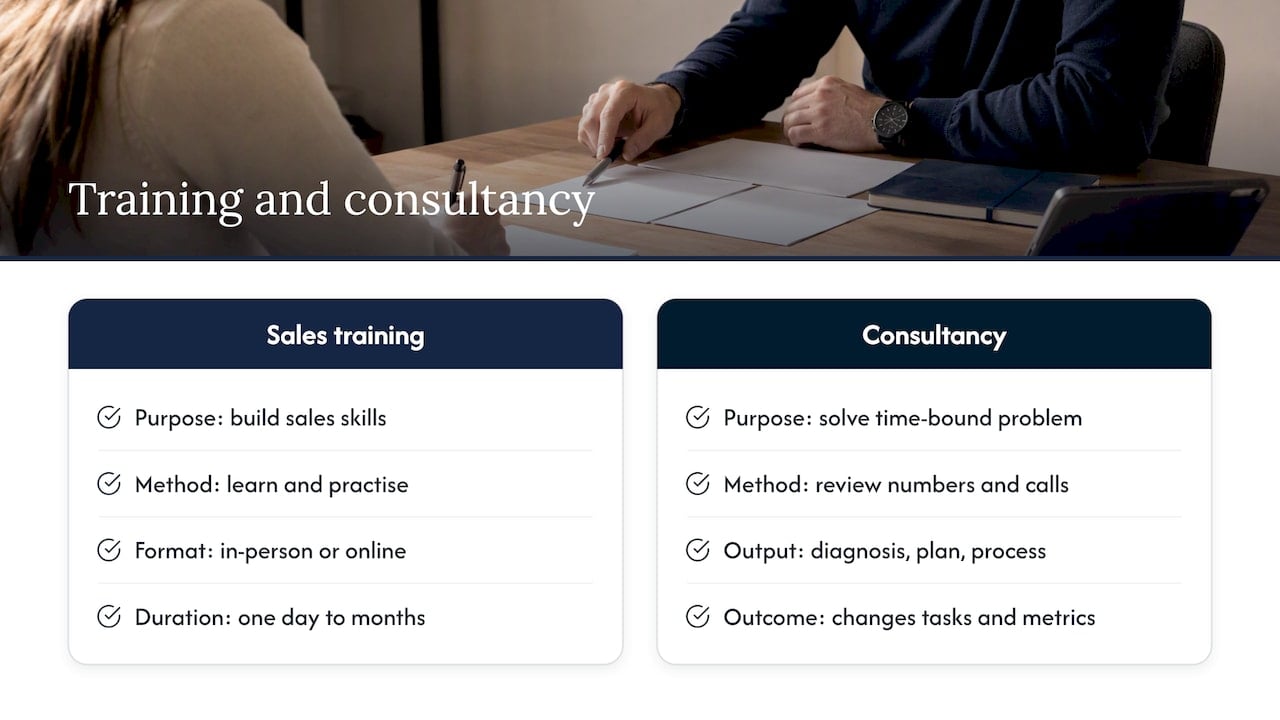
The cleanest way I can put it: training changes what people can do, consultancy changes what they are asked to do and how it is measured.
The quick comparison
| Sales training | Sales consultancy | |
|---|---|---|
| Main question | Can our people sell well? | Is our way of selling designed well? |
| Typical output | Skills, confidence, consistent behaviour | Diagnosis, strategy, process, playbook |
| Best when | The process works but execution is patchy | Pipeline is thin, targeting is unclear or results are unpredictable |
| Who is involved | Reps, managers, founders | Founders, sales leaders, sometimes marketing and operations |
| Risk if misused | Skills learned but nowhere to apply them | A beautiful plan nobody has the skills to run |
| Time frame | Weeks to months, with reinforcement | Usually project-based, then handover |
When consultancy should come first
One independent guide puts it well: consulting is needed when the growth foundation is broken, for example an unclear target customer or a pipeline that does not hold together. Training is the right lever when you have a functioning system and need people to run it better.
Here are the signs I would look for before spending a penny on training:
- You cannot say who your best-fit customer is. Different reps chase different people and nobody can explain why you win or lose.
- Your pipeline stages are vague. Deals sit at “proposal sent” for months, and forecasts are guesswork.
- Pricing and packaging keep being renegotiated. Discounting is the default closing technique.
- Marketing, sales and delivery are not aligned. Leads arrive that sales cannot convert, or sales promises what operations cannot deliver. Continuous alignment across functions matters here, and customer experience across channels is part of the same picture.
- You do not know your market well enough. Before redesigning your targeting, it helps to look at market data and benchmarks for your sector, size and region, so that decisions rest on evidence rather than instinct.
If three or more of those sound familiar, no amount of role-play will fix the problem. You need someone to look at the machine, not the operators.
Sales consultancy is also not a one-off event when done properly. Industry commentators stress that it needs ongoing measurement and alignment between marketing, operations and sales, rather than isolated sessions. You can read how we approach this on our sales consultancy page, or see the practical process guide we have written.
When training is the right answer
Training earns its money when the basics are in place. You know your customer, you have a pipeline with defined stages, and your best salesperson closes at a rate that proves the offer works. The trouble is that everyone else is not doing what that person does.
Typical symptoms:
- Reps talk about features and price before they have uncovered a problem.
- Objections such as “we need to think about it” end the conversation.
- Follow-up is inconsistent, so warm leads cool.
- New starters take far too long to reach target.
- Managers coach rarely, and only on deals that are already lost.
What the evidence says about content is useful. A review of the research from one UK sales-performance consultancy notes that training built only around product features tends to be less effective, while training that addresses customer needs, sales techniques and CRM use leads to better performance and stronger customer orientation.
The same review points to delivery. Training spread over time consistently outperforms single-tranche delivery on implementation, self-assessed competence and business measures such as new customer acquisition. That matches what I see in practice: a one-day event feels energising on Friday and has largely faded by the following Thursday.
A worked example of bespoke training paying back
A published 2018 study of a global training initiative at KONE is worth knowing about. The programme ran as two modules six months apart, with online learning built in. Among 72 UK participants, £11,463,378 in new orders was attributed directly to skills and processes learned, with a further £5,044,942 in the pipeline nine months after training. That is one company’s self-reported result, not a promise for yours, but the design lessons travel well: tailor the content, space it out and tie it to real deals.
If you want to see how we build training around your own customers and deals, start with our guide to bespoke sales training or our sales training services.
Where a fractional sales director fits
There is a third option that owners often lump in with consultancy. A consultant typically gives advice, audits or training on a project basis and then leaves. A fractional sales director embeds in the business as a part-time member of the leadership team and owns the function and the revenue outcomes.
In short:
- Consultant: tells you what to change, helps you design it, hands over.
- Trainer: teaches your people how to do it.
- Fractional sales director: runs it with you, week in and week out, until you are ready to hire a full-time leader.
If you are a founder who is still the main seller and have no sales leader, a fractional director often solves the problem that neither training nor a short consultancy project can, because someone has to own the number. We offer this through our Fractional Sales Director service.
How to decide: five questions
Work through these honestly, ideally with your sales lead and someone from outside the sales team.
- Do we know why we win and lose deals? If not, start with diagnosis.
- Is our top performer’s approach written down and repeatable? If not, consultancy builds the playbook, then training spreads it.
- Is the gap in knowledge, skill or motivation? Knowledge and skill respond to training. Motivation often points to targets, incentives or management, which is consultancy territory.
- Who owns performance day to day? If nobody, think fractional leadership.
- What will reinforce this in 90 days? If the answer is “nothing”, whatever you buy will fade.
One independent guide notes that the decision is not always either-or, and I agree. Most of the businesses we meet have a weakness in both the system and the execution.
Why the best results come from combining them
A sensible sequence for many teams looks like this:
- Diagnose. Review pipeline data, listen to real calls, speak with top performers and lost prospects.
- Fix the foundations. Clarify the target customer, qualification criteria, pipeline stages, pricing and messaging.
- Train against the new system. Teach the skills the redesigned process needs, using your own deals and objections.
- Coach over time. Reinforce through 1:1 and team coaching so behaviour changes stick.
- Measure and adjust. Track conversion, cycle length and quarterly target attainment.
Steps one and two are consultancy, three is training and four is coaching. Skipping any of them is where the budget leaks. Our sales training process guide walks through how this looks in practice, and our sales team management workflow piece covers the day-to-day rhythm that keeps the gains.
What it costs with us
I believe in being open about money, because it saves everyone’s time. These are our published prices:
- Team-based bespoke coaching and consultancy engagements: £4,500 to £8,500, one-off. These suit businesses of roughly 50 to 1,000 staff with a growth mindset.
- Sales acceleration track for solo service businesses and consultants: £2,995 to £5,995, one-off.
- The Sage Collective: £990 per month.
Other programmes, including Sales Training Cohorts, Fundamental Sales Skills and the Fractional Sales Director service, are scoped individually, so there is no published price. Where you land in each range depends on team size, how much diagnosis is needed and how much coaching you want. Our pricing page explains what sits behind each range. If budget is a concern, our guide to sales training grants in the UK is worth a read.
Our perspective: why we do not make you choose
We started Ahead of Sales because we kept watching businesses buy the wrong thing. A founder with a leaky pipeline books a motivational training day. A sales director with a great process but weak reps hires a consultant who produces a 40-page deck. Both walk away poorer and no closer to target.
So we combine bespoke 1:1 coaching with traditional training and consultancy in one engagement. We look first at what is actually holding revenue back, whether that is the system, the skills or the mindset, and then build the programme around it. Our aim is for clients to grow sales by at least 50% a year and for the team to hit target every quarter. We say it plainly because it keeps us accountable.
We are not the right fit for everyone. We work best with owners and sales leaders who have budget, who are willing to change how they sell and who want a partner rather than a one-off event. For solo consultants, coaches and service founders, we run a separate acceleration track, because a team of 200 and a team of one have very different problems.
— Jerry
Choosing by business type
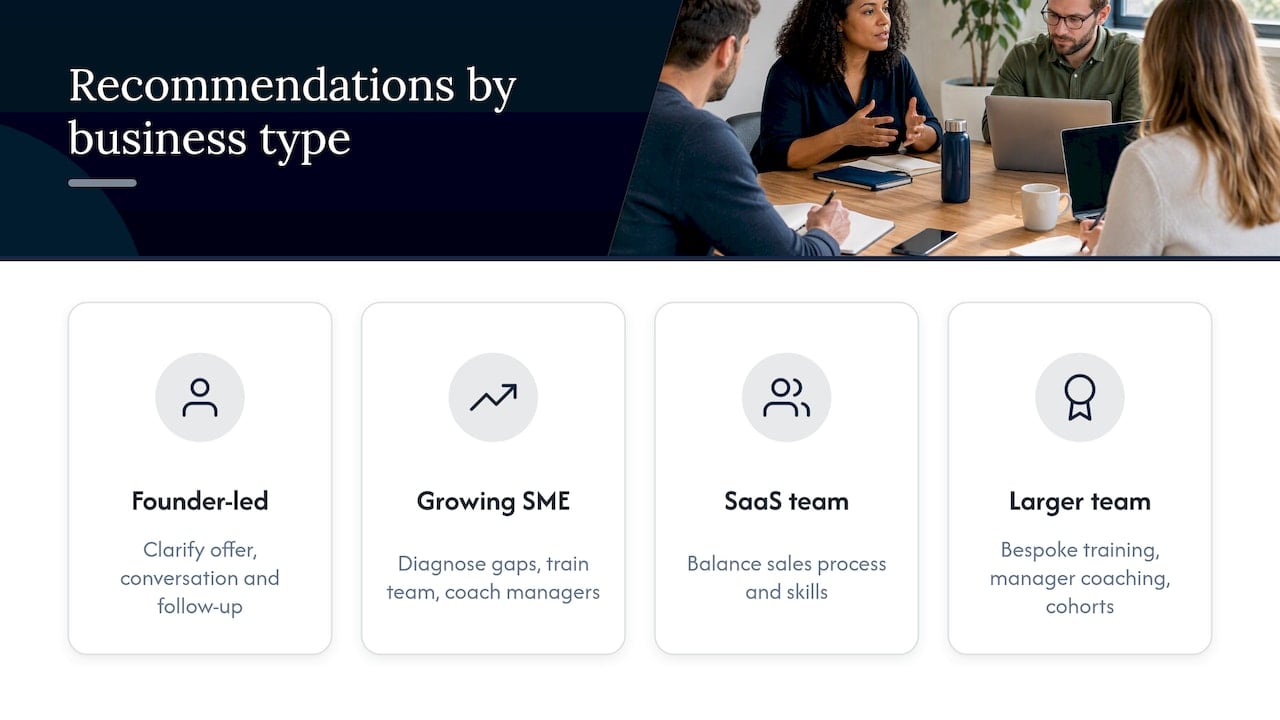
Founder-led service business or solo consultant. You are the sales team, so training and consultancy overlap. Focus on a clear offer, a repeatable conversation and consistent follow-up. Our solo sales accelerator is built for this.
Growing SME with a small sales team. Start with a short diagnostic, fix the biggest process gap, then train around it. Add coaching for managers so the work does not depend on you.
SaaS company with a sales team. Long cycles and multiple stakeholders make process and skills equally important. See our sales training for SaaS page.
Larger team with a sales leader. You probably have a system. Bespoke training, manager coaching and cohort-based learning will usually give the best return.
Ready to work out which you need?
If you are unsure where your own gap sits, talk to us. We will look at your pipeline, your team and your targets, and tell you honestly whether you need training, consultancy, fractional leadership or a blend. You can see how our engagements are structured on our packages page or explore Sales Training Cohorts if you would like your team to learn alongside peers.
FAQ
Is sales consultancy more expensive than sales training?
Not necessarily. Both vary widely with scope, team size and how much follow-up is included. A short diagnostic can cost less than a multi-month training programme, while a full redesign costs more. Judge price against the problem you are solving, not the label.
Can I do training and consultancy at the same time?
Yes, and often it is the most efficient route. Consultancy clarifies the process while training builds the skills to run it. The risk is training people on a process you are about to change, so sequence the work or run it in tight step with each other.
How long before I see results?
That depends on your sales cycle. Fast-moving service sales can show changes in conversion within weeks, while longer B2B cycles take a few quarters to show in closed revenue. Spaced learning and regular coaching tend to produce more lasting change than a single event.
What is the difference between a sales consultant and a fractional sales director?
A consultant typically advises, audits or trains on a project basis and then leaves. A fractional sales director works part time inside your leadership team and takes ownership of the sales function and its revenue results.
Sources
- Sales Strategy Consulting vs Sales Training Guide
- The B2B Sales Consulting Services Guide
- Fractional Sales Director UK: Grow Revenue
- How Can We Deliver Impact Through Sales Training?
- Building a global training initiative fit for KONE’s diverse workforce
- Omnichannel marketing: unifying customer experience for growth
- Market data due diligence checklist