
Sales results often stall when gaps in skills or process go unrecognised. For Sales Leaders across United Kingdom mid-sized firms, finding and fixing weaknesses in your team’s approach is the first step towards ambitious growth. A structured gap analysis, drawing on both internal metrics and external benchmarks, gives you the strategic visibility needed to target new revenue, sharpen performance, and secure your path to consistent results.
Table of Contents
- Step 1: Assess Organisational Sales Strengths And Gaps
- Step 2: Design A Bespoke Sales Training Roadmap
- Step 3: Implement Targeted Coaching And Training Sessions
- Step 4: Monitor Progress And Optimise Outcomes
Quick Summary
| Key Point | Explanation |
|---|---|
| 1. Assess Internal and External Sales Metrics | Understand your sales strengths and gaps by comparing internal performance indicators with external industry benchmarks. This will help identify key areas for improvement. |
| 2. Tailor Training to Specific Gaps | Develop a bespoke sales training roadmap that prioritises crucial skill deficiencies and aligns with your organisational culture and business objectives. |
| 3. Implement Focused Coaching Sessions | Conduct targeted coaching and training sessions that address specific performance challenges and connect training to real business outcomes for lasting impact. |
| 4. Monitor and Adjust Training Effectiveness | Regularly track performance metrics to evaluate the effectiveness of your training programme and make necessary adjustments to ensure it meets your goals. |
| 5. Involve Team Members in Training Design | Encourage input from team members when creating the training roadmap to foster ownership and ensure the programme is relevant and practical. |
Step 1: Assess organisational sales strengths and gaps
You’re about to uncover where your sales team truly stands and where the real opportunities lie. This assessment forms the foundation of any effective sales training process because you cannot improve what you don’t measure.
Start by defining what success looks like for your organisation. Sales metrics matter, but they tell different stories depending on your context. Are you tracking revenue targets, conversion rates, customer retention, deal velocity, or market share? Your definition shapes everything that follows.
Next, gather your data across multiple dimensions. You’ll need internal performance indicators such as individual rep performance, team productivity metrics, sales cycle length, and win-loss ratios. Then compare these against external benchmarks—industry standards for your sector, competitor performance where visible, and market expectations. This dual perspective reveals whether gaps stem from underperformance or shifting market conditions.
The following table compares internal and external sales assessment metrics to help clarify where different types of gaps may originate:
| Metric Type | Focus Area | Example Data Sources | Insight Provided |
|---|---|---|---|
| Internal Metrics | Individual and team performance | CRM reports, rep reviews | Highlights skill gaps |
| External Benchmarks | Industry and market standards | Competitor analysis, sector reports | Reveals external performance pressures |
Here’s what to measure when conducting your assessment:
- Revenue and pipeline data from your CRM system
- Individual rep performance broken down by territory, product, or client type
- Sales process metrics such as conversion rates at each stage
- Customer acquisition cost compared to lifetime value
- Skill-level assessment of your team across key competencies
- Win-loss analysis to understand what’s working and what isn’t
Conducting a gap analysis by measuring the difference between your current operations and desired performance helps you identify both performance gaps—where your goals simply aren’t being met—and opportunity gaps that reveal potential areas for growth or market expansion. This structured approach provides the strategic visibility you need to make confident decisions about where to focus your training efforts.
As you analyse these gaps, document them clearly. Create a simple matrix showing each gap, its current impact on revenue or performance, and its potential impact if addressed. This becomes your roadmap for where training will deliver the highest return.
Your gap assessment isn’t about finding fault—it’s about finding leverage points where focused training will drive measurable change.
Pro tip: Use your three poorest-performing reps as a case study. Compare their metrics against your top performer, and you’ll immediately spot skill gaps and process gaps that training can fix.
Step 2: Design a bespoke sales training roadmap
Now that you understand your sales strengths and gaps, it’s time to build a tailored training roadmap that addresses your specific needs. A generic training programme won’t cut it—your roadmap must reflect your organisational culture, leadership style, and competitive environment.
Start by prioritising which gaps will deliver the greatest impact on revenue. Not every gap deserves equal attention. Focus on the three to five skill deficiencies or process breakdowns that directly influence your bottom line. If your reps struggle with objection handling, that matters more than perfecting their email signature.
Next, assess the dimensions that shape your sales environment. Consider your leadership approach, organisational culture, existing systems and processes, and your team’s current skill levels. Understanding these critical dimensions of organisational performance helps you design training that actually sticks because it aligns with how your organisation operates.
Your roadmap should outline three key components:
- Timeframe and milestones that break training into manageable phases over three to six months
- Specific skills to address drawn from your gap analysis, whether technical selling techniques, product knowledge, or negotiation skills
- Delivery methods that match your team’s learning style and your business constraints—one-to-one coaching, group workshops, online modules, or blended approaches
- Success metrics that show whether training is actually improving performance, not just completion rates
When designing your roadmap, address skill gaps through targeted learning interventions that combine technical skill development with problem-solving and team collaboration. This comprehensive approach ensures your training tackles both individual capability and how your team works together.

Below is a summary of key sales training delivery methods with their advantages and business considerations:
| Method | Main Advantage | Ideal Use Case |
|---|---|---|
| One-to-one coaching | Personalised skill development | Addressing individual weaknesses |
| Group workshops | Fosters team alignment | Common challenges across team |
| Online modules | Flexible, self-paced learning | Remote or mixed-location teams |
| Blended approach | Combines strengths of all above | Complex, ongoing programmes |
Finally, build flexibility into your roadmap. Market conditions shift, team composition changes, and priorities evolve. Your roadmap is a living document that you’ll review quarterly and adjust as needed.
The best sales training roadmap is one your team helped create—involvement breeds ownership, and ownership drives application.
Pro tip: Assign ownership of specific training modules to your top performers. Having them lead certain sessions builds their leadership skills whilst ensuring the content reflects real-world selling challenges your team actually faces.
Step 3: Implement targeted coaching and training sessions
This is where your plan becomes reality. Your coaching and training sessions must be deliberate, focused, and directly tied to the gaps you identified. Generic workshops won’t move the needle—your sessions need to address specific skill deficiencies and performance challenges your team actually faces.
Start by structuring your sessions around real business outcomes. Rather than teaching selling techniques in isolation, focus sessions on outcomes that matter: improving customer discovery conversations, strengthening lead qualification processes, or mastering negotiation approaches. When training connects to daily work, people remember it and use it.
Design your sessions in two components: group training and one-to-one coaching. Group sessions work well for building shared knowledge, creating accountability, and fostering team dialogue. One-to-one coaching allows you to address individual skill gaps and provide personalised feedback that drives behaviour change. Implementing targeted coaching through deliberate actions ensures your team focuses efforts on high-value outcomes and consistently improves both closing rates and customer satisfaction.
Your session structure should include:
- Real-world scenarios drawn from your team’s actual deals and customer interactions
- Skill practice with feedback where reps rehearse techniques and receive immediate coaching
- Accountability mechanisms such as role plays or post-session check-ins to ensure application
- Measurement of progress against the specific skill gaps you identified earlier
Timing matters enormously. Avoid cramming all training into one week. Instead, spread sessions across your roadmap timeline—perhaps one group session every two weeks combined with weekly one-to-one coaching for five to ten minutes per rep. This cadence builds momentum without overwhelming your team.
During each session, maintain focus. You cannot address twenty skills in one meeting. Choose one or two specific capabilities to develop, allow time for practice, and ensure people leave with a single clear action they’ll take in their next customer conversation.
Training that doesn’t get applied is just entertainment. Build accountability by asking reps to report back on what they tried and what happened.
Pro tip: Record yourself demonstrating the sales technique you’re teaching, then have each rep watch it before their one-to-one coaching session. This preps them mentally and makes your coaching time far more productive than starting from scratch.
Step 4: Monitor progress and optimise outcomes
Your training programme is underway, but the real work happens now. Monitoring progress isn’t about ticking boxes—it’s about proving that training actually changes behaviour and drives revenue. Without measurement, you’re flying blind and missing opportunities to adjust what isn’t working.
Start by tracking the metrics you defined in your gap analysis. If objection handling was a gap, measure how many objections reps are successfully overcoming. If lead qualification was the issue, track the quality of leads entering your pipeline. Connect training directly to business outcomes so you can see what’s genuinely moving the needle.
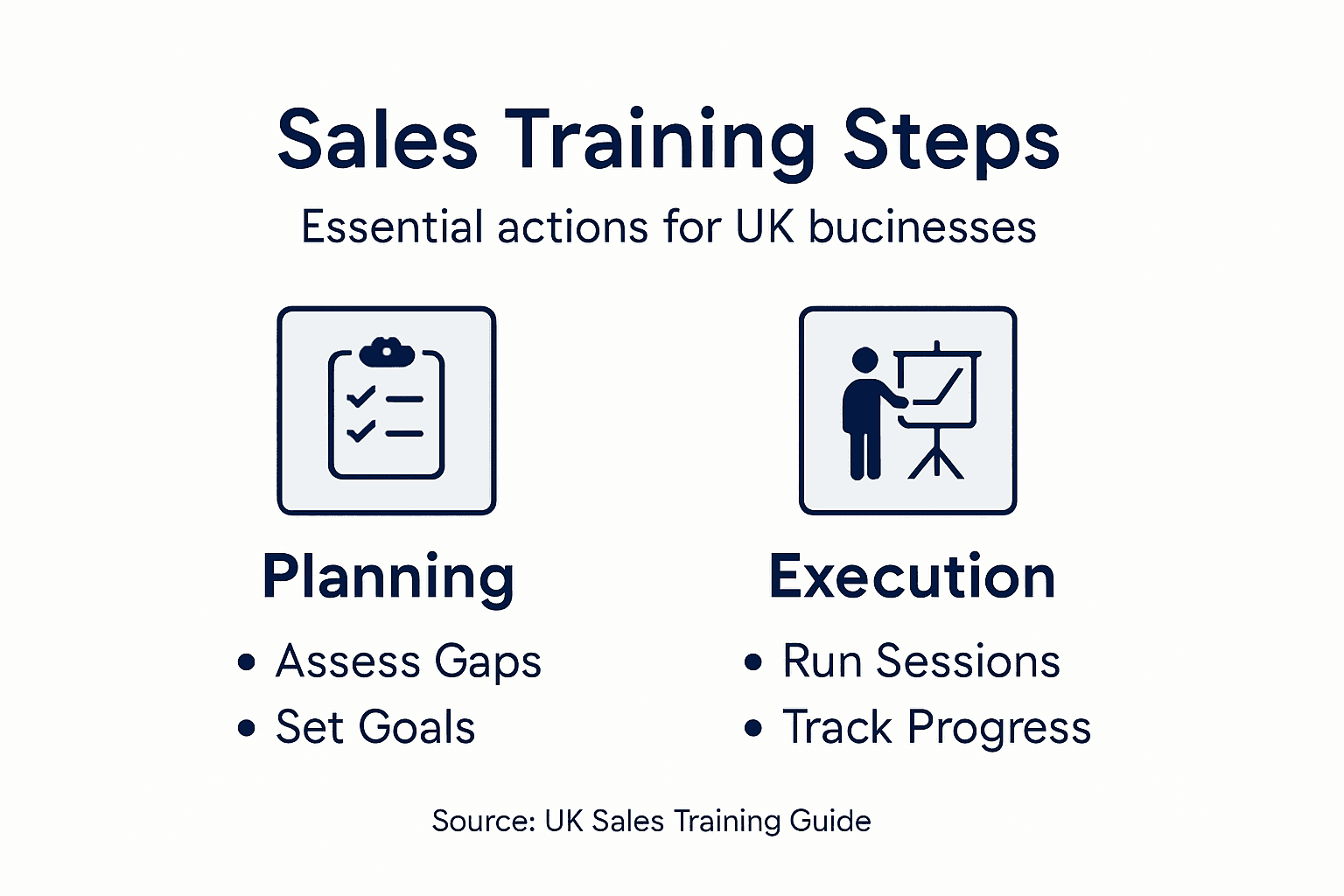
Systematic evaluation of organisational performance using valid metrics allows you to measure sales outcomes and behavioural changes. Continuous data collection and analysis help you optimise training approaches in real time, ensuring alignment with your evolving business objectives.
Your monitoring system should track:
- Individual rep performance against their baseline metrics each week
- Team-wide conversion rates at each stage of your sales process
- Deal size and sales cycle length to spot improvements in negotiation and closing
- Coaching attendance and application to ensure people are actually using what they learn
- Customer feedback on interactions to measure softer skills like communication and relationship building
Review this data every two weeks. Look for patterns rather than obsessing over single data points. One rep closing a large deal is exciting but not a trend. Three reps improving their conversion rate consistently suggests your training is working.
When data shows training isn’t delivering, adjust quickly. Perhaps your coaching approach needs refinement, or you’re addressing the wrong skill gap. Data-driven insights support informed decision-making and promote sustained improvements in sales results. This flexibility separates training programmes that work from those that become expensive exercises in checking completion boxes.
Numbers tell the story. If your training isn’t reflected in improved sales metrics within four to six weeks, something needs to change.
Pro tip: Create a simple one-page dashboard showing each rep’s three key metrics before and after training, updated weekly. Share it openly during team huddles so everyone sees the connection between what they’re learning and what’s improving.
Transform Your Sales Training into Real Growth Outcomes
If you’ve identified gaps in your sales process or skills and want a targeted solution that delivers measurable results then our approach at Ahead of Sales is tailored for you. We understand the challenge of designing bespoke sales training roadmaps that align with your organisational culture and market demands. Our proven mix of personalised 1:1 coaching with group training and consultancy addresses the exact skill deficiencies highlighted in the guide and helps your team confidently hit every quarter’s sales targets.
Take control of your sales performance today by partnering with a company dedicated to driving at least 50% sales growth annually. Visit Ahead of Sales to explore our bespoke training solutions designed for businesses ready to close their skill gaps and maximise every sales opportunity. Don’t wait for incremental gains – act now to accelerate your team’s success with expert coaching and tailored training programmes that work.
Frequently Asked Questions
How can I assess my sales team’s strengths and gaps?
To assess your sales team’s strengths and gaps, start by defining success metrics relevant to your organisation, such as revenue targets and conversion rates. Gather internal performance data and compare it with external benchmarks to identify gaps and opportunities for improvement. Use this assessment to create a clear roadmap for your training strategy.
What should I include in a sales training roadmap?
A comprehensive sales training roadmap should include a prioritised list of skill deficiencies, the timeframe for training, specific skills to address, and the delivery methods best suited for your team. Incorporate clear milestones to measure progress. Aim for a roadmap that evolves, allowing you to adjust based on real-time feedback and changing business conditions.
How do I implement targeted coaching sessions effectively?
To implement targeted coaching sessions effectively, structure them around real business outcomes that your team faces. Focus on skills that directly relate to everyday sales challenges, and ensure each session incorporates real-world scenarios, skill practice, and immediate feedback to reinforce learning. Maintain a regular schedule, spreading sessions over several weeks to allow for practice and application.
What metrics should I track to monitor the success of sales training?
Monitor individual rep performance, team-wide conversion rates, deal sizes, and customer feedback to measure the success of your sales training. Set benchmarks from your initial gap analysis and review these metrics every two weeks to identify trends. Adjust your training approach as necessary to ensure continued improvement in sales results.
How can I ensure my sales training is relevant and impactful?
Ensure your sales training is relevant by involving your team in the creation process and tailoring content to match their specific challenges. Regularly gather input on training effectiveness and adapt your programme to address emerging needs. Set clear expectations for application and accountability to drive impactful results from the training.
Recommended
- How Sales Training Works: Complete Step-by-Step Guide – Ahead of Sales
- Effective Sales Training Methods for Rapid Growth – Ahead of Sales
- 7 Essential Steps for a Winning Sales Training Checklist – Ahead of Sales
- How to Scale Sales Team for Consistent UK Business Growth
- ReliaBotAI™ | Instant Enquiry Handling for Estate Agencies