
Over 80 percent of sales leaders cite continuous process improvement as key to hitting ambitious revenue goals. Building a high-performing sales team is not just about hiring the right people. It comes down to how you assess, train, measure, and optimize every step of your sales operation. This guide breaks down the proven, actionable steps that drive measurable results and help you build a scalable, accountable sales process from day one.
Table of Contents
- Step 1: Assess Current Team Capabilities And Sales Process
- Step 2: Define Performance Benchmarks And Workflow Structure
- Step 3: Implement Tailored Training And Coaching Programs
- Step 4: Integrate Accountability And Monitoring Systems
- Step 5: Review Outcomes And Optimise Workflow Strategies
Quick Summary
| Key Point | Explanation |
|---|---|
| 1. Assess team performance thoroughly | Evaluate both quantitative metrics and qualitative observations to identify strengths and weaknesses in your sales team. |
| 2. Establish clear performance benchmarks | Set specific, quantifiable metrics aligned with business goals to motivate and guide your sales team effectively. |
| 3. Implement customized training programs | Create tailored training that addresses individual skill gaps, ensuring varied learning modalities for engagement. |
| 4. Develop accountability mechanisms | Use multi-layered tracking and transparent reporting to foster a supportive environment focused on growth. |
| 5. Regularly review and refine strategies | Maintain a dynamic feedback loop to analyze performance data and adapt sales processes continuously. |
Step 1: Assess current team capabilities and sales process
This initial step involves creating a comprehensive evaluation of your sales team’s current performance and operational effectiveness. By systematically understanding their strengths and potential improvement areas, you can develop targeted strategies for sustainable growth.
According to OpenStax, assessing sales team capabilities requires a dual approach combining quantitative and behavioural measurements. Start by collecting concrete performance data such as lead generation rates, meeting conversion percentages, and sales volume metrics. Next, complement these numbers with qualitative observations through direct team interactions and performance reviews.
The L Ten research suggests focusing on individual skill assessments to understand unique behavioural patterns. This means moving beyond simple numerical evaluations to explore each team member’s communication style, problem solving approach, and client engagement techniques. Consider implementing skills assessments, personality profiling, and one on one coaching sessions to gain deeper insights.

Quick warning: Avoid generic assessment methods. Tailor your evaluation process to your specific industry and sales model to ensure meaningful and actionable insights. Your next step will involve analysing these assessment results to design targeted training and development strategies.
Step 2: Define performance benchmarks and workflow structure
This step focuses on establishing clear performance standards and creating a structured workflow that aligns your sales team with organisational goals. By setting precise benchmarks, you provide your team with a roadmap for success and a measurable framework for progress.
According to Info Entrepreneurs, defining performance benchmarks requires linking sales targets directly to meaningful incentives. Break down your overall business objectives into specific, quantifiable metrics such as monthly revenue targets, lead conversion rates, average deal size, and customer acquisition costs. These benchmarks should be challenging yet achievable, motivating your team to stretch their capabilities without feeling overwhelmed.
Research from Fimt Ggsipu highlights the critical role of sales managers in designing comprehensive workflow structures. This involves creating clear sales policies, establishing territory assignments, and developing standardised processes for lead management, client communication, and opportunity tracking. Consider implementing a customer relationship management (CRM) system to support your workflow, enabling real time performance monitoring and providing transparency across your sales ecosystem.
Quick warning: Performance benchmarks are not static. Regularly review and adjust these metrics to reflect changing market conditions and business strategies. Your next step will involve communicating these benchmarks clearly to your team and developing a supportive training programme to help them meet these goals.
Step 3: Implement tailored training and coaching programs
This critical stage transforms your assessment insights into actionable skill development strategies. Your goal is to create personalised learning experiences that address individual team member needs while advancing overall sales team performance.
Research from L Ten emphasises the importance of targeted training approaches. Begin by segmenting your sales team based on their skill assessments, creating customised learning paths that address specific capability gaps. This might involve developing tiered training modules ranging from foundational sales techniques for junior members to advanced strategic selling skills for senior representatives.
Design a comprehensive training programme that blends multiple learning modalities. Incorporate interactive workshops, online learning platforms, role playing exercises, and one on one coaching sessions. These varied approaches ensure engagement and accommodate different learning styles. Consider implementing a mentorship programme where high performing team members can share knowledge and provide direct guidance to those needing additional support.
Quick warning: Avoid generic training programmes. Continuously validate the effectiveness of your training initiatives through regular performance tracking and feedback mechanisms. Your next step involves establishing a continuous learning culture that encourages ongoing professional development and adaptability in your sales team.
Step 4: Integrate accountability and monitoring systems
This step establishes a transparent performance tracking framework that motivates your sales team while providing actionable insights into individual and collective progress. Your objective is to create a robust system that encourages accountability without feeling punitive.
According to OpenStax, effective sales force monitoring requires a comprehensive approach combining quantitative metrics and behavioural evaluations. Implement a multi layered tracking system that captures both numerical performance indicators and qualitative assessment criteria. This might include measuring lead conversion rates, average deal sizes, client interaction quality, and individual contribution to team objectives.
Research from Fimt Ggsipu highlights the critical role of systematic reporting in sales management. Develop a standardised reporting mechanism that allows real time performance visibility. Utilise digital dashboards, weekly team reviews, and monthly performance summaries to keep everyone aligned and informed. Ensure these monitoring systems provide constructive feedback loops, enabling team members to understand their progress and identify specific areas for improvement.
Quick warning: Avoid creating a surveillance culture. Your monitoring systems should feel supportive rather than invasive, focusing on growth and development. Your next step involves using these accountability insights to refine your training programmes and team strategies.
Step 5: Review outcomes and optimise workflow strategies
This final stage transforms your collected performance data into strategic insights that will continuously evolve your sales team’s effectiveness. Your goal is to create a dynamic feedback loop that allows for ongoing refinement and improvement of your sales processes.
According to Business Initiative, evaluating your sales pipeline requires a comprehensive approach that goes beyond simple numerical analysis. Conduct a thorough review of your performance metrics, paying close attention to seasonal variations and underlying trends. Analyse not just the raw numbers, but the contextual factors driving your team’s performance such as market conditions, customer engagement patterns, and individual team member contributions.
Develop a systematic approach to workflow optimization that incorporates both quantitative insights and qualitative feedback. Schedule quarterly strategy sessions where your team collaboratively reviews performance data, identifies potential bottlenecks, and proposes innovative solutions. Create a culture of continuous improvement where data driven decision making becomes a standard practice. Implement agile methodology principles that allow for rapid adaptation and responsive strategy adjustments based on real world performance insights.
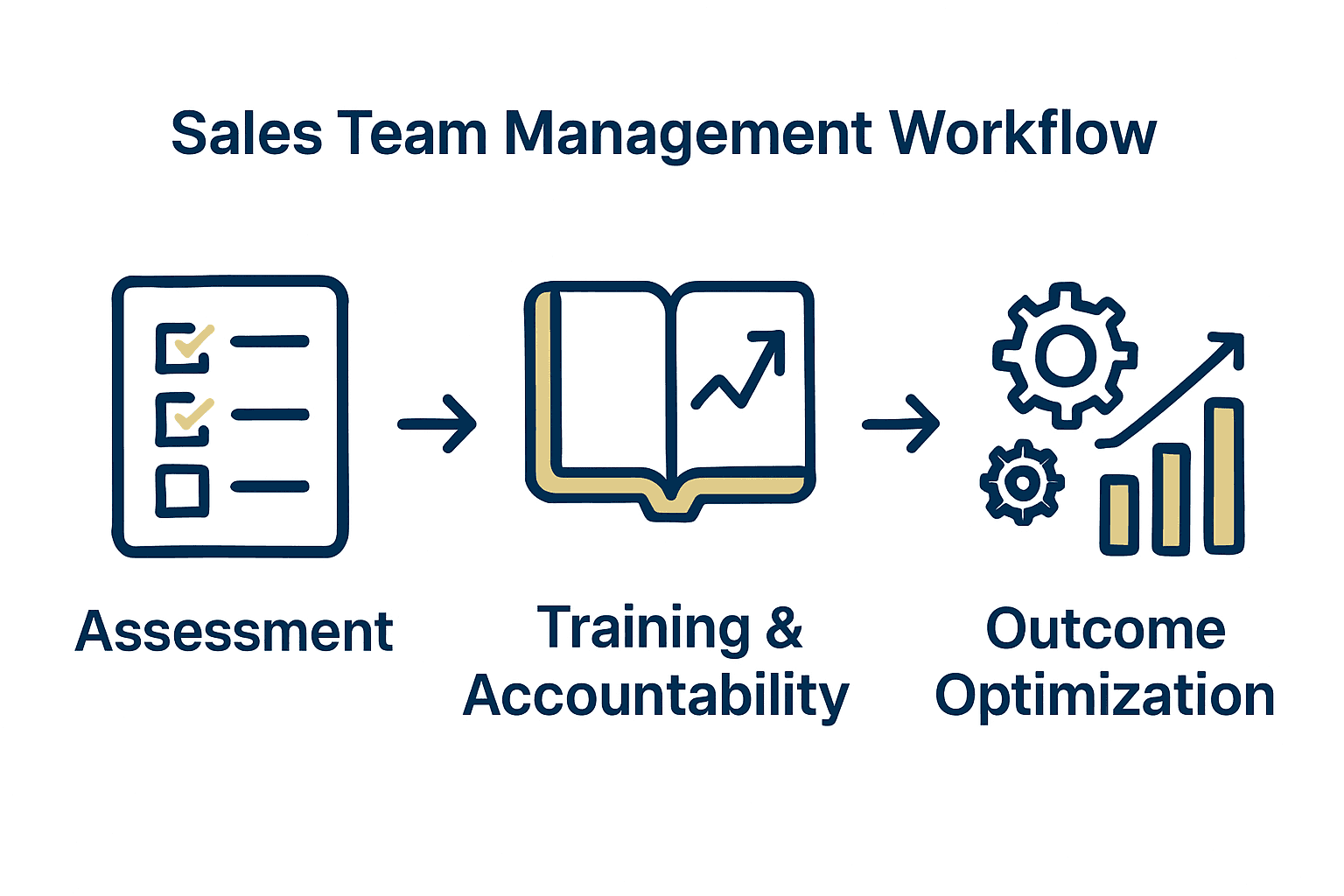
Quick warning: Avoid analysis paralysis. While data is crucial, remember that your review process should ultimately serve to empower and motivate your team rather than create unnecessary bureaucratic overhead. Your next step involves maintaining this iterative approach of assessment, learning, and strategic refinement.
Unlock Your Sales Team’s Full Potential with Tailored Growth Strategies
The article explores common challenges in sales team management such as assessing capabilities, setting clear benchmarks, implementing customised training and fostering ongoing accountability. If you find yourself grappling with inconsistent performance or struggling to turn sales data into actionable improvements, you are not alone. These pain points highlight the need for bespoke support that addresses both individual and collective growth within your team.
Imagine having a partner who helps you transform these concepts into proven results with personalised 1:1 coaching, targeted workflow optimisation and continuous performance monitoring. At Ahead of Sales, we specialise in delivering exactly that to businesses ready to accelerate sales growth sustainably.
Explore how our comprehensive packages, designed for companies who demand serious sales impact, can help your team achieve consistent quarterly targets and annual growth of at least 50 percent.
Take the next step towards transforming your sales team by visiting our homepage at Ahead of Sales. Discover bespoke training options that complement your sales management workflow and unlock the true potential within your organisation today. Your growth journey starts now with tailored solutions crafted for your unique challenges.
Frequently Asked Questions
How can I assess my sales team’s current capabilities effectively?
To assess your sales team’s capabilities, combine quantitative metrics like lead generation rates and sales volumes with qualitative observations. Start by collecting performance data and conducting one-on-one coaching sessions to understand individual strengths and areas for improvement.
What performance benchmarks should I set for my sales team?
Define performance benchmarks by breaking down your overall business objectives into specific metrics, such as monthly revenue targets and lead conversion rates. Ensure these benchmarks are challenging yet achievable to motivate your team and provide a clear roadmap for success.
How can I implement tailored training programs for my sales team?
Design customized training programs by segmenting your sales team based on skill assessments. Create learning paths that include workshops, online courses, and one-on-one coaching to address specific capability gaps and enhance overall team performance.
What accountability systems are effective for monitoring sales performance?
Implement a multi-layered accountability system that combines quantitative metrics with qualitative assessments. Use standardized reporting mechanisms, such as real-time digital dashboards and weekly team reviews, to provide visibility into individual and team performance.
How do I optimize workflow strategies based on performance data?
Review your sales team’s performance data regularly, focusing on trends and underlying factors driving results. Schedule quarterly strategy sessions to collaboratively identify bottlenecks and implement necessary workflow adjustments based on insights derived from data analysis.
2 Responses