
A good sales OKR is one objective you can say out loud in a team meeting, backed by two to five key results that each have a starting number, a target number and a quarter-end deadline. Below are worked examples for new business, conversion, sales cycle, account growth and team capability, then how to run the quarterly review and where incentives such as SPIFFs fit.
I have written this for UK business owners, sales directors and founders who run a team (or a solo practice) and want goals that move revenue, not a slide that gets forgotten by week three.
TL;DR
- A sales OKR pairs one ambitious objective with a few measurable key results, normally over a three-month cycle and reviewed weekly.
- Write key results as outcomes (revenue closed, pipeline created, win rate) with a baseline and a target, not as activity counts such as calls made.
- Use three or fewer objectives per team per quarter, and give every key result one named owner.
- A SPIFF is a short, targeted reward for one behaviour or result. Keep it simple, time-limited and tied to the OKR.
- In the UK, staff sales prizes and bonuses are generally taxable as employment income, so agree the treatment with your payroll adviser first.
Table of Contents
- What a sales OKR is (and what it is not)
- Sales OKR examples you can adapt
- How to write key results that hold up
- Running the quarter: set, check in, score
- Sales SPIFF ideas that support your OKRs
- UK tax and payroll: check before you pay out
- Quarterly incentive ideas beyond cash
- Our view: OKRs need coaching behind them
- Work with us on your next quarter
- FAQ
- Sources
What a sales OKR is (and what it is not)
OKRs, Objectives and Key Results, are a goal-setting framework that links what a team wants to achieve to the measurable evidence that it has been achieved. In sales, Pipedrive’s guidance describes a qualitative objective with a small set of quantitative, time-bound key results, usually over three months, with progress reviewed weekly.
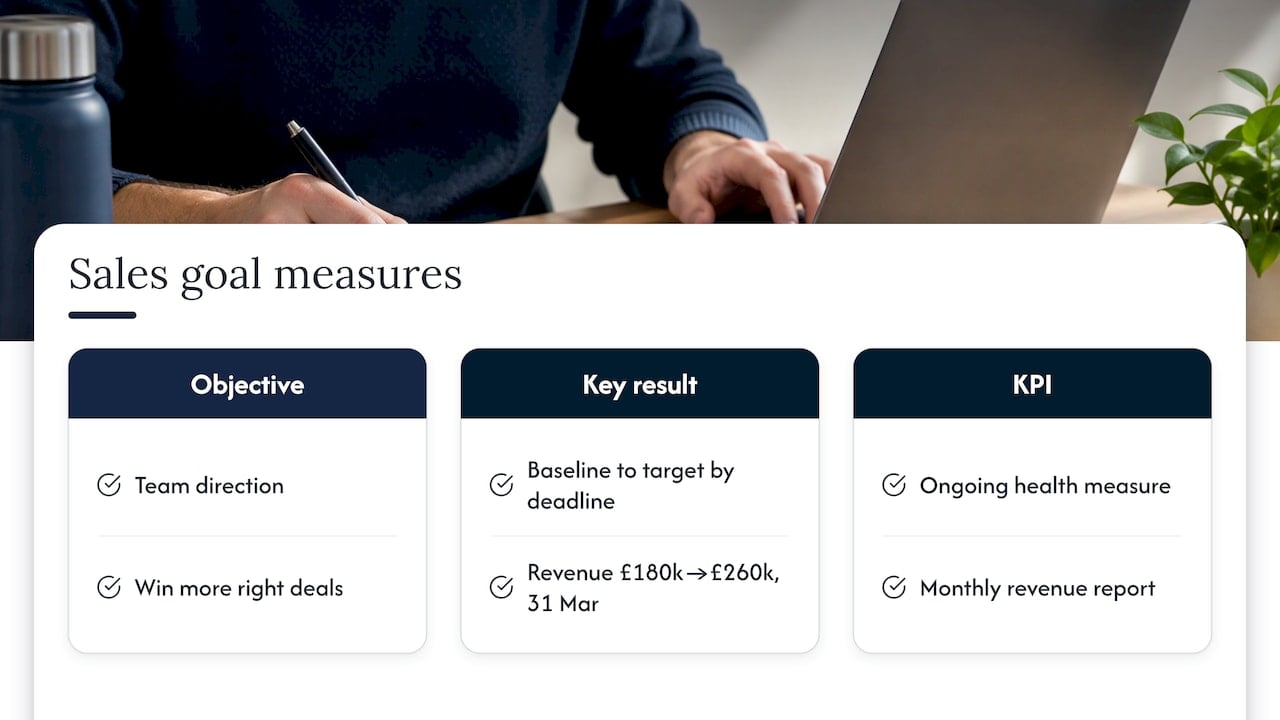
The objective is the direction. The key results are the proof. “Win more of the deals we should win” is an objective. “Raise win rate from 20% to 28%” is a key result.
One distinction saves a lot of confusion. A key result shows a baseline, a desired state and a deadline, whereas a metric that simply monitors ongoing health is a KPI, as OKRs Tool puts it. Your monthly revenue report is a KPI. “Take new-customer revenue from £180,000 to £260,000 by 31 March” is a key result (the figures are mine, to illustrate the shape).
In my experience the most common failure is not a bad objective. It is key results that describe busyness: 200 calls, 50 emails, 10 demos. Activity matters, but it belongs underneath the outcome, as a leading indicator you watch.
Sales OKR examples you can adapt
The examples below combine published ranges from the sources linked with figures that are only illustrative. Replace every number with your own baseline. A target with no baseline is a wish.
Example 1: Grow new-business revenue
Objective: Build a predictable new-business engine this quarter.
- Key result 1: Take new-customer revenue from £180,000 to £260,000 (illustrative).
- Key result 2: Lift pipeline coverage from 2x to 3.5x of target. Tability’s sales templates use this exact movement as an example.
- Key result 3: Increase rep-sourced pipeline from 25% to 40%, so the pipeline does not depend on marketing alone.
Pipeline coverage is the pipeline value divided by the target. Three times coverage is a commonly used benchmark, but your own conversion history should set the number. If you close one deal in four, you need roughly four times coverage, not three.
Example 2: Convert more of the pipeline
Objective: Win more of the deals we choose to pursue.
- Key result 1: Raise win rate from 20% to 28%.
- Key result 2: Increase mutual action plans on late-stage deals from 25% to 80%.
- Key result 3: Reduce no-decision losses from 40% to 25%.
These three are taken from Tability’s conversion example. The no-decision figure is the one I would look at first in most UK B2B teams. Buyers who do nothing cost you more than buyers who choose a competitor, because you learn nothing from them.
Example 3: Speed up the sales cycle
Objective: Make it easier and quicker for the right buyers to say yes.
- Key result 1: Raise SQL-to-opportunity conversion from 9% to 12%.
- Key result 2: Reduce the average sales cycle from 30 days to 18.
- Key result 3: Grow upsell and cross-sell revenue to 30% of new ARR.
These are the figures in WorkBoard’s sales OKR examples. A cycle that short suits a transactional sale. If your average deal takes four to six months, a better key result is the time spent in your slowest stage. Our guide to sales pipeline stages shows how to find it.
Example 4: Land larger deals by segment
Objective: Shift our revenue mix towards bigger accounts.
Microsoft’s published OKR examples include closing $500k in new enterprise deals and $300k in mid-market deals, reducing closed/lost opportunities from 100 to 25, and creating 10 outbound-generated opportunities in a territory. For a UK mid-sized firm, the same structure might read:
- Key result 1: Close £400,000 of new business from accounts with 250+ staff.
- Key result 2: Reduce closed/lost opportunities from 100 to 60.
- Key result 3: Create 10 outbound-sourced opportunities in your target region.
Splitting revenue targets by segment stops one big deal hiding a weak pipeline everywhere else.
Example 5: Build the team’s capability
Objective: Make every rep a better seller by the end of the quarter.
- Key result 1: Complete three training modules per rep.
- Key result 2: Improve average coaching-quality score from 3.4 to 4.2.
- Key result 3: Improve deal hygiene and forecast accuracy by 20%.
The pattern comes from the readiness examples in the WorkBoard article. Training completion on its own is an activity, so I always pair it with a skill score or a conversion measure. If you want a structure for scoring skills, our one-page six-skill coaching rubric is built for exactly this.
Example 6: Solo consultants and coaches
If you are a one-person service business, you still have a pipeline. A workable quarter might be:
Objective: Fill next quarter’s diary with the right clients.
- Key result 1: Hold 12 qualified discovery calls (up from 5).
- Key result 2: Convert 4 of those to paid engagements (from 2).
- Key result 3: Raise average project value from £3,000 to £4,000.
Those numbers are illustrative. What matters is that the first key result is a leading indicator, while the second and third are outcomes.
How to write key results that hold up
Five habits separate OKRs that work from those that decorate a spreadsheet.
- Start from the business goal. Ask what the company needs from sales this quarter, then write the objective.
- Write the objective in plain words. If a new rep could not repeat it back, rewrite it.
- Measure change, not effort. Revenue closed, pipeline created, win rate improved. Calls and emails are inputs you track beneath them.
- Co-create with the team. Pipedrive recommends writing sales OKRs with the reps themselves, because people hit goals they helped to set.
- Aim to stretch. A stretch goal that is hit in full every time was not a stretch.
Keep it small. Three objectives per team is plenty, with two to five key results under each. If everything is a priority, nothing is.
Running the quarter: set, check in, score
Set OKRs at the start of the quarter, check in weekly, review progress mid-cycle and score honestly at the end. OKRs Tool also advises giving each key result one named owner. Shared ownership usually means no ownership.
A simple rhythm I recommend to clients:
- Weekly (20 to 30 minutes): Each owner reports the number, the trend and one blocker. No storytelling.
- Mid-quarter: Ask whether the target is still right. If a key result is already at 90% in week five, it was too easy. If it has not moved, find out why.
- Quarter end: Score each key result from 0.0 to 1.0, then write down what you will do differently next quarter.
Scoring is where teams get nervous. If you hit 100% of everything, you set the bar too low. Many teams aim for roughly 70% on stretch goals. Never tie that score directly to pay, or people will write safe goals.
Data quality decides whether any of this works. If reps update the CRM only on Fridays, your weekly review is guesswork. Getting stages, definitions and reporting right is a revenue operations job as much as a sales one, and it is worth fixing before you set your first target. Our sales team management workflow covers the manager side of the same rhythm.
Sales SPIFF ideas that support your OKRs
A SPIFF (sales performance incentive fund) is a short-term reward for a specific behaviour or outcome, such as closing deals faster, upselling or landing new customers, as Rewardable explains. They suit new-product launches, slow periods and seasonal pushes, according to PandaDoc.
The link to OKRs is simple. If a key result is the thing you most want to move this quarter, a SPIFF can put a spotlight on it for a few weeks.
| OKR key result | SPIFF idea | Trigger type |
|---|---|---|
| Win 8 new logos in the quarter | Bonus for each new logo from a target sector | Outcome |
| Lift late-stage mutual action plans to 80% | Prize draw entry for each plan agreed with the buyer | Activity |
| Reach 80% of quota by week 9 | Team reward when 80% is hit by that date | Milestone |
| Grow upsell revenue | Fixed amount per upsell above a set value | Outcome |
GIFQ names these three trigger types (outcome, activity and milestone) and advises picking one rather than mixing them, because mixing waters down the incentive.
Reward formats that work
Cash is the obvious choice, but PandaDoc lists paid time off, recognition, gifts, experiences, development courses, technology and charity donations too. One format I like for broad participation is points: a simple demo earns one point and an outbound demo five, with a weekly or monthly prize draw, as The Revenue Engineer describes. It rewards behaviour reps control, and it is not won by your top seller every month.
Rules every SPIFF needs
BI Worldwide UK recommends clear, quantifiable and achievable objectives, no more than two or three at once, with simple rules. It also says not to run them continuously, so reps do not hold back sales waiting for the next one. In practice, write down:
- who is covered and what the qualifying result is
- the start and end dates
- how it is measured, and by whom
- the reward and when it is paid
- what happens with cancelled or refunded deals
One warning from experience: do not use a SPIFF to fix a habit of last-minute selling. If most of your revenue lands in the final week of every quarter, the cause is usually pipeline management and coaching, not motivation. A prize will not fix that. A weekly pipeline review will.
UK tax and payroll: check before you pay out
This is the part people skip. HMRC states that staff sales prizes and incentives may be chargeable as employment income. Cash is taxable at the amount received, and goods or services are normally taxed at market value, per its business income manual. HMRC’s Employment Income Manual adds that additional payments for duties performed for an employer are normally taxable earnings, even when the duties fall outside the employee’s normal contractual duties.
For cash bonuses, the Low Incomes Tax Reform Group explains that employers operate PAYE, deducting income tax and Class 1 National Insurance through payroll. Speak to your accountant or payroll provider before launching any scheme, especially for non-cash rewards such as holidays or gifts, where the tax treatment can differ.
Quarterly incentive ideas beyond cash
Not every quarterly reward needs to be a payment. Options I see working well in growing UK businesses:
- Team targets with a shared reward, such as a day out when the team hits its coverage and win-rate key results together.
- Development rewards, like a place on an advanced negotiation programme or one-to-one coaching for the rep who improved most.
- Recognition, such as a named award in the all-hands meeting with the specific deal or behaviour described.
- Time, such as an extra day off for hitting a milestone by a set week.
A sound plan is strategic, motivating, fair, simple and measurable, and it rewards things sellers can control and your systems can track. That is the conclusion of an HSMAI incentive-plan research report, written for hotel sales but a good test for any business. Reward mid-performers as well as stars: the biggest room for growth is usually in the middle of the team, which BI Worldwide also points out.
Our view: OKRs need coaching behind them
We see the same thing in almost every sales team we work with. The goals are fine. What is missing is the conversation each week about how to hit them.
An OKR tells a rep where to go. It does not tell them how to handle a price objection on Thursday or how to get a stalled buyer to commit. That is why we combine one-to-one coaching with traditional training and consultancy: the numbers set the direction, and the coaching changes the behaviour that moves them.
My advice is to pick one objective that really matters this quarter, write three key results with honest baselines, and review them every single week. Then look at what the numbers say about skills, not just effort. If win rate is stuck, the answer is almost never a bigger target. It is a better conversation with the buyer.
Our aim with clients is at least 50% sales growth a year and quarterly targets hit, and the way we try to get there is by making the weekly rhythm stick.
Jerry
Work with us on your next quarter
If you want sales OKRs that your team will actually hit, we can help. Our team-based bespoke coaching and consultancy engagements are £4,500 to £8,500 one-off, and our sales acceleration track for solo service businesses and consultants is £2,995 to £5,995 one-off. If you need senior leadership without a full-time hire, our Sales Director retainer is £990 a month.
See how the packages work on our sales training cost page, or look at the fractional sales director retainer if you want someone to own the quarterly rhythm with you. Solo consultants can start with our sales coaching programme. For a manager checklist to pair with your OKRs, see our sales leadership checklist.
FAQ
How many OKRs should a sales team have per quarter?
Keep it to around three objectives, each with two to five key results. More than that and managers cannot review them properly each week. Fewer, sharper goals get more attention and better coaching.
What is the difference between a sales OKR and a sales KPI?
A KPI monitors ongoing health, such as monthly revenue or average deal size. A key result has a baseline, a target and a deadline, and it is meant to change something. Many teams keep their KPIs as the dashboard and pull one or two into each quarter’s OKRs.
Should OKRs be linked to commission?
I would keep them separate. OKRs work best when people set stretch targets and talk honestly about misses. Tie the score to pay and reps will sandbag. Use commission for the core quota and use a short SPIFF if you want extra focus on one result.
Do UK sales incentives count as taxable income?
Generally yes. HMRC treats staff sales prizes and incentives as potentially chargeable employment income, and cash bonuses go through PAYE. Check the exact treatment of your scheme with your accountant or payroll provider before you announce it.
How often should we review sales OKRs?
Weekly check-ins, a mid-quarter review and a scored review at quarter end is a sound pattern. Weekly reviews let you spot blockers while there is still time to act.
Sources
- How to set performance-boosting OKRs for sales teams, Pipedrive
- 21 Sales OKR Examples for Every Role, OKRs Tool
- Sales OKR examples and templates, Tability
- Sales OKRs: Examples for the Revenue Org, WorkBoard
- OKR Examples, Microsoft Learn
- Planning and executing Sales Performance Incentive Funds, Rewardable
- What is a Sales Spiff?, PandaDoc
- SPIFF Programs: Designing Sales Incentives That Work, GIFQ
- SPIFFs with massive impact, The Revenue Engineer
- 11 Ways to run successful sales SPIFFs, BI Worldwide UK
- Sales incentive structures that work, BI Worldwide UK
- Hotel Management Company Sales Incentive Plans, HSMAI
- BIM45090, HMRC Business Income Manual
- EIM00730, HMRC Employment Income Manual
- Pay As You Earn (PAYE), Low Incomes Tax Reform Group