
TL;DR:
- Sales leaders in the UK face increased pressure due to shifting buyer behavior and longer sales cycles. Effective strategies in 2026 require buyer-centric, multi-channel, AI-enhanced approaches informed by measurable data and aligned messaging. Signal-based targeting, coordinated multi-channel cadences, and intelligent AI deployment are vital for predictable growth and higher conversion rates.
UK sales leaders are under real pressure right now. Buyer behaviour has shifted, cycles have lengthened, and generic outreach is getting ignored at scale. If your team is relying on last year’s playbook to hit this year’s numbers, you are already behind. The good news is that the right sales strategy tips for 2026 give you a genuinely different framework to work from. One built around how modern buyers actually want to engage, not how sellers prefer to sell. This article walks you through the tactics, tools, and mindset shifts that UK companies with ambitious growth targets need to focus on right now.
Table of Contents
- Key criteria for effective sales strategies in 2026
- Signal-based account targeting to boost conversion rates
- Multi-channel cadences: combining email, phone, and social to 287% effect
- Leveraging AI for lead research and hyper-personalisation
- Measuring and scaling sales techniques for predictable quarterly growth
- Why buyer-centricity and tech integration trump hype in 2026 sales
- Boost your team’s performance with expert sales training and consultancy
- Frequently asked questions
Key Takeaways
| Point | Details |
|---|---|
| Buyer-centric approach | Tailoring outreach to the buyer’s needs is essential to avoid rejection and increase engagement. |
| Signal-based targeting | Prioritising accounts showing buying signals improves win rates and pipeline velocity. |
| Multi-channel outreach | Combining email, phone, and social outreach boosts reply rates significantly versus single channels. |
| AI integration | Leveraging AI for research and personalisation reduces workload and increases reply rates. |
| Measurement and coaching | Tracking key metrics and coaching reps drives scalable, predictable quarterly sales growth. |
Key criteria for effective sales strategies in 2026
Having framed the challenge, let us clarify the key criteria that make sales strategy tips for 2026 worth acting on, rather than simply worth reading.
The most fundamental shift in modern B2B sales is relevance. 73% of B2B buyers actively avoid irrelevant outreach, which means volume without targeting is not just inefficient, it actively damages your brand. Every message your team sends is either building trust or burning it.
Timing matters just as much as relevance. The median B2B sales cycle has reached 281 days, yet research consistently shows that responding to inbound leads within five minutes dramatically increases conversion rates. Speed and patience must coexist in your strategy.
Here are the criteria I recommend using to evaluate any sales approach before you commit to it:
- Buyer-centricity: Does the tactic serve the buyer’s decision-making process, or just your pipeline?
- Channel integration: Does it work across email, phone, and LinkedIn in a coordinated way?
- AI compatibility: Can it be enhanced or accelerated with AI tools without losing the human touch?
- ICP alignment: Is it targeting accounts that genuinely match your ideal customer profile, reviewed at least quarterly?
- Data feedback: Does it generate measurable signals you can act on each week?
When you are building or reviewing your b2b sales strategy, run every proposed tactic through these five criteria before deploying it across your team. It saves you from chasing shiny new tools that do not actually move the needle.
Signal-based account targeting to boost conversion rates
With criteria in place, let us explore how to use buying signals for targeted, personalised outreach that genuinely drives pipeline growth.

Traditional list-based prospecting, where you pull a list of companies by industry and size and blast it, is increasingly ineffective. Signal-based account targeting works differently. You identify named accounts that are showing active interest through firmographic data, intent signals, job postings, funding announcements, or technology changes, and you prioritise those over static lists.
The results speak for themselves. Signal-based ABM programmes deliver a 32% win rate versus just 13% for list-based approaches. That is not a marginal improvement. It is the difference between hitting and missing target in a given quarter.
For mid-sized UK firms, running a full account-based marketing programme in-house can feel daunting. The platforms are expensive, often exceeding £40,000 per year, and they require dedicated headcount to operate properly. The smarter approach for many businesses is to outsource ABM execution to a specialist rather than over-investing in technology you cannot fully utilise.
Here is how to structure a signal-based targeting programme without breaking the budget:
| Approach | Best for | Approximate cost | Win rate |
|---|---|---|---|
| Signal-based ABM | Named enterprise accounts | £15k+ with specialist support | 32% |
| List-based outreach | Broad SME prospecting | Low, mostly tool costs | 13% |
| Hybrid (signal + list) | Mid-market UK firms | £8k to £20k per quarter | 20 to 25% |
Once you have identified your target accounts, personalise outreach by buying committee role. The CFO needs a different message from the Operations Director, even if you are selling the same product. Map the committee, then tailor accordingly.
Pro Tip: Review and refresh your target account list every six weeks. Buying signals have a short shelf life. An account that was warm three months ago may have already made a decision, and a new one showing fresh signals has arrived in your pipeline.
Our sales consultancy services can help UK teams build this kind of signal-based targeting without needing to invest in expensive enterprise platforms.
Multi-channel cadences: combining email, phone, and social to 287% effect
Next, let us look at how to execute outreach across multiple channels for maximum impact with proven cadence designs.
Single-channel outreach is one of the most common and costly mistakes I see sales teams making. Sending ten emails and then giving up is not a cadence. It is wishful thinking. Modern buyers are busy and distracted. They need to encounter your message in more than one place before they take action.
Combining email, phone, and LinkedIn in a coordinated sequence boosts results by 287% compared to email alone. That figure still surprises people when they first see it, but when you consider how buyers actually consume information, it makes complete sense.
Here is a ten-touch, three-week cadence structure that consistently performs well for B2B teams:
- Day 1: Personalised email referencing a specific trigger event or insight relevant to the prospect.
- Day 3: LinkedIn connection request with a brief, relevant note.
- Day 5: Follow-up email with a different angle, perhaps a case study or short video.
- Day 7: Phone call (leave a voicemail if no answer, reference the email).
- Day 9: LinkedIn message referencing the voicemail.
- Day 11: Email with a direct question or a relevant piece of content.
- Day 13: Phone call, no voicemail this time.
- Day 15: LinkedIn video message or voice note.
- Day 18: Final email acknowledging you have reached out several times and offering a clear next step.
- Day 21: LinkedIn comment on a prospect’s post, keeping the relationship warm without being pushy.
Critically, 42% of replies come from follow-ups that most reps simply skip. The reps who give up after touch three are leaving nearly half their potential responses on the table.
- Send emails on Tuesday, Wednesday, or Thursday mornings between 8am and 10am for the highest open rates.
- Make phone calls between 10am and 12pm or 4pm and 5pm when prospects are less likely to be in meetings.
- LinkedIn messages on weekday mornings tend to outperform afternoon sends.
- Keep every message under 100 words where possible. Brevity signals respect for the buyer’s time.
Pro Tip: Do not treat each touch as an isolated event. Reference what you sent previously in a natural, conversational way. It shows you are a real person running a thoughtful outreach, not a bot firing off templates.
Explore our guidance on sales cadence design if you want to build this kind of sequence for your own team.
Leveraging AI for lead research and hyper-personalisation
Having reviewed outreach execution, let us look at how AI enhances lead research and personalisation at scale, because this is where 2026 sales techniques are genuinely evolving fast.
The most practical application of AI in sales right now is not generating scripts. It is cutting the time your reps spend on research. AI tools reduce prospecting research time by up to 50% while improving the accuracy of your ideal customer profile. That means reps spend more time having conversations and less time in spreadsheets.
Where AI really earns its place is in hyper-personalisation. Rather than sending a vaguely customised email, your reps can use AI to craft messaging that speaks to a specific pain the prospect’s business is experiencing right now, based on recent news, hiring trends, or earnings reports. Generative AI drafts trigger-based emails that improve response rates by 28%, but only when a human edits and refines them before sending.
The teams generating the most pipeline in 2026 are not the ones using the most AI. They are the ones using AI intelligently and then applying human judgement to make it count.
One UK case study worth noting: hybrid AI-human lead management increased leads by 240% in 90 days for a mid-sized services business. The key was not replacing human sellers. It was using AI for the repetitive, time-consuming parts and freeing people to focus on relationships.
Here is how to integrate AI without losing the personal edge:
- Use AI tools to build prospect research summaries before calls, covering recent news, company challenges, and LinkedIn activity.
- Generate first drafts of trigger-based outreach emails, then personalise the opening two sentences manually.
- Apply AI-powered lead scoring to prioritise your highest-intent accounts each week.
- Update your ICP quarterly using AI-driven analysis of your best closed deals.
- Track which AI-assisted messages perform best and iterate accordingly.
The AI productivity improvements available to sales teams today are significant, but they require thoughtful deployment. Our sales training for technology businesses covers exactly how to blend AI tools with human selling skills.
Measuring and scaling sales techniques for predictable quarterly growth
Finally, let us look at how to use data and coaching to scale these strategies for sustained quarterly sales success.
Strategy without measurement is guesswork. If you are implementing 2026 sales techniques but not tracking the right metrics, you will not know what is working until it is too late to course correct within a quarter. The key is distinguishing between leading indicators, which tell you what is coming, and lagging outcomes, which tell you what already happened.
| Metric | Type | What it tells you |
|---|---|---|
| Reply rate | Leading | Whether your messaging is resonating |
| Discovery-to-demo rate | Leading | Whether qualified interest is converting |
| Pipeline generated per rep | Leading | Whether activity is translating into opportunities |
| Win rate by objection | Lagging | Where deals are being lost and why |
| Average deal cycle length | Lagging | Whether your process is speeding up or stalling |
Linking outreach activity to pipeline and win rates is essential for making informed decisions about which techniques to scale. Too many sales leaders review win rates at the end of a quarter when there is nothing left to do about them. The leading indicators give you time to act.
Use sales coaching software to surface skill gaps early. Recording and reviewing calls is not about surveillance. It is about identifying the specific moments where deals are won or lost, and coaching to those moments consistently.
- Hold weekly pipeline reviews that focus on leading indicators, not just deal stage.
- Create a feedback loop between your RevOps function and front-line sellers to refine messaging monthly.
- When a particular cadence or message is consistently generating replies, document it and build it into your standard playbook.
- Scale approaches with proven ROI by assigning them to your whole team, not just the rep who discovered them.
Review our sales growth strategies for UK firms for more on building the measurement framework that supports this kind of consistent quarterly growth.
Why buyer-centricity and tech integration trump hype in 2026 sales
With all the practical tips covered, I want to share a perspective that too few sales leaders stop to consider, but that I believe is the real differentiator between teams that consistently hit target and those that consistently miss it.
The instinct when performance dips is to add more. More tools. More channels. More volume. I understand it. When you are accountable for a quarterly number, action feels safer than reflection. But in my experience, the problem is almost never a lack of activity. It is a lack of alignment.
69% of B2B buyers notice inconsistencies between a vendor’s website and what their sales team says in conversations. That is a staggering figure. It means that nearly seven in ten of your prospects are arriving at sales calls already slightly unsettled, because what your reps are saying does not quite match what the website promised. That misalignment quietly kills deals that should have been won.
The highest-performing sales teams I have worked with treat selling as a service. They are not trying to convince buyers. They are helping buyers make a well-informed decision. That requires message consistency across every touchpoint, from the first LinkedIn connection to the final proposal. It requires sales and marketing speaking the same language. And it requires leadership that is more interested in building a repeatable system than in chasing the latest shiny tactic.
Technology absolutely has a role. AI, intent data, and multi-channel tooling can all accelerate results. But none of it works if the underlying message is confused, or if the buyer feels processed rather than understood. Before investing in more tools, get honest about whether your current messaging is genuinely buyer-centric, or whether it is a sophisticated way of talking about yourself.
Explore what the latest b2b sales trends tell us about buyer expectations, and let that inform your messaging decisions before your next quarter planning session.
Boost your team’s performance with expert sales training and consultancy
Turning these strategies into real results requires more than reading about them. It requires consistent execution, accountability, and the kind of coaching that reinforces the right behaviours week after week.
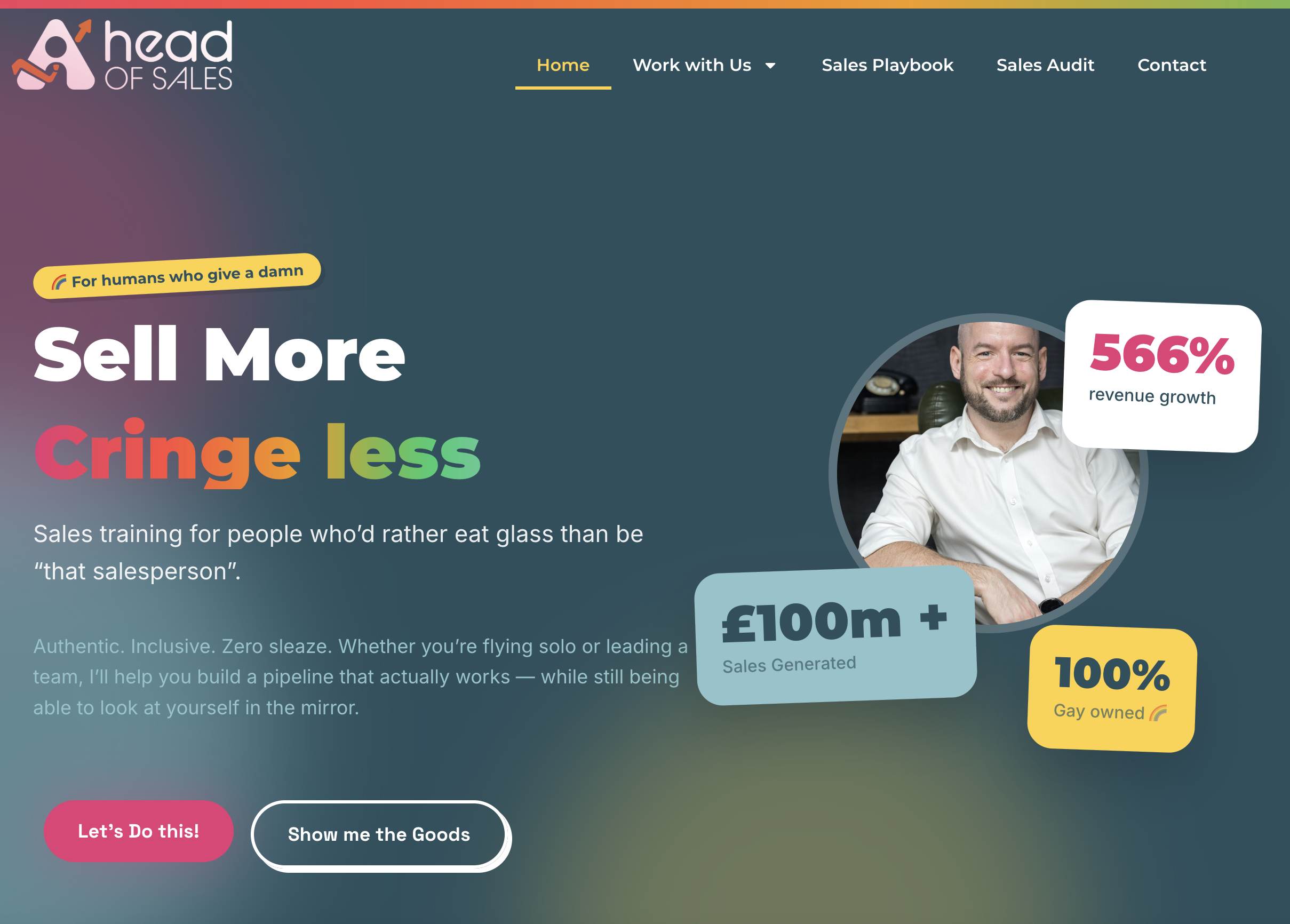
At Ahead of Sales, we work with UK companies of 50 to 1,000 people who are serious about generating at least 50% sales growth each year and hitting target every quarter. Our sales training services combine bespoke 1:1 coaching with practical group training to accelerate the adoption of multi-channel cadences, AI-augmented prospecting, and signal-based targeting. Our sales consultancy services help you refine your ICP, sharpen your messaging, and build a measurement framework that keeps your pipeline healthy all year round. If you are ready to stop guessing and start scaling, our sales growth strategies programme is the practical next step.
Frequently asked questions
What makes sales strategies effective for UK companies in 2026?
Effective strategies are buyer-centric, data-informed, and integrate multiple channels with consistent messaging and AI-enabled personalisation, ensuring your outreach reaches the right people at the right moment in their buying journey.
How important is account-based marketing in 2026?
Account-based marketing is critical for any business targeting enterprise or mid-market accounts. Signal-based ABM programmes deliver a 32% win rate versus 13% for list-based prospecting, making it one of the highest-ROI approaches available to UK sales teams right now.
What role does AI play in modern sales development?
AI automates routine lead research, drafts personalised outreach, and improves lead scoring. AI tools reduce research time, improve ICP accuracy, and raise response rates, freeing your reps to focus on the high-value conversations that actually close deals.
Why is multi-channel outreach more effective than single-channel?
Combining email, phone, and LinkedIn increases results by 287% compared to email alone, with 42% of total replies coming from follow-up touches that most reps skip, making persistence across channels one of the simplest wins available to any sales team.
How can sales leaders measure the success of new sales techniques?
Track leading indicators like reply rate and discovery-to-demo rate weekly, then link activity metrics to pipeline coverage and win rates. This combination gives you enough time to course correct within a quarter rather than discovering problems after the period has closed.
One Response