
Sales training teaches your people how to sell. Sales enablement is the wider system around them: the content, process, tools, coaching and measurement that let them use those skills on a real deal. Training sits inside enablement, so the real question is not which one to pick. It is which gap is costing you deals right now, and how to close it without building a department you don’t need.
If you run a growing UK business, that gap is usually closer to home than a job title or a software licence. We built our work at Aheadofsales around that idea: bespoke 1:1 coaching, team training and consultancy delivered together, so skills and the way you sell move at the same pace.
TL;DR
- Sales training builds skills and knowledge, usually in a defined programme with a start and an end. Sales enablement is the ongoing system that helps reps apply those skills.
- Training is one part of enablement, not a rival to it. Enablement also covers content, process, tools, onboarding and measurement.
- Smaller UK firms rarely need an enablement department. They need training that is reinforced by coaching and by a sales process that makes the new skills easy to use.
- Diagnose first: find out why reps are struggling, then choose training, process fixes, or both.
- Measure behaviour and pipeline movement, not just attendance and satisfaction scores.
Table of Contents
- What sales enablement actually means
- What sales training actually means
- Sales enablement vs sales training: the differences that matter
- Where they overlap, and why it matters
- Sales training vs sales coaching
- Who owns each one in a UK business
- How to decide what your team needs
- How to measure the result
- Why UK sales teams feel the pressure
- Our perspective
- Where Aheadofsales fits
- Common mistakes when choosing between the two
- FAQ
- Sources
What sales enablement actually means
The term is used loosely, so it helps to start with a professional definition. The Association for Talent Development describes sales enablement as a strategic, cross-functional effort to raise the productivity of market-facing teams by giving them ongoing, relevant resources throughout the buyer journey. It names sales training, coaching, content creation, process improvement, talent development and compensation among the areas it covers.
Read that list again. Training is on it, but so are content, process and pay. Enablement is a discipline for removing whatever stops a salesperson from selling well, and the cause is not always a skills gap.
The same source notes that enablement most commonly reports to the head of sales, though it can sit with operations, marketing or, more rarely, HR. In larger companies enablement professionals might design the onboarding programme, choose the sales methodology, run the sales kickoff, select tools, create sales plays and job aids, deliver training and analyse sales data. In a 60-person business, much of that falls to the founder, the sales director and whoever has the most spare hours.
If you want the longer definition, we’ve covered what sales enablement means in 2026 separately.
What sales training actually means
Sales training teaches sales skills and strategies. It might be a workshop, a series of coaching sessions, a training day or a cohort programme. Typical content includes discovery questions, handling objections, structuring a pitch, negotiating price and following a methodology consistently.
Training answers the question “can my people do this?” The research on how training works points to a useful distinction. A paper in the International Journal of Evidence Based Coaching and Mentoring describes training as having relatively pre-determined answers and an objective frame of reference, and often as filling a deficit of missing skills. That is exactly what you want when a team doesn’t yet share a way of qualifying, questioning or closing.
Sales enablement vs sales training: the differences that matter
Most explanations land on the same handful of contrasts. A professional guide from the enablement community puts the focus of enablement on improving sales processes by finding blockers in existing workflows, and the focus of training on building effective, ongoing education for sellers and their managers. Pulling the common threads together:
| Sales training | Sales enablement | |
|---|---|---|
| Main question | Can my reps do this? | What stops my reps doing this well? |
| Scope | Skills and knowledge | Skills, content, process, tools, onboarding, analytics |
| Typical form | Workshops, coaching sessions, programmes with a clear start and end | A continuing system with no end date |
| Who usually owns it | Sales manager, L&D or HR, or an external specialist | Sales leadership, operations, marketing or a dedicated enablement lead |
| How it is measured | Confidence, win rate, assessments, rep feedback | Ramp-up time, content use, quota attainment, sales cycle length, revenue impact |
| Buyer focus | Usually the rep’s technique | The whole buyer journey |
The ownership and measurement rows come from the way these two disciplines are normally described in the sector. The sales enablement community guide lists training metrics as sales confidence, win rate, sales velocity, customer satisfaction and team feedback, and enablement metrics as things like sales productivity, content usage, tool adoption and time to respond to customer enquiries.
The same guide is honest that there is nuance and overlap, because both aim to lift sales productivity and close rates. In practice the person running one often runs the other.
Where they overlap, and why it matters
Training is a subset of enablement, and enablement without training is thin. You can give reps the best battlecards, a tidy CRM and a polished playbook, but if they cannot run a discovery call, none of it converts. Equally, you can send a team on an excellent two-day course and watch the lessons fade within weeks because nothing in the process asks them to use what they learned.
That second failure is the common one in growing firms. Seleste Lunsford, chief research officer at CSO Insights, told Selling Power that you need to find out why reps are struggling and that reinforcement has to fit into the workflow of a rep’s normal day. Her point was that some trainers ask for a long list of reinforcement sessions that will simply never happen.
In the same piece she reports research suggesting that companies that treat training as one element of sales enablement see win rates 15 per cent higher than those that focus only on training needs. That is a single analyst’s figure from 2020, so treat it as direction rather than a promise. The direction is sensible, though: skills stick when the environment supports them.
Sales training vs sales coaching
People often ask where coaching fits, so it is worth separating the three terms.
Training transfers a defined set of skills or knowledge to a group. It is structured and has a curriculum.
Coaching works with one person (or a small group) on their own live deals, habits and mindset. The research paper above describes coaching as more associated with expanding existing skills, and it is often aimed at higher performers. It does not run from a fixed answer sheet. It starts from the rep’s actual calls and pipeline.
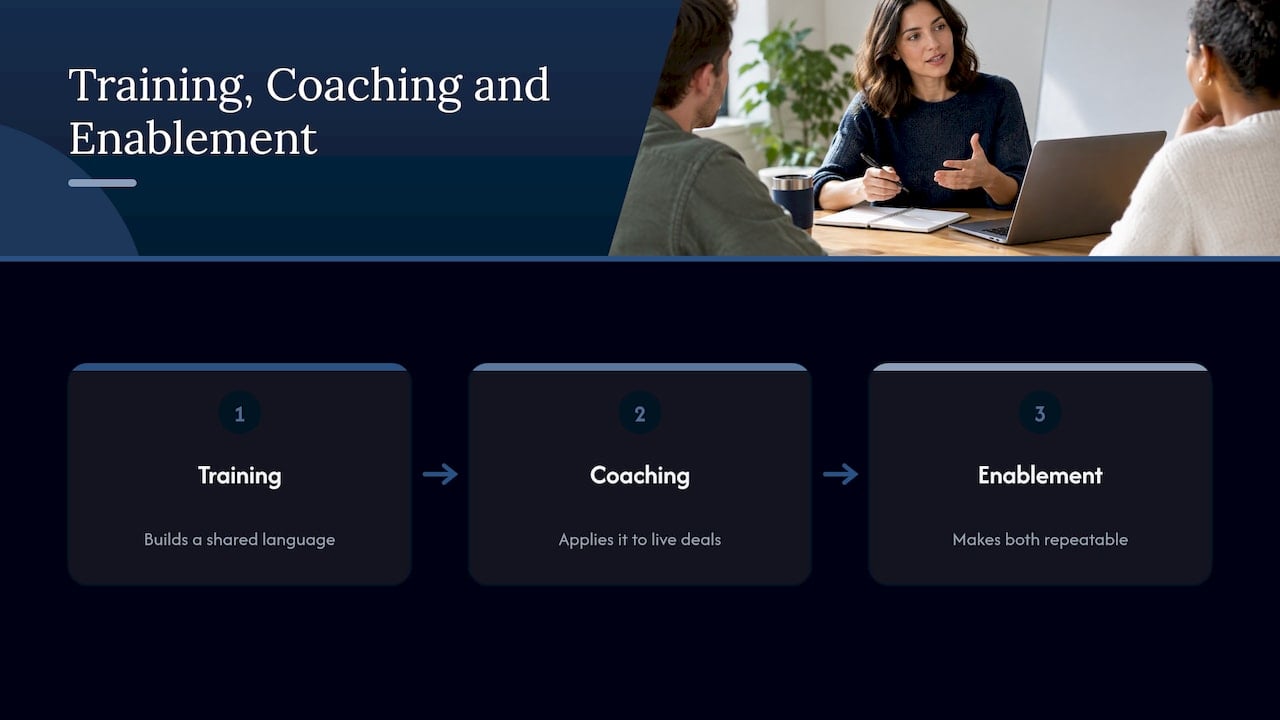
Enablement is the system that makes both repeatable.
The most useful way to think about it is as a sequence. Training gives the team a common language. Coaching turns that language into each person’s own habit, on real opportunities. Enablement keeps the whole thing running when the trainer has left the building. Our own approach joins the first two and brings consultancy in for the third, which is why we describe our work as coaching, training and consultancy in one package rather than as three separate purchases.
If you want to see what good coaching looks like day to day, our guide to sales team coaching techniques walks through the methods.
Who owns each one in a UK business
In a large organisation, enablement is a function with its own head and budget. In most UK businesses with 50 to 1,000 staff, that role doesn’t exist as such. Ownership usually falls like this:
- The founder or managing director sets the sales approach and often does the most important selling.
- The sales director or head of sales owns targets, forecasting and the pipeline, and by default owns onboarding and coaching too.
- Marketing produces the content reps use with prospects. The HubSpot view that enablement is shared between marketing and sales matches what we see in how firms divide content work.
- HR or L&D may arrange formal training but seldom owns commercial outcomes.
That spread of ownership is the real enablement problem for mid-sized firms. Nobody is accountable for the whole system, so everything is accountable to a short-term target instead. A fractional sales director is one way smaller businesses put one accountable person across process, coaching and reporting without hiring a full-time executive. Our guide to when UK founders hire a fractional sales director sets out the point at which it makes sense.
How to decide what your team needs
At this point most articles simply say “it depends”. Here is a practical way to find out, in four steps.
1. Find out why deals are stalling
Pull the last 20 lost or stalled opportunities and sort the reasons. Note where in the sales process each one stopped. Kelley O’Reilly of Western Michigan University’s Haworth College of Business says companies should look at each individual in the sales team to identify training needs, then look outward at customer trends, expectations and whether their products remain competitive. Both views are needed. A rep who fails at discovery is a training matter. A rep who cannot find the latest pricing sheet is not.
2. Sort the causes into skill, process and information
- Skill causes: weak questioning, discounting too early, avoiding the money conversation, poor handling of objections. These point to training and coaching.
- Process causes: unclear stages, no agreed definition of a qualified lead, inconsistent handovers, forecasts nobody trusts. These point to consultancy and process work, the enablement side.
- Information causes: outdated collateral, no case studies for a sector, reps unsure of a product change. These point to content.
Most teams have a mix. If skill causes dominate, start with training and coaching. If process causes dominate, fix the process first, or training will simply push reps harder through a broken pipeline.
3. Decide the sequence
A short sequence works for most mid-sized firms:
- Agree the sales process and what “good” looks like at each stage.
- Train the whole team on it, so everyone shares one method.
- Coach individuals on live deals for the following months.
- Review the numbers and adjust the process.
This is the loop we run with clients: we combine training cohorts, 1:1 coaching and consultancy so the process and the skills improve together.
4. Set the measures before you start
Pick a small number of numbers and agree them in advance: win rate, average deal size, time from first meeting to close, and the share of reps hitting target. Don’t rely on happy sheets at the end of a workshop.
How to measure the result
Measurement is where both disciplines struggle. An enablement practitioner writing in December 2025 argues that there is no direct causation between enablement and revenue, only correlation, so revenue shouldn’t be the only metric. She suggests using existing frameworks such as the Kirkpatrick-Phillips levels: reaction, confidence, application at about 30 days after training, business impact tied to leading indicators such as conversion rate, and finally return on investment.
That is a useful discipline for any UK sales leader. In plain terms, check four things:
- Did people find it useful, and are they more confident?
- Thirty days later, are they doing something different on calls?
- Is a leading indicator moving, such as meetings booked, proposals sent or conversion between stages?
- Eventually, is revenue per rep rising?
A 2021 analytics report from the enablement profession, drawing on around 300 practitioners across the US, UK and other countries, found that using sales training tools could raise win rates by 6 percentage points, customer retention by 6 points and upsell deals by 3 points. Those are self-reported practitioner results rather than guarantees, but they show the kind of movement worth tracking.
Why UK sales teams feel the pressure
The reason this question keeps coming up is that selling has become harder. HubSpot’s 2020 UK sales enablement survey found that 58% of UK reps expected it to get harder to reach their targets and that 25% were not hitting their targets, with the shift to remote selling the main reason given. That survey is a few years old, but remote and hybrid buying has not gone away.
Research from the University of Reading’s Henley Business School points the same way. Oliveira, Belitski and Perez-Vega found in a 2025 peer-reviewed study that sales enablement platforms improve collaboration, reduce costs and increase flexibility in how firms run their sales processes. Technology helps, but it only produces results when the people using it know how to hold a good sales conversation.
Our perspective
I get asked this question most weeks, and the honest answer is that the label matters less than the result. Most of the business owners and sales leaders I speak to don’t need an enablement department. They need their team to sell better and to keep selling better after I’ve gone.
That is why we don’t run training in isolation. A day of training with no follow-up gives a team a nice day out. Coaching on real deals, a process that supports the new habits and a clear set of targets give them a different quarter. Our packages are built to combine all three, for teams and for solo service businesses.
If you’re setting a budget, start by naming the one number you want to move. Then work backwards: what skill, what process change and what coaching does it take? That’s the conversation I’d rather have than a conversation about job titles.
Jerry
Where Aheadofsales fits
Our team-based bespoke coaching and consultancy engagements are priced from £4,500 to £8,500 as a one-off. They combine 1:1 coaching with team training and consultancy, so the skills and the sales process are worked on together. For solo service businesses and consultants, our sales acceleration track runs from £2,995 to £5,995 one-off. If you prefer a monthly route, The Sage Collective is £990 per month.
You can see how the packages are laid out on our sales training cost page, or look at Fundamental Sales Skills if your team needs a common foundation first.
Common mistakes when choosing between the two
Buying training to fix a process problem. If reps follow different stages and nobody agrees what a qualified lead is, a workshop will not align them. Fix the process, then train on it.
Buying tools to fix a skills problem. A new CRM or a content library doesn’t teach someone to ask better questions.
Treating training as an event. A single session is where learning starts. Without coaching on live deals, most of it fades.
Measuring attendance instead of behaviour. Completion rates tell you who turned up. They don’t tell you whether discovery calls improved.
Waiting for a dedicated enablement hire. Many firms postpone action until they can afford a specialist. Bringing in outside training, coaching and consultancy lets you start with the highest-value gap now.
FAQ
Is sales training part of sales enablement?
Yes. Training is one of the capabilities within enablement, alongside content, coaching, process improvement, tools and measurement. Enablement is the continuing system, while training builds a particular skill, typically in a programme with a clear start and end.
Do I need sales enablement or sales training first?
Start with the cause of your lost deals. If reps struggle with questioning, objections or negotiating, begin with training and coaching. If the pipeline stages, handovers or forecasts are unclear, begin with process work. Most teams need both, in that order of priority.
What is the difference between sales training and sales coaching?
Training teaches a group a defined set of skills through a structured programme. Coaching works with an individual on their own deals and habits, and tends to build on skills they already have. Used together, training gives the team a shared method and coaching makes it stick.
How long before I see results?
It depends on your sales cycle. Leading indicators such as conversion between stages and meetings booked often move first, with revenue following as deals close. Agree these measures before you start and review them at about 30 days, then each quarter.
Sources
- What is Sales Enablement? (Association for Talent Development)
- Sales enablement vs sales training: 5 key differences
- Training and coaching research paper, International Journal of Evidence Based Coaching and Mentoring
- Selling Power: how to determine what sales training your team needs
- What is sales enablement and how should it be delivered?
- 2021 Sales Enablement Analytics Report
- Sales digitization and sales process optimisation for firm performance, University of Reading