
The essential SaaS sales training topics fall into six modules: discovery, demo delivery, objection handling, qualification, onboarding handover, and structured practice with certification. Teams that teach and assess all six typically see faster ramp and stronger demo-to-opportunity conversion than those running one-off workshops. This article walks through the module catalogue, the formats that make it stick, how to sequence a curriculum, and how to prove it worked.
TL;DR:
- Effective SaaS sales training should sequence discovery, demo delivery, qualification, and objection handling modules for faster ramp-up and better conversion rates.
- Blended learning formats, including microlearning, roleplay, and call analytics, are more effective than classroom training alone in creating lasting behavior change.
- Certification must be tied to specific skill assessments, with regular coaching and real call review to ensure progress and prevent superficial compliance.
- Measuring key KPIs such as ramp time, demo-to-opportunity rate, and call quality is essential to proving training impact and guiding continuous improvement.
- Building or buying training depends on your speed needs, budget, internal expertise, and ability to measure results, with hybrid models often offering the best flexibility.
Table of Contents
- SaaS sales training topics: the core module catalogue
- Which training formats actually change behaviour?
- How to sequence a SaaS sales training curriculum
- Discovery and demo flows that actually convert
- Roleplay, analytics, and certification that hold up
- Measuring the impact: KPIs that prove training worked
- Should you buy a training programme or build one in-house?
- How bespoke coaching maps to these modules in practice
- Renewals and upselling strategies within training modules
- Where to focus first if your training budget is tight
- Ready-built modules versus building your own from scratch
- Sources
- FAQ
SaaS sales training topics: the core module catalogue
If you’re building a curriculum from scratch, start with the seven modules below. Each one needs a written learning objective, not just a slide deck title, because the objective is what you’ll assess against later.
1. Discovery and uncertainty mapping. The goal here is not “ask good questions”. It’s teaching reps to map what they don’t know about a deal before they pick up the phone, then choose only the questions that resolve those unknowns. Highspot’s discovery framework breaks this into nine categories: situation, problem, impact, desired state, stakeholders, decision process, economics, risk, and next steps. Learning objective: by the end of the module, a rep can write a call objective and select the smallest relevant set of questions from those nine categories, rather than working through a generic script.
2. Demo best practice. Most reps default to a feature tour. Train them to build a demo around three beats instead: the hook, the promised land, and the personalised payload. Rep’s founder guide to SaaS demos makes the case that demos should front-load the “killer feature” and show the result before explaining how it works, because attention drops fast once a buyer feels they’re watching a tutorial rather than a sales conversation.
3. Qualification and methodology. Whether you run MEDDPICC, a lighter MEDDPICC variant, or something homegrown, reps need a shared language for what “qualified” means. Learning objective: a rep can articulate metrics, economic buyer, decision criteria, decision process, identified pain, champion, and competition for any live opportunity, in under two minutes, without notes.
4. Objection handling and commercial conversations. This covers pricing pushback, procurement stalls, and the “we’re happy with our current tool” brush-off. Roleplay this one relentlessly. Reps who’ve only read objection scripts freeze the first time a real buyer challenges them; reps who’ve practised out loud recover in seconds.
5. Buyer committee navigation and multi-threading. SaaS deals rarely close through one contact. Teach reps to map the decision-making unit early: who uses the product, who pays for it, who can block it, and who actually signs. A rep who’s only ever spoken to one champion is exposed the moment that champion changes job.
6. Product and technical enablement. This includes integrations, common technical objections, and knowing exactly when to loop in a solutions engineer rather than bluffing an answer. Weak technical grounding is one of the fastest ways to lose credibility mid-deal.
7. Personal execution skills. Time management, meeting hygiene, and negotiation fundamentals round out the catalogue. These sound soft next to discovery and demo work, but a rep who double-books discovery calls or negotiates from a position of anxiety will undermine everything else you’ve taught them.
A few things worth building in from day one:
- Onboarding handover to customer success, so reps learn to close the loop rather than treat signature as the finish line.
- A shared vocabulary for qualification, so pipeline reviews don’t turn into translation exercises.
- A recorded call library, so new starters can watch real (anonymised) examples rather than relying purely on theory.
Aheadofsales’s SaaS-focused training modules are built around this exact catalogue, adapted to each team’s product and sales cycle rather than delivered as generic content.
Which training formats actually change behaviour?
Classroom training alone rarely produces lasting change. The stronger model is 70:20:10: roughly 70% hands-on practice, 20% coaching and peer learning, and 10% formal instruction. Dale’s research on SaaS sales training strategies backs this allocation, arguing that teams over-relying on one-off sessions struggle to see the training reflected in actual calls.
In practice, that mix looks like this:
- Microlearning cycles: a short video (5 to 10 minutes), a practice assignment applying it to a live deal, then spaced repetition a week later.
- Peer roleplay: two reps take turns as buyer and seller on a defined scenario, scored against a simple rubric.
- Coached roleplay: a manager or trainer plays the buyer and gives live feedback, reserved for harder scenarios like pricing objections.
- AI-simulated practice: useful for volume, since reps can rehearse discovery or objection scenarios outside working hours without waiting for a colleague.
- Manager-as-coach routines: weekly 1:1s with a fixed agenda item for reviewing one recorded call, not just pipeline numbers.
Blended delivery works best when it’s built into existing tools rather than sitting on a separate platform nobody opens. If your LMS content links directly from CRM opportunity records, reps are more likely to revisit a module right before the call where it matters, instead of during a mandatory training week they’ll forget by Friday.
Pro Tip: Cap formal instruction at 15 minutes per topic. If a module needs longer than that to explain, it’s really two modules, and you’ve probably buried the practice time under theory.
How to sequence a SaaS sales training curriculum
Sequencing matters more than most training plans admit. Teaching objection handling before a rep understands your qualification framework just produces confident-sounding guesses.
- Weeks 0 to 2: foundations. Product knowledge, ICP, qualification vocabulary, and shadowing live calls. Knowledge check at the end of week 2, not a survey, a short written or verbal test.
- Weeks 3 to 5: discovery and demo skills. Roleplay-heavy, with a manager or trainer observing at least two live discovery calls per rep by week 5.
- Week 6: first milestone gate. This is where you check the demo-to-opportunity conversion rate for new starters against an early target, because week 6 is realistic enough to catch problems without punishing reps for still being new.
- Weeks 7 to 9: objection handling, negotiation, and buyer committee navigation. Introduce harder roleplay scenarios and multi-threading exercises using real (anonymised) deals.
- Weeks 10 to 12: certification and live contact readiness. A rep needs to pass a recorded roleplay assessment and a manager sign-off before running unsupervised discovery calls or demos with prospects.
- Ongoing cadence: weekly micro-modules, a monthly skill sprint on one weak area identified from call analytics, and a quarterly full reassessment.
Certification gates are where most curricula get soft. If “certified” just means “attended the sessions”, you haven’t actually protected your pipeline from undertrained reps. Tie certification to a specific pass mark on a recorded roleplay, reviewed against the same rubric used for later coaching. Aheadofsales’s growth guide to sales coaching covers manager coaching templates that plug directly into this kind of gated structure.
Discovery and demo flows that actually convert
Discovery is the spine of the whole sales process, not a box to tick before the real conversation starts. Practitioners citing Highspot’s discovery framework treat it as continuous evidence-gathering: map the uncertainty first, then choose only the questions needed to resolve it, rather than working through a fixed script regardless of what’s already been answered.
A useful classroom exercise: give reps a fictional (or anonymised real) account and ask them to write one call objective and pick no more than five questions, one from each of the most relevant Highspot categories, that would move that specific deal forward. Reps who can’t do this quickly usually reveal they don’t actually know what’s uncertain about the deal, they’re just following habit.
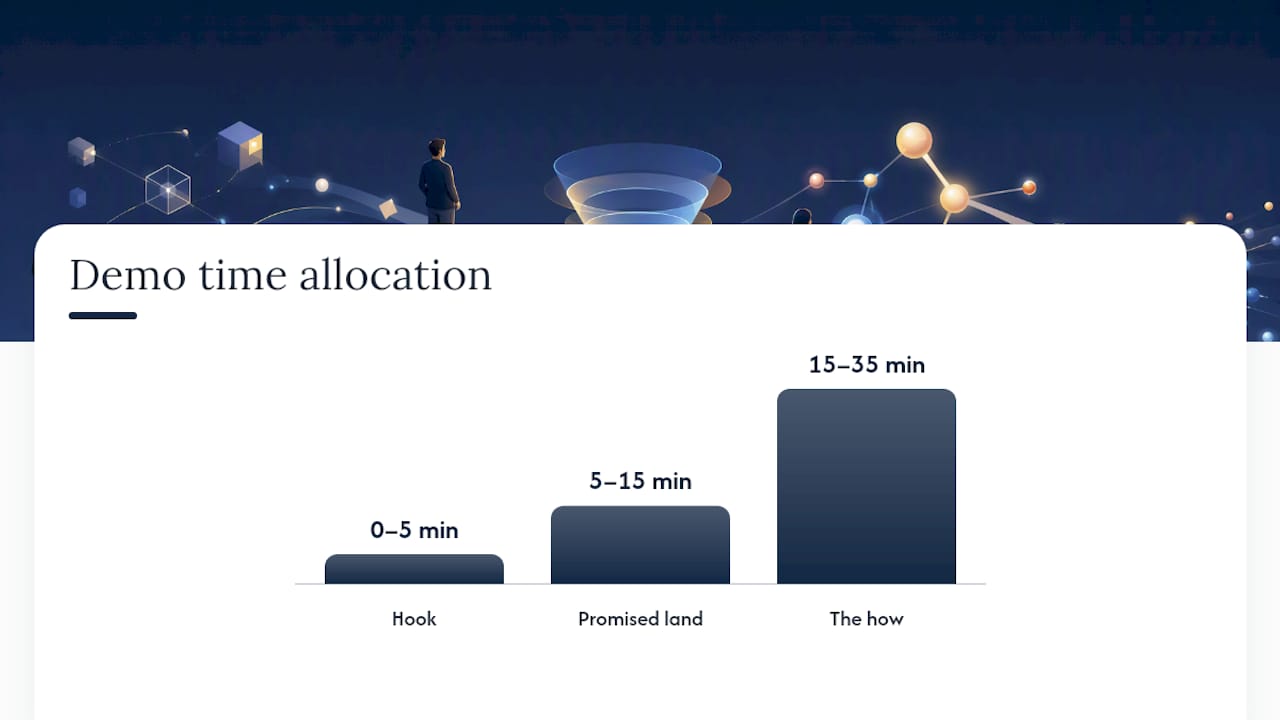
For demos, teach a four-part flow:
- Hook (0 to 5 minutes): confirm the buyer’s stated problem and set a single demo goal.
- Promised land (5 to 15 minutes): show the outcome first, the “killer feature” and its result, before explaining mechanics.
- The how (15 to 35 minutes): walk through the workflow that produces that outcome, tailored to what came up in discovery.
- Close and next steps: a specific commitment, not “let me know if you have questions”.
LevelUpDemo’s demo checklist adds a fail-safe layer worth teaching alongside the flow: research the prospect beforehand, prep a lived-in demo environment rather than a sterile default one, and send personalised follow-up within two hours of the call ending. Reps who skip the environment prep step are the ones whose demo crashes mid-pitch because they’re using seeded test data nobody’s touched in months.
Assessment idea: record every rep’s first five live demos and score them against a simple five-point rubric covering hook clarity, personalisation, time management, and close strength. Salesforce’s research shows only around 28% of reps hit quota in a typical year, and weak demo execution is one of the quieter reasons why.
Roleplay, analytics, and certification that hold up
Roleplay only works if it’s scheduled, not improvised the week before a review. Set a fixed cadence, say, one discovery roleplay and one demo roleplay per rep per fortnight, using a scoring template that doesn’t change from session to session, so progress is comparable over time.
- Discovery roleplay: score on uncertainty mapping, question relevance, and whether the rep stopped once they had enough evidence rather than working through a checklist regardless.
- Demo roleplay: score on hook strength, personalisation, and whether the “wow moment” landed within the first 15 minutes.
- Negotiation roleplay: score on how the rep handles a pricing objection without immediately discounting.
Conversation analytics tools can flag coaching moments automatically, long monologues, missed buying signals, weak closes, and surface anonymised call snippets from top performers as training examples. This is where microlearning earns its keep: a two-minute clip of a strong objection response, watched the same week a rep fumbled a similar moment, sticks better than a generic tip in a handbook.
Certification should have teeth. Set a clear pass mark, a remediation plan for reps who don’t hit it first time (not a second chance at the exact same test), and require manager sign-off before unsupervised customer contact.
Pro Tip: Use the same rubric for certification and for ongoing 1:1 coaching. If the language changes between “test mode” and “real coaching”, reps learn to perform for the exam rather than for the job.
Measuring the impact: KPIs that prove training worked
Training that isn’t measured is a cost centre with no defence when budgets get reviewed. Track these core metrics against a pre-training baseline:
- Ramp time: days or weeks until a new rep hits a defined productivity threshold.
- Demo-to-opportunity rate: the percentage of demos that convert to a qualified opportunity.
- Average deal size and quota attainment, tracked separately for new starters versus tenured reps.
- CS handover issues: the number of onboarding escalations traceable to a poor sales-to-success handoff.
- Operational signals: roleplays completed per rep, certification pass rates, and average call-quality scores from your rubric.
Salesforce’s data pointing to roughly 28% of reps hitting quota sets a rough external benchmark. If your quota attainment sits meaningfully below that after a full ramp cycle, training execution, not just talent, is worth investigating.
Set a baseline before you launch anything new, define a realistic target delta (a five to ten percentage point lift in demo-to-opportunity conversion within a quarter is a reasonable ask), and review it monthly rather than waiting for an annual report. A simple dashboard tracking these five metrics side by side will surface training leakage faster than a narrative summary ever will.
Should you buy a training programme or build one in-house?
The honest answer depends on four things: how fast you need results, what budget you’ve set aside, how much internal sales-training expertise already exists, and whether you can actually measure impact once it’s running.
- Buy when you need speed, lack a dedicated enablement function, or want an outside perspective to break bad habits fast.
- Build when your product or sales motion is unusual enough that generic content won’t map cleanly, and you have the internal bandwidth to maintain it.
- Hybrid (“buy then internalise”) is often the pragmatic middle ground: bring in external design and delivery to get the curriculum right, then hand ongoing coaching and reinforcement to your own managers.
Whichever route you pick, check licence terms, who owns the content afterwards, how much facilitator time it demands from your own team, and whether it integrates with your CRM and coaching workflow rather than living as a standalone system nobody revisits after week one.
How bespoke coaching maps to these modules in practice
Aheadofsales builds its programmes around the exact structure above: discovery and uncertainty mapping, demo flow design, objection handling, and certification, delivered through a mix of cohort training and 1:1 coaching rather than a slide deck handed over once and forgotten.
- Cohort sessions cover the shared framework (qualification language, demo structure) so the whole team speaks the same way about pipeline.
- 1:1 coaching addresses the individual gaps a group session can’t reach, a rep who freezes on pricing objections, another who over-talks in discovery.
- Fractional sales director support extends this into ongoing pipeline reviews, not just training delivery.
A team that starts with weak discovery habits and a generic demo script typically sees the clearest early shift in demo-to-opportunity conversion once discovery and demo modules are retrained and certified against a rubric, rather than left to informal habit. Aheadofsales’s sales acceleration packages are built around that kind of measurable, staged improvement rather than a single training event.
Renewals and upselling strategies within training modules
Most SaaS training programmes stop at the signature, which is a mistake given how much revenue sits in renewals and expansion. Build a dedicated module covering the handover from sales to customer success, because a poor handover is one of the most common causes of early churn, regardless of how well the initial deal was sold.
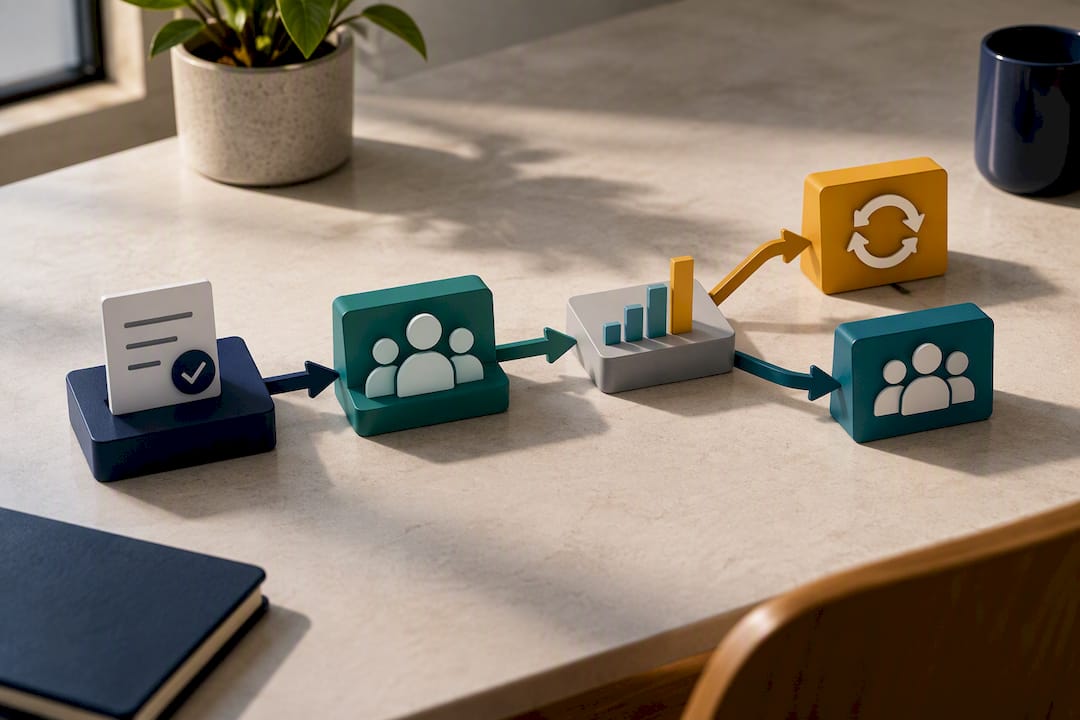
Teach reps to plant expansion seeds during the original sales cycle rather than treating upsell as a separate conversation months later. That means documenting where a customer’s usage is likely to grow, which teams beyond the initial buyer might adopt the product, and flagging this in the CRM before close, not after a renewal date appears on someone’s calendar.
Renewal conversations need their own objection-handling variant: buyers who’ve had a mixed first year push back differently than net-new prospects, often citing usage gaps or unmet expectations rather than price alone. Roleplay this specifically, using real (anonymised) renewal calls where possible, rather than assuming the objection-handling skills from new-business selling transfer automatically.
Where account management sits with the original seller rather than a separate team, build quarterly business review skills into the curriculum too: how to present usage data, connect it back to the original business case, and open an expansion conversation without it feeling like an upsell pitch bolted onto a routine check-in.
Where to focus first if your training budget is tight
If you can only fix two things this quarter, fix discovery and demo delivery first. They sit earliest in the funnel, so improvements there compound through every later stage, and they’re also the easiest to observe and score quickly through recorded calls.
Behaviour change doesn’t come from the training session itself. It comes from what happens in the weeks after, structured 1:1s where a manager reviews one real call, not a generic pipeline update, and gives specific feedback tied to the rubric you’ve already built. Reps forget slide decks. They remember being coached on a call they actually made.
— Jerry
Ready-built modules versus building your own from scratch
Reading a module catalogue is one thing; running it with a live team under quota pressure is another. Aheadofsales runs both routes: Sales Training Cohorts for teams roughly 50 to 1,000 strong who want the discovery, demo, and objection-handling curriculum delivered and coached rather than designed from a blank page, and a dedicated sales acceleration track for solo consultants and service business founders who need the same rigour without a training department behind them.
The difference from generic training content is the 1:1 layer. Cohort sessions build the shared framework; individual coaching fixes the specific habit holding one rep back, whether that’s a weak demo hook or a discovery call that turns into an interrogation. Bespoke coaching and consultancy engagements are available, as well as sales acceleration tracks for solo consultants, with pricing varying according to the size and complexity of the team involved.
If you’re not sure which fits, start with a discovery call. Visit Aheadofsales to request a skill audit against the modules covered here, and get a clear view of where your team’s ramp time and demo conversion actually stand before committing to a full programme.
Sources
Claims in this article draw on Highspot’s discovery framework, Rep’s SaaS demo guide, LevelUpDemo’s demo checklist, Dale’s research on SaaS training strategies, and Salesforce’s state of sales data, alongside Harvard Business Review’s guidance on making training stick.
- 50 discovery call questions — Highspot
- SaaS demo best practices: a founder’s guide | Rep
- SaaS demo checklist: a step-by-step guide for 2026 | LevelUpDemo
- Mastering SaaS sales: effective training strategies | Dale
FAQ
What are some good topics for SaaS sales training?
The strongest starting set covers discovery, demo delivery, qualification, objection handling, buyer committee navigation, and certification-based practice. Aheadofsales structures its SaaS training modules around this exact catalogue, adapted to each team’s product and sales cycle.
What are the 5 C’s of sales?
Definitions of the “5 C’s” vary across sources, and there’s no single agreed version specific to SaaS selling. Rather than force-fit an unverified acronym, focus on the module areas covered above: discovery, qualification, demo delivery, objection handling, and closing, since these map to measurable outcomes.
What are the 7 golden rules of sales?
There’s no universally agreed list of “7 golden rules” backed by consistent industry sources. What does hold up across the research is that discovery should resolve genuine uncertainty rather than follow a fixed script, and that demos work best when they lead with the result rather than a feature tour.
How difficult is SaaS sales?
SaaS selling is demanding because deals often involve multiple stakeholders, longer cycles, and technical complexity that reps must translate for non-technical buyers. Quota attainment reflects this difficulty: Salesforce’s data shows only around 28% of reps hit quota in a typical year, which is exactly why structured, practice-heavy training matters more than a one-off induction session.
How much does SaaS sales training cost?
Aheadofsales prices its team-based bespoke coaching and consultancy engagements between £4500 and £8500 as a one-off, while the solo sales acceleration track is priced between £2995 and £5995 for a one-off. Cohort programme pricing and other packages are available on request via Aheadofsales.