
The single best move for Series B sales training is personalised 1:1 coaching paired with cohort reinforcement and just-in-time microlearning, built around live deals rather than a classroom calendar. Done this way, we’ve seen the approach drive faster rep ramp, stronger win rates and quicker deal velocity. Gartner and McKinsey both point the same direction, and practitioners build programmes around exactly this model.
TL;DR:
- Gartner found that just in time nudges combined with coaching can be two to two and a half times more effective than classroom training alone.
- Match format to deal complexity: senior account executives need bespoke coaching, while cohort programs suit teams hired during a growth push.
- Run a baseline before launch, then review ramp time, stage conversion, pipeline velocity, and logged coaching activity every two to four weeks.
- Train managers before reps and establish the change story first; the suggested rollout spans 90 days, with cohort coaching beginning in weeks three to six.
Table of Contents
- What makes Series B sales training effective
- Training formats, modules and delivery options founders should consider
- How to measure training impact: KPIs, leading indicators and reporting cadence
- Rollout and adoption: change story, manager role and sustaining behaviour change
- Ahead of Sales: how a practitioner builds Series B ready programmes
- Integration of sales training with fundraising and investor relations
- Case studies or success stories of Series B sales training outcomes
- Practitioner perspective: common mistakes Series B leaders make and what to do instead
- How Ahead of Sales can help: package options and next steps
- FAQ
- Sources
What makes Series B sales training effective
Most sales training fails at Series B for a simple reason: it’s designed for a smaller, simpler team and never redesigned for the complexity that follows a growth round. Once you’re carrying bigger quotas, longer sales cycles and a more varied buyer base, broad classroom sessions stop moving the needle.
McKinsey’s research on next-generation B2B sales capabilities makes the point directly: personalised, experiential learning applied to active deals outperforms broad classroom approaches when organisations are trying to scale. The same research found that many leaders estimate only a portion of their salesforce has the capabilities needed for next-generation selling, which tells you the reskilling gap at this stage is rarely small.
Effective programmes share a few traits:
- They attach to real, live opportunities rather than hypothetical case studies.
- They run on a weekly cadence, mixing peer coaching, manager mentorship and 1:1 coaching sessions.
- They use just-in-time nudges, delivered at the moment a rep needs them, rather than a single upfront course.
- They rely on deal and pipeline data to target coaching where it will move a specific stage forward.
Gartner’s leadership research on sales enablement found that just-in-time learning and behavioural nudges measurably improve seller revenue outcomes compared with static training, and that nudges combined with coaching can be two to two and a half times more effective than classroom-only approaches. That’s a strong argument for building coaching into the workflow rather than bolting training onto the calendar.
Data and AI tools increasingly make this targeting possible. Instead of guessing which rep needs help with discovery calls versus negotiation, managers can see exactly where deals stall and coach to that specific gap, which shortens the distance between a training intervention and a faster-moving pipeline.
Pro Tip: Tie every coaching session to a specific deal stage a rep is currently working through, not a generic skill category.
Training formats, modules and delivery options founders should consider
Series B leaders rarely need one training format. They need a curriculum that blends several, matched to the problem each one solves best.
- Bespoke 1:1 coaching works best for senior AEs carrying complex, high-value deals where generic advice falls short.
- Cohort programmes suit mid-sized teams hired in a single growth push, giving new starters a shared foundation and a peer group.
- Short masterclasses fit a narrow skill gap, such as objection handling or pricing conversations, and typically run as a half-day or two-hour session.
- Microlearning integrated with CRM delivers prompts at the point of need, for example a script suggestion the moment a deal moves to a negotiation stage.
- Negotiation simulations give reps a safe space to rehearse high-stakes conversations before they happen with a real prospect.
SaaS founders tend to lean on cohort training plus SaaS-specific modules that address usage-based pricing conversations and procurement cycles. Professional services founders often need more bespoke 1:1 work, since their deals are more relationship-driven and harder to templatise. Enterprise AE teams typically benefit most from negotiation simulations and CRM-integrated microlearning, since their deal cycles are long enough that a single nudge at the right moment can shift an outcome.
A workable curriculum blends these: a cohort kickoff to establish shared language, 1:1 coaching layered on top for the reps carrying the biggest deals, and microlearning nudges running continuously in the background. Most formats run in cycles of four to twelve weeks, with 1:1 coaching often continuing well beyond that as an ongoing cadence rather than a fixed course.
How to measure training impact: KPIs, leading indicators and reporting cadence
Training investment without measurement is a guess dressed up as a strategy. A tiered metrics model gives you a way to judge impact without waiting months for revenue to move.
- Tier 1, productivity metrics: activity volume, call quality scores, time spent in live deals.
- Tier 2, lagging indicators: win rate, average deal size, quota attainment.
- Tier 3, leading indicators: ramp time to first deal, stage conversion rate, pipeline velocity.
The link between these tiers matters more than any single number. A leading indicator like stage conversion should trace back to a specific coaching activity, for example a negotiation module, and that activity should eventually show up in a lagging metric like win rate. When you can draw that line, you know the training is working rather than merely happening.
Faster sales stage velocity is one of the clearest signals to watch. Gartner predicts AI-driven sales enablement will deliver significantly faster sales stage velocity than traditional enablement methods by 2029, which gives Series B leaders a concrete benchmark to aim coaching investment towards.
Run a baseline test before any new programme starts, then review results on a short sprint cadence, ideally every two to four weeks, rather than waiting for a quarterly business review. A simple dashboard for managers and CSOs showing ramp time, conversion by stage and coaching activity logged against each rep is usually enough to spot what’s working early.
Rollout and adoption: change story, manager role and sustaining behaviour change
A good programme can still fail if the rollout is weak. McKinsey’s research on B2B capability building points to culture, not content, as the usual bottleneck: leaders need a clear change story and incentives tied to the new behaviours, or the rollout stalls quietly.
- Write the change story first: explain why the old approach won’t scale and what’s different now.
- Secure manager sponsorship before launch, since managers who believe in the programme will coach to it and managers who don’t will let it slide.
- Put managers through coaching training before reps, so they can run ride-alongs and performance conversations that reinforce what reps learn.
- Build apprenticeship and peer coaching into the weekly rhythm rather than treating it as optional extra.
- Use just-in-time nudges to keep behaviours fresh between formal coaching sessions.
A sample 90-day sequence: weeks one to two for manager training and the change story, weeks three to six for the first cohort plus early 1:1 coaching, weeks six to ten for peer coaching cadence to kick in, and weeks ten to twelve for a review against the baseline metrics set earlier.
Pro Tip: Celebrate one visible early win, such as a rep closing a stalled deal using a new negotiation technique, to keep momentum through the harder middle weeks of rollout.
Ahead of Sales: how a practitioner builds Series B ready programmes
Programmes are built around the same principles the research points to: personalisation, live-deal application and manager-led reinforcement, rather than a one-off workshop that fades within weeks.
Our offering spans several formats to match where a business sits:
- Bespoke 1:1 coaching and consultancy for teams that need senior AEs coached against live, complex deals.
- Sales Training Cohorts for mid-sized teams hired in a single growth push who need a shared foundation.
- A sales acceleration track built specifically for solo service businesses and consultants who are selling and delivering at the same time.
- A fractional sales director option for businesses that need strategic sales leadership without a full-time hire.
Team-based bespoke coaching and consultancy engagements are offered as one-off packages aimed at businesses roughly 50 to 1,000 staff with a growth mindset. The solo acceleration track is built for individual consultants and service founders rather than larger teams. Both packages lean on a coaching-plus-consultancy model: personalised sessions tied to real pipeline, with manager or founder involvement and ongoing reinforcement rather than a single training day.
Integration of sales training with fundraising and investor relations
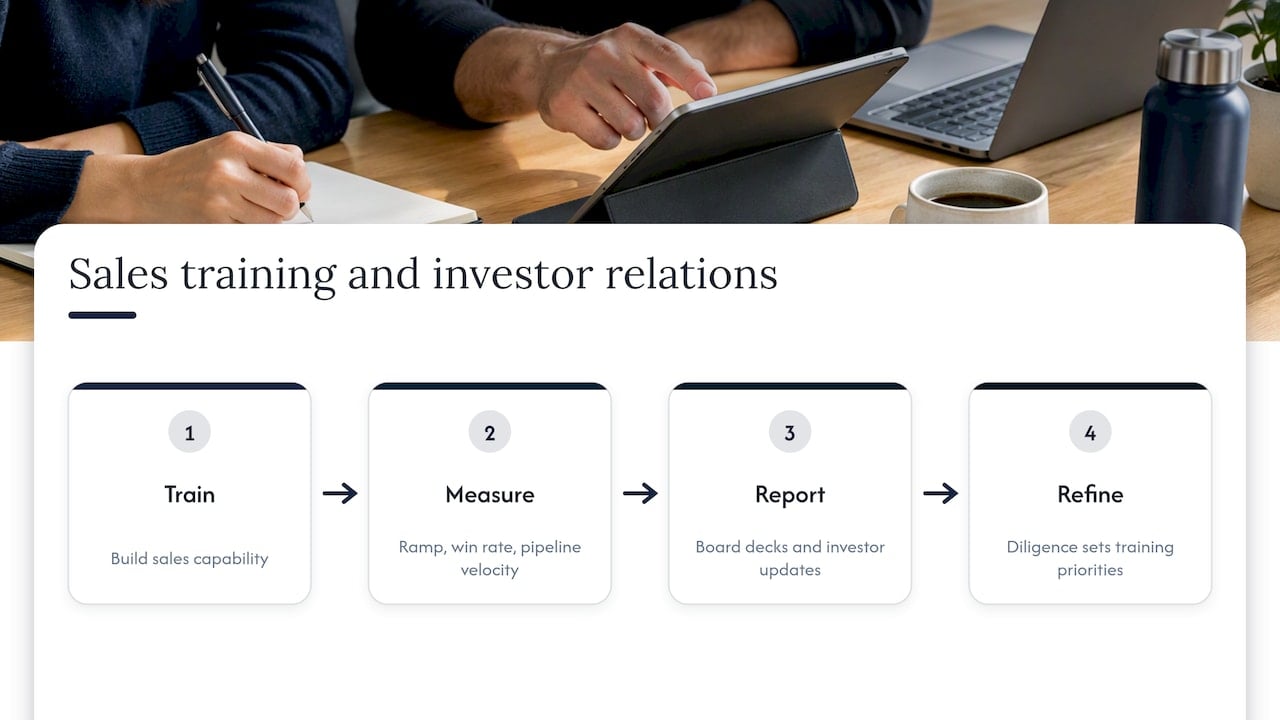
Series B sales training doesn’t sit in isolation from the fundraising story. Investors backing a growth round are underwriting a sales engine, and the metrics that come out of a well-run training programme, ramp time, win rate, pipeline velocity, are often the same ones that appear in a board deck or a future fundraising narrative.
Founders preparing for a next round benefit from treating sales capability as part of the investor relations story, not a separate workstream. A improving ramp time or a rising win rate gives a founder a concrete, defensible data point to bring to investor updates, rather than a qualitative claim that the sales team is “getting stronger.” Founders building a capital raising narrative alongside their sales programme may find it useful to work from a structured capital raising checklist, which helps align what investors expect to see with what the sales organisation can realistically demonstrate by the time of a next round.
The reverse link matters too: a fundraising process often surfaces exactly where the sales engine is thin, since investor diligence tends to probe quota attainment, rep productivity and pipeline coverage in detail. Treating that diligence as an early signal, rather than a pass or fail moment, gives a sales leader a head start on the training priorities the next 12 months will demand.
Case studies or success stories of Series B sales training outcomes
The pattern across well-documented B2B scaling research is consistent: companies that combine personalised coaching with technology and hyperpersonalised execution grow faster than those relying on broad, generic training. McKinsey’s analysis of B2B growth leaders found that top-performing organisations combine omnichannel sales teams, advanced sales technology and hyperpersonalisation to accelerate growth, a combination that training programmes need to prepare reps for directly rather than leaving them to work out independently.
The practical lesson for a Series B leader reading these outcomes is not to copy a specific case study wholesale, since every pipeline and buyer base differs, but to apply the same underlying levers: personalise the coaching to the deal in front of a rep, give managers the tools to reinforce it, and measure the result against a clear baseline. Businesses that have run structured sales acceleration programmes alongside a growth round report the same combination showing up in their own numbers: shorter ramp times for new hires and a tighter link between coaching activity and deals actually closing.
Practitioner perspective: common mistakes Series B leaders make and what to do instead
The biggest mistake we see is waiting for perfect CRM data before starting any coaching. That wait can cost months. A better approach, backed by McKinsey’s research on B2B sales transformation, is to pick one high-value pipeline use case, instrument it, run a short sprint and scale from there.
The second mistake is treating training as a single classroom event rather than a repeated rhythm. One workshop rarely survives contact with a busy quarter. Microlearning and coaching, repeated weekly, stick far better than a day-long session nobody revisits.
Third, many leaders invest in tools before they invest in manager capability. Get managers coaching well first; the tools amplify good coaching, they don’t replace it.
For a 90 day plan: pick one use case, train managers first, then launch coaching tied to live deals.
— Jerry
How Ahead of Sales can help: package options and next steps
If you’re scaling a sales team through Series B and want training that’s personalised, measurable and tied to live deals rather than a generic course, that’s precisely what we build.
Depending on where your team sits, a few of our packages are likely to fit:
- The Sage Collective, our ongoing coaching membership, at £990 per month.
- Sales Training Cohorts for teams hired in a growth push who need a shared foundation.
- Fractional Sales Director services for businesses that need senior sales leadership without a full-time hire.
- Solo sales acceleration for founders and consultants selling and delivering at the same time, via our solo coaching programme.
| Package | Fits |
|---|---|
| Ongoing coaching membership | Ongoing coaching membership |
| Team-based coaching and consultancy | Businesses roughly 50-1,000 staff |
| Solo sales acceleration track | Solo service businesses and consultants |
The next step is a conversation about where your team is today and which package fits. Visit our sales training cost page to see how a customised package would be scoped for your stage of growth.
FAQ
Who is considered a leading authority on B2B sales training?
There’s no single, universally agreed “number one” sales trainer; the field includes many respected practitioners and firms with different specialities. What matters more for Series B leaders is choosing a trainer or programme whose methodology, whether cohort-based, 1:1 coaching or consultancy, fits their specific stage and deal complexity.
What should founders learn first about B2B sales when scaling?
The first lesson most founders learn is that B2B sales at scale depends on repeatable process, not individual heroics. Personalised coaching tied to live deals, reinforced by managers, tends to build that repeatability faster than one-off training sessions.
What salary range should I expect for B2B sales roles?
Salary ranges for B2B sales roles vary widely by seniority, sector and region, and no single figure applies across the board. Rather than anchoring on a generic number, benchmark against roles of similar complexity and quota size in your own market.
What is the 3-3-3 rule in sales?
Definitions of the “3-3-3 rule” vary across sales commentary, and there’s no single authoritative version. Given that inconsistency, it’s worth treating any specific framework you encounter as one interpretation among several rather than an industry standard.
How much does Series B sales training typically cost?
Pricing depends heavily on format and team size. Our team-based coaching and consultancy packages run from £4500 to £8500 as a one-off, while our solo sales acceleration track runs from £2995 to £5995 as a one-off, and our ongoing Sage Collective coaching membership is 990 £ per month.
Sources
- Building next‑generation B2B sales capabilities
- Leadership Vision for 2024: Sales enablement leaders
- Gartner press release on AI-driven sales enablement