
A mutual action plan (MAP) is a shared document that a seller and a buyer build together. It sets out who needs to do what, and by when, for the buyer to reach a successful purchase and a smooth start. It is also called a mutual close plan, a mutual success plan or a joint execution plan, and the “MAP” you may have seen in sales conversations almost always means this. Below, I explain what goes into one, when to introduce it, how to keep it alive and where teams go wrong.
TL;DR
- A MAP is a customer-facing plan, co-created with the buyer, that maps actions, owners and dates from first agreement to go-live.
- It works best on complex, multi-stakeholder deals, and you should introduce it early, once you understand the buyer’s problem, and ask permission first.
- Every step needs a named owner on both sides and a real date. Vague ownership and missing dates are the commonest failures.
- A MAP differs from your internal close plan: the buyer sees it, edits it and owns half of it.
- If a buyer will not spend time on a MAP, that is useful information about how real the deal is.
Table of Contents
- What a mutual action plan is, and what MAP means in sales
- Why mutual action plans help buyers and sellers
- What to include in a mutual action plan
- When to introduce a MAP in your sales process
- How to build and maintain a mutual action plan
- Common mistakes with mutual action plans
- Perspective: why we put MAPs at the heart of deal reviews
- How we can help
- Frequently asked questions
- Sources
What a mutual action plan is, and what MAP means in sales
MAP stands for mutual action plan. One guide puts it simply: it exists to answer who needs to do what, and when, to make the deal happen. Another describes it as a shared document, typically a collaborative spreadsheet or document, showing how the buying and selling organisations will solve a problem together.
The word that matters is mutual. Dock’s view is that it means co-created and co-owned. It does not mean the seller can hand the admin to the buyer and hope. The seller usually does most of the operational work (drafting, sharing, updating, chasing), but the buyer’s name sits against real tasks and the buyer agrees the dates.
I like to describe it to clients this way: a MAP is the buyer’s project plan for solving their problem, with your product or service as one part of it. If it reads like your sales process with the buyer’s logo pasted on, it is not a MAP.
MAP versus your internal sales action plan
Most sales teams already have some form of close plan. The difference is ownership. Smartsheet’s guide explains that an internal sales action or close plan records the seller’s own steps toward closing and need not be shared with, or co-owned by, the buyer. A MAP is customer-facing and jointly informed, and it covers the buyer’s outcome as well as both parties’ actions.
Rework makes the same point: traditional plans are owned internally by the seller, while MAPs are created with the buyer to build shared commitment. You still need your internal plan. It holds the things you would not share, such as your own forecasting notes and your view of each stakeholder. The MAP is the version you are happy for the buyer’s finance director to read.
Why mutual action plans help buyers and sellers
Buyers rarely complain that a supplier was too organised. Most B2B purchases involve several people, internal approvals and a process nobody fully owns. Salesforce reports that B2B buying journeys can last anywhere from three to 24 months, which is a long time for a deal to drift.
What the buyer gets
Dock’s guide says a MAP reduces surprises and workload for the buyer, makes responsibilities visible and can build trust by showing the seller as an organised partner. In practice that means your champion is not left to explain, from memory, what happens after the demo. They can forward one document to a colleague who arrives late to the decision, and that colleague understands the deal in five minutes.
What the seller gets
For you, the benefits are mostly about visibility. Clari’s guide says MAPs help sellers identify internal processes and stakeholders early, expose roadblocks, reduce communication delays and improve close-date projection. Salesforce adds that a MAP gives you a regularly updated single source of truth, creates urgency and accountability, and helps guide how you engage.
There is a quieter benefit too. Rework describes it as bilateral accountability: the process stops being purely seller-driven, and both sides commit to shared objectives. That shift changes the tone of follow-up calls. You are no longer chasing, you are reviewing progress against something the buyer agreed to.
One more point, which I have seen play out many times. Salesloft’s perspective is that if a buyer is unwilling to invest time in a MAP, disqualifying faster can shorten your sales cycle. I agree. A deal where the buyer will not commit to a single date is usually not the deal your forecast says it is.
What to include in a mutual action plan
Keep it to one page where you can. Highspot’s UK guide suggests including the buyer’s desired outcome and success criteria, milestones and target dates, buyer and seller owners, deliverables, status, approval checkpoints, dependencies, funding, procurement, legal and technical steps, implementation or onboarding, and measurable checkpoints. Outreach’s template is shorter: objective, milestones and target dates, owners on both sides, deliverables, status and success metrics.
Here is how I would arrange those elements in a simple table.
| Element | What to write | Why it matters |
|---|---|---|
| Buyer’s goal | The outcome in the buyer’s own words, with a measure | Keeps the plan about their result, not your signature |
| Milestones | Key steps in order, from next meeting to go-live | Shows the whole route at a glance |
| Dates | A target date for each step, agreed with the buyer | Turns intentions into commitments |
| Owners | One named person per step, buyer or seller | Stops “the team” owning everything and nothing |
| Dependencies | What must happen first, such as budget approval | Exposes blockers early |
| Approvals | Procurement, legal, security, finance sign-off | The steps that most often cause late slippage |
| Status | Not started, in progress, done, blocked | Makes review meetings quick |
| Onboarding | What happens after signature | Reassures the buyer that the plan runs past the contract |
A short worked example
Imagine you are selling a sales training programme to a 120-person UK services firm. The managing director wants the sales team to hit quarterly target consistently by the start of the next financial year. A simplified MAP might look like this:
- Discovery call with the managing director and sales director, to agree the goal and the measure (owner: me, this week).
- Skills and pipeline review shared with the team (owner: sales director, supplies two months of pipeline data).
- Proposal reviewed by the managing director and finance director (owner: managing director, internal review meeting booked).
- Procurement and contract check (owner: finance director, named contact confirmed).
- Kick-off session and first coaching block scheduled (owner: me, with the sales director confirming diaries).
- First review against the agreed measure (both owners).
Each line has a person and a date. That is all it takes. The skill is in getting the buyer to fill in the buyer’s lines honestly, particularly the approval steps.
When to introduce a MAP in your sales process
Earlier than most people expect. Accord recommends introducing it around the time you create the CRM opportunity, once you understand the buyer’s problem, and asking permission first. Introduce it before you understand the problem and it feels like pressure. Wait until after the proposal and it feels like a closing tactic.
A line that works well: “Would it help if we mapped out the steps between now and having this running, so neither of us is surprised by anything?” That frames the plan as protection for the buyer.
Dock notes that MAPs are especially useful for higher-value, complex opportunities with multiple stakeholders and longer cycles, though they can also add structure to transactional deals. If you sell a £500 product to one person who decides in a day, skip it. If three departments and a procurement team are involved, use one. If you want to see where a MAP sits among the other stages, our B2B sales cycle stages guide walks through the full journey.
How to build and maintain a mutual action plan
Work backwards from the buyer’s outcome
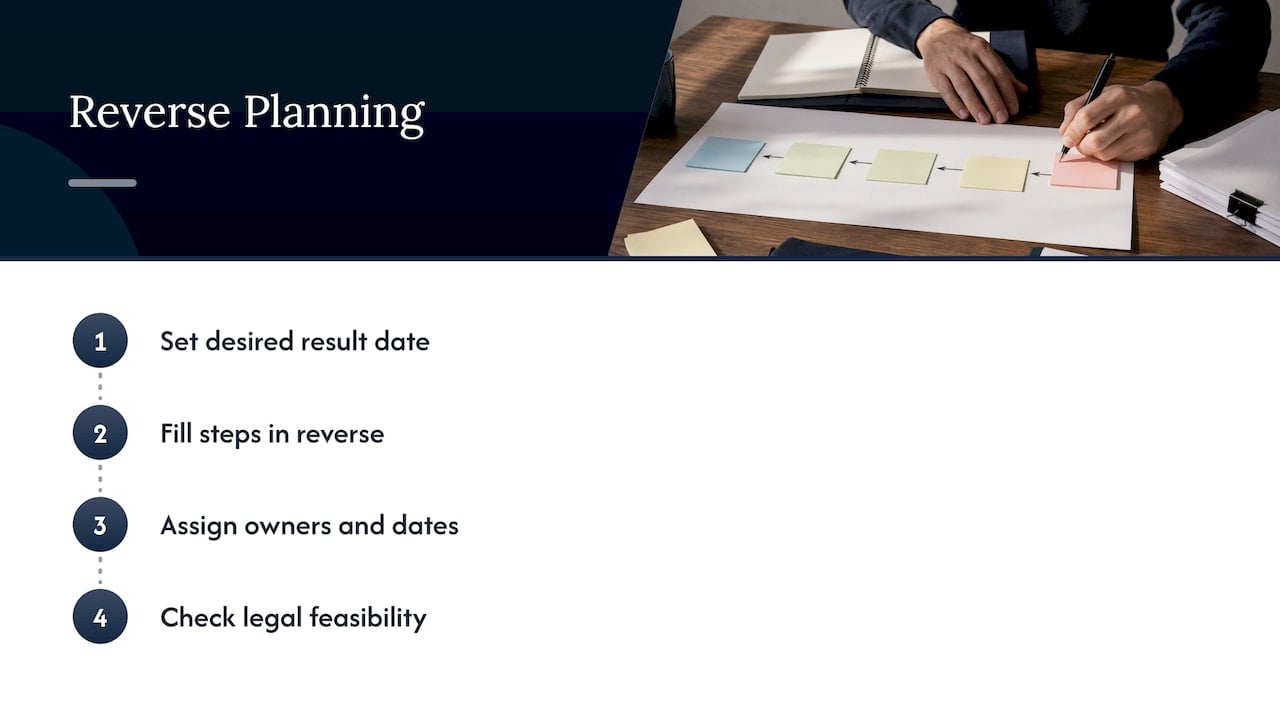
Salesforce suggests working back from the desired outcome by asking what must happen, when and who is responsible. Start with the date the buyer wants the result, then fill in the steps in reverse. This is also the quickest way to discover that the buyer’s preferred start date is unrealistic once legal review is counted.
Draft it, then co-author it
Smartsheet’s advice is that the seller should initiate the MAP, but both sides should co-author it so the problem, value, roles, timelines and deliverables are jointly understood. In practice: bring a draft with your steps filled in and the buyer’s steps left as questions. Then ask your champion to complete the gaps in the meeting, not afterwards by email.
Use it in every conversation
Accord recommends consulting the plan at least once in every meeting, usually at the start or the end, so it remains the source of truth for the relationship. I would add that you should send the updated version within an hour of each call. A plan that is only touched at the end of the month is a plan the buyer has forgotten.
On deals with many moving parts, the maintenance burden is real. If your team struggles to keep records current, AI handling CRM actions is one way some companies reduce the manual follow-up that lets plans go stale. Whatever you use, the rule is the same: one live version, visible to the buyer, the rep and the sales manager.
Our own sales follow-up workflow guide covers the cadence between meetings, and our piece on an effective sales meeting process shows how to structure the calls that review the plan.
Common mistakes with mutual action plans
Vague ownership and missing dates. Rework flags both as common errors. “Legal review: buyer’s team, sometime in March” is not a step. “Legal review: Priya Shah, by 14 March” is.
Treating it as a way to get a signature. Salesforce warns against framing a MAP as a device to get a contract signed. It should centre the buyer’s outcomes, implementation and expected value. Buyers can smell a countdown timer in a spreadsheet.
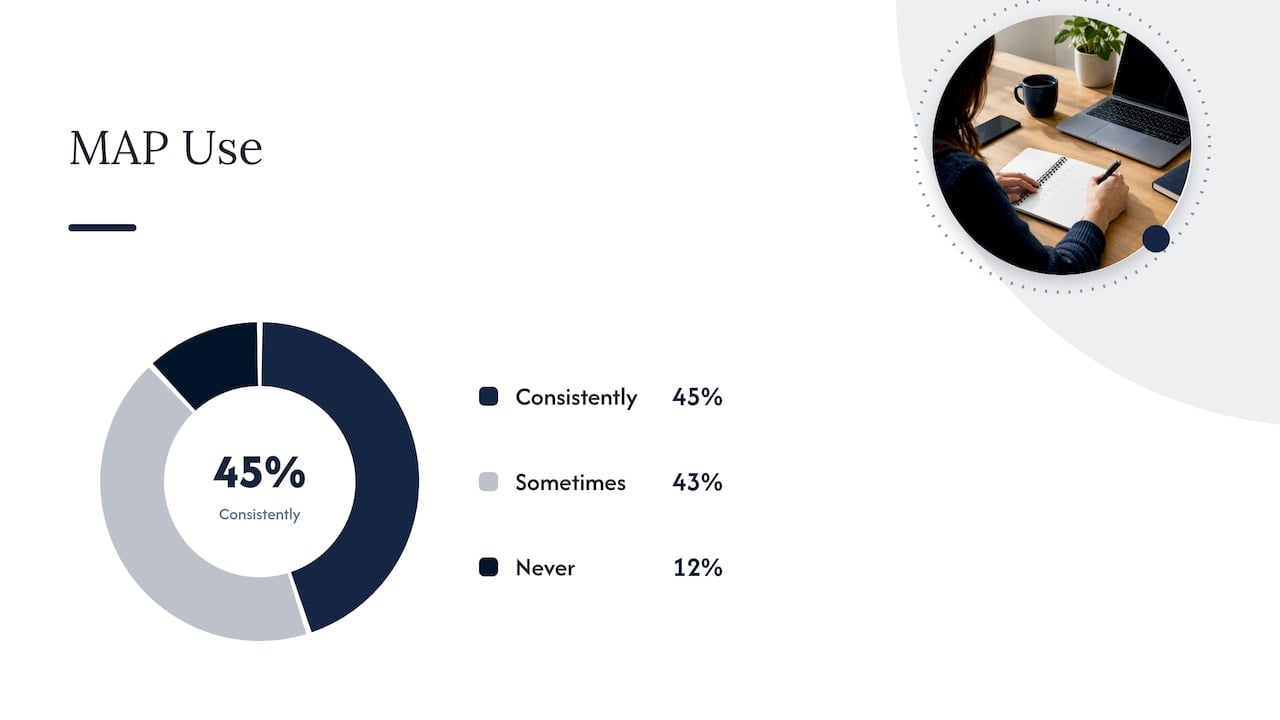
Inconsistent formats and a plan that lives apart from daily work. Outreach identifies inconsistent formats, separation from daily workflows and weak buyer engagement as typical problems, and proposes templates and process integration as remedies. Outreach also reports that 45% of sellers consistently use MAPs, 43% use them sometimes and 12% never do, so most teams are somewhere in the middle, and a shared template is what makes usage consistent.
Skipping the awkward steps. Procurement, security review and legal are the ones buyers avoid mentioning. Ask about them directly. “Who else needs to approve this, and what do they usually need to see?” is one of the most valuable questions in a deal.
Sending it cold. A MAP emailed to a stranger before any conversation is a template, not a plan. It has to be built with someone who cares about the result.
Perspective: why we put MAPs at the heart of deal reviews
We work with sales teams and solo service owners who often say the same thing: “The deal went quiet.” When we look closer, the deal rarely went quiet by accident. Nobody agreed what happened next, so nothing did.
Our view is that a MAP is a coaching tool as much as a deal tool. When a rep brings us a stalled opportunity, we ask to see the plan. If the buyer’s side is blank, we know the real problem is the conversation, not the follow-up: the rep has not yet earned enough trust to ask the buyer to commit time. That is a skills issue, and it is fixable through objection handling, consultative questioning and honest qualification.
We also believe a MAP should be allowed to end a deal. If a buyer agrees steps, then misses all of them, the plan has done its job by showing you where to spend your time. Teams that accept this forecast more accurately and sell with more confidence, because they are no longer defending hope.
For teams, we build MAP discipline into pipeline reviews, so managers inspect buyer actions and not just rep activity. For solo owners, the plan is a gentle way to sell without feeling pushy: you are simply organising the buyer’s decision.
— Jerry
How we can help
If you want your team to use MAPs consistently, with coaching on the conversations that make buyers commit, our team-based bespoke coaching and consultancy engagements run at £4,500 to £8,500 one-off. For solo service businesses and consultants, our sales acceleration track runs at £2,995 to £5,995 one-off. You can see how the packages work on our sales training cost page, or look at our sales consultancy services if you would rather start by fixing the process. If you lead a sales team and want to see how deals are managed week to week, our sales team management workflow article is a good companion read.
Frequently asked questions
What is a mutual action plan in sales?
It is a shared plan between buyer and seller listing the actions, owners and dates needed to reach a purchase decision and a successful start. It is built together and both sides keep it up to date. Other names include mutual close plan, mutual success plan and joint execution plan.
What does MAP mean in sales?
In sales, MAP almost always means mutual action plan. The point of it is to make clear who does what, and by when, so the deal moves forward on agreed terms.
Who should create the plan, the buyer or the seller?
The seller usually starts it and does most of the upkeep, but the buyer should help shape and own their share. If the buyer never edits it, it is still just your close plan with a different title.
Do I need a MAP for every deal?
No. They pay off most on higher-value deals with several stakeholders and long cycles. For quick, single-decision sales, a short email confirming next steps is usually enough.
Sources
- A Guide to Using a Mutual Action Plan, Salesforce
- The Ultimate Guide to Mutual Action Plans, GTM Now
- What is a mutual action plan in B2B sales, Accord
- Free Mutual Action Plan Sales Templates, Smartsheet
- Mutual Action Plans 101, Dock
- How Mutual Action Plans Help Increase Sales, Clari
- Mutual Action Plans: Collaborative Closing with Buyer, Rework
- Mutual Action Plan: Essential for Deal Collaboration, Highspot
- Mutual action plans: 5 tips for your sales team, Outreach
- 10 Key Mutual Action Plan Elements for Sales, Salesloft