
The best approach is a blended model: bespoke 1:1 coaching for reps, coaching skills for the managers who lead them, and practice-led cohorts, all tied to measurable KPIs. Done well, it shortens ramp time, lifts quota attainment and sharpens forecast accuracy. Below, we set out what to look for, how to evaluate vendors, how to measure results and how to connect coaching to your tech.
TL;DR:
- Reject proposals that cannot explain fit with deal size and cycle, manager transfer, cadence, outcomes, coach ratio, scalability, and transparent pricing.
- Ask how vendors handle trust or structural problems uncovered during coaching, because a 2025 B2B team case study found these can block lasting improvement.
- Pilot one to one coaching with four to six reps, then expand only when leading indicators such as stakeholder engagement and next step quality improve.
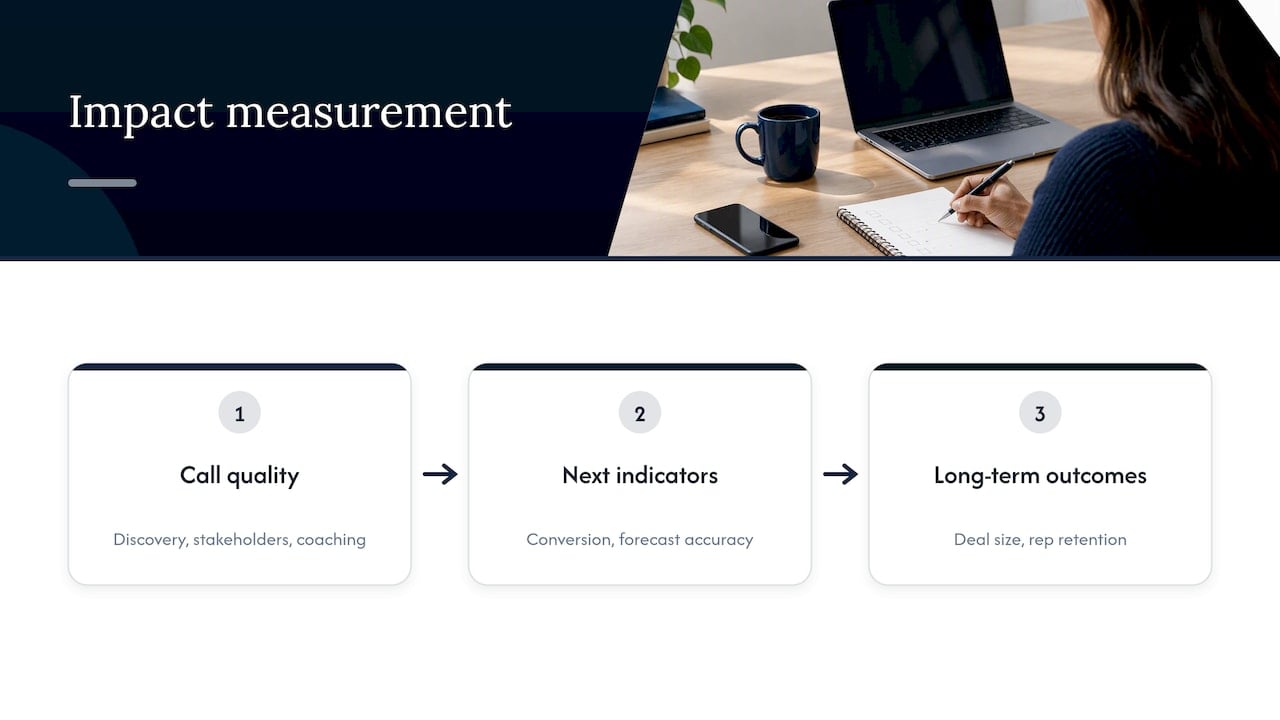
- Set baselines before launch; leading indicators such as call quality and stakeholder engagement move first, while deal size and retention need completed sales cycles.
- Connect CRM activity, call snippets, and practice prompts to existing workflows, and pair every AI suggestion with human feedback to prevent low adoption.
Table of Contents
- What does good enterprise SaaS sales coaching include?
- How do you evaluate and choose a coaching programme for your team?
- Which delivery model fits your team: 1:1, cohort, workshop or fractional director?
- How should you measure impact, and how long does it take?
- How do you connect coaching to sales technology and AI?
- Why most coaching fails to scale, and what we do differently
- How can we help your enterprise SaaS team?
- FAQ
- Sources
What does good enterprise SaaS sales coaching include?
Enterprise deals run for months, involve buying committees and hinge on procurement. Generic skills training rarely survives contact with that reality. Good coaching is built around the deal your reps actually face, and it has several parts working together:
- One-to-one sessions focused on live opportunities, not abstract theory.
- Manager enablement, so coaching continues after any external coach has left.
- Live call coaching, where a coach reviews real conversations and gives calibrated feedback.
- Negotiation and stakeholder management practice, including multi-threading and senior sell-in.
- A shared skills rubric, so every coach and manager scores the same behaviours the same way.
Coach credentials matter more than polish. Look for someone who has sold at your ARR range, handled complex procurement and sold to senior stakeholders. A coach who has only sold transactional deals may struggle to advise on a high-value, multi-stakeholder cycle. The research agrees on where the difficulty sits: a semi-systematic review of large B2B deals identifies stakeholder management, product tactics and commercial tactics as the core micro-level tactics, and stresses adapting your approach to context and building trust with stakeholders.
Embedded practice is what separates coaching from a motivational talk. Role plays with a silent observer, structured feedback against the rubric and review of recorded calls with sensitive details redacted all turn learning into habit. If you want more detail on how we define the discipline, our guide to what sales coaching for SaaS looks like in practice goes further.
How do you evaluate and choose a coaching programme for your team?
Judge every proposal against consistent criteria: fit with your deal size and cycle length, how coaching transfers to your managers, coaching cadence, measurable outcomes, coach-to-rep ratio, scalability and pricing transparency. A programme that cannot answer clearly on all seven is not ready for an enterprise team.
Then put questions like these to every vendor:
- How do you measure impact on ramp time? A strong answer shows a sample dashboard, not a promise.
- Which enterprise deal sizes have your coaches personally sold?
- How do you transfer coaching skills to our front-line managers?
- What is the cadence of sessions, and who owns the follow-up between them?
- What is your coach-to-rep ratio, and does it change as we scale?
- How do you coach on live opportunities rather than hypotheticals?
- Which leading indicators will we see during the engagement?
- How do you handle trust or structural issues that surface during coaching?
- What does the pricing include, and what costs extra?
- What happens when the engagement ends: how does the coaching sustain itself?
Question eight deserves attention. A 2025 case study of a B2B sales team intervention found that coaching often exposes underlying trust and structural problems, and that these must be addressed before coaching can deliver lasting improvement. A vendor who has never seen this has probably not coached an enterprise team.
Pro Tip: Ask each vendor to describe a pilot that failed to deliver and what they changed. The quality of that answer tells you more than any case study.
Expect a sensible engagement to move through phases such as audit, pilot, roll-out and sustain. If you want a quick structural check before you start, our coaching rubric guide shows how we approach coaching structure.
Which delivery model fits your team: 1:1, cohort, workshop or fractional director?
The right format depends on team shape and urgency, and most enterprise teams end up combining two. Here is how we see the four main options:
- 1:1 coaching suits senior reps and managers working live, high-value deals. It is the fastest route to impact on specific opportunities, but the cost per rep is the highest. Pilot it with a small group of four to six reps, track leading indicators such as multi-threading and next-step quality, and expand when this move.
- Cohorts suit teams that need a common method and peer practice. Cost per rep falls and a shared language emerges, though impact on individual deals comes more slowly. Pilot one cohort, measure skill rubric scores before and after, and expand when scores and manager feedback improve together.
- Workshops suit a single, defined gap, such as negotiation or discovery. They are quick and affordable but fade without follow-up, so pair them with manager coaching. Treat the pilot as a test of whether behaviour changes within 30 days.
- A fractional sales director suits a team without senior sales leadership, or one in transition. It adds direction, forecast discipline and manager development at once, at a fraction of a full-time hire. Judge the pilot on pipeline hygiene and forecast accuracy.
Set expansion triggers before you begin: a named metric, a threshold and a date. That keeps the decision to scale objective. Our Sales Training Cohorts page explains how we structure group delivery.
How should you measure impact, and how long does it take?
Track core KPIs such as ramp time, quota attainment, conversion rates, average deal size, forecast accuracy and rep retention. Agree the baseline for each before coaching starts, or you will be arguing about results later.
The metrics move at different speeds. Leading indicators appear first, such as call quality, discovery depth, number of stakeholders engaged and the consistency of manager coaching. Conversion rates and forecast accuracy follow. Average deal size and retention take longer, because they depend on whole sales cycles passing through the pipeline.
Frequency matters as much as format. Salesforce’s five steps eBook reports that districts receiving at least ten minutes of daily coaching had 17% higher goal attainment in one study.
Short, regular coaching correlates with higher goal attainment: districts with at least ten minutes of daily coaching reached 17% higher attainment in one study. The lesson for your contract is that cadence is a success criterion, not a detail.
Write the success criteria into the supplier agreement: named KPIs, baselines, reporting cadence (monthly is sensible) and a review point at the end of the pilot. Be wary of any vendor who will not commit to a measure.
How do you connect coaching to sales technology and AI?
Coaching that lives in a workshop room and never reaches the CRM leaves a gap between what managers think they are doing and what reps experience. Salesloft’s 2025 research describes exactly this: managers report regular coaching while sellers experience it inconsistently, and sellers who use AI effectively are 3.7 times more likely to hit quota.
Technology closes that gap when it is wired into the coaching routine:
- CRM activity shows where deals stall, giving coaches a concrete agenda for each session.
- Conversation intelligence snippets let you coach on real calls in minutes instead of reconstructing them from memory.
- AI-driven practice prompts give reps low-stakes repetition between sessions.
- Manager dashboards show who is being coached, how often and on which skills.
Evidence for AI in training is growing. Highspot’s State of Sales Enablement 2025 finds that organisations using AI in training and coaching report higher average deal size and win rates.
The pitfalls are mundane. Too many tools, unclear ownership and coaching tasks that sit outside the rep’s daily workflow all kill adoption. Keep the workflow simple, put coaching tasks where reps already work, and always pair an AI suggestion with a human conversation. Leaders thinking about how AI-driven content supports outreach may also find this piece on measuring content in AI search useful. Our article on pairing AI training with 1:1 coaching covers the practical side.
Pro Tip: Start with one integration, usually call snippets in weekly 1:1s, and add others only once managers use it without being chased.
Why most coaching fails to scale, and what we do differently
Most programmes fail at the handover. An outside coach lifts a few reps, leaves, and the habits fade because no manager owns them. We build the opposite way: audit first, pilot with a small group, scale through cohorts and manager coaching, then sustain with a lighter cadence. That sequence maps onto our services, from bespoke coaching in the audit and pilot stages to cohorts for scale and a fractional sales director where leadership is thin.
In early pilots, we assess progress against the KPIs agreed at the start. We treat that as progress, not proof, and we judge success against those KPIs.
— Jerry
How can we help your enterprise SaaS team?
If you are ready to move from reading to piloting, we can help in several ways:
- The Sage Collective at £990 per month
- Sales Training Cohorts for teams that need a common method
- Bespoke coaching and consultancy, with team packages from £4,500 to £8,500
- A fractional sales director for teams that need senior direction
A pilot begins with an audit of your current coaching, pipeline and manager habits. From there we agree KPIs, a small pilot group and the review date that triggers expansion, so procurement has clear criteria. The next step is simple: request a pilot proposal or book an audit and we will tell you what we would test first.
FAQ
What is enterprise SaaS sales coaching?
It is structured, ongoing coaching that develops reps and managers for complex, multi-stakeholder software deals. It combines one-to-one sessions, live call review and practice, and it is measured against KPIs such as ramp time and quota attainment.
How long does enterprise sales coaching take to work?
Leading indicators such as call quality and stakeholder engagement can move as coaching progresses. Deal size and retention take longer, because they depend on full sales cycles completing.
How often should managers coach their reps?
Little and often works best. Salesforce’s five steps eBook links short, regular coaching with higher goal attainment, so build a weekly rhythm rather than occasional long sessions.
Does AI replace a sales coach?
No. AI helps with practice and visibility, but behaviour change still needs a person who can give calibrated feedback. Combine the two rather than choosing between them.
Sources
- Salesloft 2025 Report Reveals Critical Gaps in Sales Skills
- Trust Deficit and Coaching Breakdown: Insight from a B2B Sales Team Intervention
- Micro-level tactics salespeople use to pursue large B2B deals: A semi-systematic review and research agenda
- FIVE STEPS
- State of Sales Enablement 2025 | Drive Revenue with AI