
A sales consultant diagnoses what is wrong with your sales engine and tells you how to fix it, often building the fix with you. A sales coach works with a person (or a small group) so they get better at selling for themselves. A sales trainer teaches a group a set of skills or a method. Most businesses need a mix of all three at different moments, and the skill is knowing which one to buy first.
I have sat on both sides of this conversation, and the confusion is understandable. Plenty of providers use the words interchangeably, and a good many do a bit of everything. So here is a plain guide to what each role really does, what you should expect to pay in the UK, and how to choose.
TL;DR
- Consultant: expertise-led. They diagnose the problem, prescribe a solution and often help implement it. Best when the system (process, pipeline, pricing, structure) is broken or missing.
- Coach: person-led. They build the capability and confidence of an individual so results last after the engagement ends. Best when the system is sound but people are not performing in it.
- Trainer: group-led. They transfer knowledge and a common method to a team. Best for shared skills such as discovery calls or objection handling.
- Training on its own rarely sticks. Training Industry argues that training alone cannot fully equip sales professionals, which is why reinforcement matters.
- The strongest results usually come from a blend: diagnose first, train the shared skills, then coach individuals to apply them.
Table of Contents
- The core difference in one minute
- What a sales consultant actually does
- What a sales coach actually does
- Where the sales trainer fits
- What each costs in the UK
- Our view: you rarely need to choose just one
- How to choose: five questions
- Which of our services matches which need
- Mistakes I see when people buy this help
- FAQ
- Sources
The core difference in one minute
The cleanest way to separate the two is to ask who holds the answer.
In coaching, the client does. The professional definitions set by bodies such as the ICF and EMCC describe coaching as a client-driven partnership focused on maximising potential and future performance. The coach asks questions, challenges assumptions and holds you accountable.
In consulting, the expert does. The same source describes consulting as expertise-driven and advice-based: the consultant diagnoses a specific problem and prescribes, sometimes implements, the solution.
That gives you a useful test. If your provider mostly tells you exactly what to do, they are acting as a consultant or adviser, whatever their website says. If they mostly ask questions and let you find the path, that is coaching. Neither is better. They answer different problems.
| Sales consultant | Sales coach | Sales trainer | |
|---|---|---|---|
| Works with | A team, department or the whole commercial function | An individual (a rep, manager or founder) | A group, usually a whole team |
| Main method | Diagnose, recommend, implement | Questions, practice, feedback, accountability | Teach a method, run exercises |
| Who holds the answer | The expert | The client | The curriculum |
| Typical shape | A project with a defined scope | Regular sessions over months | A workshop, cohort or programme |
| Output | A working process, plan or structure | Changed behaviour and confidence | Shared knowledge and language |
| Best question to ask | “What is broken?” | “Why am I not doing what I know works?” | “Does my team know how to do this?” |
What a sales consultant actually does
A sales consultant looks at the machine rather than the driver. They will typically review your pipeline, conversion rates at each stage, pricing and proposals, lead sources, sales process, CRM data and how the team is structured. Then they tell you what they found and what to change.
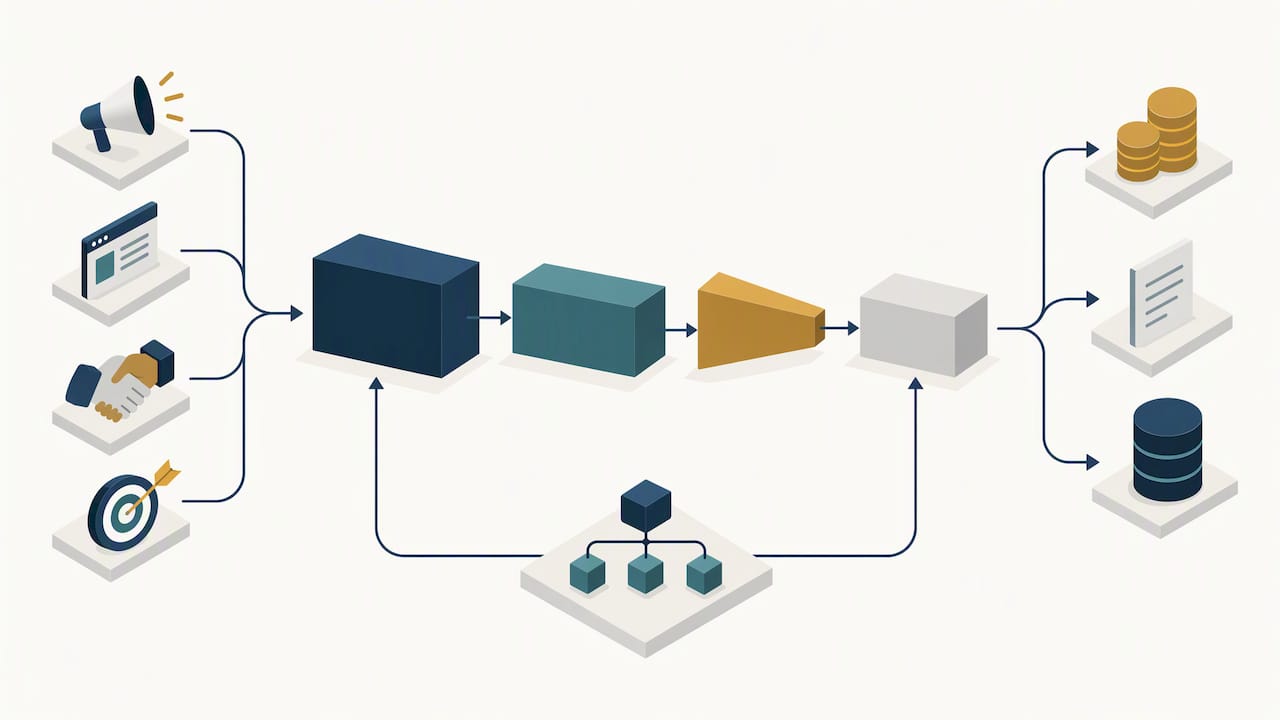
The work is normally project-based, and it tends to be about the team rather than one person. As one consulting explainer puts it, a sales consultant typically helps a team or department, not just a single salesperson, and it is common for consultants to add coaching afterwards.
Here is a scenario I see often. A B2B services firm has five salespeople, a decent flow of enquiries and a close rate that has sat at the same level for two years. Nobody is lazy. The problem is that there is no agreed qualification step, so reps spend weeks on prospects who were never going to buy, and proposals go out with no decision-maker involved. No amount of motivational coaching fixes that. A consultant would map the process, set qualification criteria, redesign the proposal stage and put in place the reporting to track it.
Choose a consultant when:
- you have no repeatable sales process, or everyone sells differently;
- you are changing market, pricing or product and need a sales plan to match;
- numbers are flat or falling and you do not know why;
- you are hiring your first sales team and need the structure before the people.
If you want to see how this works in practice, our guide to the effective sales consultancy process walks through the stages, and our sales consultancy service page explains how we run it.
What a sales coach actually does
A coach looks at the driver. The work is personal and ongoing: reviewing real calls and deals, practising the hard conversations, working through the mindset that makes someone discount too early or avoid asking for the sale. It is slower than consulting, and it lasts longer.
That durability is the whole point. Coaching aims to build long-term capability inside the person, where a consulting fix is more of an expert-delivered solution. When the coaching ends, the skill stays.
Another scenario. A founder runs a small consultancy and gets plenty of discovery calls, yet half of them end with “let me think about it”. The offer is fine and the pricing is fair. What is happening is that she gets nervous when the price comes up and rushes past it. A consultant would struggle to help with that. A coach can listen to the call recordings, spot the pattern, rehearse the moment with her and check in the following week on whether she held her nerve.
Choose a coach when:
- the process is sound but individual performance varies widely;
- a promising rep or manager needs to step up;
- you are a solo founder or consultant whose own selling is the bottleneck;
- previous training did not change what people do on calls.
For teams, how coaching is delivered matters as much as who delivers it. Our piece on sales team coaching techniques covers what tends to lift performance in practice.
Where the sales trainer fits
Many searchers type “sales consultant vs trainer” or “sales coach vs trainer”, so it is worth being precise. Training transfers knowledge to a group: a methodology, a framework for discovery, ways to handle objections. It is efficient, because you teach ten people at once and give them a common language.
Its weakness is stickiness. Training Industry notes that sales managers’ three main tools are training, coaching and mentoring, and that they are often misused because leaders do not understand how the three differ. A two-day workshop with no follow-up is the classic example: people leave enthused, then drift back to old habits within weeks.
Training is also needed in some sectors before anyone can sell at all. In regulated products, for example, new agents have to complete licensing education before they can sell, as with the Illinois-approved pre-licensing courses offered for final expense insurance agents in the US. That is pure knowledge transfer. The coaching comes afterwards, when the agent has to apply it with real families.
Use a trainer when your whole team lacks the same skill, when you onboard a new cohort, or when you want one shared sales language. Then plan the reinforcement before you book the day, not after.
What each costs in the UK
Prices vary by seniority, depth and region, so treat published ranges as a guide only. A 2025 overview of UK business coaching fees gives these figures for coaching generally:
| Model | Typical UK range |
|---|---|
| Hourly, mid-level coach | £80 to £150 |
| Hourly, expert coach | £300 or more |
| Daily rate for intensive work | £500 to £1,200 |
| Monthly package | £300 to £3,000 |
The same source notes that bespoke consulting projects vary widely, depending on the value or growth they target. That is the honest answer: consulting is priced on scope and expected return, so two quotes can differ several times over.
A cheap hourly rate can still be expensive if it produces nothing. When you compare quotes, ask what outcome the fee is tied to, how progress will be measured, and what happens after the final session. Our guides on pricing coaching by cost per outcome and why coaching retainers are more than a set number of sessions go deeper on this, and the UK sales training cost guide covers the total cost of ownership for team programmes.
Our view: you rarely need to choose just one
We don’t think “consultant vs coach” is the real decision. In our experience it is a sequencing question. A team with a broken process will not be rescued by coaching, and a team with a good process will not hit target if the people running it avoid the difficult parts of selling. You need the system and the skills.
That is why we built our work around a blend. Our bespoke engagements combine 1:1 coaching with traditional training and consultancy, so the person who spots the structural issue is also in the room when your people practise the new approach. Nothing falls between two suppliers who each assume the other is handling the follow-through.
Here is the order we would normally suggest:
- Diagnose. Look at the data and listen to real calls. Is the problem the process, the skills or the mindset?
- Fix what is structural. Qualification, pipeline stages, proposals, pricing conversations.
- Train the shared skills. Give everyone the same method and vocabulary.
- Coach individually. Apply it to live deals, with feedback and accountability, until it becomes habit.
- Measure against target. Review quarterly, not annually.
One warning. If a coach never gives you a direct opinion, or a consultant never asks what you think, you are probably getting half a service. The best people in either role switch between asking and advising, and tell you when they are doing which.
— Jerry
How to choose: five questions
1. Is the problem a system or a person? If every rep struggles at the same stage, suspect the system. If one rep excels and another does not in the same conditions, suspect the person.
2. Who is the buyer of the help? A founder asking for help with their own selling needs coaching. An SVP of Sales inheriting a team that misses target usually needs a diagnosis first.
3. How fast do you need a result? A consultant can change a process in weeks. Behaviour change takes months, so coaching is a longer commitment.
4. Can you reinforce it internally? If you have capable sales managers, training plus manager coaching can work. If not, you need an outside coach, or a fractional sales director to lead the team while capability builds.
5. What will you measure? Agree the numbers before you start: conversion rate, average deal value, sales cycle length, target attainment. Anyone unwilling to be measured is worth avoiding.
Which of our services matches which need
If you are not sure where you sit, this is how we usually map it.
- A team with no consistent approach: sales training for teams and solo operators, or our sales training cohorts for shared skills.
- A structural problem in the commercial function: our sales consultancy.
- No senior sales leader: a fractional sales director.
- A solo founder or consultant whose own selling is the limit: our sales coaching programme.
- A SaaS team: sales training for SaaS.
Our team-based bespoke coaching and consultancy engagements are priced at £4,500 to £8,500 as a one-off, and our sales acceleration track for solo service businesses and consultants runs from £2,995 to £5,995 as a one-off. The Sage Collective is £990 per month. Details of how the packages fit together are on our pricing and packages page, and you can start from the Ahead of Sales homepage if you would like to talk through which route suits you.
Mistakes I see when people buy this help
Buying a trainer to fix a process problem. The team learns a great discovery framework, then goes back to a pipeline with no qualification. Nothing changes.
Buying a consultant and expecting behaviour change. A beautiful new process is useless if reps will not follow it. Plan for adoption from the start.
Buying coaching with no goal. Sessions turn into pleasant chats. Tie the work to a number and a date.
Judging by job title. “Consultant”, “coach” and “trainer” are not protected terms in the UK. Ask what the person will actually do in week one, and look for relevant selling experience, not only credentials.
FAQ
What is the difference between a sales consultant and a sales coach?
A consultant is an expert who diagnoses problems and recommends or builds solutions, usually for a team or the whole sales function. A coach develops an individual through questions, practice and accountability, so the skills stay with them. The first changes the system, the second changes the person.
What is the difference between a sales coach and a sales trainer?
A trainer teaches a group a method or skill set, typically in workshops or cohorts. A coach works one to one (or with a very small group) on real deals and real behaviour over time. Training gives people knowledge, and coaching helps them use it consistently.
Can one person be both a consultant and a coach?
Yes, and many are. Consultants often add coaching once a project ends, and the best coaches will advise when it is useful. Just make sure the provider is clear about which role they are playing at any moment, and that the engagement is scoped for both.
How much does a sales coach cost in the UK?
As a guide, published UK figures for business coaching run from about £80 to £150 an hour for mid-level coaches, with monthly packages between £300 and £3,000. Bespoke sales programmes that combine coaching and consultancy are priced on scope, so ask for a quote tied to measurable outcomes.
Which should I hire first, a consultant or a coach?
Start with whichever matches the problem you can prove. If your data shows the process is leaking, hire a consultant first. If the process is sound and people are the variable, start with coaching, and add training where the whole team shares a gap.
Sources
- What is Coaching? A Complete Guide, TPC Coaching Academy
- Coaching vs Consulting: What’s The Difference?, Consulting Success
- Driving Sales Training Results Through Manager Coaching, Training Industry
- Sales Coaching, Mentoring and Training: What’s the Difference?, Training Industry
- How Much Do Business Coaches & Mentors Charge in the UK?, Ninja Coach