
For most UK sales teams the honest answer is neither one alone. In-person training is stronger for live practice, role play and team culture. Online training is stronger for reach, cost and reinforcement between sessions. The best results come from using each where it does the most work, and the research points the same way.
If you are a business owner or sales leader deciding where to spend a training budget, this guide gives you the criteria I would use, with worked examples and the mistakes I see most often.
TL;DR
- In-person training suits skills that depend on live pressure: objection handling, negotiation, difficult conversations and team alignment.
- Online training suits knowledge transfer, regional or hybrid teams, and short follow-up sessions that keep learning alive.
- 93% of organisations with highly effective sales training include an in-person, instructor-led element, and those teams usually blend formats rather than pick one.
- Spacing sessions over weeks beats a single block, whichever format you choose.
- Decide on the behaviour you need to change, your team’s geography and how you will reinforce the training afterwards, not on price alone.
Table of Contents
- What people really mean by in-person and online
- Where in-person sales training wins
- Where online sales training wins
- Side by side
- What the research says about blending
- A perspective from our side
- How to choose for your situation
- Questions to ask any provider
- Budget, and what drives the cost
- Working with us
- FAQ
- Sources
What people really mean by in-person and online
The labels hide more than they show. “In-person” can mean a two-day off-site with 30 people, or a half-day workshop in your own office with six. “Online” can mean a live video session with an instructor and breakout rooms, or a library of pre-recorded modules that people open when they remember.
Those are very different experiences. A live online session with a skilled facilitator has far more in common with a workshop than with a recorded course. So when you compare formats, compare three things separately:
- Where people are: the same room or different locations.
- When it happens: live with an instructor, or self-paced.
- How it is reinforced: one-off event, or a programme with practice and feedback between sessions.
The third point matters most, and I come back to it below.
Where in-person sales training wins
Sales is a performance skill. You can understand a good discovery question perfectly and still freeze when a prospect pushes back on price. Being in a room together makes it easier to create realistic pressure and to correct it straight away.
Live role play and real-time feedback
In a room, a trainer sees the whole picture: the hesitation before an answer, the arms crossed when a pricing objection lands, the rep who rushes to fill silence. That body language is the coaching material. On video you get a face and a voice, which is useful but narrower.
When I run objection handling in person, I will often pair people up, give one a tough buyer persona and stop the conversation midway to ask what just happened. That kind of interruption feels natural in a room and a little awkward on screen.
Team culture and shared language
A team that trains together builds a shared vocabulary. When everyone has heard the same framework explained at the same time, a manager can say “what were your three outcomes for that call?” and be understood. A well-known example is the 3-3-3 rule: three desired outcomes, three key questions and three agreed next steps for a conversation. It is simple, but it only becomes habit when the whole team uses it the same way.
In-person sessions also let reps swap what works. The best tactic of the day is often shared over lunch, not on the slide.
Fewer distractions
One of the quieter advantages is attention. People in a room, with phones away and a clear block of time, tend to stay with the material. Online, the inbox is one click away and the prospect who “just needs a quick reply” is in the next tab.
The downsides
- Cost and time: travel, venue, and a full day or more away from the pipeline.
- Scheduling: getting a whole team together is hard when people work across regions or hybrid patterns.
- The one-off problem: a great day in a room can fade within weeks if nothing follows it.
Training specialists have long noted that sales organisations traditionally trained in person over several days, and that it gives people the chance to learn from instructors and from each other. The challenge has always been what happens after the days end.
Where online sales training wins
Reach and flexibility
If your reps are in Leeds, Bristol, Glasgow and working from home across the south-east, gathering them costs time and money. Online delivery removes the travel and lets you train people at the same moment without pulling them off the road for a day.
Shorter, more frequent sessions
This is the most underrated benefit. A 60 to 90 minute live session each week lets reps try something on real calls on Tuesday and bring the results back on Friday. It is easy to schedule online and hard to organise in person.
Consistency and recordings
A recorded session means a new starter in March can see what the team covered in January. Online also makes it simple to build a library of call examples to review later.
Cost
Online usually costs less per head once you remove travel, venue and catering. That matters for smaller teams and for solo business owners, who do not need a classroom at all.
The downsides
- Weaker group dynamics: quieter people can hide behind a muted microphone.
- Shallower practice: role play on screen works, but it can feel stilted without good facilitation.
- Engagement drift: self-paced content has a habit of being started and never finished.
For teaching online sales skills well, academic work such as a guide to teaching online sales courses shows that the challenge is moving an interactive, skills-based subject online without losing the interaction. That is a design problem rather than a limit of the medium.
Side by side
| Factor | In-person | Online (live) | Online (self-paced) |
|---|---|---|---|
| Live role play and coaching | Strongest | Good with small groups | Weak |
| Team bonding | Strongest | Moderate | Minimal |
| Cost per person | Highest | Medium | Lowest |
| Scheduling across locations | Hardest | Easy | Easiest |
| Fit for spaced, weekly learning | Harder | Natural | Natural, if people complete it |
| Best for | Mindset, objections, negotiation, kick-offs | Reinforcement, new tactics, hybrid teams | Product knowledge, process basics |
What the research says about blending
The most useful finding I know of comes from an ATD study of 242 sales professionals. 93% of organisations with highly effective training programmes include in-person instructor-led sessions, alongside virtual instructor-led sessions (66%) and self-study (50%). The high performers blended. A Training Industry summary of the same research reports that only 65% of organisations with less effective training used in-person instructor-led sessions.
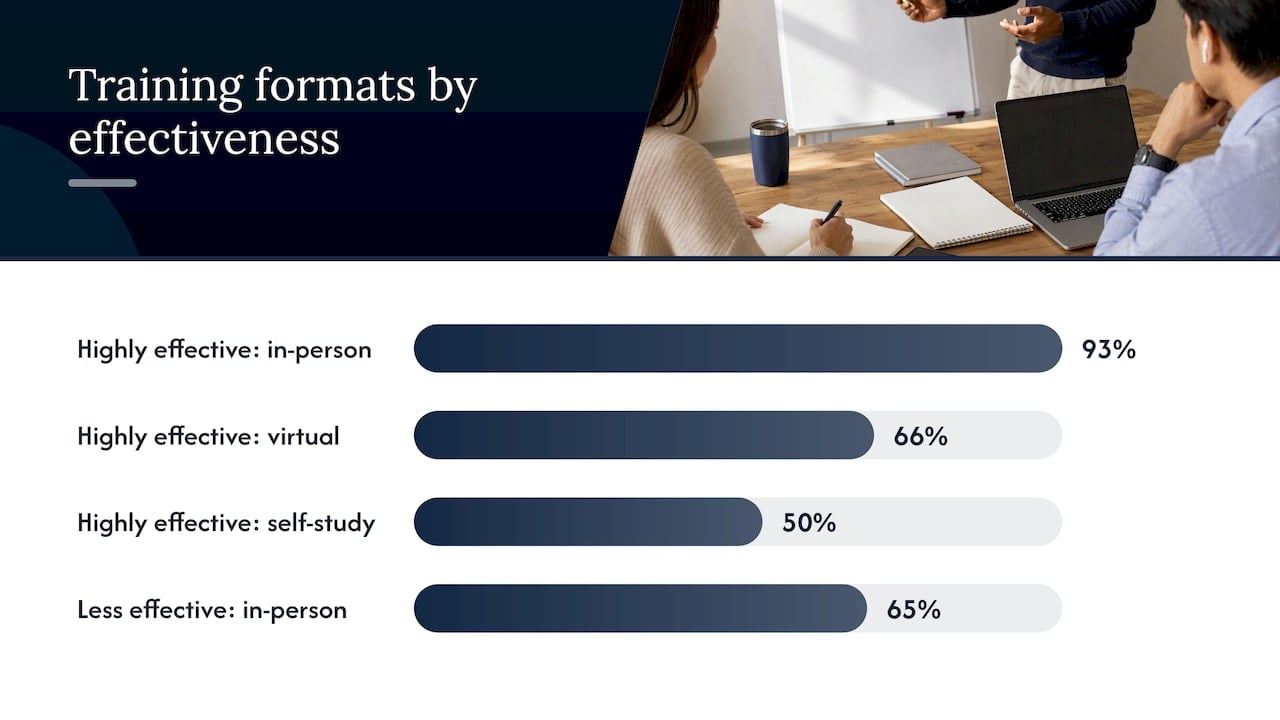
Two cautions. This is an association, not proof that in-person causes better results, and the sample is of sales professionals surveyed, not a controlled trial. Still, it matches what I see: face-to-face time is rarely the only ingredient, but it is seldom missing from the programmes that work.
Timing matters as much as format
A field study from Vrije Universiteit Amsterdam compared identical sales training delivered in a spaced format against a single block. The spaced version produced stronger competence, higher self-reported skills and better financial outcomes. The reason is that people can apply what they learned in the field and return for feedback.
That is the strongest argument I know for combining formats. Online sessions are a natural way to space learning. In-person sessions are a natural way to launch it and to practise the hardest skills. A one-day course with no follow-up wastes the best part of the investment, whichever way it is delivered.
A perspective from our side
We do not sell a format. We sell a change in what your team does on sales calls, and we choose the format that gets there fastest for the people in front of us.
Our work combines bespoke 1:1 coaching with team training and consultancy, and the format follows the job. Mindset, objection handling and the first conversation about price usually need a room, or at least a very well run live session, because that is where habits are visible and fixable. The weeks after are where the result is won or lost, and that is where coaching calls, call reviews and short online sessions do the heavy lifting.
The mistake we see most is buying a format as if it were a result. A business books a one-day workshop because it is easy to diarise, or a bundle of videos because it is cheap, and then wonders why the pipeline looks the same three months later. Ask instead: what should a rep do differently on Monday, who will notice if they do not, and when will we check?
We would rather you spent your budget on a smaller, longer, better reinforced programme than a large one-off event. If you want the longer reading on that, our piece on making blended sales training stick covers the manager’s role in detail.
— Jerry
How to choose for your situation
There is no universal winner, but there are good rules of thumb.
Choose mostly in-person when
- You are launching a new sales process or methodology and need everyone aligned.
- The team is in one or two locations and can be gathered without much disruption.
- The core problem is behavioural: discounting too early, avoiding hard questions, weak objection handling.
- Morale or team cohesion is part of the problem.
Choose mostly online when
- The team is spread across the UK or works hybrid.
- You need short, regular sessions to embed something already taught.
- The content is knowledge-led, such as product updates or a new CRM workflow.
- You are a small business or solo operator who wants coaching without travel.
Choose a blend when
- You want lasting change in how people sell. This is most teams.
A worked example
Imagine a 40-person B2B software company with account executives in London and a remote team elsewhere in the UK. The sales director wants better discovery calls and fewer discounted deals.
A sensible shape would be a one-day in-person kick-off for the London team and a live online equivalent for the remote group, covering questioning and price conversations with plenty of role play. Then six to eight weeks of weekly 60-minute live online sessions, each starting with one real call from the previous week. Managers would run short call reviews using the same checklist, and a final half-day, in person or online, would close the programme with a review of what changed in the numbers.
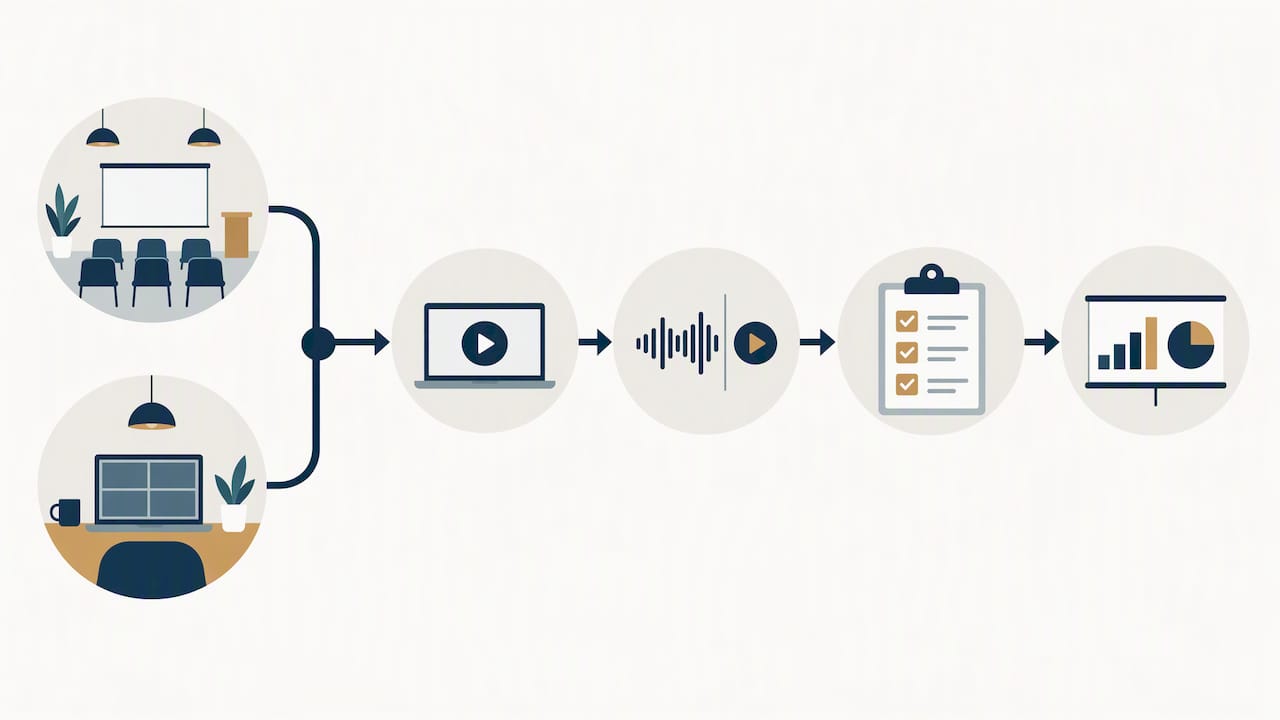
Nothing in that plan is exotic. It is simply the combination of the two formats doing the job each is best at. If your team sells to SaaS buyers specifically, our page on sales training for SaaS shows how we apply that thinking.
Questions to ask any provider
Whoever you hire, ask these before you sign:
- What will my reps do differently, and how will we measure it?
- How much of the programme is practice versus presentation?
- What happens in the weeks after the main sessions?
- Is the content built around our product, buyers and sales cycle, or is it generic?
- How are managers involved, so the training does not stop when the trainer leaves?
A provider who answers the first question with a course outline rather than a behaviour is selling content, not change. Our guide to in-house versus public sales training explains why the coaching layer decides the outcome.
Budget, and what drives the cost
Price differences between formats are real but smaller than people expect once you count the whole picture. In-person training adds travel, venue and time out of the field. Online removes most of that but needs more sessions to achieve the same practice.
The larger cost is a programme that does not change behaviour. If a team of ten loses a month of momentum because the training faded, that dwarfs any saving on delivery. We publish our ranges openly on our sales training cost page: team-based bespoke coaching and consultancy engagements run from £4,500 to £8,500 as a one-off, and the sales acceleration track for solo service businesses and consultants runs from £2,995 to £5,995 as a one-off.
Working with us
If you want a programme designed around your team rather than a standard course, we build blended engagements that combine 1:1 coaching, team training and consultancy, delivered in person, online or both. Solo business owners can start with our sales coaching programme, and teams can look at our sales training services or get in touch through the Ahead of Sales site to talk through what format would fit.
FAQ
Is online sales training as effective as in-person?
It can be, for the right skills and with live facilitation and follow-up. Knowledge-based content transfers well online. Skills that rely on live pressure, such as objection handling and negotiation, usually benefit from in-person practice. The research on high-performing programmes shows most of them include an in-person element alongside virtual and self-study formats.
Is virtual training cheaper than in-person?
Usually per head, because there is no travel, venue or time away from the road. It is not always cheaper per result. If a self-paced course is never finished, or a team needs extra sessions to get the same practice, the saving shrinks. Compare the cost of the whole programme against the behaviour change you expect.
How long should a sales training programme last?
Longer than one day. A field study of sales training found that spaced delivery with intervals for applying skills outperformed the same content delivered in one block. Several weeks of sessions with practice between them is a sound starting point.
What is the 3-3-3 rule in sales?
It is a planning framework for a single sales conversation: three desired outcomes, three key questions and three agreed next steps. It helps keep a call focused and gives you a clear result afterwards. Note that other versions of the rule exist for outreach, so check which one your team means.
Sources
- Beyond Virtual vs. In-Person: What New Research Tells Us About Blending Sales Training Modalities (ATD)
- 5 Research-Backed Tips for Effective Sales Training (Training Industry)
- Sales training: Effects of spaced practice on training transfer (Vrije Universiteit Amsterdam)
- Selecting the Best Sales Training Delivery Method (ATD)
- TONS: A Guide to Teaching On-Line Sales Courses
- What Is the 3-3-3 Rule in Sales?