
Blended sales training works when it combines instructor led sessions, self study, simulations and coaching and it consistently improves selling behaviour when you design it backward from the outcome you want, not the content you happen to have. The rule is simple: decide what a rep must do differently on a call, then choose the modality and practice volume that gets them there. Skip that step and you get a slicker version of the same training that never sticks.
TL;DR:
- The effectiveness of blended sales training depends on aligning modalities with specific behaviors and incorporating repetition and follow-up, not just on content delivery.
- Combining in-person, virtual, simulated, and coaching formats is proven to produce better behavior change and faster onboarding than relying on a single method.
- Core design elements include clear observable outcomes, pre-work, high-volume practice with feedback, structured coaching, and reinforcement tools like job aids.
- Piloting with one team or region before full deployment prevents costly mistakes and allows for content and scheduling adjustments based on real sales floor feedback.
- Prioritizing coaching cadence over content is critical, as ongoing reinforcement and follow-up sustain skills and improve long-term sales performance.
Table of Contents
- What is blended sales training and which modalities matter?
- What does the evidence say about blending modalities?
- Core components every blended sales programme must include
- How to design a blended sales curriculum step by step
- Which delivery tools actually support blended learning?
- How do you measure whether blended training actually works?
- Implementation checklist and what it costs
- How Ahead of Sales approaches blended design
- What actually moves the needle in blended programmes
- Ready to build a programme that actually changes behaviour?
- Sources
What is blended sales training and which modalities matter?
Blended sales training pairs structured formats so knowledge, practice and feedback each happen in the setting best suited to them. Nobody masters objection handling from a slide deck, and nobody absorbs a compliance update through a role play. The skill is matching the modality to the job.
The core modalities you’re choosing between:
- In-person instructor led training (ILT): best for launch events, complex negotiation scenarios, and anything requiring real-time group energy.
- Virtual ILT: cheaper to scale across regions, works well for skill refreshers and manager cascades.
- Asynchronous e-learning: ideal for product knowledge, compliance and anything a rep can absorb solo before a live session.
- Simulations and role play: where behaviour actually forms, whether delivered live or through AI-scored practice tools.
- 1:1 and group coaching: the mechanism that turns a one-off skill into a habit.
- Job aids and microlearning: short reference tools reps pull up mid-call, not during a training window.
Get the sequencing wrong (say, using a live session to deliver content reps could have read beforehand) and you burn your most expensive resource on the least valuable task.
What does the evidence say about blending modalities?
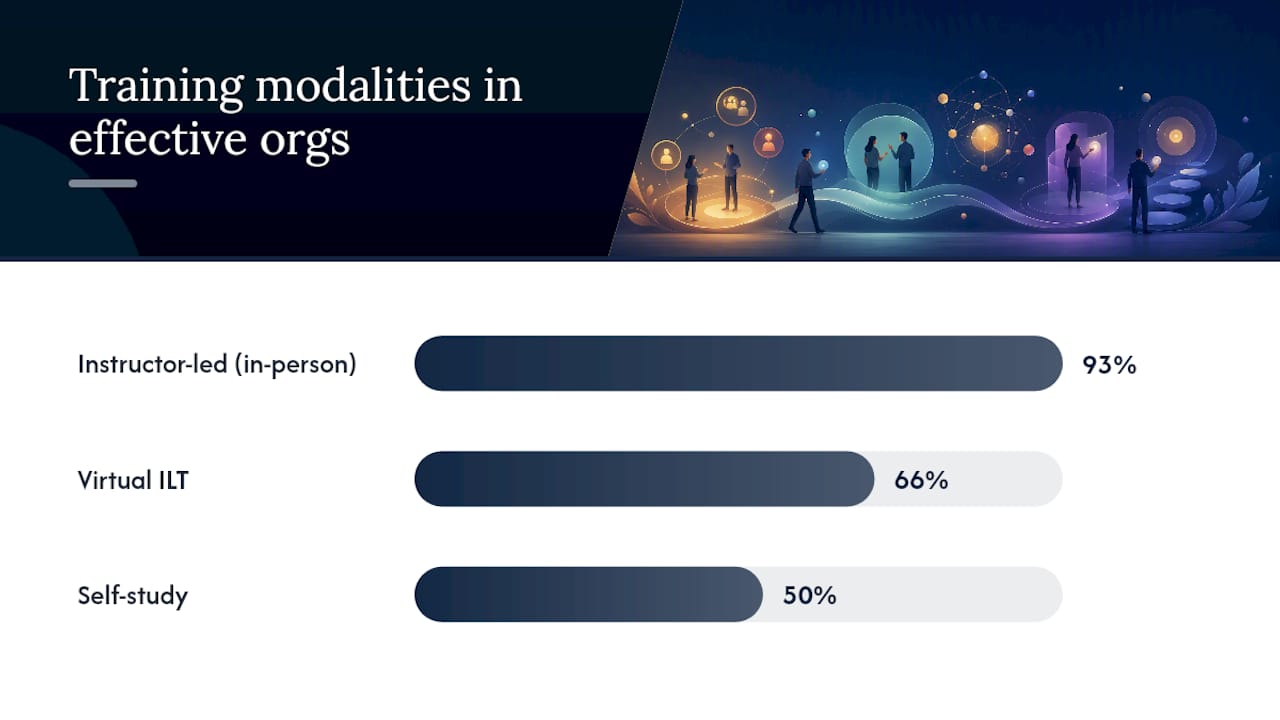
Organisations that build genuinely effective sales training rarely rely on one format. According to TD/ATD research, 93% of organisations with highly effective sales training include an in-person, instructor led component, alongside virtual ILT (66%) and self study (50%). Live human interaction still does something asynchronous content cannot replicate, especially for handling pushback and reading a room.
The same research found effective organisations are far more likely to treat onboarding as an ongoing journey rather than a single event, and nearly five times more likely to provide continuous reinforcement after the initial rollout. Case data backs this pattern: Liberate Global’s blended leadership programme paired pre-work with live simulations and produced measurable field behaviour change, while UMU’s practice platform data links higher practice volume directly to faster ramp and stronger assessment scores.
What this tells programme designers: the format mix matters less than the discipline of pairing it with repetition and follow-up. A single brilliant workshop, however well delivered, competes badly against a mediocre programme with weekly coaching behind it.
Core components every blended sales programme must include
Strip away the branding and every strong blended sales training programme contains the same five building blocks.
- Observable learning outcomes. Define the exact behaviour you want to see on a call, not a topic you want covered. “Handles pricing objections using a value reframe” is testable. “Understands objection handling” is not.
- Pre-work via flipped classroom. Reps absorb product knowledge and frameworks before the live session, so facilitator time goes entirely on practice and discussion.
- High-volume applied practice with corrective feedback. This is where skill actually forms. Role play once and reps remember the exercise; role play a dozen times with feedback and they remember the behaviour.
- Manager coaching cadence and scorecards. Structured, recurring coaching, weekly 1:1s, monthly workshops, formal check-ins, is what stops new skills decaying within a fortnight, as QUOTA Training’s coaching framework sets out.
- Job aids and microlearning for reinforcement. Short, retrievable prompts reps use mid-deal, not during a training block.
Pro Tip: Build your scorecard before you build your content. If you can’t score a behaviour on a call, you haven’t defined it clearly enough to train it.
How to design a blended sales curriculum step by step
Backward design starts with the result and works its way to the classroom, not the other way round.
- Set measurable outcomes and a baseline. Establish current quota attainment, ramp time or win rate before you touch content, so you have something to compare against later.
- Map each skill to a delivery modality. Product knowledge goes async. Negotiation nuance goes live. Objection handling gets simulation reps, ideally dozens rather than one.
- Decide practice volume per skill. A skill that appears on every call, discovery questioning, needs far more repetition than a skill used once a quarter.
- Design pre-work, live sessions and distributed practice windows. Spread practice over weeks rather than compressing it into a single offsite; skills decay fast without reinforcement.
- Set coaching rhythms and assessment checkpoints. Weekly manager check-ins plus a formal assessment at 30, 60 and 90 days gives you both qualitative and quantitative signal.
- Plan resources and pilot first. Run the design with one team or region before a full rollout. A pilot surfaces content gaps and scheduling problems cheaply.
Skipping the pilot is the single most common mistake in this process. Programmes designed on paper rarely survive contact with a real sales floor unchanged, and Ahead of Sales’s consultancy work exists largely to catch the gap between what a curriculum assumes and what a sales team actually needs.
Which delivery tools actually support blended learning?
Platform choice shapes whether the practice component of your programme scales or collapses under facilitator workload.
- LMS vs LXP: a traditional learning management system tracks completion; a learning experience platform tends to drive higher engagement through recommendation and social features, worth the extra cost if reinforcement is a priority.
- Simulation and role play tools: prioritise branching scenarios, automated scoring and instant feedback over polish. UMU’s approach shows how automated scoring lets one facilitator support far more reps than manual review allows.
- Virtual classroom features: breakout rooms and screen annotation matter more than production value. Use live sessions for practice and discussion, never for lecture.
- Conversation intelligence and coaching dashboards: tools that surface coachable moments from real calls help managers spend limited 1:1 time on the highest leverage gaps, a use case Salesforce’s coaching guidance covers well.
For teams selling complex, multi-stakeholder products, SaaS-specific blended delivery usually needs heavier simulation weighting than a simpler transactional sales motion.
How do you measure whether blended training actually works?
Measurement has to link learning activity to commercial outcome, or the programme becomes a cost centre nobody can defend at renewal time.
- Commercial KPIs: quota attainment, win rate, and ramp time to first deal closed.
- Skill KPIs: role play scores, coaching scorecard trends, and practice session frequency per rep.
- Causal design: run pilots against a comparison group where possible, so gains can be attributed to the programme rather than seasonality or a strong quarter.
- Reporting cadence: monthly stakeholder dashboards keep sponsors engaged and catch a stalling cohort early.
Pilots should track both a behavioural proxy, such as role play scores, and a commercial proxy, like pipeline progression on coached deals, over a six to twelve week window to catch early signal before committing to a full rollout. Case data on programmes that increased practice volume points to a reduction in ramp time by up to half in some corporate rollouts, a scale of impact worth demanding evidence for before you sign off a full year of budget.
Implementation checklist and what it costs
A phased rollout keeps risk contained and gives you evidence to defend further investment.
- Pre-launch: run a needs analysis, secure stakeholder buy-in, and agree the measurement plan before writing a single slide.
- Pilot: test with one team, iterate weekly, and treat the first cohort as a design exercise, not a finished product.
- Roll-out: enable managers first, since a coaching cadence without a trained manager behind it fails within weeks.
- Sustain: maintain coaching rhythm, refresh scorecards quarterly, and retire content that no longer matches the buyer conversation.
Budget typically splits across four buckets: content creation, live facilitation, platform licensing, and coaching hours, with coaching often the most underfunded line despite being the one that determines whether skills stick. Reps mapping their own skill gaps before a rollout can use a structured skills checklist to speed up the needs analysis stage. Programmes that also want commercial follow-through often pair training reinforcement with structured lead nurturing practices, so improved conversation skill actually converts into pipeline movement rather than stalling after the training window closes.
How Ahead of Sales approaches blended design
Ahead of Sales builds every programme around the same backward design principle covered above: a measurable behaviour first, then the modality mix and coaching cadence that gets a team there. Coaching sits alongside structured group training and consultancy, so a rep who struggles with a specific objection type gets targeted practice rather than repeating a generic module. That combination, live facilitation, applied practice, and recurring coaching, mirrors exactly the structure the strongest case studies in this piece describe. For sales leaders managing teams of 50 to 1,000 people, or solo consultants needing a faster route to consistent quota attainment, the design steps above translate directly into how engagements get scoped and delivered, with structured coaching techniques forming the reinforcement layer that keeps skills from decaying after the initial rollout.
What actually moves the needle in blended programmes
Three things separate programmes that change behaviour from programmes that just look good in a steering committee deck. First, spend your live facilitator hours on practice, never on content delivery reps could have read beforehand. Second, build the coaching cadence before you build the curriculum, because a brilliant workshop with no follow-up coaching decays within a fortnight. Third, pilot with one team before rolling out to the whole sales floor. Skipping the pilot is the single most expensive mistake I see, because it means you scale mistakes instead of catching them.
The trap most training professionals fall into is treating modality choice as the strategic decision. It isn’t. Modality is a logistics question. The strategic question is what behaviour you’re trying to produce and how much repetition that behaviour needs before it survives contact with a hostile buyer.
Pro Tip: If you can only fix one thing this quarter, fix the coaching cadence. Content without reinforcement is the single biggest source of wasted training budget I’ve seen in this field.
— Jerry
Ready to build a programme that actually changes behaviour?
Most blended programmes fail not because the content is wrong, but because nobody designed the coaching layer that makes skills stick, and nobody piloted before committing budget to a full rollout. Aheadofsales builds bespoke 1:1 coaching directly into every blended curriculum, so the practice reps do in a workshop gets reinforced weekly rather than left to decay.
That matters most for businesses that need every quarter to hit target, not just the odd standout month. Whether you need a full team rollout or a sales leadership resource to run the diagnostic first, the starting point is the same: get a clear read on where your current programme leaks behaviour before it reaches a live call. Explore Ahead of Sales’s sales training services and book a diagnostic conversation to scope a pilot for your team.
Sources
The ATD research on blending modalities covers the prevalence data cited above. The Liberate Global and UMU case studies detail simulation design and practice-to-outcome links. QUOTA Training’s coaching guide and Kellogg’s Mastering Sales programme illustrate coaching cadence and modular curriculum design respectively.
- Blended learning sales training that closes the practice gap — UMU
- Advanced EDS Program: Blended Sales Training case study — Liberate Global
- Sales coaching guide: build a programme that delivers — QUOTA Training