
Run a diagnostic of your leading indicators now, not another pep talk. Check pipeline coverage, rep activity and stage conversion before you touch comp plans or morale. Diagnostics tell you whether the miss is structural (a quota, process or capacity problem) or behavioural (a coaching problem), and that distinction decides everything you do next.
TL;DR:
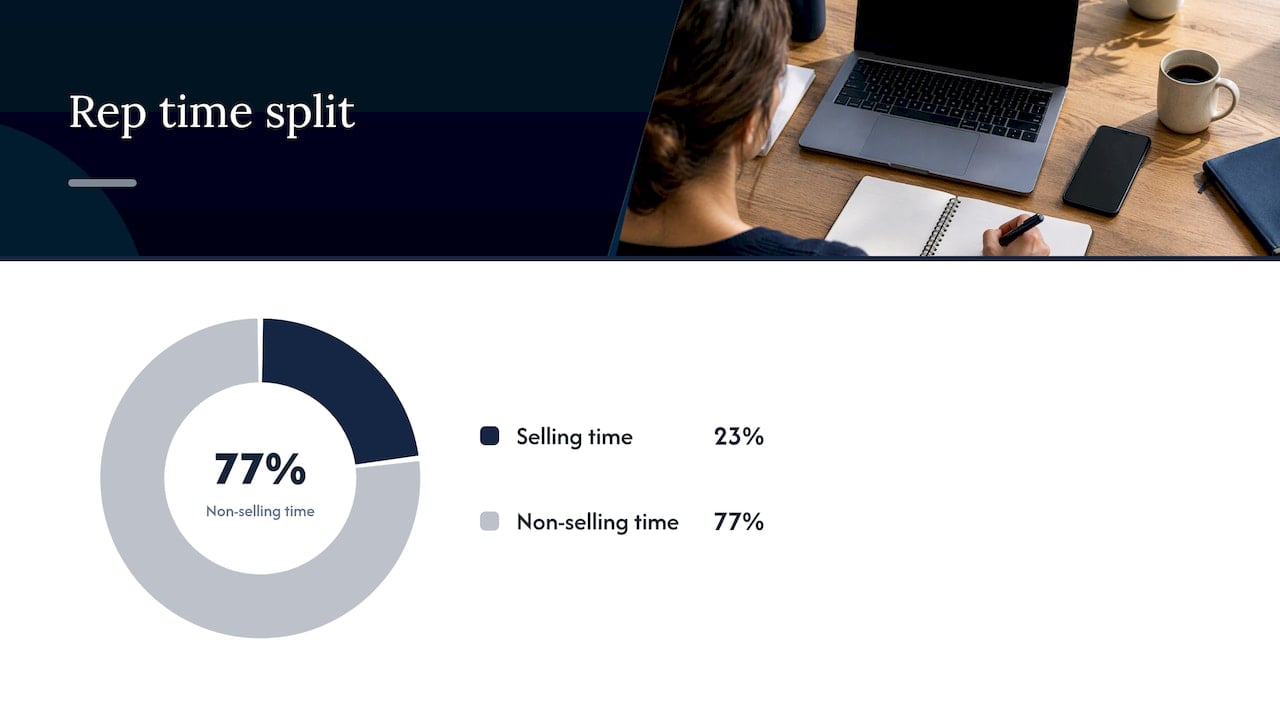
- Most missed quotas result from pipeline, process, or behavioral issues, not from lack of effort, with reps only spending about 23% of their time on core selling activities.
- Key diagnostics include verifying pipeline-to-quota ratios, analyzing funnel stage conversion rates, and auditing CRM data hygiene within 72 hours to identify capacity, pipeline, or quota problems.
- Fixes should focus on high-probability deals, reducing admin tasks, and deploying targeted coaching, with offloading non-selling work significantly increasing attainment.
- Quota design flaws often cause misses, such as over-assigned territories or inflated targets for top performers, requiring bottom-up planning and deliberate adjustments.
- Building habits around leading indicators like pipeline health, activity levels, and AI tool adoption can prevent future misses, as sales teams using AI are 3.7 times more likely to hit their quotas.
Table of Contents
- Common root causes of missed quota
- Step-by-step diagnostic checklist: the metrics to run now
- Actionable fixes to recover revenue this quarter
- Fixing quota design and compensation alignment
- Preventing future misses: processes, tools and leading indicators
- Why bespoke coaching and consultancy lift attainment
- What leaders often miss when responding to a miss
- When to call in external support and how we typically help
- FAQ
- Sources
Common root causes of missed quota
Most missed quotas trace back to a handful of repeat offenders, and rarely to effort alone. Forrester’s research on sales productivity found that reps typically spend only around 23% of their time on core selling activities, with the rest lost to internal admin, reporting, and tool-switching. That single fact explains more missed quotas than any lack of motivation does.
Pipeline coverage and qualification failures sit close behind: if reps are chasing deals that were never going to close, no amount of calling harder fixes the maths. Quota design itself is often the quiet culprit, particularly when territories are over-assigned or when strong performers quietly get their targets raised the following quarter as a reward, a pattern Forrester has flagged as corrosive to morale and retention.
Add cross-functional friction (slow pricing approvals, legal review, fulfilment delays) and fragmented technology that steals selling time rather than protecting it, and a miss becomes far less mysterious.
- Reps spend the minority of their week actually selling, with admin absorbing the rest.
- Pipeline coverage looks healthy on paper but is full of unqualified or stalled deals.
- Quota design over-assigns territories or punishes last quarter’s high performers.
- Pricing, legal or fulfilment delays stall deals that are otherwise ready to close.
- Disconnected tools and poor data trust force reps to double-check everything manually.
Step-by-step diagnostic checklist: the metrics to run now
Before you change anything, measure it. This sequence takes most managers 48 to 72 hours and tells you whether you’re facing a capacity problem, a pipeline problem or a quota problem.
- Check pipeline-to-quota ratio. Compare total open pipeline value against the remaining quota, and sanity-check it against your average deal size: thin coverage with inflated deal sizes is a warning sign on its own.
- Run stage conversion and velocity analysis. Pull conversion rates between each funnel stage and compare them to the team’s own historical baseline, not an industry benchmark, to find exactly where deals are leaking.
- Measure selling activity and selling-time percentage. Track calls, meetings and proposals per rep against the time they actually spend selling versus on admin.
- Audit CRM data hygiene and top-deal qualification. Spot-check the ten largest open deals for stale close dates, missing next steps or deals that should have been disqualified weeks ago.
- Reconcile the sum of individual rep quotas against the company target. If the totals don’t match, you’ve found a structural cause before you’ve even looked at a single rep’s performance.
Only around 1 in 4 sales representatives met or exceeded their assigned quota last year, according to Salesforce’s compensation research. That distribution matters: if three-quarters of your team are missing, the problem usually sits in design or process, not in three-quarters of your people suddenly underperforming at once.
Actionable fixes to recover revenue this quarter
Once the diagnostic points you somewhere, act fast and act narrow. Chasing every root cause at once dilutes effort exactly when you need it concentrated.
- Prioritise deals with the highest probability of closing this quarter and personally clear blockers like pricing approvals or fulfilment delays.
- Offload non-selling admin (data entry, reporting, scheduling) to a coordinator or shared system so reps get selling hours back.
- Deploy a focused 30 to 60 to 90 day coaching plan for underperformers, built around specific behaviours like discovery questions and next-step agreements rather than general encouragement.
- Make short-term capacity moves: reassign accounts, add shared coverage on key territories, or hand reps a tighter playbook for their best-fit deals.
- Introduce quick automation wins such as email templates, CPQ snippets and automated follow-up scheduling to cut friction in the close process.
Forrester’s productivity analysis cites a client that improved attainment from 25% to 85% largely by offloading non-selling tasks from reps, which is a sharper lesson than most coaching advice offers: the fastest fix is often removing work, not adding effort.
Pro Tip: Fix one blocker at a time and measure its effect before layering on the next change, or you will never know which fix actually worked.
Fixing quota design and compensation alignment
Sometimes the diagnostic points past behaviour and process, straight at the quota itself. This is where many leaders flinch, because it means admitting the target was wrong before a single rep touched it.
Start by checking whether the sum of individual quotas exceeds what the company actually needs to hit, a mismatch Forrester warns quietly erodes both attainment and trust over time. Watch too for the “punish success” cycle, where your best performers get their targets quietly inflated next quarter as a reward for last quarter’s win. It demoralises exactly the people you can least afford to lose.
- Reconcile total rep quotas against the company target before assuming an individual performance problem.
- Avoid raising a top performer’s quota disproportionately as an informal penalty for strong results.
- Build next quarter’s targets bottom-up, with frontline input on territory and account realities.
- Decide deliberately whether the fix is a comp rate change or a territory and product-scope rationalisation, not both at once.
Our guide to setting sales quotas for sustained growth walks through this reconciliation in more depth.
Preventing future misses: processes, tools and leading indicators
The teams that stop missing quota, rather than just recovering from one miss, build habits around leading indicators instead of waiting for the revenue report to tell them the bad news.
- Track pipeline ratio, activity dips and conversion trends weekly rather than reviewing them only at quarter close.
- Consolidate your tech stack and clean up CRM data so the whole team trusts one source of truth.
- Run regular capacity planning alongside weekly pipeline health checks, not just at annual planning season.
- Pilot AI agents in a controlled way to cut research and admin time, rather than rolling them out team-wide untested.
Sellers who use AI sales tools are 3.7 times more likely to hit quota, and AI agents are expected to cut prospect research time by around 34%, per Salesforce’s 2026 State of Sales report. Our piece on pairing AI training with 1:1 coaching looks at how to pilot this without disrupting a live pipeline.
Why bespoke coaching and consultancy lift attainment
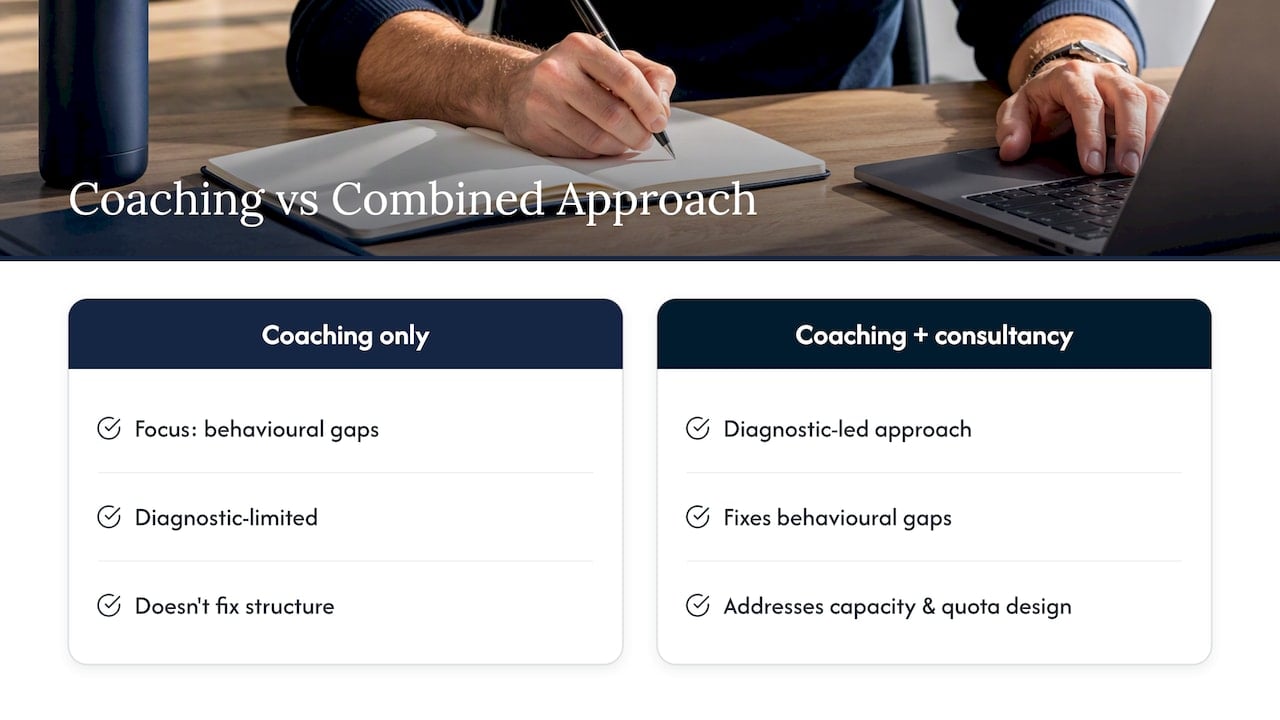
We built our approach around the belief that a missed quota is rarely a motivation problem, it’s a diagnostic one. Combining bespoke 1:1 coaching with traditional consultancy lets us work on the specific behavioural gaps a diagnostic surfaces, alongside the structural issues, like capacity and quota design, that coaching alone never fixes.
What leaders often miss when responding to a miss
We default to pep talks because they feel like leadership. A missed quota is data, not a morale problem: run the diagnostic first.
— Jerry
When to call in external support and how we typically help
When a miss points to capacity or quota design rather than a quick coaching fix, speed matters more than doing it all in-house. We work with growth-minded businesses and solo service operators who need rapid capacity planning, team coaching or an urgent ramp plan delivered without a long search for the right programme.

Our team-based coaching and consultancy packages run from £4,500 to £8,500 as a one-off engagement, and solo consultants can explore our sales acceleration track from £2,995 to £5,995. Visit Ahead of Sales to talk through which route fits your team.
FAQ
What happens if you don’t meet your quota?
Consequences vary by company, but typically range from a coaching conversation and a performance improvement plan to reduced commission payouts. A single miss rarely triggers serious action on its own; a pattern of misses usually prompts a review of both the rep and the quota design behind it.
What is the 3-3-3 rule in sales?
Definitions vary across sales organisations, so there’s no single agreed standard for this rule. Where it’s used, it generally refers to a structured approach to prospecting or pipeline review in three-part stages, but you should confirm the specific framework your source means before applying it.
What does your quota mean?
A sales quota is the revenue or activity target a rep or team is expected to hit within a set period, usually a quarter or year. It’s typically built from a company-wide sales target that’s divided across territories, products or reps, which is why checking that division for errors matters when a miss occurs.
Is 90% sales quota good?
Ninety per cent attainment is generally considered solid performance, since Salesforce data shows only around 1 in 4 reps hit 100% or more in a given year.
Sources
- Salesforce Trends in Sales Compensation Report
- Use science to improve sales productivity (Forrester blog)