
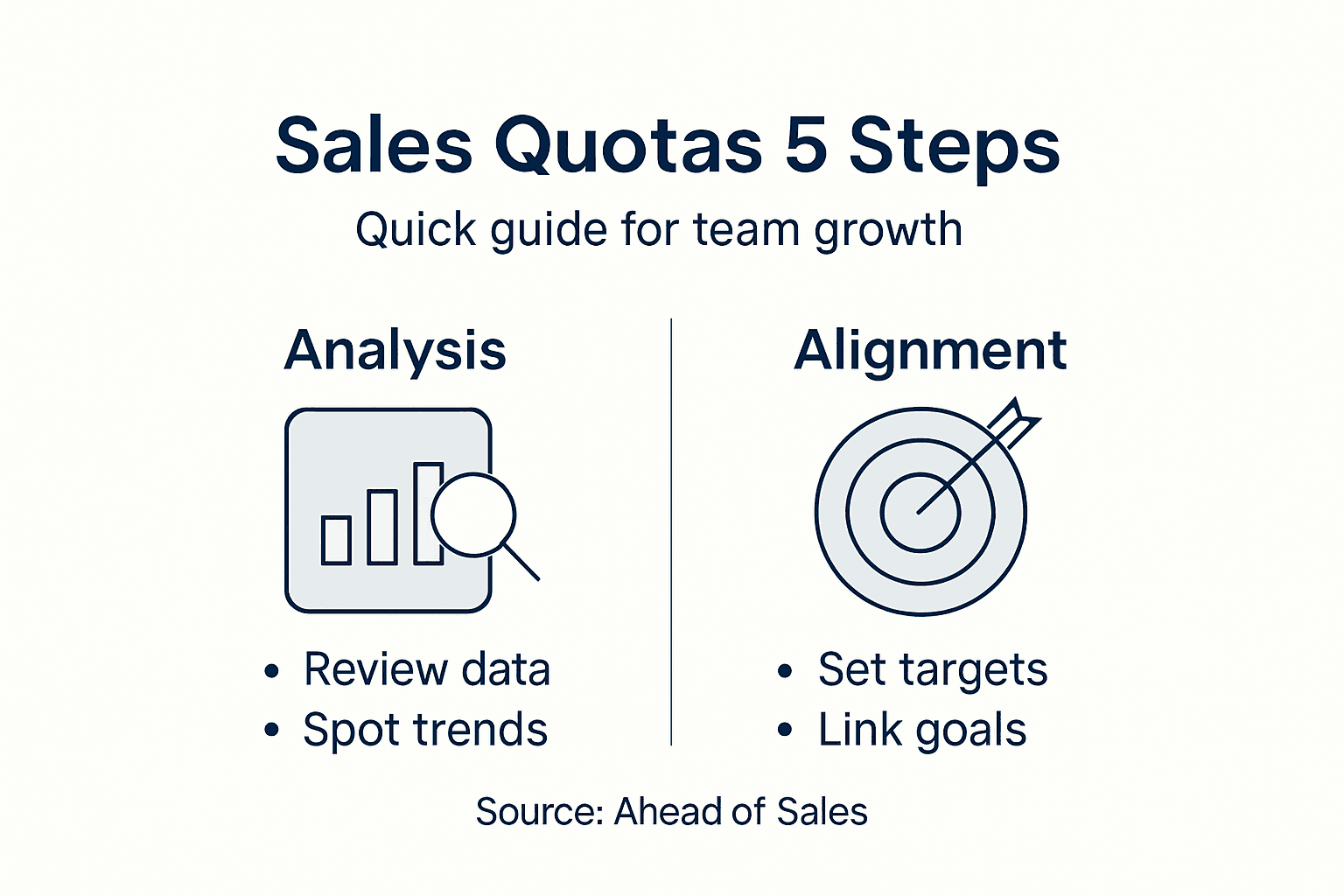
Setting quotas that push your team forward without risking morale can feel like solving a puzzle in constant motion. For British sales directors balancing growth ambitions and team well-being, getting this right is critical. Drawing from proven frameworks like the SMART goal approach and strategies from Harvard Business Review, you will discover how effective quota setting drives performance and aligns sales targets with business priorities, creating a clear path to sustainable growth.
Table of Contents
- Step 1: Analyse Current Sales Performance Data
- Step 2: Define Achievable And Motivating Targets
- Step 3: Align Quotas With Business Objectives
- Step 4: Implement Quotas Across Your Sales Team
- Step 5: Review And Adjust Quotas For Optimal Results
Quick Summary
| Key Insight | Explanation |
|---|---|
| 1. Analyse historical data thoroughly | Review past sales data for insights on team performance and trends essential for setting accurate quotas. |
| 2. Use the SMART framework for targets | Structure quotas with Specific, Measurable, Achievable, Relevant, and Time-bound criteria to ensure clarity and realism. |
| 3. Align quotas with business objectives | Ensure quotas support overarching business goals like market share, profitability, and customer retention for effective performance. |
| 4. Implement clear communication strategies | Discuss quotas individually with team members to foster understanding, commitment, and trust in the targets set. |
| 5. Regularly review and adjust quotas | Conduct periodic assessments of quota effectiveness to maintain relevance and motivation, adapting to market changes if necessary. |
Step 1: Analyse current sales performance data
Before you set quotas that actually work, you need a clear picture of where your team stands right now. This means diving into your historical sales data, identifying patterns, and understanding what’s driving results. Without this foundation, your quotas will be guesses rather than strategic targets.
Start by gathering your sales data from the past 12 to 24 months. You’re looking for three key metrics:
- Total revenue generated per team member
- Deal win rates and deal cycle lengths
- Product or service line performance
Your CRM should hold most of this information already. If you’re using spreadsheets, consolidate everything into one place so you can see patterns clearly. The accuracy of your quota depends entirely on how reliable your baseline data is.
Now examine the trends within your data. Did performance improve during certain months? Did specific sales reps consistently outperform others? Understanding monthly retail sales trends across your industry helps contextualise whether changes in your team’s performance reflect market conditions or individual effort.
Break down performance by individual rep, territory, customer segment, and product line. This segmentation reveals what’s actually working and where the weak spots are. A rep might excel at closing enterprise deals but struggle with SME accounts. One territory might be saturated whilst another has untapped potential.
Here’s a summary of ways to segment and analyse sales performance for quota setting:
| Segmentation Type | What It Reveals | Impact on Quota Setting |
|---|---|---|
| Individual Rep | Identifies outliers and consistent trends | Enables tailored individual targets |
| Territory | Shows regional demand and saturation | Adjusts quotas to match local reality |
| Customer Segment | Highlights strengths in client types | Focuses reps on most profitable groups |
| Product Line | Pinpoints high- and low-performers | Shifts targets toward growth products |
Your historical data tells the story of what’s possible for your team. Use it to set realistic but aspirational quotas.
Next, identify your top performers and your developing team members separately. What does success look like for your highest achievers? What does a reasonable growth target look like for someone still building their skills? These aren’t the same number.
Also examine external factors that influenced performance. Did a major client leave? Did you launch a new product? Did the market shift? These contextual details matter because they help you predict whether past performance is repeatable.
Pro tip: Create a simple dashboard showing each rep’s quarterly performance over the past two years. This visual reference becomes invaluable when you’re setting individual quotas and having those conversations with your team.
Step 2: Define achievable and motivating targets
Setting quotas that land is an art. They need to stretch your team without demoralising them. Too easy and your top performers coast. Too hard and everyone gives up before the quarter starts. The sweet spot lives in the middle, where ambition meets realism.
Start by using the SMART goal framework to structure your targets. This means your quotas must be Specific (not vague), Measurable (tied to actual numbers), Achievable (based on your data), Relevant (aligned with business strategy), and Time-bound (clear deadlines). This approach removes guesswork and gives your team clarity about what success looks like.
Take the performance data you’ve already gathered and calculate the realistic growth rate for each segment. If your average rep generated £80,000 last year, pushing them to £100,000 might be a reasonable 25% stretch. But if your top rep hit £200,000, expecting the struggling rep to match that is setting them up to fail.
Here’s how to build targets that work:
- Set individual quotas based on territory potential and past performance
- Create team quotas that align with company revenue goals
- Build in quarterly milestones so progress feels achievable
- Factor in seasonal variations or market cycles specific to your business
Your quotas should also reflect strategies that balance aggressiveness with attainability. This isn’t about being soft. It’s about being strategic. A rep who consistently hits 110% of quota is performing better than one who misses 150% every month.
Motivating targets feel within reach but require genuine effort to achieve. That tension is what drives performance.
Consider involving your team in the quota-setting conversation. When reps help shape their targets, they own them differently. They’ll push harder for something they’ve helped create than something handed down from above.
Also build in flexibility for different circumstances. Your enterprise sales manager might operate on a different quota structure than your inside sales team. One might need to focus on deal count. The other might prioritise revenue per deal. Different roles, different metrics.
Pro tip: Share your quota logic transparently with each team member. Walk through how you calculated their specific number using their historical data and market opportunity. Transparency builds trust, and trust makes quotas feel fair rather than punitive.
Step 3: Align quotas with business objectives
Your sales quotas should never exist in isolation. They’re not just about hitting revenue targets. They’re about moving your business towards its strategic goals. Without this alignment, your team might hit their numbers whilst the company moves in the wrong direction.

Start by clarifying what your business is actually trying to achieve this year. Are you prioritising profit margins or market share? Are you launching into a new sector or deepening penetration in existing markets? Do you need to reduce customer churn or increase lifetime value? Your quotas should reflect these priorities.
Once you’ve identified your core business objectives, map how sales quotas support them. If your priority is expansion into enterprise accounts, your quotas should reward enterprise deal closures, not just activity. If you’re focused on profitability, weight quotas towards higher-margin products. If you’re building market share, quotas should drive volume even if margins are tighter initially.
Here’s how to build this alignment:
- List your 3 to 5 primary business objectives for the year
- Determine what sales activities directly support each objective
- Assign quota weightings that reflect your strategic priorities
- Communicate explicitly how each rep’s quota connects to company goals
Strategic alignment integrates your sales quotas with broader organisational goals, ensuring coherent efforts across all business units. This isn’t bureaucratic. It’s practical. When your sales team understands how their work contributes to real business outcomes, engagement increases and results follow.
Consider your different customer segments too. A quota structure for winning new clients looks different from one focused on growing existing accounts. Your quotas should push reps towards the mix of business that matters most right now.
The table below contrasts quota types and their strategic alignment benefits:
| Quota Type | Best Use Case | Strategic Business Impact |
|---|---|---|
| Revenue-Based | Overall sales growth | Directly increases turnover |
| Deal Count | Market penetration | Grows total customer base |
| High-Margin Focus | Profitability initiatives | Improves bottom line |
| Product Mix | Launch or cross-selling focus | Accelerates adoption of key offers |
When sales quotas align with business strategy, your team doesn’t just hit numbers. They build genuine competitive advantage.
Also review how quotas interact with your company’s broader resources and capacity. If your delivery team can only onboard 20 new clients per quarter, setting quotas for 40 new clients creates chaos. Quotas need to align with what your business can actually deliver.
Pro tip: Create a one-page document showing how each quota tier connects to your strategic objectives. Share this widely so your entire team understands the business reasoning behind the numbers, not just the numbers themselves.
Step 4: Implement quotas across your sales team
Having set your quotas, the real work begins. Implementation is where strategy becomes reality. You need to communicate these quotas clearly, answer questions honestly, and ensure your team understands not just the numbers but the reasoning behind them.
Start by scheduling one-on-one conversations with each team member before announcing anything publicly. This gives you space to explain their individual quota, address concerns, and listen to their perspective. A rep who feels heard is far more likely to commit to their target than one who receives an email announcement.
During these conversations, walk through the data. Show them their historical performance, the growth you’re expecting, and how their quota compares to peers in similar positions. Transparency builds trust. If a rep sees the logic, they’re more likely to accept the stretch.
Here’s your implementation roadmap:
- Schedule individual quota conversations with each rep
- Present the data and reasoning behind their specific number
- Ask for their input and concerns
- Document their commitment and any relevant context
- Announce team-wide quotas and celebrate the goals together
Territory and quota management requires systematic alignment and fair target allocation to ensure your sales team feels properly challenged. When reps believe quotas are fair and achievable, motivation increases and performance follows naturally.
Build in clear visibility during the implementation phase. Create a shared dashboard or spreadsheet showing progress towards quotas. Regular check-ins keep momentum alive and allow you to course-correct early if someone’s struggling.
Also establish your review cadence upfront. Will you check progress monthly, weekly, or quarterly? Set expectations now so nothing feels like a surprise later.
Implementation succeeds when your team understands the “why” behind the numbers, not just the numbers themselves.
Consider celebrating quota announcements positively. Frame this as a vote of confidence in your team’s ability, not as an arbitrary increase. The tone you set during rollout shapes how your team responds to the challenge.
Finally, build in flexibility for genuine market changes. If a major client leaves or a new competitor enters your space, be willing to revisit quotas mid-year. Rigid quotas that ignore reality destroy motivation faster than anything else.
Pro tip: Document each rep’s quota conversation including their questions, concerns, and any special circumstances affecting their target. This record becomes invaluable for mid-year reviews and helps you show objectivity in quota decisions.
Step 5: Review and adjust quotas for optimal results
Quotas aren’t set-and-forget targets. They’re living frameworks that need regular review and refinement. Market conditions shift, team composition changes, and your understanding of what’s realistic evolves. Reviewing quotas quarterly keeps them aligned with reality whilst maintaining motivation.
Start your review by pulling actual performance data against your original quota projections. Compare what you expected to happen with what actually happened. Did certain reps consistently exceed their quotas by 30%? That suggests their quotas were too conservative. Did others miss by significant margins despite genuine effort? That might indicate quotas were unrealistic or external factors created obstacles.
Look for patterns across your team. If most reps are hitting 110% to 120% of quota, your quotas may be too easy. If most are missing their targets, they’re likely too aggressive. The goal is a distribution where strong performers exceed targets whilst average performers hit them.
Here’s your quarterly review process:
- Analyse actual results against quota projections
- Identify systematic biases in your quota setting
- Note changes in territory potential or market conditions
- Review individual circumstances that affected performance
- Determine if quotas need adjustment going forward
Regular review and adjustment of quota frequency can motivate salespeople appropriately and balance product focus, leading to improved sales volume and profitability. This isn’t about constantly moving the goalposts. It’s about maintaining fairness as circumstances change.
When you discover that quotas need adjusting, be transparent about it. Explain what you learned and why adjustments make sense. A rep who sees you willingly revising quotas based on evidence trusts that quotas are fair, not arbitrary.
Also monitor whether your quotas are driving the right behaviours. If your product mix quota is pushing reps towards lower-margin sales just to hit numbers, that’s a problem worth addressing. Your quotas should reinforce your strategic priorities, not undermine them.
Quotas that never adjust lose credibility. Regular reviews show your team you’re paying attention and committed to fairness.
Don’t wait for quarterly reviews if market conditions shift dramatically. A major client loss, a new competitor, or an unexpected economic change warrants mid-quarter review and adjustment. Clinging to quotas that no longer make sense demoralises your entire team.
Pro tip: Create a simple tracking sheet showing each rep’s performance against quota by month throughout the quarter. Review it weekly to spot problems early, then use quarterly data to inform adjustments for the next period.
Empower Your Sales Team with Quotas That Drive Real Growth
Setting effective sales quotas is one of the toughest challenges sales leaders face. This article highlights the importance of analysing accurate performance data, setting achievable but motivating targets, and aligning quotas with your business goals. If you find your team struggling with inconsistent quota attainment or unclear sales targets, these common pain points can be transformed with the right expert guidance.
At Ahead of Sales, we specialise in bespoke 1:1 coaching combined with tailored training and consultancy designed to help businesses achieve at least 50% sales growth each year. Our experienced coaches work alongside you to implement quota strategies that boost team motivation and ensure every quarter ends on target. Whether you lead a medium-sized business or a larger organisation, our proven methods help you balance ambition with realism to foster sustained growth.
Explore our sales training solutions to discover how transparent quota-setting and strategic alignment can transform your team’s results. Don’t let poorly set quotas hold your business back: partner with Ahead of Sales today and set your team up for success.
Frequently Asked Questions
How do I analyse current sales performance data to set quotas?
To analyse current sales performance data, gather historical sales data from the past 12 to 24 months, focusing on total revenue per team member, deal win rates, and product performance. Assess patterns and trends, then break down the data by individual rep and territory to identify strengths and weaknesses before setting realistic quotas.
What is the SMART goal framework for setting sales quotas?
The SMART goal framework helps structure sales quotas to be Specific, Measurable, Achievable, Relevant, and Time-bound. Use this method to ensure quotas align with your team’s performance data, setting clear growth targets, for instance, increasing a rep’s quota from £80,000 to £100,000, achieving a 25% stretch.
How can I align sales quotas with my business objectives?
To align sales quotas with business objectives, clarify your company’s main goals for the year, such as increasing market share or profitability, and ensure quotas reflect these priorities. For example, if expanding enterprise accounts is a goal, set quotas that reward closures in that segment specifically.
What steps should I take to implement quotas across my sales team?
Start by scheduling individual conversations with each team member to discuss their specific quotas, addressing any concerns they might have. Clearly communicate the data and reasoning behind each quota to build trust and ensure buy-in before announcing team-wide quotas.
How often should I review and adjust sales quotas for optimal results?
Sales quotas should be reviewed quarterly to remain relevant and motivating. During your review, compare actual performance against projections, and adjust quotas if necessary to reflect changing market conditions or team composition, ensuring your team is consistently challenged but not overwhelmed.