The fastest way to improve demo conversion is to run short, outcome-first, prospect-data-led demos that lead directly into a timeboxed, success-metric-led trial. Human validation at key decision moments still matters more than polish or feature coverage, and measurement is what turns a one-off good demo into a repeatable process. Below, we set out the tactics, templates and metrics that make this work in practice.
TL;DR:
- Starting demos with the buyer’s success metrics and personal terminology increases engagement and relevance.
- Limiting demos to two or three tailored use cases aligned with the buyer’s goals improves memorability and focus.
- Building reliable, role-specific demo templates and scripted fallback points ensures scalability and consistent quality.
- Concluding demos with a clear, timeboxed trial or pilot linked to specific success criteria boosts decision likelihood.
- Tracking key funnel metrics and conducting controlled A/B tests on demo variables highlight improvement areas and guide best practices.
Table of Contents
- Five high-impact demo techniques to increase conversion
- How to build a demo environment that scales and converts
- Designing trials, pilots and POCs as conversion engines, not experiments
- Post-demo follow-up and hand-offs that materially increase conversion
- Measure and iterate: demo analytics, A/B testing and success metrics
- How Ahead of Sales applies these tactics: evidence and practitioner playbook
- Why demos must become evidence sessions in the age of AI and self-serve buying
- How Ahead of Sales helps teams convert demos into revenue
- FAQ
- Sources
Five high-impact demo techniques to increase conversion
Most demos lose the room in the first ninety seconds because they open with a tour of the product rather than a conversation about the buyer’s problem. We’ve found that the single biggest lever in improve demo conversion efforts is reordering what comes first: outcomes before features every time.
Start with the buyer’s own success metrics, not yours. If a prospect has told you their goal is cutting onboarding time or lifting win rates, open the demo by restating that goal in their words, then show only what moves that number. Everything else is noise at this stage.
Personalisation goes further than using the prospect’s logo on a slide. Build the narrative around their actual terminology, their reporting cycles and the workflow their team already follows. A demo that mirrors how a buyer already works feels like a fit; one that mirrors how your product is built feels like homework.
Keep it tight. A demo trying to cover ten features in forty minutes teaches the room nothing memorable. Structure the session around two or three high-value use cases tied directly to the stated goal, and leave the rest for a follow-up resource.
Guided interactivity beats a free-for-all. Letting a buyer click anywhere invites distraction and off-script questions you can’t answer well. Controlled exploration, where you invite questions at defined checkpoints, keeps the session focused while still feeling collaborative rather than scripted.
- Lead with the buyer’s success metric, not your product’s feature list.
- Mirror their workflow and vocabulary rather than your internal naming conventions.
- Limit the demo to two or three use cases that map directly to their stated goal.
- Build in checkpoints for questions instead of open-ended exploration.
- End every session with a named next step: a trial, a pilot, or a defined evaluation window.
Pro Tip: Write the buyer’s own success metric on the first slide of the demo, word for word from their earlier conversation, and refer back to it at the close.
Closing with a concrete evidence plan is the step most sellers skip. Rather than ending on “any questions?”, propose a specific, timeboxed trial with agreed acceptance criteria before the call ends. Forrester’s research on trials and proof of concepts found that trials and proofs of concept have become the real decision-making moment in B2B buying, which means the demo’s job is to earn the right to run one, not to close the deal outright.
How to build a demo environment that scales and converts
A demo that depends on one person’s memory and a lucky network connection will eventually fail in front of the wrong buyer. Building a reliable environment takes some upfront investment, but it pays back every time a rep reuses it without reinventing the session from scratch.
- Build role-specific templates for your two or three most common buyer personas, each structured around that persona’s typical goal rather than a generic walkthrough.
- Prepare sample data that mirrors the buyer’s real workflows closely enough that the numbers and screens look believable, not generic placeholder content.
- Script fallbacks for predictable failure points, such as a slow integration or a missing data field, so a glitch never stalls the session.
- Choose the format deliberately: a live interactive demo suits a buyer who wants to steer, a guided sandbox suits a self-serve evaluator, and a narrated recording suits a stakeholder who can’t attend live.
- Run a pre-demo checklist covering system access, permissions, who from the buying group will attend, and a technical test on the exact device and network you’ll use.
A field service platform such as Curcle illustrates this well: its demo resources are built around specific compliance and operational scenarios rather than a single generic tour, which gives a buyer something concrete to react to.
The checklist step matters more than it sounds. A structured pre-demo checklist covering technical readiness and stakeholder alignment is standard advice across sales operations guidance precisely because logistics failures, not product gaps, are what most often sink an otherwise strong demo.
Designing trials, pilots and POCs as conversion engines, not experiments
Too many trials are set up as open-ended “have a look around” periods with no defined end point. That structure helps nobody: the buyer doesn’t know what success looks like, and the seller has no clean trigger to move to a commercial conversation. Forrester’s analysis of trials and proofs of concept frames these as mission-critical decision experiences, built around the customer’s own data and use case, rather than as free trials in the old sense.
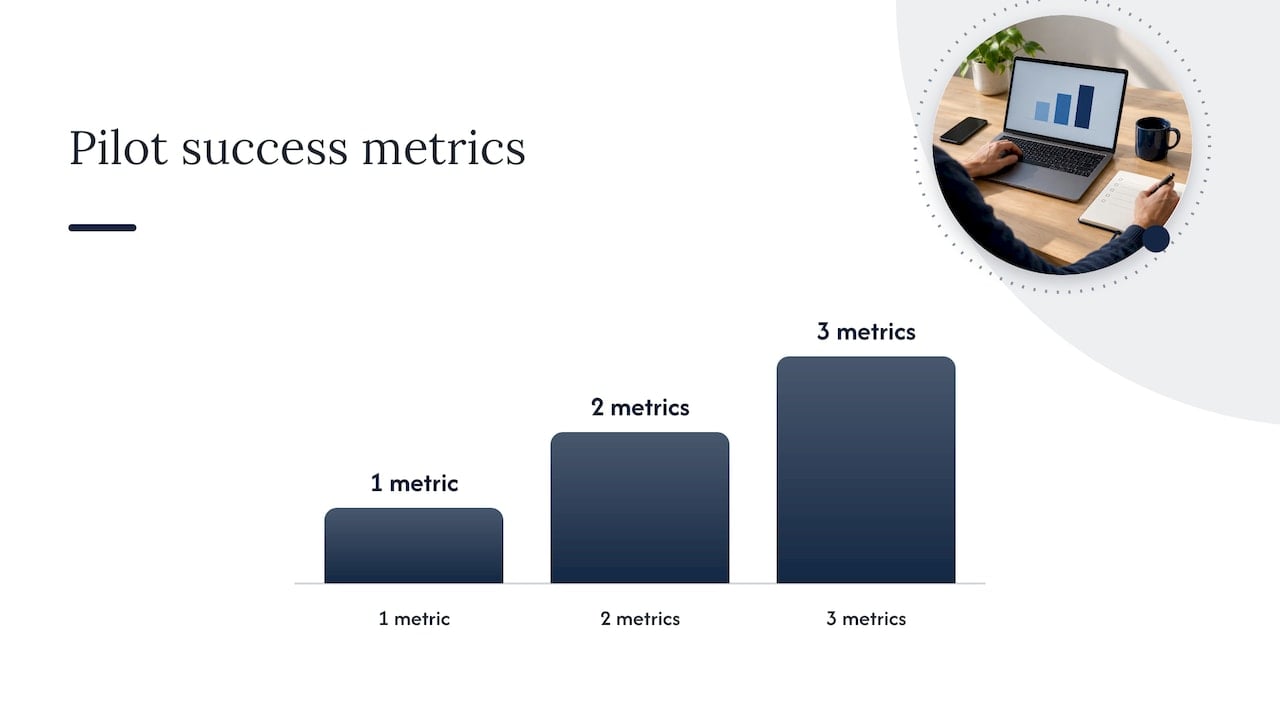
Before a pilot starts, agree on one to three success metrics and a fixed timebox. More than three metrics dilutes focus and makes a mixed result harder to interpret.
- Define success metrics and a clear end date before the pilot begins, not during it.
- Use the prospect’s own data and real workflows so results are attributable to the product, not to a favourable test setup.
- Agree roles and acceptance gates upfront: who signs off, and against what criteria.
- Schedule checkpoints during the pilot to surface objections early rather than at the final review.
- Scope the pilot narrowly, with an explicit path to expand once success criteria are met.
A pilot with no commercial next step attached is just a longer demo. State the scope that follows success before the pilot begins, so the conversation about rollout isn’t a surprise at the end.
Post-demo follow-up and hand-offs that materially increase conversion
The hours after a demo decide more than the demo itself. A generic “great speaking with you” email gets ignored; a one-page memo tying what you showed to the buyer’s own KPIs gets forwarded internally.
- Send a one-page decision memo within hours, linking each demo outcome back to a specific KPI the buyer named.
- Map the next step with named owners, a realistic timeline and the inputs needed from the buyer’s side to start a pilot.
- Use a short, personalised video or voice note to re-engage a stakeholder who went quiet, rather than another generic email.
- Identify and equip an internal champion with the materials they need to build consensus without you in the room.
- Set a clear rule for when to escalate to product or executive sponsorship, such as a stalled decision after two follow-ups.
Pro Tip: Ask directly during the demo who else needs to see this before a decision gets made, then build your follow-up plan around that person, not around the attendee list.
A champion inside the buying group does more for conversion than any amount of seller persistence, because they carry the message when you’re not there to carry it yourself.
Measure and iterate: demo analytics, A/B testing and success metrics
What gets measured gets improved, and most sales teams measure far too little about their demos beyond whether one got booked at all.
Track four numbers consistently: show-to-book rate, demo-to-POC conversion, pilot-to-paid conversion, and time-to-decision. Together these show where prospects stall, which matters more than any single headline conversion figure.
- Track show-to-book, demo-to-POC, pilot-to-paid and time-to-decision as a connected funnel, not isolated metrics.
- Instrument behavioural signals during the demo itself: which slides get questions, where attention drops, what gets clicked when buyers are given a guided sandbox.
- Run controlled A/B tests on one variable at a time, such as opening framing, total demo length, or level of interactivity, rather than changing several things at once.
- Feed winning variants back into a shared playbook so the whole team benefits from what one rep discovers works.
Interactive, personalised demos consistently show higher buyer engagement than generic feature tours, which is why instrumenting engagement signals, not just outcomes, is worth the setup effort.
Gartner’s research on the B2B buying journey points to specific stages where sellers add the most value through validation, which is exactly where A/B testing should concentrate: the moments where a buyer is deciding whether to trust what they’ve just seen.
How Ahead of Sales applies these tactics: evidence and practitioner playbook
We built an approach to demo and pilot conversion around the same principle that runs through this guide: proof beats persuasion. Bespoke coaching can combine consultative demo design with a disciplined pilot-to-paid methodology, so a trial isn’t just a free look, it’s a structured step towards a decision.
- Sales teams can run win-loss analysis after every pilot, feeding what’s learned straight back into the next demo script.
- Pilot governance frameworks can set roles, checkpoints and acceptance criteria before a trial starts, not after it stalls.
- Adaptable templates, including a decision memo format and a pilot success-criteria sheet, can be reused without rebuilding them from scratch each time.
This is the same structure covered above: outcome-first framing, a timeboxed proof, and a follow-up process with clear ownership.
Why demos must become evidence sessions in the age of AI and self-serve buying
Buyers now do a large share of their early research through AI tools and self-serve content before a seller ever gets involved. Gartner found that 69% of B2B buyers turn to sales reps to validate AI-generated insights, even while many of those same buyers say they’d prefer a rep-free experience if they could get one.
That tension is the whole argument for this guide. Buyers don’t want more selling, they want confirmation that what they’ve already found is true. We think this means fewer demos, run with more preparation, each one built to validate a specific claim rather than to showcase everything the product does. The seller’s role shifts from gatekeeper of information to validator of outcomes, and that shift rewards the teams who invest in training sellers for consultative conversations over those who simply run more demos.
— Jerry
How Ahead of Sales helps teams convert demos into revenue
We work with sales teams who already know their demo-to-close rate isn’t where it should be and want a faster route to fixing it than trial and error. Our consultative selling training, pilot-to-paid conversion coaching and win-loss analysis are built around the same outcome-first approach covered in this guide, applied directly to your team’s own pipeline and buyers.
- Bespoke 1:1 coaching alongside team training, built for businesses with growth targets to hit every quarter.
- Packages for teams typically run from £4,500 to £8,500, with a solo accelerator track from £2,995 to £5,995 for independent consultants and founders, as listed on our sales training cost page.
- A monthly coaching option, The Sage Collective, is available from £990 per month.
If you’d like a straightforward next step, book a discovery call through our sales training services page and we’ll talk through where your demo-to-close rate is stalling.
FAQ
What are the biggest demo mistakes sales teams make?
The most common mistake is opening with a feature tour instead of the buyer’s own success metric, which loses attention before the session earns it. A close second is running an open-ended trial with no timebox or success criteria, leaving the buyer unsure what a good outcome even looks like.
What makes a good sales demo?
A good demo is short, built around two or three use cases tied directly to the buyer’s stated goal, and uses their own data or terminology rather than generic examples. It closes with a specific, timeboxed next step, such as a pilot with agreed acceptance criteria, rather than a vague offer to “stay in touch”.
Can you give an example of a strong sales demo structure?
A strong structure opens by restating the buyer’s goal in their own words, moves through two or three relevant use cases with checkpoints for questions, and ends by proposing a defined trial with a named success metric and end date. This mirrors the proof-led approach Forrester describes for trials and proofs of concept.
What is the purpose of a sales demo?
A demo exists to validate, for a specific buyer, that a product solves the problem they’ve already identified, not to showcase every capability the product has. Its real job is to earn the right to a structured trial or pilot, which is where most B2B purchase decisions actually get made.
How do we know if our demo changes are working?
Track show-to-book, demo-to-POC, pilot-to-paid and time-to-decision together as a funnel, then run one-variable A/B tests, such as opening framing or demo length, to isolate what moved the numbers. Feed whatever wins back into a shared playbook so the improvement isn’t limited to one rep’s instinct.