
A proof of concept (PoC) tests whether something can work. A pilot tests whether it does work, with real users, real data and real daily operations, before a full rollout. If a buyer asks you for “a quick PoC” when what they want is a live trial across a team, you are about to agree to the wrong project. This guide shows you how to tell the two apart, where proof of value (PoV) fits, and how to run each so it ends in a decision rather than a drifting trial.
I write this as someone who works with B2B sales leaders and founders, so I’ll look at both sides: running a test as a buyer, and selling into one as a vendor.
TL;DR
- A PoC checks feasibility in a controlled setting (“can it work?”). A pilot checks fit in live conditions (“does it work here, with our people?”).
- A proof of value sits alongside them and asks whether the investment pays off, which is the question most finance directors actually care about.
- PoCs are short and narrow. Pilots involve more users, more departments and usually more months.
- Agree success and stop criteria in writing before anything starts, and name who decides what happens afterwards.
- If you sell the product being tested, the pilot is where deals are won or quietly lost, so plan the conversion to a paid rollout from day one.
Table of Contents
- PoC vs pilot at a glance
- What a proof of concept is for
- What a pilot is for
- Where proof of value fits
- How to choose: a simple decision path
- Setting success criteria before you start
- If you are the vendor: how pilots are won and lost
- If you are the buyer: protecting your time and budget
- Common mistakes with PoCs and pilots
- Our perspective
- Getting help with the sales side
- FAQ
- Sources
PoC vs pilot at a glance
The two terms are often used interchangeably, and Nesta has pointed out that a PoC demonstrates feasibility while a pilot is a live activity used to find problems before full operation. That is the distinction worth holding on to, even when the people around you blur it.
| Proof of concept (PoC) | Proof of value (PoV) | Pilot | |
|---|---|---|---|
| Core question | Can this work? | Is it worth the investment? | Does it work in our real operation? |
| Environment | Sandbox or controlled set-up | Controlled or semi-live | Production or production-like |
| Data | Sample, synthetic or masked | Often real, scoped | Real |
| Typical scale | One function, few users | A defined use case | More users and departments |
| Typical length | A few weeks | Weeks to months | Often several months |
| Output | Go or no-go, build estimate | Business case, ROI evidence | Rollout decision, refined process, training and support plan |
The durations and scope in the table come from a sales-focused breakdown of PoC, PoV and pilot, and the outputs from a comparison of pilots and PoCs. Treat the lengths as typical, not fixed. Your own project will set its own clock.
What a proof of concept is for
POC stands for proof of concept. TechTarget defines it as a demonstration used to test whether an idea can become reality, and whether it is feasible and viable, before you commit significant resources.
In practice a PoC is usually small and theoretical. UK government guidance on testing and piloting services notes that a PoC may use a sandbox in software, and that it can also flag technical, logistical or operational issues that could get in the way of a full-scale implementation.
A good PoC is time-bound and fixed in scope, and it tests against clear goals and success metrics. One vendor whitepaper suggests a software or data PoC should typically be deliverable in 12 weeks or less. If yours is heading for six months, it has probably become a pilot without anyone saying so.
A worked PoC example
Take a finance team considering an AI tool to read supplier invoices. A sensible PoC asks one question: can the system extract invoice line items and match them to purchase orders at an agreed accuracy level? A UK guide to AI proofs of concept describes exactly this kind of test, using representative real data and success and stop criteria agreed beforehand.
Notice what the PoC does not ask. It does not ask whether the accounts team will like the tool, whether it connects to your ERP, or whether it saves money at scale. Those belong to the pilot and the proof of value.
What happens when a PoC fails
A failed PoC is not wasted money. You can either retry with different goals and a different approach, or accept that the idea has been disproved and save further effort. The failure is only expensive when nobody had defined what failure looked like.
What a pilot is for
A pilot takes the thing you now believe can work and puts it in front of real people. The government guidance describes it as testing a preferred service on a smaller scale to identify issues before full rollout, and says a pilot is usually the final stage of testing a delivery model before new services go live.
Three things change compared with a PoC:
- Real users. People who will use it every day, not the project team.
- Real data. PoC data may be sample, synthetic or masked, whereas pilot data is real.
- Real integrations. A pilot shows how the solution behaves alongside your other systems and in daily operations.
The same guidance gives a useful warning: a pilot should not be used to test whether a policy is appropriate, to look at alternative options, or to justify a business case. Those jobs suit other kinds of testing. If your “pilot” is really a way to choose between three vendors, you are running an evaluation, and it will behave differently.
Where proof of value fits
POV stands for proof of value. The government guidance puts it neatly: a PoC asks whether an idea is viable and can deliver the required functionality, while a PoV goes further and determines the economic case. In short, a PoC proves feasibility and a PoV proves the implementation is worth the investment.
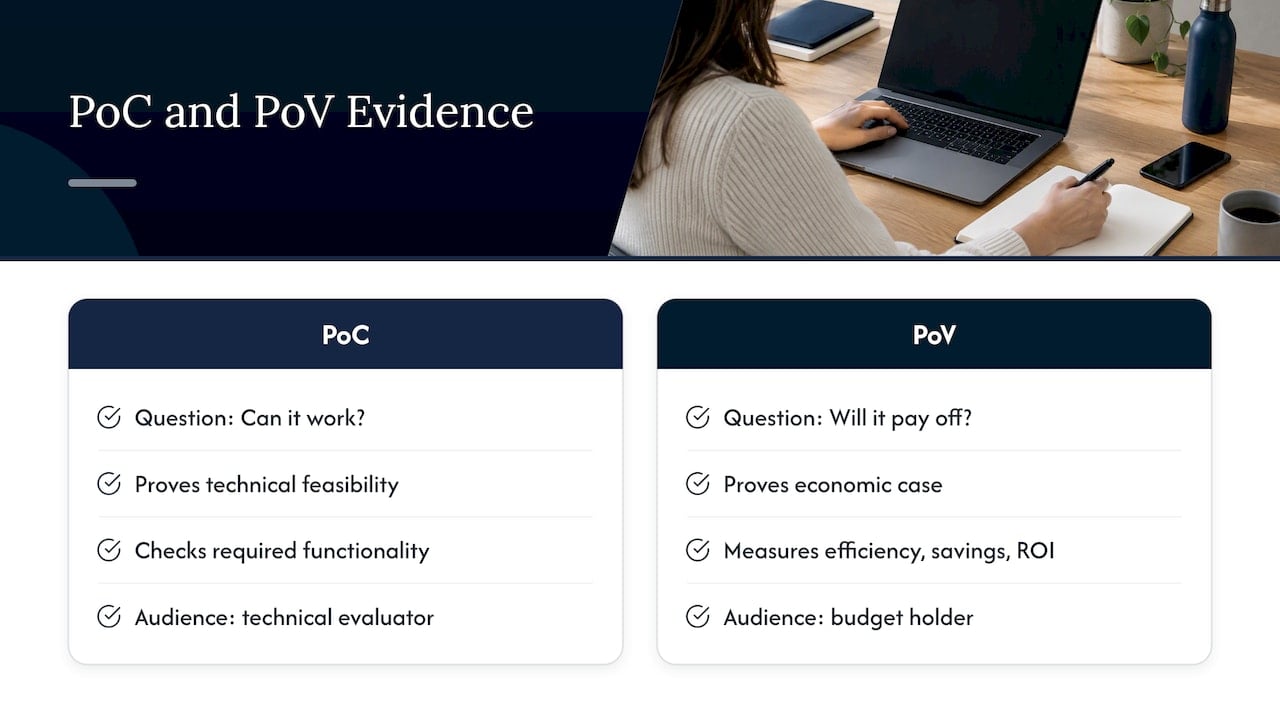
A sales-side explanation frames the same shift as moving from “Can it work?” to “Will it pay off?”, with the evidence being efficiency, cost savings or ROI rather than technical function.
So when you see “PoV vs PoC” in a buying process, read it as a change of audience. A PoC convinces the technical evaluator. A PoV convinces whoever holds the budget. In many B2B deals you need both, and the second is the one that gets a purchase order signed.
How to choose: a simple decision path
Skipping the right stage has a predictable cost. Skip the PoC and you risk building something that cannot work. Skip the pilot and you risk rolling out something people cannot or will not use.
Use this order of questions:
- Are you unsure the technology or method is feasible at all? Run a PoC.
- Is feasibility reasonably clear, but the financial case is not? Run a PoV, with the outcome expressed in money or time saved.
- Is the case made, but you do not know how people and systems will cope? Run a pilot.
- Is everything clear? Skip straight to rollout and don’t call it a test.
The UK government’s Test, Learn and Grow playbook adds a helpful scale principle: early-stage testing should reduce uncertainty and risk, while later decisions such as scaling or further investment need stronger evidence of outcomes. A £2,000 experiment needs less proof than a £200,000 rollout.
Setting success criteria before you start
This is the part that decides whether the test is any use. The same playbook advises setting decision criteria before testing, matching the evidence to the size of the decision, and choosing afterwards whether to continue or scale, iterate, pause or stop.
In plain terms, write down five things before day one:
- The question. One sentence. “Can the tool match 95% of invoice lines to purchase orders?” is a question. “See how it goes” is not.
- The measure and threshold. What number counts as a pass, and what counts as a stop.
- The data and users. Which sample or which team, and who provides access.
- The time limit. A fixed end date, with a review meeting booked.
- The decision maker. One named person who says yes or no.
The threshold in my example is illustrative. Set your own with the people who will live with the result.
If you are the vendor: how pilots are won and lost
Most of the sales leaders I work with are on the other side of the table. They sell the product being tested, and the most common failure I see is a pilot that goes well and then stalls. Everyone liked it, nobody objected, and nothing was signed.
That usually happens because the commercial route out of the pilot was never agreed. Three habits help:
Agree the next step before the start. If the pilot hits its criteria, what happens? Who signs, at what price, from when? Put it on one page and have the buyer’s decision maker initial it.
Involve the budget holder early. A pilot run purely with end users produces enthusiasm but not authority. Bring in the person who approves spend at the kick-off and again at the review.
Keep the pilot short enough to keep urgency. We cover the mechanics in our guide on how to convert a 6 to 10 week pilot into a signed rollout, and the demo stage that comes before it in turning pilots into paid rollouts.
It also helps to know exactly where a test sits in your pipeline. A PoC normally belongs in the evaluation stage, a pilot in late evaluation or early negotiation. Our practical guide to sales pipeline stages shows how to track them so that free trials do not inflate your forecast.
If you are the buyer: protecting your time and budget
Buyers can be caught out too. A vendor who offers a free “pilot” that is really an extended demo will use your team’s time and give you little evidence in return. Before you agree:
- Ask what real data and real users are involved, and whether your security or compliance team has signed off on the data use.
- Ask what the vendor expects you to commit afterwards. A good pilot has no hidden obligation.
- Check what is being tested. If it is the vendor’s sandbox, it is a PoC, whatever they call it.
- Agree who owns the work and the results if you decide not to proceed.
If the test involves moving from early validation to live delivery and then implementation, a 60 day layered pilot approach is one example of staging the work in layers rather than all at once. For AI projects specifically, there is a step-by-step walk-through of launching an AI pilot project in mid-sized companies.
Common mistakes with PoCs and pilots
Calling everything a pilot. Language drifts, and so does scope. If a test has no sample data and no real users, it is a PoC.
Letting a PoC grow. Every extra feature added to a PoC pushes it towards an unfocused half-pilot. Park extras in a list for the pilot.
No stop criteria. Teams agree what success looks like but never what failure looks like, so a weak result gets another month.
Testing the wrong audience. A pilot in your most enthusiastic team will flatter the result. Include at least one sceptical group.
Using a pilot to justify a decision already made. The government guidance is clear that pilots are not for justifying a business case. If you need that, run a PoV.
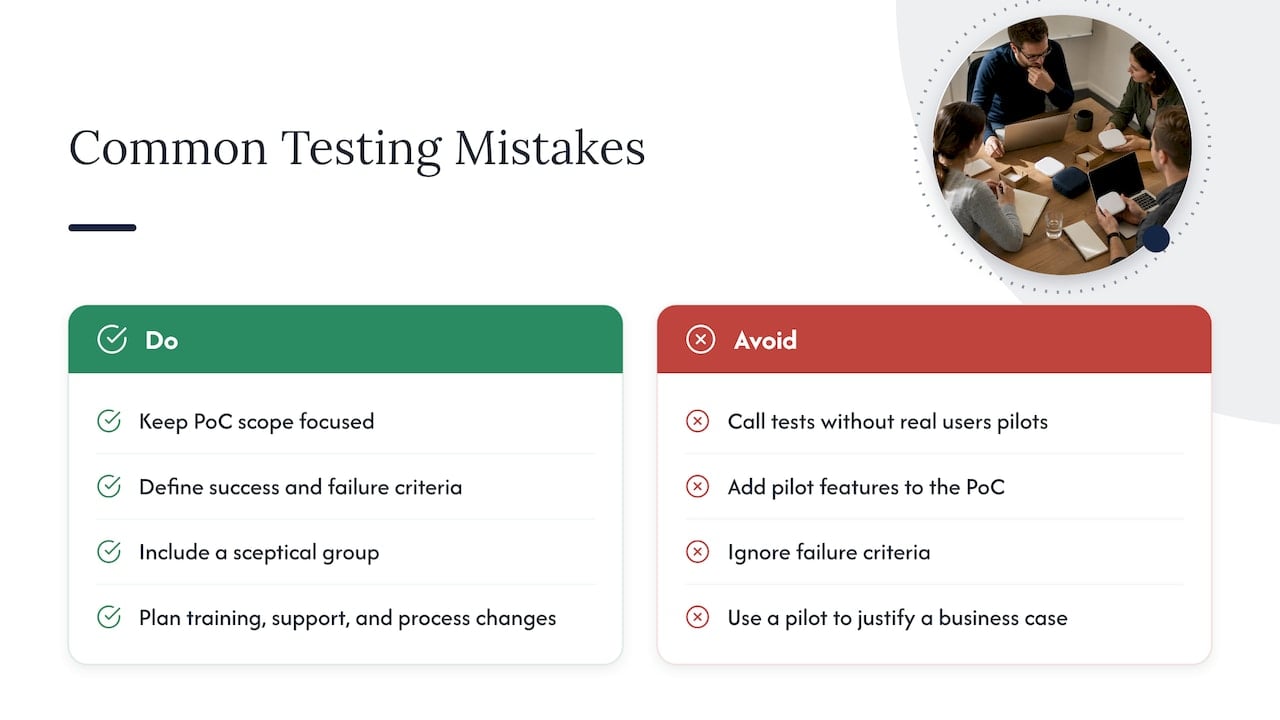
Ignoring the handover. Training, support and process changes are part of what a pilot should produce. A successful pilot can deliver a rollout decision, a refined process, and a training and support plan, so budget time for those.
Our perspective
When a client tells me they are “running a pilot”, the first thing we do is ask what decision it will inform and who makes it. About half the time nobody can answer both questions, and that is the real problem, not the technology or the product.
We work with sales leaders, founders and teams who sell complex B2B products, and the pattern is consistent. The deals that stall after a pilot are almost never lost on product quality. They stall because the commercial conversation was left until the end, the budget holder wasn’t in the room, and the success criteria were vague enough that everyone could read the result their own way.
Our approach is designed to fix that upstream. Through 1:1 coaching alongside team training and consultancy, we help your people qualify tests properly, set criteria with the buyer, handle the objections that appear mid-pilot, and ask for the signature when the criteria are met. That is the difference between a trial that costs you time and one that becomes revenue.
If you are on the buying side, the same discipline protects you. Be precise about the question, the numbers and the decision maker, and you will rarely waste a quarter on an inconclusive test.
Jerry
Getting help with the sales side
If your team keeps running promising pilots that do not convert, that is a sales process problem we work on directly. Our team-based bespoke coaching and consultancy engagements are priced at £4,500 to £8,500 one-off, and our sales acceleration track for solo service businesses and consultants runs from £2,995 to £5,995 one-off. You can see how the packages are built on our sales training cost page.
If you would rather start with a monthly option, The Sage Collective is £990 per month. For senior leadership without a full-time hire, there is also our fractional sales director service. To see how this fits your pipeline first, our sales consultancy page is a good place to begin.
FAQ
Are a PoC and a prototype the same thing?
No, though they overlap. A PoC tests whether an idea or method is feasible, often without producing anything you could show a customer. A prototype is an early version of the product itself, built to test how it works and feels. One rule of thumb from a hardware guide is that a PoC tests the idea, a prototype tests the product and an MVP tests the market.
Can a PoC turn into a pilot?
Yes, and that is the normal route when the PoC succeeds. The PoC produces a go or no-go decision and a build estimate. If it is a go, the pilot takes the same solution into live conditions with real users and real data. Agree the criteria for moving from one to the other at the start of the PoC.
How long should a PoC or pilot run?
PoCs typically run a few weeks, and one vendor whitepaper suggests a software or data PoC should be deliverable in 12 weeks or less. Pilots often run several months, because they involve more users and departments. Fix the end date before you begin, whatever the length.
What does POV mean in a business project?
POV means proof of value. Where a PoC asks whether something can work, a PoV asks whether it will pay off, using evidence such as efficiency gains, cost savings or ROI. It is the stage that builds the economic case for the people who control the budget.
Sources
- Testing and Piloting Services guidance note, GOV.UK (May 2021)
- Test, Learn and Grow Playbook, GOV.UK
- Track 3: Pilot to Production Checklist, GOV.UK
- Proof of concept, prototype, pilot, MVP: what’s in a name? Nesta
- What is a proof of concept (POC)? TechTarget
- Proof of Concept in Sales: PoC vs PoV vs Pilot
- Pilot vs Proof of Concept: Differences and Examples
- Delivering a great Proof of Concept (whitepaper)
- How to Run an AI Proof of Concept That Reaches Production
- Scale Link Building With a 60 Day Layered Pilot
- AI pilot projekt indítása középvállalatoknak