
The fastest way to lift team performance is a weekly, skill-focused 1:1 rhythm coupled with recorded call reviews and a simple coaching scorecard. Gartner-linked research shows data-driven coaching can produce measurable uplifts, commonly cited at 8%, and faster ramp times follow the same discipline. We’ve built entire engagements around this rhythm at Aheadofsales, and it’s the one habit that separates managers who coach from managers who just check in.
TL;DR:
- Consistent weekly coaching on specific skills with regular call reviews and scorecards consistently improves rep performance over time.
- Focusing on middle performers yields the most significant gains, with top and bottom performers requiring different approaches.
- Using structured frameworks like GROW or Describe-Impact-Action helps keep coaching sessions focused and measurable.
- Varying coaching modes—development, training, management, deal review—clarifies purpose and prevents trust erosion.
- Scaling coaching effectively involves peer coaching, team workshops, calibration, and technology tools while maintaining high standards.
Table of Contents
- Sales team coaching techniques you can start this week
- Coaching modes: when to coach, train, manage or review a deal
- How to run a 1:1 that actually changes behaviour
- Call review and role-play: turning evidence into behaviour change
- Measuring coaching: scorecards, KPIs and proving it worked
- Scaling coaching without losing quality
- Common coaching mistakes and quick fixes
- How Aheadofsales applies these techniques with client teams
- Why most coaching advice undersells the boring part
- Get bespoke coaching support from Aheadofsales
- Sources
Sales team coaching techniques you can start this week
Most sales managers know coaching matters. Far fewer know what to actually do in the room when a 1:1 starts. Below are 16 techniques we use with client teams, each with a first step and a metric worth tracking so you know if it’s working.
-
Build trust with authenticity. Skip the script and ask a genuine question about a rep’s week before touching numbers. Share a mistake you made early in your own career. Track it through rep-initiated conversations. If reps only talk to you when summoned, trust isn’t there yet.
-
Encourage self-evaluation before you weigh in. Ask “how do you think that call went?” before offering your own read. Let silence sit. Track self-assessment accuracy against your own scoring over a month. Trust builds fastest when reps feel able to be honest about their struggles, and that starts with you asking rather than telling.
-
Micro-focus on one skill at a time. Pick a single behaviour, such as discovery questions or objection framing, and coach only that for two weeks. Resist the urge to fix everything in one session. Track the chosen skill’s rating on your scorecard week over week.
-
Model accountability yourself. If you commit to reviewing a call by Thursday, do it by Thursday. Say out loud when you’ve missed a commitment. Track your own follow-through rate; reps notice before you think they do.
-
Record and review real calls, not hypotheticals. Choose two calls per rep per week, including one that went well. Timestamp specific moments rather than giving a vague overall impression. Track review coverage: what percentage of reps get at least one reviewed call weekly.
-
Run structured role-play, not improvised sparring. Give reps a defined scenario and a defined objection, not “just practise.” Rotate who plays the prospect so reps see different styles. Track confidence ratings before and after a role-play block.
-
Use peer coaching to multiply your time. Pair a strong closer with someone struggling on objection handling for a fortnight. Set a specific, observable goal for the pairing. Track whether the coached skill shows up in the next batch of reviewed calls.
-
Let conversation intelligence surface the moments worth reviewing. Tools that flag talk-to-listen ratios and objection patterns save you from scrubbing through hours of audio. Set alerts for specific triggers, like long monologues or missed pricing questions. Track how many flagged moments turn into actual coaching conversations.
-
Protect wellbeing and boundaries in the room. Ask about workload and burnout risk, not just pipeline health, especially during a tough quarter. Never let a coaching session become a disguised discipline meeting. Track voluntary attrition and sick-day patterns as a lagging indicator.
-
Let reps set their own observable goals. Ask what they want to improve, then help them make it measurable. A goal like “handle price objections better” becomes “reduce price-related call drop-off by two calls a week.” Track goal completion rate at each check-in.
-
Co-create the action plan together. Draft it collaboratively in the session rather than emailing it afterwards. Read it back to confirm the rep genuinely agrees, not just nods. Track whether actions from last week’s plan actually happened before adding new ones.
-
Focus your limited time on the middle performers. Training Industry’s research points to the middle 60% of a team as the group where coaching moves the needle most, since top performers are already close to their ceiling and bottom performers often need a different intervention entirely. Track team-wide average score, not just top-line revenue, to see this effect.
-
Celebrate skill improvement, not just closed deals. Call out a well-handled objection in a team channel even if the deal didn’t close. Make the recognition specific to the behaviour. Track how often you praise process versus outcome in a given week.
-
Use a simple framework so coaching doesn’t drift. GROW (Goal, Reality, Options, Way forward) keeps sessions structured; Describe–Impact–Action keeps feedback specific. Pick one and use it consistently for a quarter. Track session consistency by auditing your own notes.
-
Practise in short, repeated bursts rather than one long session. Ten minutes of objection drilling every week beats a two-hour workshop once a quarter. Space the repetition so it sticks. Track retention by re-testing the same scenario a month later.
-
Use AI role-play for volume practice, sparingly. It’s useful for repetition on scripted objections, but it can’t replace a human reading tone and hesitation. Reserve it for warm-up reps, not the core coaching relationship. Track whether reps who use it show improvement in live calls, not just simulated ones.
Pro Tip: Pick three of these sixteen to run consistently for a month before adding more. Coaching programmes fail more often from trying everything at once than from doing too little.
Coaching modes: when to coach, train, manage or review a deal
Not every conversation with a rep should be a coaching conversation, and treating them all the same way is one of the fastest ways to erode trust. There are four distinct modes, and knowing which one you’re in matters more than any technique on the list above.
- Coaching develops a skill over time through questions, reflection and practice. Use it in scheduled 1:1s when there’s no immediate fire to put out.
- Training delivers new knowledge or a new process to the whole team at once. Switch to this mode when several reps show the same gap, such as nobody knowing how to handle a new competitor’s pricing.
- Managing sets direction and holds people accountable to standards. Use it when a rep is missing basic activity expectations, not skill.
- Deal review solves a specific, live opportunity. Pull this out when a rep needs help moving a real deal forward this week, not developing a general capability.
Mixing these modes inside one meeting confuses reps about what kind of conversation they’re in. If a 1:1 turns into a forecast interrogation, say so out loud: “let’s park the pipeline numbers, this is your development time.” Harvard Business School’s research on sales coaching is blunt about this: keeping coaching separate from forecast calls is what keeps 1:1s developmental rather than threatening. When you do need to switch mode mid conversation, name it, so the rep isn’t left guessing whether they’re in trouble or being developed.
How to run a 1:1 that actually changes behaviour
A weekly 1:1 cadence, backed by a monthly team skill workshop and a quarterly full skill assessment, gives you the rhythm most high-performing coaching programmes run on, according to QUOTA’s sales coaching guide. The session length matters less than the structure inside it.
- The 15-minute check-in. Five minutes on wins and blockers, seven minutes on one skill focus with a specific example, three minutes agreeing next week’s single action.
- The 30-minute standard 1:1. Five minutes rapport, ten minutes reviewing a timestamped call moment together, ten minutes role-playing the fix, five minutes locking in the action plan.
- The 45-minute deep session. Use this monthly. Ten minutes rapport and goal review, fifteen minutes on a recorded call with Describe–Impact–Action feedback, fifteen minutes structured role-play, five minutes updating the scorecard together.
Before any of these, prep matters more than the meeting itself: pull two call timestamps worth discussing, check the rep’s self-assessment if you use one, and glance at last week’s action to see if it happened.
| Session length | Core focus | What you leave with |
|---|---|---|
| 15 minutes | Quick check-in and one action | A single observable task for the week |
| 30 minutes | Call review plus role-play | One skill practised and reinforced |
| 45 minutes | Deep skill session, monthly | Updated scorecard and next month’s focus |
Set exactly one observable action per session. Two or three competing priorities is how coaching plans quietly die.
Call review and role-play: turning evidence into behaviour change
Choosing which calls to review matters as much as the review itself. Pick one call that went well and one that struggled, rather than only reviewing failures, which teaches reps to dread the process. Timestamp the specific moment, not the whole call, so feedback stays concrete.
- Describe what happened at that exact timestamp, in neutral language, no judgement yet.
- Impact what effect it had on the prospect, the pace of the call, or the outcome.
- Action agree together what the rep will try differently next time.
Role-play works best with rotation: change who plays the prospect each session, vary the objection type, and occasionally throw in a scenario the rep hasn’t prepared for. A monthly team workshop where reps rotate through three or four scenarios in small groups builds far more resilience than a single manager running every role-play alone.
Conversation intelligence tools are genuinely useful here, flagging talk ratios and missed cues across far more calls than you could listen to yourself. But the technology surfaces the moment; it doesn’t understand why a rep hesitated or what’s going on in their week. Use it to widen your coverage, never to replace the actual conversation.
Pro Tip: Never open a call review with the moment that went badly. Start with something that worked, even briefly, or the rep spends the whole session defending rather than learning.
Measuring coaching: scorecards, KPIs and proving it worked
A scorecard doesn’t need to be complicated to be useful. Keep it to four or five categories, scored consistently, so trends become visible over weeks rather than guessed at after the fact.
- Discovery quality — are the right questions being asked, and is the rep listening to the answers?
- Objection handling — does the rep address the concern or just push past it?
- Call control — does the rep guide the structure without dominating the conversation?
- Follow-through — are agreed next steps actually happening on time?
- Self-awareness — how accurately does the rep assess their own calls?
Behavioural KPIs sit alongside outcome KPIs. Track call review coverage (what share of reps get reviewed weekly) and skill improvement ratings from the scorecard. Then track outcome KPIs separately: conversion rate by stage and time to ramp for new starters.
Gartner’s research links data-driven coaching to a measurable uplift in sales performance in overall sales performance, a figure worth treating as directional rather than a guarantee for any single team.
Resist the temptation to claim a direct line from one coaching session to one closed deal. What you can credibly say is that teams with consistent scorecards and reviewed skill improvement tend to show better conversion and shorter ramp over a quarter. Our guide to sales performance metrics breaks down which numbers are worth tracking alongside your scorecard, and this partner resource on business performance metrics is a useful companion if you’re mapping coaching data against wider business KPIs.
Scaling coaching without losing quality
One manager can only coach so many people well. Scaling coaching properly means spreading the load without diluting what makes it effective in the first place.
- Deploy peer coaching deliberately, pairing specific strengths with specific gaps rather than leaving it informal.
- Run monthly workshops so skill-building happens at the team level, freeing 1:1 time for individual depth.
- Calibrate across managers regularly, comparing how each of you scores the same call so standards don’t drift apart.
- Use skill-focused gamification, rewarding improved discovery questions or objection handling rather than pure revenue, which top performers already win by default.
- Let technology extend your reach, using conversation intelligence and AI role-play to widen coverage while you focus your own time on the reps who need judgement, not just repetition.
Consistency across managers is the part that quietly fails most often. Two managers scoring the same call three points apart on a five-point scorecard means your data is noise, not signal. A monthly calibration session where managers review the same recorded call together, and argue out the scoring, fixes this faster than any policy document.
Common coaching mistakes and quick fixes
Most coaching programmes don’t fail from lack of effort. They fail from a handful of repeatable errors.
- Using 1:1s as forecast calls. Fix: move pipeline review to a separate, clearly labelled meeting.
- Giving vague feedback like “good call, keep it up.” Fix: name the exact timestamp and the exact behaviour.
- Only coaching your top or bottom performers. Fix: deliberately schedule time with the middle of the team.
- Letting cadence slip when things get busy. Fix: protect the calendar slot as you would a client meeting.
If a rep’s scorecard shows no movement after six weeks of consistent coaching on the same skill, that’s the signal to escalate, change the technique, or bring in outside support rather than repeating what isn’t working.
How Aheadofsales applies these techniques with client teams
We built our coaching engagements around this exact rhythm because it’s what actually moves scorecards, not because it looks good in a proposal. A typical engagement starts with a diagnostic covering call reviews and a baseline scorecard, then moves into weekly bespoke 1:1 coaching alongside monthly team workshops, usually over a 90-day initial cycle before we reassess.

Client teams we’ve worked with have seen measurable movement in discovery quality and objection handling scores within the first month, with conversion and ramp-time improvements following as the habits bed in over a full quarter. The pattern holds across sectors: SaaS teams selling to Series B+ companies, professional services firms, and solo consultants running their own pipeline all respond to the same core rhythm, adapted to their sales cycle length.
Jerry leads Aheadofsales’s coaching practice, drawing on the same research base cited throughout this piece, Gartner’s coaching data, HBR’s work on learnable coaching skills, and QUOTA’s practitioner framework, to build engagements that fit a business’s actual growth mindset and stage rather than a generic template.
Why most coaching advice undersells the boring part
The research behind this article makes an uncomfortable point that most coaching content skips: the actual techniques aren’t the hard part. GROW, role-play, call review, these are all well documented and none of them are complicated to learn. The gap between teams that coach well and teams that don’t is almost entirely about consistency, not sophistication.
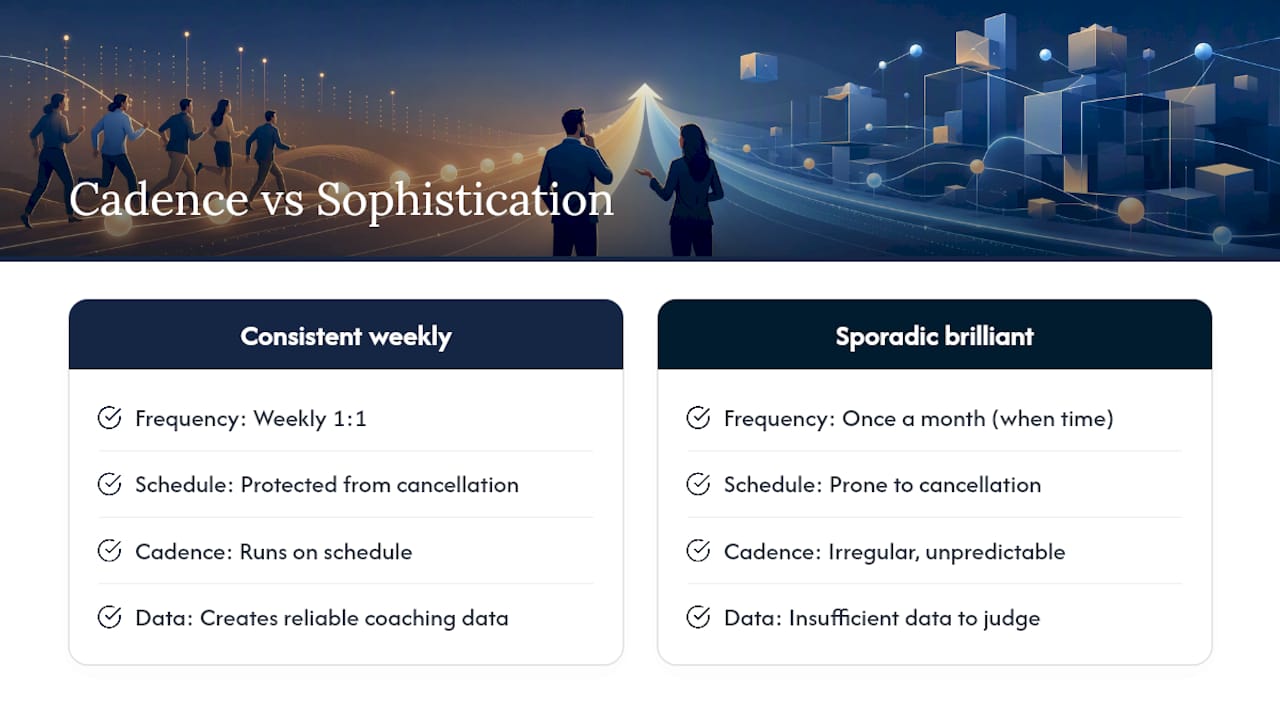
Conventional advice tends to oversell frameworks and undersell cadence. A manager who runs a mediocre 1:1 every single week, on schedule, protected from cancellation, will outperform a manager who runs a brilliant session once a month when time allows. That’s not a satisfying answer for anyone hoping a new framework will fix their coaching problem overnight, but it’s what the evidence on cadence and scorecards actually supports.
If you take one thing from this article, prioritise protecting the calendar slot before you worry about which framework to use inside it. Consistency creates the data you need to know if any technique is even working.
— Jerry
Get bespoke coaching support from Aheadofsales
Everything above works better with dedicated capacity behind it, and that’s precisely the gap Aheadofsales fills for growing teams. Rather than adding another framework to a manager’s already full plate, Aheadofsales runs the weekly coaching rhythm, call reviews and scorecards directly with your reps, freeing your leadership team to focus on strategy rather than squeezing coaching in between meetings.

Team packages suit B2B businesses with roughly 50 to 1,000 staff who want bespoke 1:1 coaching layered with structured training, typically starting from £4,500. SaaS businesses at Series B and beyond get a sector-specific programme built around longer, more technical sales cycles. Solo consultants and service business founders can access a leaner sales acceleration package from £2,995, built for one person carrying their own pipeline.
A discovery call usually runs 30 minutes and covers your current coaching cadence, team size, and growth targets, with a proposed programme structure following within a few days. Book a look at Aheadofsales’s sales training services to see which package fits your team.
Sources
- Demand Gen Report — coverage of Gartner research on sales coaching
- Zendesk — sales coaching practical guidance
- Harvard Business School — Sales coaching and value creation
- QUOTA training — sales coaching guide
4 Responses