
6sense and Demandbase are both enterprise account-based marketing (ABM) platforms, and they are direct competitors. The short version: 6sense is built as an AI-first revenue intelligence platform focused on predicting buying stages and automating outreach, while Demandbase is a data- and advertising-led platform with its own B2B demand-side platform (DSP). Neither is cheaper or easier to run than the other, so the right pick depends on what your team can actually operate.
I sell sales training and consultancy, not software, so I have no tool to push. What I can tell you is what I see when UK sales leaders weigh up platforms like these: the decision rarely fails on the feature list. It fails on process, data and people. This guide covers both the comparison and the groundwork.
TL;DR
- 6sense leans towards predictive buying-stage models and automated orchestration. Demandbase leans towards advertising, with a native B2B DSP.
- Pricing is custom-quoted for both. Mid-market to enterprise contracts typically run from about $50k to $150k+ a year, before seats, data credits and ad budgets.
- Neither is plug-and-play. Rollouts typically take weeks to months and need real RevOps capacity.
- Your CRM hygiene and ideal customer profile (ICP) matter more than the logo on the platform.
- If your sales process is not yet defined, fix that first. A platform will only tell you faster where your pipeline leaks.
Table of Contents
- What each platform actually is
- 6sense vs Demandbase at a glance
- How to choose between them
- The part nobody puts in the demo: rollout and data
- Which type of company suits which platform
- Our perspective on ABM tools
- Where sales training fits alongside either platform
- Questions to put to both vendors
- FAQ
- Sources
What each platform actually is
It helps to strip away the marketing language. Both products try to answer the same question: which accounts are in-market right now, and what should we do about it?
6sense: prediction first
6sense positions itself as a revenue intelligence platform. Its core idea is to estimate where an account sits in its buying journey, even when nobody has filled in a form, and then trigger outreach. The company says it processes more than a trillion signals a day. That is a vendor claim, so treat it as a description of scale rather than proof of accuracy.
It also publishes customer stories. Malbek reports a 14x increase in BDR capacity and 22x ROI after treating AI as a primary workforce. Those are the vendor’s own case studies, chosen to flatter the product, and results like that depend heavily on the team behind the tool.
One practical difference: 6sense offers a free Sales Intelligence tier with 50 data credits a month, according to one third-party comparison, which lets individual sellers try it before an enterprise contract. Check the current terms with the vendor, as free tiers change.
Demandbase: advertising and account data
Demandbase has been in ABM for roughly twenty years and now calls its approach “Pipeline AI”. In January 2026 it appointed Rachel Truair as Chief Marketing Officer to define that category, and the company has introduced Agentbase, a suite of AI agents, and JourneyIQ. The same release describes the company as accelerating the evolution of B2B go-to-market technology, so expect the product to keep moving.
The real distinction is the native B2B DSP. If you plan to run serious paid media against target accounts, having advertising inside the same platform as your account data is a genuine advantage. Demandbase says it processes more than two trillion intent signals a month, though again, volume of signals is not the same as quality of decisions.
6sense vs Demandbase at a glance
| Question | 6sense | Demandbase |
|---|---|---|
| Core philosophy | AI-first revenue intelligence, buying-stage prediction | Data and advertising-led ABM |
| Strongest for | Teams wanting predictive prioritisation and automated outbound | Teams running heavy paid media against target accounts |
| Native advertising | Account-based ads | Native B2B DSP |
| Tuning effort | Less manual model tuning, more RevOps governance | More manual model tuning, per the vendor comparison |
| Pricing | Custom quote, opaque | Custom quote, opaque |
| Free entry point | Limited free tier reported | None reported |
The tuning row comes from a 6sense blog post, so it is written by one of the two parties. Read it as one side of the argument.
How to choose between them
Industry analysis keeps landing in the same place: the better choice is almost always about your team’s core competency, not a feature checklist. Here is how I would turn that into criteria.
Start with the channel you can run
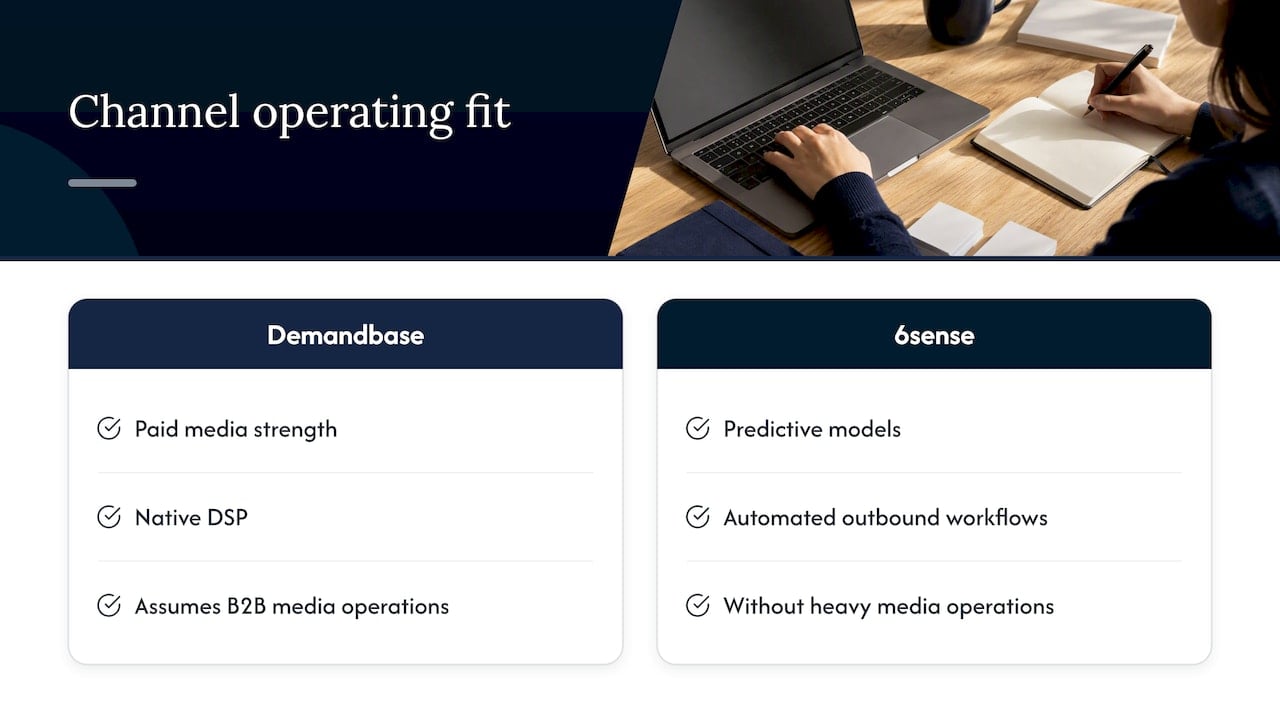
If paid media is already a strength and you want a native DSP, Demandbase is often favoured. If your team would rather lean on predictive models and automated outbound workflows without the heavy lift of B2B media operations, 6sense is frequently preferred. Be honest here. A platform that assumes a media team you do not have becomes expensive shelfware.
Count your RevOps capacity
This is the question most buyers skip. The trade-off is between manual model tuning, which is often needed with Demandbase, and AI-led orchestration that needs less hands-on tuning but arguably more sophisticated RevOps governance, which is the 6sense side. Either way, someone senior has to own the system. If that person does not exist yet, hire or assign them before you sign.
Check what happens after the signal
These tools identify in-market accounts. Neither is a complete go-to-market system out of the box: you still need extra tools or manual processes to reach and engage those buyers across channels. If your question is also about verified contact data to reach those accounts, a ZoomInfo comparison page frames that as one of five deciding questions, though bear in mind it is written by a data vendor.
Ask about total cost, not the base fee
Pricing for both is custom-quoted. Buyers are warned that base platform fees can be deceptive because total cost is driven by seats, data credits, advertising minimums and implementation support. If you are a UK business, ask for the quote in sterling, ask what is included in year one, and ask what the renewal uplift looks like. Request a written breakdown of every line.
Run a proper proof of concept
Ask both vendors to test against your own closed-won and closed-lost accounts. If a platform cannot show it would have flagged your best customers before they bought, you have learned something valuable for free.
The part nobody puts in the demo: rollout and data
Enterprise deployment is rarely quick. Expect significant CRM and marketing automation integration, data onboarding and ongoing admin governance, lasting several weeks to months whichever platform you choose. Neither is a set-it-and-forget-it tool.
The same source makes a point I fully agree with: success depends more on your existing data maturity than on the tool. If your foundation is weak, these platforms will probably underperform, and the effort to clean CRM data and define your ICP is often the real bottleneck.
Here is a quick readiness test I would run before any demo:
- Can you describe your ICP in one paragraph? Industry, size, trigger events, buying committee. If three people give three answers, you are not ready.
- Is your CRM trusted? If reps do not log activity or update stages, predictive models learn from noise.
- Are your pipeline stages defined and consistently used? Our guide to B2B sales pipeline stages is a good place to check yours.
- Do sales and marketing agree what a qualified account is? Without it, “in-market” signals get ignored by the people meant to act on them.
- Who will own the platform day to day? Name them.
If you answered no to more than two of these, the platform is not your first problem.
Which type of company suits which platform
Let me give you scenarios rather than a verdict, because the honest answer depends on the shape of your business. These are illustrative, not real client cases.
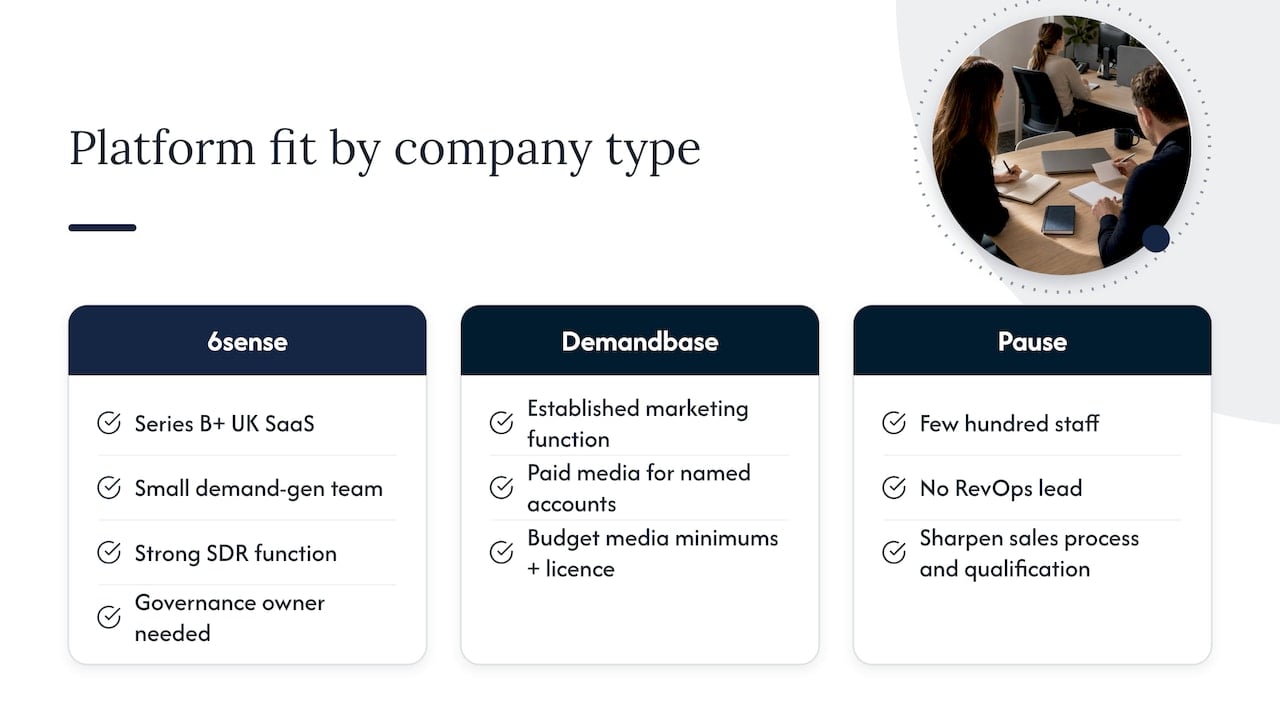
A UK SaaS company at Series B or beyond with a small demand-gen team and a strong SDR function. Predictive prioritisation and automated outbound are attractive because they help a lean team focus. 6sense’s approach tends to fit, provided you have someone handling governance. Our page on sales training for SaaS covers how we support teams at that stage.
A company with an established marketing function and a real paid media budget aimed at a named list of accounts. Native advertising is the draw, and Demandbase’s DSP is a reasonable fit. Budget for the media minimums as well as the licence.
A business with a few hundred staff but no RevOps lead. Pause. Either platform will demand more administration than you can give it, and you may get more from sharpening the sales process, coaching managers and tightening qualification.
Our perspective on ABM tools
We work with sales teams, not with software, and that gives us an unusual vantage point. When a business tells us it wants an ABM platform, the real question underneath is usually one of three things: reps are chasing the wrong accounts, conversations stall at the second meeting, or forecasts do not match what closes.
A platform helps with the first. It does very little for the second and third. Intent data tells a rep an account is researching your category. It does not teach the rep to run a discovery call, handle a price objection or get a second stakeholder into the room. That is a skills and coaching problem, and it is where we spend our time: bespoke one-to-one coaching combined with team training and consultancy.
Our view is simple. Buy the platform if your process, data and people can use it. Before that, make sure your team can convert the opportunities you already have. If you cannot turn a warm inbound enquiry into a booked and paid engagement, a smarter list of accounts will not rescue the quarter.
— Jerry
Where sales training fits alongside either platform
Whichever way you go, the signal still has to reach a person who knows what to do with it. That is why teams who invest in tools often get the best return when they also invest in how reps and managers sell.
In practice that means three things. First, a defined pipeline, so that “in-market” has a clear next stage. Our guide to sales pipeline optimisation walks through it. Second, manager coaching, so that the data from your platform becomes a weekly conversation rather than a dashboard nobody opens. Third, consultancy to connect it all, which is what our sales consultancy work is for.
If you are a team of roughly 50 to 1,000 people, our bespoke coaching and consultancy engagements cost £4,500 to £8,500 one-off. Solo service businesses and consultants can use our sales acceleration track at £2,995 to £5,995 one-off. Those figures are a small fraction of what an enterprise ABM licence can cost, and they target the step that decides whether the licence pays back. If you want to see how we work, start with our sales training for teams and solo operators.
Questions to put to both vendors
Whatever you decide, take a written list into the demo:
- What is the total first-year cost, including seats, data credits, ad minimums and implementation?
- How long until the first live campaign, and what do you need from our team to get there?
- How is the model trained, and how often does someone need to retune it?
- Which CRM and marketing automation integrations are native, and which need custom work?
- Where is our data stored and processed, and how do you handle UK data protection requirements?
- Can we speak to a customer of similar size in the UK?
- What does the renewal look like?
The vendors’ own customer stories are useful for understanding what good looks like. For instance, Folloze reports exceeding its meetings target by 104% after integrating with 6sense. Ask what the team around the tool looked like, because that is rarely in the headline.
FAQ
Are 6sense and Demandbase competitors?
Yes. They are the two best-known enterprise ABM platforms and direct competitors, with overlapping scope across account identification, intent data and advertising. They differ mainly in philosophy: predictive and AI-led for 6sense, advertising and data-led for Demandbase.
Which is cheaper, 6sense or Demandbase?
Neither publishes prices, and neither is reliably cheaper. Typical mid-market to enterprise contracts sit between roughly $50k and $150k+ a year, and extras such as seats, data credits and ad minimums change the total. Get both quoted on the same scope and compare the full first-year cost.
Who is the CEO of Demandbase?
As of October 2026, Gabe Rogol is Demandbase’s CEO, according to the research I reviewed. The company also named a new CMO in January 2026. Leadership details can change, so confirm on the company’s own site.
Do I need an ABM platform to hit my sales targets?
No. A platform helps when your process, data and team can use it. Many businesses get more from clearer pipeline stages, better qualification and sales coaching first, then add tooling once the basics work.
Sources
- 6sense vs Demandbase: account-based marketing comparison (6sense)
- 6sense vs Demandbase: pricing and key differences (Salesmotion)
- Top Demandbase alternatives in 2026 (Salesmotion)
- Demandbase vs 6sense scores, reviews and verdict (RFP.wiki)
- 6sense vs Demandbase comparison (The ABM Pulse)
- 6sense vs Demandbase (ZoomInfo)
- 6sense vs Demandbase: enterprise ABM for your team (2026)
- Demandbase appoints Rachel Truair as CMO (Yahoo Finance)
- Malbek customer story (6sense)
- Folloze customer story (6sense)