
The fastest way into sales leadership as a woman is not simply “sell more, wait longer.” It’s targeted development: cohort-based leadership programmes, 1:1 coaching, deliberate sponsorship, and a deliberate move into P&L-owning roles. The main routes are development programmes, sponsors, revenue-owning projects, and communities like WISE and WISL. What follows sets out the evidence and the exact steps.
TL;DR:
- Women in sales leadership face a significant pipeline and promotion gap, with only 6% of sales director roles occupied by women compared to nearly a quarter in HR.
- Early career pipeline bias, informal sponsorship, and organizational habits primarily block women’s progress into leadership rather than a lack of ability.
- Effective development programs involve small cohorts, applied projects, coaching, and alumni networks, with proven success in boosting confidence and promotion rates.
- Women can accelerate their promotion by volunteering for P&L roles, securing high-level sponsors, and building measurable project evidence within their organizations.
- Communities like WISE and WISL aid visibility and sponsorship, but tangible leadership progress depends on targeted projects, sponsor advocacy, and evidence-based conversations.
Table of Contents
- Women in sales leadership: what the numbers actually say
- Why the gap exists: pipeline, bias and organisational habit
- What makes a leadership development programme actually work?
- How can women accelerate their own promotion right now?
- Which networks and communities actually help your career?
- How do you know if your development plan is working?
- What actually moves the needle, based on practitioner experience
- Case studies: how women have actually broken into sales leadership
- What I’d tell any woman starting this climb today
- How Aheadofsales supports women building a case for leadership
- Sources
- FAQ
Women in sales leadership: what the numbers actually say
The gap is not subtle. Research cited by Spencer Stuart found women held a very small minority of sales director roles in 2017, compared with nearly a quarter of HR director roles in the same period. That is not a talent gap. It’s a pipeline and promotion gap, and it has persisted long enough that treating it as an anomaly no longer holds up.
There’s momentum worth noting alongside the sobering figure. More organisations are running structured diversity initiatives inside their sales functions, and interest in women-focused leadership programmes has grown steadily as companies realise that closing this gap improves commercial performance, not just optics.
- Women occupy a small minority of sales director seats compared with equivalent director roles in HR.
- Employer interest in sponsorship and structured development programmes for women in sales is rising.
- HBR argues that the skills increasingly valued in modern B2B selling, relationship depth, consultative reasoning, long-cycle patience, map closely onto strengths often underused in support-role career tracks.
The number that should reframe your thinking: if only 6% of sales director roles go to women while nearly a quarter of HR director roles do, the constraint sits in structure and pathway, not capability. That reframing matters for how you plan your own next three years.
Why the gap exists: pipeline, bias and organisational habit
Most of the imbalance traces back to where women land early in sales careers, not to any shortfall in performance once they arrive in line roles. Understanding the mechanics helps you plan around them rather than simply hoping for a fairer system.
- Pipeline concentration: women are disproportionately routed into customer success, enablement, and marketing-adjacent sales support roles rather than quota-carrying, P&L-owning positions.
- Relational exclusion: informal sponsorship often happens over golf, drinks, or corridor conversations that women are less likely to be invited into by default.
- Promotion bias: assumptions about career breaks or “readiness” frequently block women from stretch roles that men are offered on potential rather than proven track record.
- Organisational deficits: Spencer Stuart’s research points to a real gap between stated commitment to diversity and what employees actually experience, largely because senior leaders rarely back words with structured, measurable interventions.
None of these barriers are fixed by working harder in your current role alone. Practitioner guidance from the same Spencer Stuart research consistently points to one lever above the rest: encouraging women earlier in their careers to commit to the sales track itself, rather than drift into support functions that feel safer but rarely lead to the boardroom.
What makes a leadership development programme actually work?
Generic training courses rarely move the needle on promotion. What does, according to alumni across multiple programmes, is a specific format: small, closed cohorts working on live applied projects, backed by coaching and feeding into an alumni network that keeps working long after the programme ends. The Women in Sales Leadership (WISL) Forum and the Center for Elevating Women in Sales Leadership both build around this structure, and alumni consistently report tangible confidence and promotion gains after completing them.
1:1 coaching does something a workshop cannot: it applies the programme’s ideas directly to your actual pipeline, your actual manager, your actual promotion case. Sponsorship built inside a cohort, where someone senior has watched you deliver a real project, tends to carry far more weight than a mentor relationship built on conversation alone.
Before you commit time or money to any programme, check it against this:
- Does it run in small, closed cohorts rather than open enrolment webinars?
- Is there an applied project tied to real commercial outcomes, not just theory?
- Does it have a visible, active alumni network you can actually verify?
- Does the curriculum touch P&L ownership specifically, not just soft-skills coaching?
- Is the cost and time commitment realistic against your current workload?
Pro Tip: Ask any programme for two named alumni you can contact directly before you enrol. A programme confident in its outcomes will connect you; one that hesitates is telling you something.
How can women accelerate their own promotion right now?
You don’t need to wait for your organisation to fix its structural gaps before you start moving. Several tactics work inside almost any sales organisation, starting this quarter.
- Volunteer for P&L-owning or revenue-impact projects. Spencer Stuart’s research is unambiguous that early ownership of revenue or P&L responsibility predicts promotion far more reliably than individual sales performance alone.
- Ask for a sponsor directly, not a mentor. Say specifically: “I want to take on [project], and I’d value your support making the case for it to leadership.” Sponsors advocate for you in rooms you’re not in; mentors just talk to you.
- Practise interruption-handling language. A simple, rehearsed line, “Let me finish this point, then I’ll come to you”, protects your voice in meetings without sounding defensive.
- Bring numbers to promotion conversations, not just narrative. Track pipeline generated, deals closed above target, or margin improved, and present them as evidence, not anecdote.
- Build a 90-day development project with a measurable output: a named account you’ll grow by a set percentage, a process you’ll redesign, a team metric you’ll move. Present the result at your next review.
Pro Tip: Write your 90-day project brief as if you were pitching it to your manager before you start, not after. That single step turns a vague ambition into a documented case for promotion.
Reviewing how revenue-generating activity translates into leadership credibility is worth studying properly. Guidance on lead nurturing and conversion strategy offers a useful grounding in exactly the kind of pipeline metrics that make a strong P&L case.
Which networks and communities actually help your career?
Not every community delivers the same thing. Peer networks are good for benchmarking your experience against others; mentor pods work best for candid, ongoing feedback; job boards matter when you’re ready to move. Knowing which one you need saves you from joining the wrong group and feeling like it didn’t work.
WISE (Women In Sales Everywhere) runs at genuine scale, with mentoring pods and a job board members use to build both sponsorship relationships and direct job pipelines. The WISL podcast is worth a regular listen for a lighter-touch option: episodes lean on executive interviews and applied leadership narratives rather than abstract theory, which makes them easy to absorb between calls.
- Set one specific goal before joining any community: a sponsor, a job lead, or feedback on a live challenge.
- Show up with a prepared question or project update rather than arriving passively.
- Follow up individually with at least one person after every event or episode that resonates.
- Give it a defined trial period, three months is reasonable, before deciding whether it’s earning your time.
How do you know if your development plan is working?
Progress on the leadership track shows up in stages, and it’s worth tracking each one deliberately rather than waiting for a promotion to arrive as proof.
- Short term (0 to 3 months): increased confidence in meetings, a sponsor conversation secured, a P&L or revenue-impact project agreed.
- Medium term (3 to 9 months): measurable ownership of a revenue line, a completed applied project with documented results, first promotion interview.
- Employer-visible (9 months plus): consistent revenue ownership, a track record leadership can point to, sponsor advocacy in succession conversations.
| Stage | What to measure | What to present at review |
|---|---|---|
| Short term | Sponsor secured, project scoped | Project brief and target outcome |
| Medium term | Revenue owned, project completed | Documented result vs target |
| Long term | Sustained ownership, sponsor advocacy | Track record and succession readiness |
A sales leadership checklist gives you a structured way to keep these milestones visible rather than letting them slide between quarterly reviews.
What actually moves the needle, based on practitioner experience
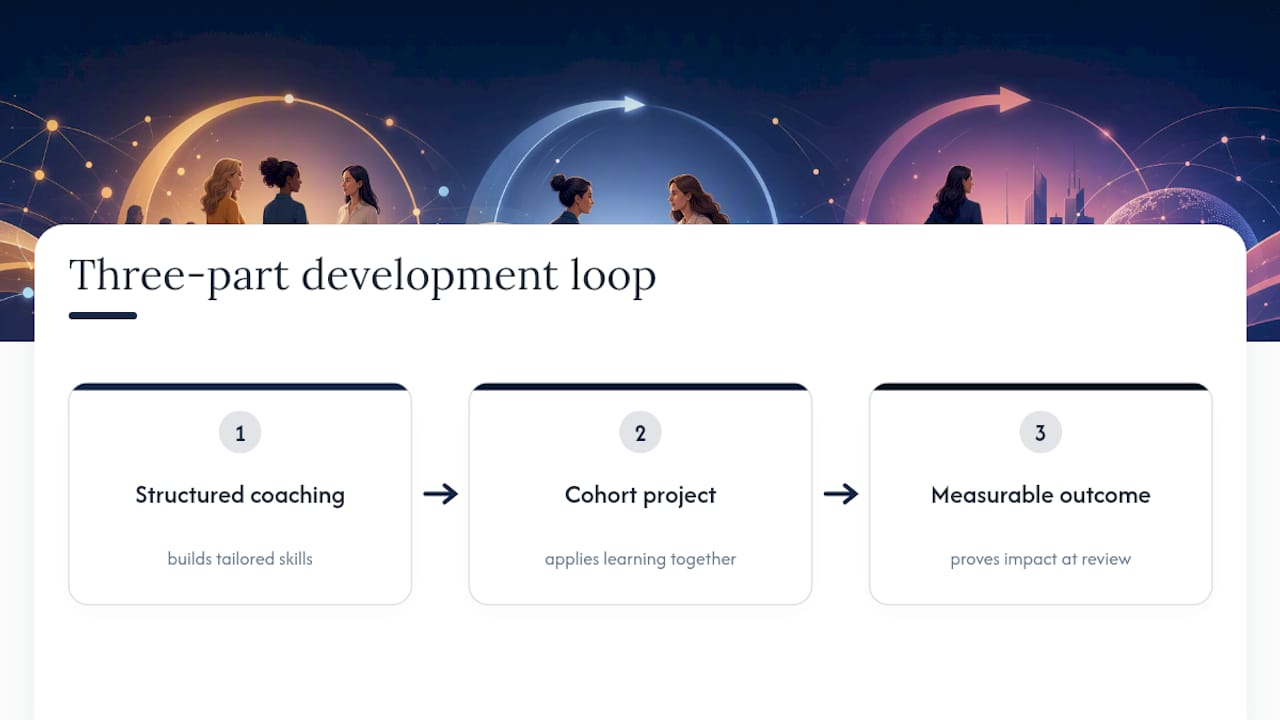
The combination that shows up repeatedly across successful cases is straightforward: structured coaching, a real applied project inside a small cohort, and a measurable outcome you can point to at review time. None of those three elements works especially well alone.
Insert client case studies demonstrating [50% sales growth achieved through coaching and consultancy engagements]
Peer communities and free resources work well for early-stage development and networking. Bespoke, paid coaching earns its cost when you need a faster, more personalised push, particularly around a specific promotion window or a named stretch role.
Case studies: how women have actually broken into sales leadership
Patterns repeat across the women who make this jump successfully, even though their industries and starting points differ.
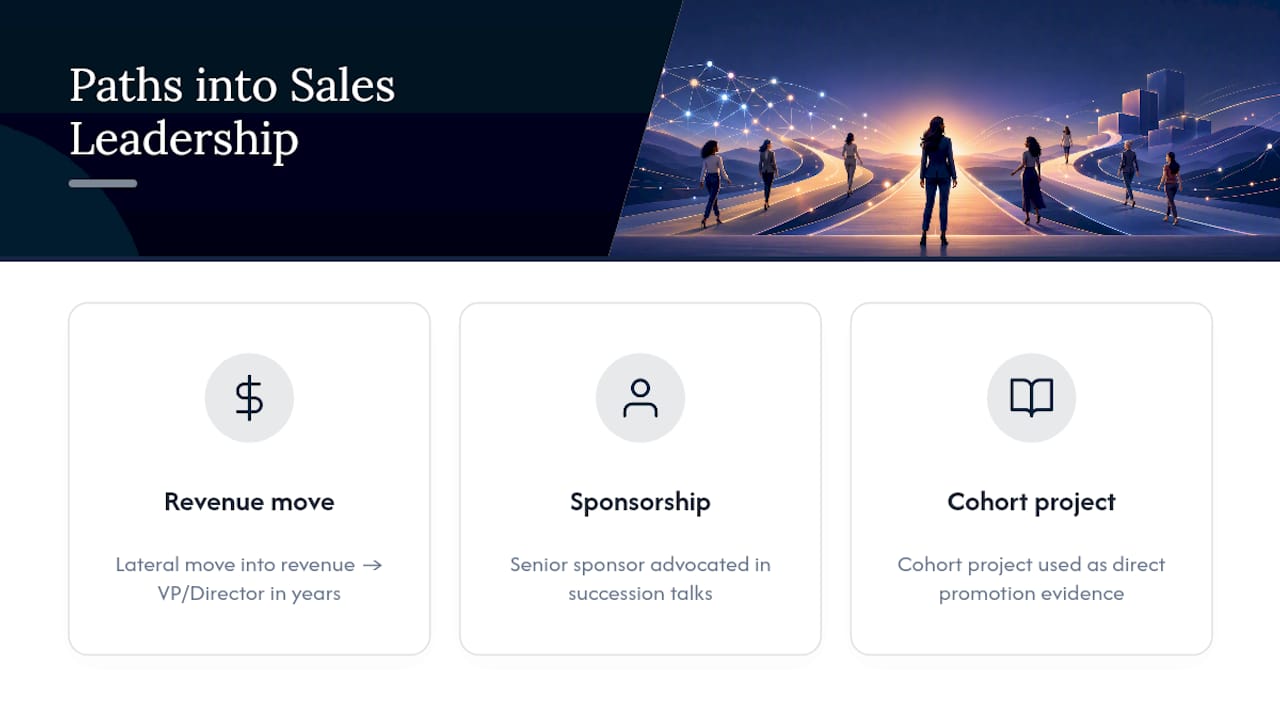
One consistent pattern: women who moved from customer success or enablement into a quota-carrying or revenue-owning role, often taking a lateral step that looked like a smaller job on paper, went on to reach VP or director level within a few years. The lateral move mattered more than any single performance metric, because it put them in front of the P&L decisions that boards actually promote against.
Another recurring pattern involves sponsorship rather than mentorship. Women who secured a senior sponsor willing to advocate for them in closed-door succession conversations moved faster than equally capable peers who relied only on strong individual numbers. The sponsor did the advocacy work that a CV alone cannot do.
A third pattern shows up in cohort programme alumni specifically: women who completed a small-cohort leadership programme with an applied project, then used that project as direct evidence in their next internal promotion case, reported both faster timelines and stronger confidence going into those conversations. The project became proof, not just preparation.
None of these paths depended on luck. They depended on a deliberate choice to move toward revenue ownership, ask directly for sponsorship, and produce evidence rather than wait to be noticed.
What I’d tell any woman starting this climb today
Progress here is rarely fast, and it’s rarely linear either. The women who move quickest aren’t the ones with the best sales numbers; they’re the ones who ask for the P&L role and the sponsor before they feel fully ready. This quarter, pick one revenue-owning project and one person senior enough to advocate for it, and put both in writing.
— Jerry
How Aheadofsales supports women building a case for leadership
Community and networking will get you visibility, but a promotion case built on a real, measurable project tends to move faster with structured coaching behind it. Aheadofsales offers coaching and cohort-based sales training focused on building practical leadership skills and promotion evidence.
If you’re weighing up a paid route against a free community, the Sales Training Cohorts page sets out the cohort format directly, including how projects are structured and coached through to a measurable outcome. Solo consultants and service business founders building their own leadership case have a dedicated sales coaching programme, while women already leading a team can explore fractional sales director support as a way to prove P&L capability before stepping into a permanent role. Full pricing and package details sit on the sales training cost page. Book a conversation through Aheadofsales to talk through which route fits your current stage.
Sources
- Women in sales leadership: How to help close the gender gap — Spencer Stuart
- Why women are the future of B2B sales — Harvard Business Review
FAQ
What are seven traits of successful female sales leaders?
Traits repeatedly cited across programme alumni and research include consultative selling strength, resilience, direct communication, sponsorship of others, evidence-based negotiation, comfort owning P&L targets, and persistence through informal exclusion.
Who are some strong female business leaders in sales?
Rather than a fixed list, the strongest examples tend to be women who moved from support roles into revenue-owning positions and secured senior sponsors, a pattern documented across Spencer Stuart’s research on the sector.
How can a woman succeed in sales leadership?
Prioritise P&L-owning or revenue-impact projects, secure a senior sponsor rather than only a mentor, and bring measurable evidence, not just narrative, to every promotion conversation.
Who are examples of female leaders in retail sales?
Retail sales leadership follows the same pattern seen across B2B: women who move from merchandising or support functions into store or regional P&L ownership tend to progress into director roles fastest.
Does Aheadofsales offer coaching specifically for women moving into sales leadership?
Aheadofsales runs bespoke 1:1 coaching and cohort-based training designed around P&L readiness and promotion evidence; current packages and pricing are listed on the sales training cost page.