
A sales playbook is the central operating manual for your sales team, documenting the repeatable strategies, processes and tactics your reps need to win deals consistently. Done well, it turns your best seller’s instincts into a system anyone on the team can follow. The single most important business outcome it delivers is predictability: fewer deals lost to inconsistency, faster ramp for new hires, and a sales motion that scales without depending on one or two star performers.
Three outcomes you can expect from a well-built playbook:
- Faster onboarding. New account executives can get up to speed in a fraction of the usual time when the playbook gives them a clear path from first call to close.
- Consistent messaging. Every rep handles objections, demos and pricing conversations from the same foundation, so your brand and value proposition land the same way regardless of who is on the call.
- Repeatable wins. Patterns from your best deals get codified so the whole team can replicate them, not just the people who happened to be in the room.
A typical sales playbook contains buyer personas and ideal customer profiles (ICPs), discovery scripts and qualification criteria, objection-handling guides, demo flows, pricing and concession rules, and the KPIs that tell you whether each play is working.
Table of Contents
- What does a sales playbook actually contain?
- Why use a sales playbook? Key benefits and business outcomes
- How does a sales playbook differ from a sales process and a sales strategy?
- How to create a sales playbook: a practical UK checklist
- Sample plays, scripts and templates you can adapt
- How do you keep a playbook alive and actually used?
- How Aheadofsales builds and applies playbooks
- Key takeaways
- The playbook pitfall most sales leaders walk straight into
- Aheadofsales helps UK sales teams build playbooks that actually get used
- Further reading and primary sources
What does a sales playbook actually contain?
The components of a sales playbook fall into roughly ten categories, and each one earns its place by answering a specific question a rep might have mid-deal.
Buyer personas and ICPs. Who are you selling to, what do they care about, and what does a good-fit account look like? This section stops reps wasting time on prospects that will never close.

Qualification criteria. A clear framework (MEDDIC, BANT, or your own variation) that tells reps when to advance a deal and when to walk away. Without this, pipeline becomes wishful thinking.
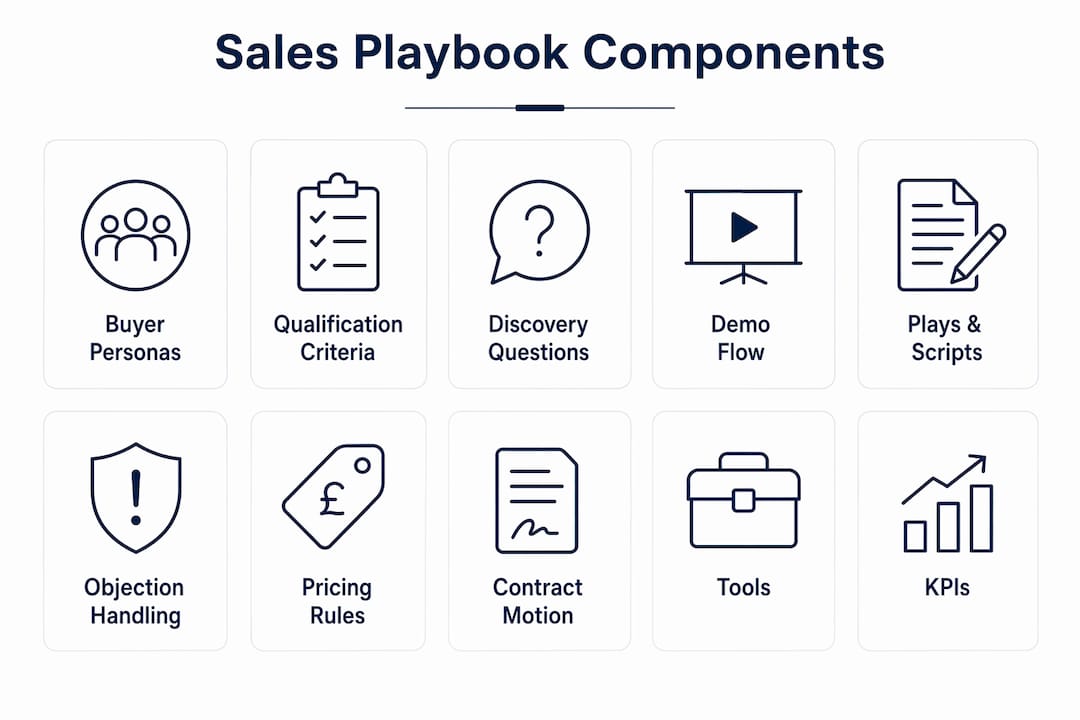
Discovery questions. A curated set of open questions mapped to the buyer’s role and stage. Not a script to read verbatim, but a reliable starting point that surfaces pain quickly.
Demo flow and talk tracks. A structured sequence for product demonstrations, including which features to lead with for each persona and how to handle common interruptions.
Plays and scripts. Specific step-by-step instructions for recurring situations: a competitive displacement play, a multi-stakeholder expansion play, a stalled-deal re-engagement sequence.
Objection handling. Named objections with recommended responses and the reasoning behind each one. “We’re already using a competitor” and “the budget isn’t there right now” should never catch a rep off guard.
Pricing and concession rules. What discounts are permitted, at what deal size, and who must approve them. This alone prevents margin erosion in late-stage negotiations.
Contract motion. Who handles legal review, what the standard terms are, and how to escalate non-standard requests without stalling the deal.
Tools and integrations. Which CRM fields to update at each stage, which sequences to use in your sales engagement platform, and where plays live so reps can access them during a live call.
KPIs per play. What does success look like for each play? Stage conversion rate, average deal size, time-to-close. Tying metrics to plays is what separates a playbook from a training manual.
Scope and length: match the playbook to your stage
An early-stage team does not need a 200-page document. Effective early-stage playbooks are typically 10–20 pages, focused on actionable content rather than filler. Enterprise teams with complex multi-product portfolios will naturally need more depth, but the principle holds: every page should answer a question a rep actually asks.
Pro Tip: Before you add a section, ask yourself: “Would a rep open this during a live deal?” If the answer is no, cut it or move it to a separate reference document.
Why use a sales playbook? Key benefits and business outcomes
The most compelling case for a playbook is what happens without one. Founders close deals through relationships and instinct. That knowledge stays locked in their heads. When they hire the first two reps, those reps either shadow the founder for months or they improvise, and the results are inconsistent at best.
A playbook solves that by codifying tacit knowledge so it can be transferred, tested and improved. The benefits are practical and measurable.
Accelerated ramp time. A properly structured playbook can reduce ramp time from 90 days to around 30 days for a new account executive. That is two months of productive selling recovered per hire.
Higher win rates. When every rep handles discovery, objections and pricing from the same evidence-based foundation, the team’s average performance rises toward the standard set by your top performers.
Reduced variability. Inconsistent customer conversations are one of the biggest drags on conversion rates. A playbook narrows the gap between your best and worst calls.
Preserved institutional knowledge. When a top performer leaves, their approach does not walk out with them. The playbook captures what worked and keeps it available to the team.
The benefits look different depending on where you are. A solo service business owner building their first repeatable pitch gets something different from a playbook than a 50-person sales team at a Series B SaaS company. For the solo operator, the value is clarity and confidence. For the growth-stage team, it is consistency and scalability. For the enterprise, it is governance and onboarding speed. The playbook adapts to the context, but the underlying logic is the same.
- Faster ramp for new hires
- Consistent messaging across the team
- Preserved knowledge when people leave
- Measurable improvement in stage conversion rates
How does a sales playbook differ from a sales process and a sales strategy?
This is one of the most common points of confusion, and it matters because teams that conflate the three end up duplicating effort or leaving gaps.
What is a sales strategy? Your sales strategy defines the what and the why: which markets you are targeting, what your value proposition is, and how you are positioning against competitors. It is directional and usually set at the leadership level.
What is a sales process? The process defines the when: the stages a deal moves through from first contact to closed-won, with entry and exit criteria for each stage. It is the skeleton of your CRM pipeline.

What is a sales playbook? The playbook provides the how: the specific scripts, tactics, questions and instructions a rep uses at each stage of the process to execute the strategy. It is where the strategy and process become real, practical actions.
A simple example makes this concrete. Suppose your strategy targets mid-market professional services firms in the UK. Your process includes a discovery stage. The playbook tells the rep exactly which questions to ask in that discovery call for a professional services buyer, how to handle the “we handle this internally” objection that comes up frequently in that sector, and which KPI to log afterwards.
Without the playbook, the strategy and process are a map with no directions. The playbook is the turn-by-turn navigation.
Where teams waste effort is by writing the same content twice: a “sales process document” that already contains scripts and objection handlers, and then a separate “playbook” that repeats them. Audit what you already have before you build. Consolidate into one living document with clear sections rather than maintaining two overlapping artefacts.
How to create a sales playbook: a practical UK checklist
Step 1: gather real deal data first
Wait until you have closed 10–20 deals across two or three ICP variations before writing anything. A playbook built on theory rather than pattern will mislead your team. Pull your CRM data, interview your best closers, and listen to call recordings. The playbook should describe what actually works, not what you hope will work.
Timeline: 2–4 weeks for data gathering and interviews.
Step 2: draft the core sections
Start with the highest-leverage sections: ICP, discovery questions, top five objections, and one or two core plays. Resist the urge to document everything at once. A 15-page draft that reps actually use beats a 60-page document that sits on a shared drive.
Timeline: 1–2 weeks for a minimum viable draft.
Step 3: pilot with two or three reps
Choose your most coachable reps, not necessarily your best performers. Run the playbook live for four to six weeks. A practical test: a new rep should be able to run a discovery call using only the playbook content, without additional coaching. If they cannot, the playbook needs more work, not the rep.
Timeline: 4–6 weeks for the pilot.
Step 4: gather feedback and iterate
Collect structured feedback from pilot reps and their managers. Which sections did they use? Which did they skip? Where did the scripts feel unnatural for UK buyers? Revise before rolling out to the full team.
Timeline: 1–2 weeks for iteration.
Step 5: roll out with training and manager coaching
A playbook launch is a training event, not a file share. Run a workshop, walk through each section, and role-play the core plays. Embed the playbook into your CRM workflows so reps can access it during live deals. For UK organisations with regional teams or sector-specific divisions (financial services, professional services, technology), build brief appendices that address local buyer behaviour and procurement norms.
Timeline: 1–2 weeks for rollout.
Pro Tip: Set a clear acceptance criterion before the pilot begins: “A new rep can run a full discovery call from the playbook alone, without manager support.” If the pilot does not meet that bar, the playbook is not ready for full rollout.
Roles and responsibilities
Building the playbook is a cross-functional effort. Sales leadership leads, but other functions must contribute to keep the content accurate and current.
| Role | Responsibility | Cadence |
|---|---|---|
| Playbook owner | Maintains the document, runs quarterly reviews, manages version control | Ongoing |
| Sales leadership | Sets strategic direction, approves plays, signs off on pricing rules | Quarterly |
| Marketing | Provides messaging, personas, competitive positioning, case studies | Quarterly |
| Product | Updates product positioning, new feature guidance, technical FAQs | Per release |
| HR / enablement | Onboarding integration, training design, new-hire access | Per hire cycle |
| Executive sponsor | Removes blockers, ensures adoption is a management priority | Quarterly |
The playbook owner should be a designated role, not a side project for a quota-carrying rep. When ownership is unclear, the playbook stops being updated within months.
Sample plays, scripts and templates you can adapt
These templates are starting points. Adjust the language, the sequence and the KPIs to fit your product, your sector and your buyers.
Discovery call script outline
- Opening (2 minutes): Confirm agenda, set expectations for the call, ask permission to take notes.
- Situation questions (5 minutes): “Walk me through how your team currently handles [problem area].” “How long has that been the approach?”
- Problem questions (8 minutes): “What does that cost you in time or revenue when it goes wrong?” “How often does that happen?”
- Implication questions (5 minutes): “If this carries on for another 12 months, what does that mean for the team’s targets?”
- Need-payoff questions (5 minutes): “If you could solve that, what would that free up for you?”
- Close the discovery (5 minutes): Summarise what you heard, confirm next steps, agree a date for the next conversation.
KPI to track: Discovery-to-demo conversion rate.
Objection-response examples
- “We’re already working with someone.” “That’s useful to know. What’s working well with them, and what would you change if you could?” (Surfaces dissatisfaction without attacking the incumbent.)
- “The budget isn’t there right now.” “Understood. When does your budget cycle reset? And if the numbers stacked up, is this a priority for that cycle?” (Qualifies timing without closing the door.)
- “We need to think about it.” “Of course. What specifically would help you make a decision? Is there information I haven’t given you yet?” (Identifies the real objection.)
Demo flow checklist
- Confirm the buyer’s top priority before you start the demo.
- Lead with the outcome, not the feature: “Here’s what this looks like when it’s working for a team like yours.”
- Show one core use case per persona in the room.
- Pause after each section and ask: “Does this match what you described earlier?”
- End with a clear next step, not an open question.
KPI to track: Demo-to-proposal conversion rate.
Pricing negotiation play
- Anchor on value before you discuss price.
- Present three options (good, better, best) rather than a single number.
- If a discount is requested, trade it for something: a faster decision, a longer contract, a reference.
- Know your floor before the call. Never agree to a number you need to check with your manager in the room.
KPI to track: Average deal size and discount rate by rep.
For UK professional services buyers, expect longer procurement timelines and a stronger emphasis on references and case studies. Build those into your demo flow and your follow-up sequences. For SaaS teams, the sales training for SaaS context matters: buyers are often technically literate and will probe your integration story early.
How do you keep a playbook alive and actually used?
The most common failure mode for a sales playbook is not a bad draft. It is a good draft that nobody opens after the first month. Avoiding that requires deliberate governance.
Adoption checklist
- Integrate plays into your CRM so reps see them at the relevant pipeline stage, not buried in a shared drive.
- Reference the playbook in weekly one-to-ones and deal reviews. If managers do not use it, reps will not either.
- Include playbook adherence in performance reviews, not as a compliance measure but as a coaching conversation: “Which plays did you use on this deal? What worked?”
- Run a coaching-led adoption programme for the first 90 days post-launch.
Ownership and update cadence
Quarterly reviews are the recommended cadence to keep the playbook aligned with product launches, pricing changes and competitor moves. Without a structured review, the playbook becomes obsolete within 12 months. Each quarterly review should ask: which plays are winning, which are not, and what has changed in the market or product that requires an update?
The playbook owner runs the review, collects input from sales, marketing and product, and publishes a versioned update. Version control matters: reps need to know they are working from the current document.
KPIs to track
- Ramp time: Days from hire to first closed deal.
- Win rate by play: Which plays convert at the highest rate?
- Stage conversion rate: Where are deals stalling in the pipeline?
- Average deal size: Is the pricing play protecting margin?
- Discount rate by rep: Who is giving away too much, and why?
These metrics close the feedback loop. When a play’s win rate drops, that is a signal to review the script, not to blame the rep.
How Aheadofsales builds and applies playbooks
At Aheadofsales, the playbook build is not a standalone document exercise. It sits inside a broader diagnostic and coaching engagement, which is what makes it stick.
The process runs in five stages: diagnostic, build, pilot, coach, iterate. The diagnostic phase surfaces what is actually happening in deals right now, not what the leadership team believes is happening. That gap is almost always where the problems live.
Typical outcomes from a bespoke Aheadofsales playbook engagement include measurable reductions in new-hire ramp time, improved stage conversion rates, and a consistent messaging standard across the team. Client confidentiality means specific numbers stay private, but the pattern is consistent: teams that combine a well-built playbook with structured sales coaching outperform those that rely on either alone.
If you want to explore a playbook workshop or a bespoke build for your team, the sales consultancy services page is the right starting point.
Key takeaways
A well-built sales playbook, grounded in real deal data and maintained with a quarterly review cadence, is the single most reliable way to make your sales results repeatable and scalable.
| Point | Details |
|---|---|
| Start with real deals | Build from 10–20 closed deals across ICP variations before writing a single page. |
| Keep it short and actionable | Early-stage playbooks should be 10–20 pages; every section must answer a question a rep asks mid-deal. |
| Ramp time impact | A properly structured playbook can cut new-hire ramp from 90 days to around 30 days for a new account executive, based on data from Allston Labs. |
| Assign a dedicated owner | A non-quota-carrying playbook owner with a quarterly review cadence prevents the document becoming obsolete. |
| Aheadofsales | Offers bespoke playbook builds combined with coaching, helping UK sales teams achieve consistent, measurable growth. |
The playbook pitfall most sales leaders walk straight into
There is a version of this conversation I have had more times than I can count. A sales leader, usually six to twelve months into building their team, tells me they have a playbook. When I ask to see it, they send a 70-page PDF that covers everything from company history to the technical architecture of the product. Nobody has opened it since the last onboarding.
The mistake is not writing a playbook too early, though that is a real risk. The deeper mistake is confusing documentation with enablement. A playbook is not a record of everything your company does. It is a tool a rep picks up during a live deal to answer a specific question. If it does not pass that test, it is not a playbook. It is a filing cabinet.
The other pitfall I see regularly in UK sales teams is the ownership vacuum. The playbook gets built during a burst of energy, usually tied to a new hire or a board request, and then nobody is responsible for keeping it current. Six months later, the pricing section is wrong, the personas no longer match the ICP, and the objection responses refer to a competitor who pivoted their product two quarters ago. Reps stop trusting it, and it becomes shelfware.
My practical advice: appoint the owner before you write the first word. Make the ownership explicit, give that person time in their week to maintain it, and tie the quarterly review to a calendar event that does not move. In UK professional services and financial services sectors especially, buyer behaviour and procurement norms shift with regulation and market conditions. A playbook that was accurate in January can mislead a rep by October if nobody is watching it.
The playbook is not a one-time project. It is a living part of how your team operates. Treat it that way from day one, and it will pay back the investment many times over.
Aheadofsales helps UK sales teams build playbooks that actually get used
If your team is generating inconsistent results, losing deals you should be winning, or struggling to onboard new reps at pace, a bespoke playbook build combined with structured coaching is the most direct route to fixing that.
Aheadofsales works with UK businesses of 50–1,000 staff to build sales playbooks grounded in real deal data, then embeds them through 1:1 coaching and team training so they get used in live deals, not just in onboarding packs. Packages start from £4,500, and the engagement is designed to deliver at least 50% sales growth year on year. For solo service businesses, sales acceleration packages start from £2,995.
The next step is straightforward: visit the sales training services page to see how a playbook build fits into a broader coaching engagement, or get in touch directly to discuss what your team needs.
Further reading and primary sources
The following sources were used in researching this article. They are worth bookmarking if you want to go deeper on specific components.
- Allston Labs: What Is a Sales Playbook? — Methodology and practical guidance on building playbooks from real deal data; includes the ramp-time data cited above.
- Salesforce: Sales Playbook Guide — Clear framework for distinguishing strategy, process and playbook; useful for leaders mapping their existing documentation.
- Zendesk: How to Build a Sales Playbook Framework — Cross-functional contributor model and free template; practical for teams starting from scratch.
- Uplift GTM: Sales Playbook Template — Living-document governance, quarterly review cadence and the case for codifying founder-led sales knowledge.
- Shopify: Sales Playbook Guidance — Playbook ownership model and the case for a dedicated, non-quota-carrying owner.
- Revenue.io: What Is a Sales Playbook? — Concise component checklist covering personas, scripts, objection handlers and KPIs.
- Chad Burmeister: Sales Books — Complementary reading on sales methodology and coaching for leaders who want to go beyond the playbook itself.
One Response