
TL;DR:
- Client retention is a vital growth driver, focusing on keeping existing clients through consistent value delivery. Measuring retention using the customer retention rate formula helps distinguish true loyalty from growth noise and highlights areas for improvement. Embedding retention strategies across leadership teams, fostering reliable engagement, and leveraging predictive analytics can significantly enhance long-term profitability and client advocacy.
Most business leaders spend the majority of their time chasing new clients. It is an understandable instinct, but it often means the clients you already have are quietly slipping away. Understanding what is client retention, and why it deserves a permanent seat at your leadership table, is one of the most commercially important things you can do. Retention, or what professionals formally call customer retention, is not a support metric. It is a growth engine, a profitability driver, and in many cases, the clearest signal of whether your business is genuinely delivering value.
Key takeaways
| Point | Details |
|---|---|
| Retention is measurable | Track your client retention rate using a clear formula to separate real retention from growth noise. |
| Consistency drives loyalty | Clients leave after repeated friction, not just one bad moment, so every touchpoint counts. |
| Retention fuels profit | Customer-obsessed businesses grow revenue 41% faster than those focused purely on acquisition. |
| Metrics need standardising | Align your team on one churn definition before setting targets to avoid measuring the wrong thing. |
| Leadership must own retention | Embed retention goals across sales, marketing, and customer success, not just in your support team. |
What is client retention, and how is it measured?
Client retention is the practice of keeping customers over time by consistently delivering value beyond the initial purchase. The industry standard term is customer retention, though both phrases refer to the same fundamental idea: your existing clients choose to stay, re-engage, or renew rather than leave for a competitor or simply stop buying.
This is worth separating clearly from client acquisition. Acquisition brings someone through the door. Retention keeps them at the table. Confusing the two, or treating growth in your overall client numbers as proof of good retention, is one of the most common mistakes leadership teams make.
The customer retention rate formula
The most widely used measure is the Customer Retention Rate (CRR). The formula for CRR is:
CRR = ((E − N) / S) × 100
Where S is the number of clients at the start of a period, E is the number at the end, and N is the number of new clients acquired during that period. The reason you subtract new clients is critical. Without doing so, a business that is haemorrhaging existing clients can still appear to have strong numbers simply because it is acquiring aggressively. That is not retention. That is a leaking bucket with a powerful tap.
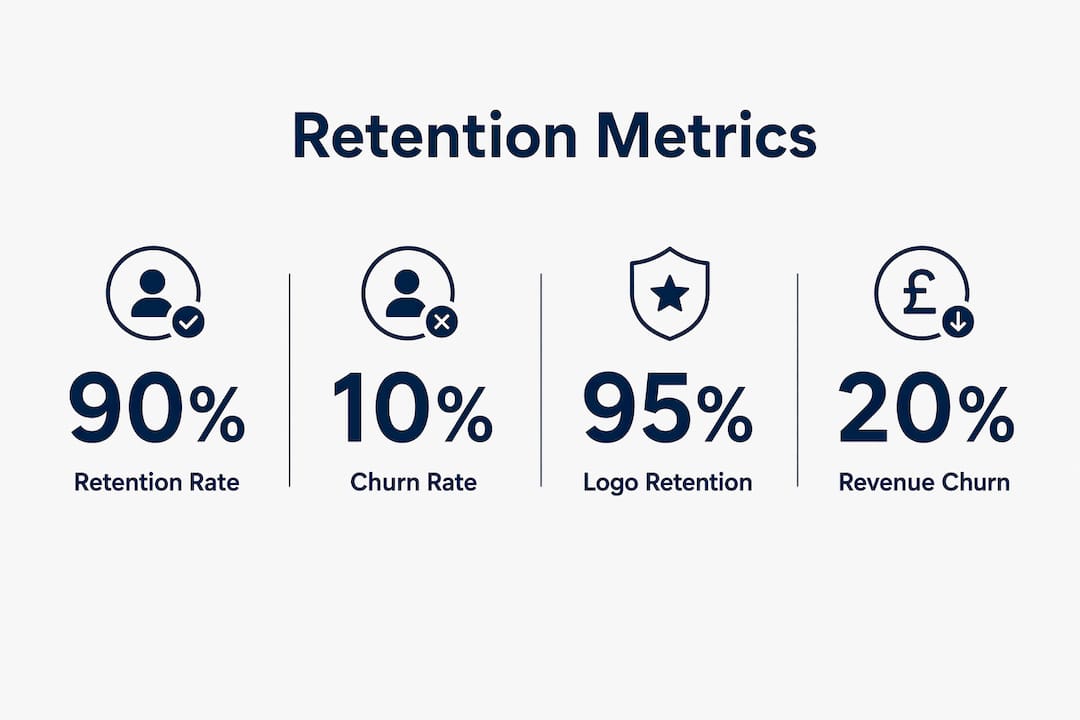
To put it in concrete terms: if you start a quarter with 200 clients, end with 210, and acquired 30 new ones, your CRR is ((210 − 30) / 200) × 100 = 90%. That means 10% of your original clients did not stay.
Retention versus churn
Churn rate is the inverse of your retention rate. A 90% retention rate means a 10% churn rate. Churn tells you who left; retention tells you who stayed. Both figures matter, and looking at only one gives you an incomplete picture.
Pro Tip: Before you set any retention targets, agree on a single definition of churn across your organisation. Logo churn, revenue churn, and customer churn all measure different things, and conflating them leads to wildly different conclusions from the same data.
| Metric | What it measures | Best used for |
|---|---|---|
| Customer retention rate | Percentage of existing clients retained | Overall retention health |
| Churn rate | Percentage of clients lost | Identifying departure trends |
| Revenue churn | Revenue lost from departing or downgrading clients | Financial impact assessment |
| Repeat purchase rate | How often clients buy again | Non-subscription businesses |
| Customer lifetime value | Total revenue from a client over their relationship | Long-term profitability planning |
Why client retention matters for growth
The importance of client retention goes well beyond avoiding churn. Retained clients cost significantly less to serve than newly acquired ones. They require no onboarding investment, no extended trust-building period, and they tend to buy more over time as confidence in your product or service deepens.

The numbers are striking. Customer-obsessed businesses reported 41% faster revenue growth and 49% faster profit growth compared to their peers in a 2024 study. That is not a marginal advantage. That is the difference between a business that compounds growth year on year and one that runs to stand still.
Retained clients also generate something that acquisition cannot buy: word-of-mouth credibility. A client who has worked with you for three years and seen consistent results is your most credible sales asset. They refer, they advocate, and they provide the kind of social proof that no advertising budget can replicate.
“Retention is a growth engine as it reduces the acquisition burden and makes revenue more predictable. Leadership needs to reframe their view beyond just support metrics.” — Stripe on retention strategy
This reframing is exactly what separates high-growth businesses from those that plateau. When you view retention as a commercial priority rather than a service function, your entire leadership strategy shifts. You stop asking “how do we acquire more?” and start asking “how do we make staying the obvious choice?” That is a far more powerful question.
Client retention strategies that actually work
Understanding the benefits of client retention is one thing. Building the operational habits that deliver it consistently is another. Here is what the most effective retention strategies have in common.
Consistency beats brilliance. Research shows that 85% of CX leaders say customers leave after just one unresolved issue. Clients do not necessarily need you to be exceptional every time. They need you to be reliable every time. A single frustrating interaction, left unaddressed, can undo months of goodwill.
Techniques for client retention that leaders should prioritise include:
- Personalised engagement: Use client history, preferences, and behaviour to tailor your communications and offers. Generic outreach signals that you are not paying attention.
- Proactive support: Contact clients before problems arise. Quarterly check-ins, account reviews, and milestone calls show clients they are not just an invoice number.
- Client loyalty programmes: Structured rewards for longevity or spend volume give clients a concrete reason to stay. This works particularly well in service businesses where switching costs are low.
- Regular feedback loops: Systematically gather and act on client feedback. Clients who feel heard are significantly less likely to leave.
- Structured renewal conversations: Do not wait for a contract end date to have a retention conversation. Build renewal dialogue into your account management practices throughout the year.
Beyond these foundational approaches, AI and predictive analytics are reshaping what is possible. BCG reports that always-on retention approaches using machine learning can anticipate churn drivers and personalise retention actions in real time, moving well beyond generic discounts or reactive outreach. This matters because it allows leadership to act on signals before a client has mentally moved on.
Pro Tip: Build a retention cadence aligned to customer success milestones, not just calendar dates. A check-in at the point a client hits a meaningful outcome with your product or service lands far more powerfully than a routine quarterly call with no specific hook.
Retention programmes fail, as Zendesk’s research shows, when teams focus on single metrics like support response time without attending to the broader picture of ongoing value. Speed is good. Speed plus substance is what keeps clients.
Calculating retention metrics correctly
Getting your measurement right is where most organisations stumble. The CRR formula from Salesforce addresses the most common trap: mixing growth with retention in your calculations. If your client numbers grew by 15% this quarter, that tells you nothing about how well you retained your existing base. You must isolate the two.
Beyond the headline retention rate, there are nuances worth understanding. Churn definitions vary widely across businesses, and this matters enormously when you are setting targets or reporting to a board. Logo churn counts the number of client accounts lost. Customer churn counts individual users within those accounts. Revenue churn measures the income lost from departing or downgrading clients. All three can be true at the same time and point in entirely different directions.
A SaaS business, for instance, might retain 95% of its logos while losing 20% of its revenue if the clients who leave are disproportionately large accounts. Reporting only logo retention in that scenario is misleading. Equally, a professional services firm counting only billable revenue might overlook the quiet erosion of smaller client relationships that will matter significantly in two years’ time.
Customer lifetime value (CLV) is another metric that belongs alongside your CRR. CLV tells you how much a retained client is actually worth over the course of the relationship, which gives you a rational basis for deciding how much to invest in retention activities. If a client is worth £85,000 over five years, a £3,000 investment in a dedicated account manager is not a cost. It is a return.
Applying retention thinking across your leadership
Knowing how to improve client retention is only useful if it translates into organisation-wide behaviour. Too many businesses treat retention as the responsibility of a single customer success team, which creates a structure where clients experience inconsistency between the promises made during the sale and the reality of the ongoing relationship.
Here is a practical sequence for embedding retention thinking across your leadership:
- Define retention ownership. Assign clear accountability for retention metrics to specific leaders, not just to support or service teams. Sales, marketing, and operations all influence whether a client stays.
- Align incentives. If your sales team is rewarded only for new business, they have no structural reason to care about retention. Introduce renewal targets and expansion revenue into your compensation design.
- Map the client journey end to end. Identify every touchpoint after the initial sale and assess honestly where the experience drops off. This is where most retention problems live.
- Create feedback loops with teeth. Gathering client feedback means nothing without a process to act on it and report back to clients that you have done so.
- Invest in consultative selling skills. Clients who feel their supplier understands their business and not just their immediate transaction are far less likely to leave. The advantages of consultative selling extend well into the post-sale relationship.
Industries from professional services to SaaS to retail have demonstrated that when leadership takes ownership of client acquisition and retention together as a unified commercial strategy, growth becomes far more predictable and sustainable.
My take on retention as a leadership priority
I have worked with a lot of business leaders who are genuinely brilliant at winning new clients. The discipline, the pitch, the close. They have that dialled in. But when I ask them what their current retention rate is, there is often a pause. Sometimes a long one.
What I have observed consistently is that retention is treated as something that happens automatically if the product is good enough. That belief is expensive. Clients leave not because your product failed but because they felt overlooked, under-communicated with, or simply found someone who made them feel more valued.
In my experience, the businesses that build real retention into their culture are the ones that measure it, talk about it at every leadership meeting, and hold every function accountable for it. Not just the service team. Everyone. When your sales team cares about what happens 18 months after the signature, the quality of clients they bring in changes too.
Data-driven retention decisions are not the future. They are the present. If you are not using behavioural signals to spot disengagement before a client tells you they are leaving, you are already behind. The good news is that this is entirely fixable with the right structure and coaching behind it.
Retention is not a support function. It is your growth strategy.
— Jerry
How Aheadofsales can help you retain more clients

If this article has made you think seriously about retention as a commercial priority, the next step is building the team capability to deliver it consistently. Aheadofsales works with businesses of 50 to 1,000 staff to develop the sales and client relationship skills that make retention a structural outcome rather than a happy accident.
Through bespoke sales training programmes, Aheadofsales helps your team move from transactional relationships to the kind of consultative, value-led engagement that keeps clients for the long term. For leaders who need a deeper structural approach, the sales consultancy service helps you build retention-aligned growth plans with measurable targets and clear accountability. If your team is currently hitting targets on acquisition but struggling to hold the base, that is exactly the gap Aheadofsales is built to close.
FAQ
What is client retention in simple terms?
Client retention is the ability of a business to keep its existing clients over a defined period by consistently delivering value. It is measured as a percentage of the original client base that remains at the end of a given time frame.
How do you calculate client retention rate?
Use the formula CRR = ((E − N) / S) × 100, where S is your starting client count, E is the ending count, and N is new clients acquired. This isolates how many of your original clients stayed.
What is a good client retention rate?
It varies by industry, but generally a retention rate above 85% is considered healthy for most B2B service businesses. SaaS businesses often target 90% or above, particularly for revenue retention.
Why is client retention more profitable than acquisition?
Retained clients require no onboarding cost, tend to spend more over time, and refer new business. Research shows that customer-obsessed companies grow profits 49% faster than those focused primarily on acquisition.
What is the difference between logo churn and revenue churn?
Logo churn measures the number of client accounts lost, while revenue churn measures the income lost from those departing or downgrading clients. A business can have low logo churn but high revenue churn if its largest accounts are the ones leaving.