TL;DR:
- Understanding whether your sales are B2B or B2C is essential, as each has unique decision processes, cycles, and pricing models. B2B involves longer cycles, multiple stakeholders, and negotiation, while B2C relies on quick, emotion-driven purchases by individual consumers. Adapting your sales approach to these differences is key to building effective strategies and achieving sustained revenue growth.
If you’ve ever wondered what is b2b sales and b2c sales and why the distinction actually matters, you’re not alone. On the surface, both models involve selling something to someone. But the moment you look at who is buying, why they are buying, and how long the process takes, the two models could not be more different. Getting this wrong in your sales strategy costs time, money, and deals. This guide breaks down both models clearly, compares them side by side, and gives you practical frameworks to align your sales approach with the right model.
Table of Contents
- Key takeaways
- What is B2B sales?
- What is B2C sales?
- B2B vs B2C: the real differences
- Where the lines start to blur
- Applying this to your sales strategy
- My perspective on the B2B and B2C divide
- Ready to get your sales model working harder?
- FAQ
Key takeaways
| Point | Details |
|---|---|
| B2B involves multiple stakeholders | B2B sales cycles average around two months and require navigating several decision-makers within an organisation. |
| B2C is faster and emotion-driven | B2C purchases are often completed in a single session, driven by brand signals and personal emotion rather than ROI calculations. |
| Pricing structures differ significantly | B2B pricing is typically negotiated and contract-based, while B2C pricing is usually fixed and transparent. |
| Post-sale priorities diverge | B2B success depends on ongoing account management; B2C focuses on retention through brand experience and repeat purchasing. |
| Strategy must match buyer type | Misaligning your sales process with your buyer type is one of the most common causes of stalled growth. |
What is B2B sales?
B2B stands for business-to-business. The B2B sales definition is straightforward: one business sells products or services to another business rather than to an individual consumer. Think of a software company selling a CRM platform to a logistics firm, or a training provider selling sales coaching to a mid-sized manufacturer.
What makes B2B sales genuinely complex is not the product itself. It is the buying structure on the other side of the table.
B2B sales cycles average about two months, and that is on the shorter end. Enterprise deals regularly stretch to six months or longer. Within that cycle, you are rarely selling to one person. You are selling to a buying committee that might include a finance director, a head of operations, a procurement manager, and occasionally a board-level sponsor. Each person has their own priorities, objections, and evaluation criteria.
Key characteristics of B2B sales include:
- Multiple stakeholders: Decisions involve several people across departments, each requiring different information and reassurance.
- Longer sales cycles: Demos, trials, proposals, and contract negotiations all extend the timeline.
- ROI-driven purchasing: Buyers need to justify expenditure with measurable outcomes such as cost savings, productivity gains, or revenue growth.
- Negotiated pricing: Final pricing is rarely listed publicly and often tailored through a formal proposal process.
- Formal documentation: B2B buyers need formal proposals and evidence to satisfy organisational evaluation requirements.
Pro Tip: Map every stakeholder in your B2B opportunity before you progress. Note their role, their concern, and what success looks like to them personally. This one habit alone will help you avoid deals collapsing at the final stage.
The B2B sales process typically flows through awareness, qualification, discovery, proposal, negotiation, and close, with active nurturing happening at every stage. It is a structured, relationship-heavy process that rewards patience and preparation.
What is B2C sales?
B2C stands for business-to-consumer. B2C sales explained simply: a business sells directly to an individual for personal use. A clothing retailer, a subscription meal kit company, and a personal finance app are all operating in the B2C space.
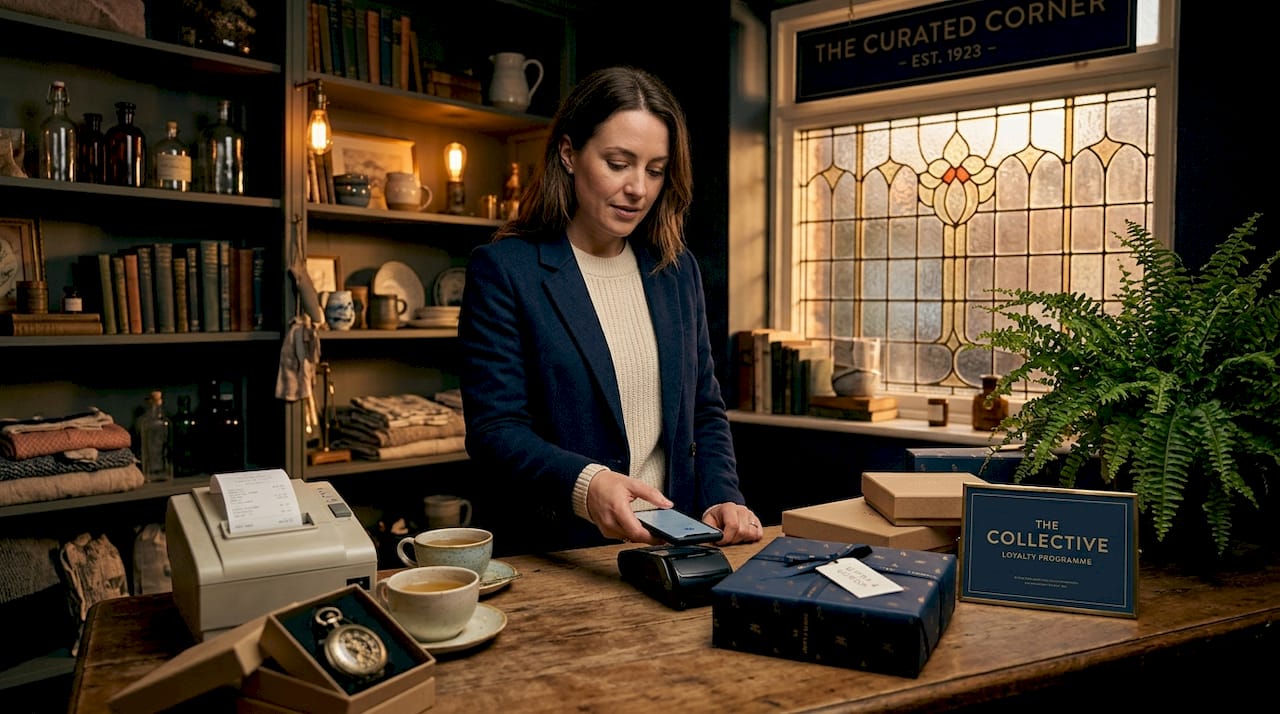
The purchasing dynamic here is fundamentally different. Many B2C purchases happen within a single session, particularly for lower-cost items. The decision-maker and the buyer are usually the same person, and that person is often influenced by emotion, social proof, urgency, and brand perception rather than a formal evaluation process.
Key characteristics of B2C sales include:
- Single decision-maker: The individual consumer decides alone, which significantly shortens the path to purchase.
- Shorter and simpler cycles: A consumer might see a product on social media in the morning and buy it by lunchtime.
- Emotion and brand-driven: B2C buyers rely heavily on emotional brand signals, making storytelling and urgency tactics central to conversion.
- Fixed pricing: Prices are transparent, consistent, and rarely open to negotiation.
- Impulse purchasing: Effective B2C sales techniques create moments of desire and remove friction quickly.
When you think about how to sell B2C effectively, the focus shifts away from relationship nurturing and toward brand experience. Your product page, your checkout flow, your email subject line, and your social proof all carry enormous weight. Speed and emotional resonance are your primary tools.
B2B vs B2C: the real differences
Understanding what is b2b and b2c sales at a surface level is one thing. Applying that understanding to your strategy is another. Here is a direct comparison of the dimensions that matter most.
| Dimension | B2B sales | B2C sales |
|---|---|---|
| Decision-maker | Multiple stakeholders across departments | Individual consumer |
| Sales cycle length | Weeks to months | Minutes to days |
| Primary buying motive | ROI, efficiency, productivity | Emotion, desire, convenience |
| Pricing model | Negotiated, contract-based | Fixed, transparent |
| Lead nurturing | Long-term, multi-touch | Short-term, brand-driven |
| Post-sale focus | Account management, expansion | Repeat purchase, loyalty programmes |
The biggest difference lies in buying journey complexity and stakeholder involvement, not just the customer type. A B2B salesperson who treats every prospect like a single-person consumer purchase will consistently lose deals to competitors who understand how to progress each stakeholder individually.
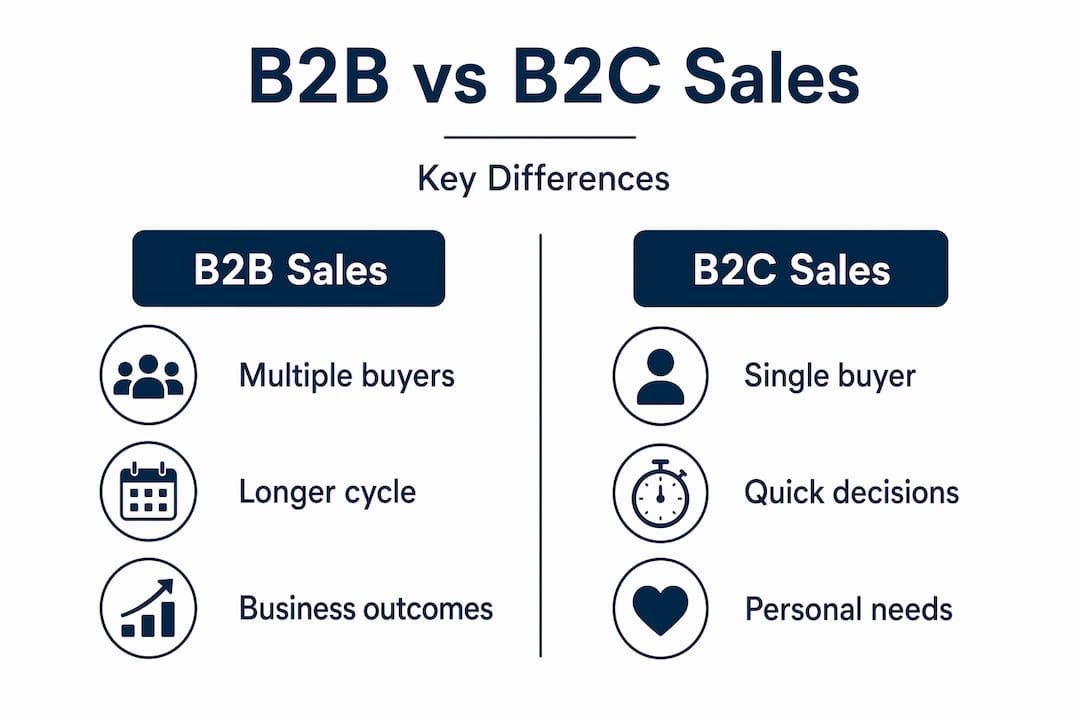
B2B sales focus on business outcomes such as ROI and operational efficiency, whereas B2C sales tap into personal desires and lifestyle aspirations. This is not a minor nuance. It changes your messaging, your channel strategy, your content, and your conversation style entirely.
Pro Tip: Before writing a single line of sales copy or building a call script, write out who you are selling to and what they care about at a practical and personal level. B2B buyers care about what happens to their business. B2C buyers care about how they feel.
Post-sale activities differ sharply too. In B2B, your job does not end at contract signature. Account management, quarterly reviews, and value demonstration are what protect and grow revenue. In B2C, the post-sale priority is creating a brand experience compelling enough to drive repeat purchases and word-of-mouth referrals.
Where the lines start to blur
The clean separation between B2B and B2C sales models is becoming less absolute. Technology supports different goals in each model, but digital transformation is reshaping buyer expectations across both.
Here is what is changing:
- B2B buyers now expect consumer-grade digital experiences. A procurement manager shopping for software on behalf of their company now expects the same ease of research, self-service, and transparent information they get when buying personally online.
- Many businesses operate both models simultaneously. A food manufacturer might sell wholesale to supermarket chains (B2B) and run a direct-to-consumer online shop (B2C). Both channels require fundamentally different sales and marketing approaches.
- B2C is adopting longer engagement cycles. High-value B2C categories such as property, financial services, and premium technology now involve extended consideration periods that feel closer to B2B than traditional impulse purchasing.
- Personalisation is crossing over. B2B has long relied on personalised outreach and tailored proposals. B2C is now catching up, with brands investing in one-to-one digital personalisation at scale.
Recognising these overlaps matters because it stops you from applying a rigid framework where a flexible one is needed. If you run a SaaS platform and sell to both enterprise clients and individual subscribers, your B2B SaaS sales approach needs to look and feel very different from your self-serve consumer funnel, even if both live on the same website.
Adapting your sales approach based on buyer expectations, rather than simply product type, is one of the more useful shifts in thinking you can make here.
Applying this to your sales strategy
Once you are clear on the differences between B2B and B2C, the question becomes: how do you actually apply this to build a better sales approach?
Here is a practical framework:
-
Define your buyer precisely. Are you selling to an organisation or to an individual? If it is an organisation, map out who within that organisation actually makes the decision and who influences it. This shapes everything from your prospecting method to your follow-up cadence.
-
Align your sales cycle to buying complexity. B2B buyers need time to evaluate, consult internally, and get budget approval. Build this into your pipeline stages and your activity plan. Rushing a B2B prospect who has not yet aligned internally will cost you the deal. For B2C, the opposite applies. Friction kills conversions. The faster and smoother the path to purchase, the better.
-
Choose channels that match your buyer’s behaviour. Sales motions must change according to buyer decision-making. LinkedIn outreach, referral programmes, and effective lead generation workflows are core B2B tactics. Paid social, influencer partnerships, and search advertising tend to dominate in B2C.
-
Structure your team accordingly. B2B typically needs account executives, business development representatives, and customer success managers. B2C often relies more on marketing automation, customer service, and e-commerce optimisation than on individual salespeople.
-
Invest in the right relationship at the right depth. In B2B, your relationship with a client can span years and multiple contract renewals. Long-term account management and ongoing value demonstration underpin every successful B2B business. In B2C, depth of relationship is less common, but brand loyalty and community can be equally powerful.
Pro Tip: If you are an entrepreneur unsure which model your business operates in, look at who signs the invoice. If it is a company, you are in B2B territory. If it is a person spending their own money, you are in B2C. Your entire approach to sales and marketing should follow from that one answer.
My perspective on the B2B and B2C divide
I’ve worked with businesses across both sales models, and the single most costly mistake I see is entrepreneurs treating B2B like a slightly longer B2C sale. They send a quick email, follow up once, and wonder why nobody is buying. Treating B2B merely as a longer B2C sale leads to failure when you do not account for the stakeholder evaluations happening behind the scenes.
What I’ve learned is that the discipline of stakeholder mapping is completely underused. Most salespeople can name the person they spoke to. Far fewer can tell you what the CFO’s concern is, whether procurement has been involved yet, or whether there is a competing internal project that could delay the decision. Getting clear on those details is what separates a closed deal from a stalled one.
On the B2C side, I’ve seen businesses overcomplicate things by trying to educate their way to a sale. B2C buyers are not looking for a white paper. They are looking for a reason to trust you quickly and a simple path to buying. Speed and emotional resonance genuinely do most of the heavy lifting here.
My honest advice: continuously test your assumptions about your buyer. Markets shift, buyer expectations change, and the strategy that worked twelve months ago may not be the right one today. Explore the B2B sales strategy guidance that matches where your business is right now, not where it was when you last revised your approach.
— Jerry
Ready to get your sales model working harder?
Understanding the difference between B2B and B2C sales is the foundation. Translating that understanding into consistent revenue growth is where most businesses need genuine support.
At Aheadofsales, we work with businesses of 50 to 1,000 staff to build sales approaches that are tightly aligned with their buyer type, their team structure, and their growth targets. Whether you are operating in B2B, B2C, or a hybrid model, our bespoke coaching and consultancy programmes are built around achieving at least 50% sales growth per year. From full team sales training and workshops to dedicated SaaS sales training and individual sales acceleration packages, we have the right programme for where you are now and where you want to go.
FAQ
What is B2B sales and how does it differ from B2C?
B2B sales involve one business selling to another, typically with longer sales cycles, multiple stakeholders, and negotiated pricing. B2C sales target individual consumers, with faster transactions, fixed pricing, and emotion-driven purchasing decisions.
How long does a typical B2B sales cycle take?
B2B sales cycles average around two months, though complex enterprise deals can extend to six months or longer depending on the number of stakeholders and the value of the contract.
Why do B2B buyers make decisions differently from B2C buyers?
B2B buying decisions involve multiple stakeholders and require justification based on business outcomes like ROI and efficiency. B2C buyers typically decide alone and are influenced by emotion, brand trust, and personal desire.
Can a business operate both B2B and B2C sales models at once?
Yes. Many businesses sell wholesale to other companies and directly to consumers simultaneously. Each channel requires a distinct sales process, messaging approach, and team structure to perform effectively.
What is the biggest mistake businesses make with B2B sales?
The most common mistake is treating B2B like an accelerated consumer sale. Effective B2B sales require mapping each stakeholder’s evaluation individually and progressing each one through the buying journey with tailored evidence and communication.