
A good weekly sales meeting agenda has five or six timed blocks: wins, pipeline movement, one deal review, blockers, one skill topic and agreed actions. Each block has one question to answer and one output to write down. Below you will find a ready-to-use 45-minute agenda, a shorter 20-minute version, the topics worth rotating through, and how to prepare and follow up so the meeting changes what your team does on Thursday.
TL;DR
- Time-box every block and give each one a single question and a single output, so the meeting ends in decisions rather than updates.
- Review pipeline movement (new, advanced, slipped, lost), not a stage-by-stage recital, and pick one live deal to dig into.
- Send the agenda and the numbers beforehand, so the session is for discussion.
- Close with actions that have an owner and a deadline, written into your CRM before anyone leaves.
- Hold it at the same time every week, and cut items rather than overrun.
Table of Contents
- What a weekly sales meeting is actually for
- The 45-minute weekly sales meeting agenda
- A 20-minute version for smaller teams
- Sales meeting topics worth rotating through
- Which numbers belong in the meeting
- How to prepare, and what to record afterwards
- Keeping the meeting focused and engaging
- Our perspective
- Want help running this with your team?
- FAQ
- Sources
What a weekly sales meeting is actually for
Most weekly sales meetings I see in UK businesses fail in the same way: the manager goes round the table, each rep reads out their deals, and everyone else waits for their turn. Forty minutes later nobody has decided anything.
A weekly sales meeting has three jobs. It keeps the team’s attention on the same priorities, it moves specific deals forward, and it teaches one useful thing. Anything that does none of those belongs in an email or a one-to-one.
Research from sales-software publishers points the same way. HubSpot’s guidance recommends consistent, time-boxed segments focused on actionable outcomes rather than status updates: recognition first, then key metrics, specific pipeline opportunities, blockers and documented actions.
If your meeting also has to cover things like quarterly planning, keep those out of the weekly slot. They have their own format, and we cover it in our sales QBR agenda.
The 45-minute weekly sales meeting agenda
This is the structure we suggest for a team of roughly five to fifteen people. It follows the pattern of SalesTap’s weekly template, which uses five blocks: wins and losses for 7 minutes, pipeline movement for 8, one rotating deal review for 15, blockers for 5, and one skill, market or process topic for 10. It also uses a timekeeper to stop overruns. I have added a closing block for actions, which takes the total to 45 minutes.
| Block | Time | Question it answers | Output |
|---|---|---|---|
| Wins and losses | 7 min | What did we win or lose, and what did we learn? | One lesson per result, one person recognised |
| Pipeline movement | 8 min | Which deals moved, slipped or died this week? | Named accounts needing attention |
| One deal review | 15 min | What would move this one deal forward? | A next step the rep commits to |
| Blockers | 5 min | What is stopping anyone hitting target? | Each blocker has an owner and a date |
| One topic | 10 min | What one skill, market or process point will help next week? | One thing to try this week |
| Actions | 5 min | Who does what, by when? | Written actions in the CRM |
That adds up to 50 minutes if you run the actions block on top, so in practice I trim the topic block to 5 minutes when the deal review runs long. Pick the version that suits your team and stick to it for a month before changing anything.
Wins and losses (7 minutes)
Start with recognition. HubSpot recommends opening with wins to build motivation, reinforce the behaviours you want and set a productive tone.
Make the recognition specific. “Great job on the Hartley deal” is pleasant. “Priya got the finance director into the second call, which is why that deal closed in five weeks” is a lesson the whole team can copy.
Include losses, but keep them short and curious rather than defensive. One sentence on why, one on what you would do differently.
Pipeline movement (8 minutes)
This is where most meetings go wrong. The standard pipeline review has what Rework describes as a design flaw: managers focus on deal status rather than deal movement. SalesTap makes the same point: discuss what is new, advanced, slipped or lost, and do not turn the meeting into a forecast call in disguise.
A useful discipline is to name five accounts that need attention that week, rather than recite every deal. That approach comes from RevenueFlow’s agenda guidance. Tech Sales Playbook suggests choosing deals by consequence and uncertainty: the big deals where the outcome is unclear get the airtime.
If your team uses stage names loosely, the conversation will drift. Our guide to sales pipeline stages helps you define them so “advanced” means the same thing to everyone.
One deal review (15 minutes)
Pick one live opportunity and go deep. SalesTap suggests the rep presents the buyer’s stated problem, the named buying committee, the current stage, the booked next step and the one point where they are stuck.
Rotate the rep each week so everyone presents over a quarter, and tell them on the Friday before. The rep who is stuck gets the benefit of the room’s experience, and everyone else learns how a good deal is qualified.
The discipline here is that the review ends with a decision. If it ends with “let’s see how it goes”, you have not reviewed anything.
Blockers (5 minutes)
Ask one question: what is getting in the way of hitting target? Typical answers include slow legal review, no budget confirmation, a lack of marketing leads, or a pricing question nobody has answered.
Record each blocker with an owner and a date. A blocker without an owner is a complaint.
One topic (10 minutes)
Use this block to build skill, not to read out a product update. We cover ideas for this slot below.
Actions (5 minutes)
Reserve the final minutes for reviewing actions, confirming owners and setting deadlines, as HubSpot advises. RevenueFlow adds that the recap should be written into the CRM before anyone leaves. I would go further: whoever runs the meeting types the actions live while the team watches.
A 20-minute version for smaller teams
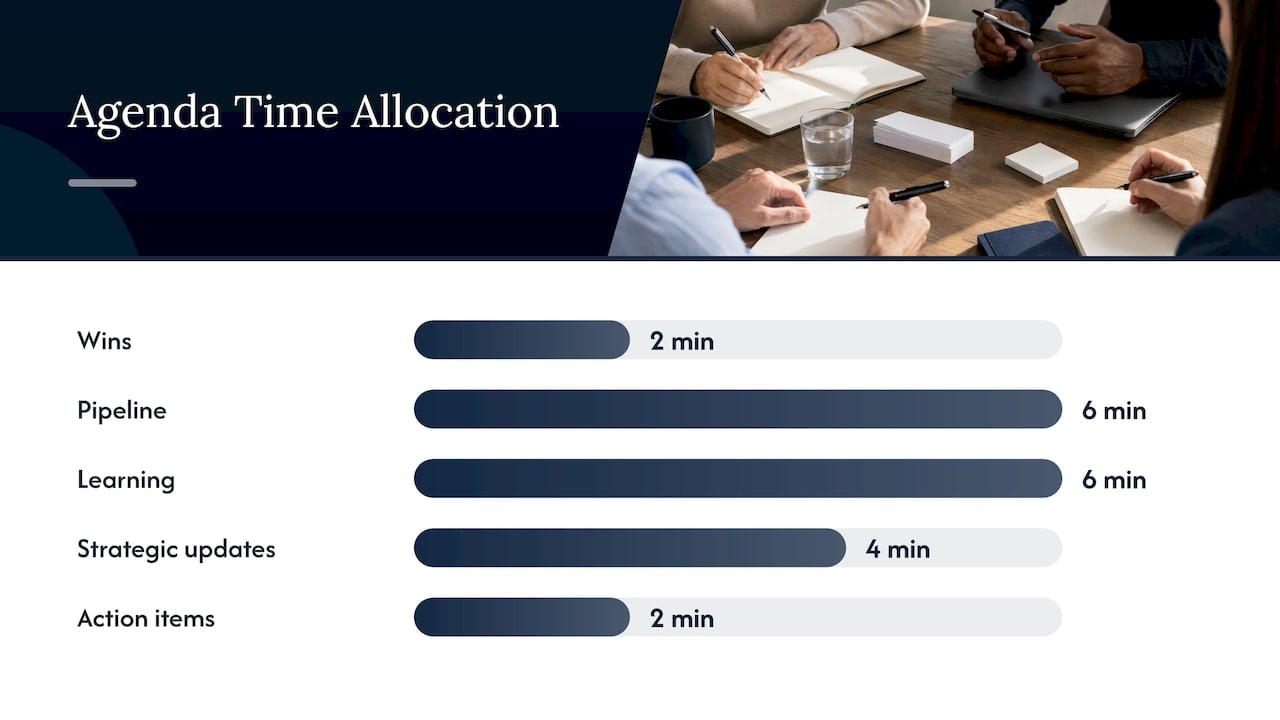
If you have a team of three or four, or a busy period, a shorter format works. HubSpot’s 20-minute template allocates 2 minutes to wins, 6 to pipeline, 6 to learning, 4 to strategic updates and 2 to action items.
Short meetings only work if the preparation is done beforehand. That means numbers circulated, deals updated and the agenda sent out. Without that, 20 minutes becomes 45 and nobody notices.
Sales meeting topics worth rotating through
The topic block is where you stop the meeting becoming repetitive. HubSpot lists the recurring weekly themes as pipeline health and forecast accuracy, wins and losses, competitive intelligence and market shifts, upcoming initiatives or process changes, and peer learning through deal strategy.
Here is how I would rotate a four-week cycle:
- Week one: an objection. Take one objection your team keeps hearing (“we need to think about it”, “your price is higher”) and practise answers. Revenue.io suggests a 15-minute coaching segment on one specific challenge, such as an objection or a competitor mention. Our guide to objection handling in B2B sales gives you material to start from.
- Week two: a call play-back. Play a 60 to 90 second clip of a real call and ask the team what they would have said next. The same Revenue.io piece recommends short call segments for collaborative skill development. Ask the rep’s permission first, and choose a good moment as well as a poor one.
- Week three: market and competitors. One news item, one competitor move or one customer trend, and what it means for the next fortnight’s calls.
- Week four: process. A CRM change, a new proposal template, a pricing update. Keep it to the one change that matters.
For wider skills work, see our ideas for sales workshops that move the pipeline and sales team coaching techniques.
Which numbers belong in the meeting
Keep the metrics to a handful. Laxis lists bookings against target, pipeline coverage, win rate and stage conversion, and advises against in-depth dashboard reviews in the meeting itself.
How you read those numbers matters. Tech Sales Playbook recommends interpreting measures such as stage ageing and disqualification rates against your own segments, territories and cycle lengths rather than universal benchmarks. A deal that has sat in proposal stage for 30 days is normal in a long enterprise cycle and a warning in a short one.
Circulate the figures beforehand. RevenueFlow recommends managers share numbers and key metrics before the meeting so the session is for discussion and decisions, not reporting. If you want those numbers clean and joined up across outreach, enrichment and CRM, a full-service growth team can help set up the reporting behind them.
How to prepare, and what to record afterwards
Before the meeting
Send the agenda 24 hours ahead and ask reps to review their specific deals in the CRM, as HubSpot suggests. Tech Sales Playbook expects reps to update stage, close date, next steps and stakeholder information before the review.
This makes the CRM the single source of truth. If a deal is not updated, it does not get discussed. That one rule tends to fix data quality faster than any reminder email.
After the meeting
Record three things:
- The actions, each with an owner and a deadline.
- The blockers, with who is clearing them and by when.
- The deal-review decision, in the deal record itself.
Then set a follow-up mechanism. HubSpot recommends one alongside owners and deadlines. A simple version is to open the next meeting by checking last week’s actions, which takes 60 seconds and changes behaviour more than most training.
If accountability is the recurring problem in your team, our six ways to boost sales accountability goes into more detail.
Keeping the meeting focused and engaging
The meetings people dread are the ones where they are an audience. Three habits fix that.
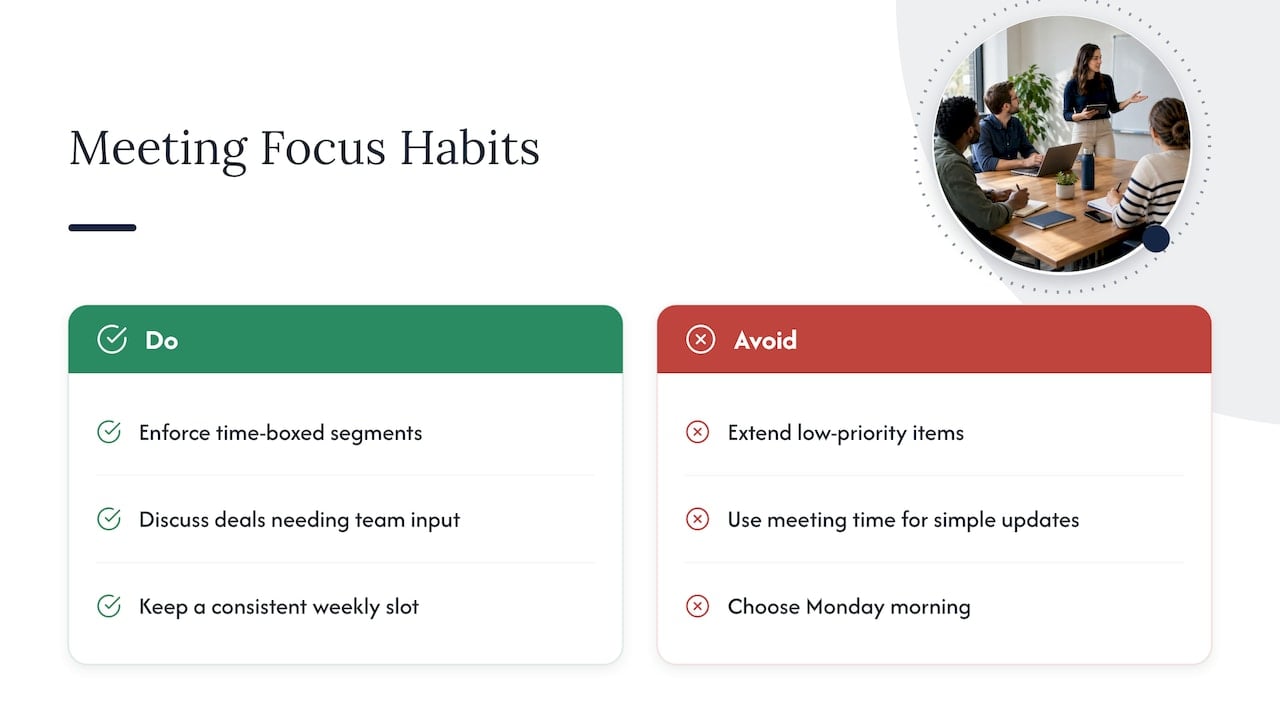
Enforce the clock. HubSpot’s advice is to strictly enforce time-boxed segments and cut low-priority items rather than extend the meeting. Appoint a timekeeper, as SalesTap suggests, and rotate the role.
Discuss only what needs the room. Cover deals that need team or management input. If a rep only needs to give you an update, take it by message.
Hold it at the same time each week. HubSpot recommends a consistent slot to build rhythm, and suggests Tuesday or Wednesday to avoid the disruption of Monday morning tasks. In UK teams I find Tuesday mid-morning works well because it falls after the weekend backlog and before the end-of-week scramble.
Once the weekly rhythm is steady, see our wider guides on sales meeting best practices and the sales meeting process.
Our perspective
We have sat in a lot of sales meetings, and the pattern is consistent: the teams that hit target every quarter are rarely the ones with the cleverest agenda. They are the ones whose manager treats the meeting as coaching time.
That is why our work combines bespoke 1:1 coaching with team training and consultancy. The weekly meeting is where the team practises together, but the real change happens in the one-to-one conversations in between, where a manager or a coach looks at one rep’s calls and deals in detail. The agenda gives you the rhythm. The coaching gives you the improvement.
If your meeting feels flat, look at the deal review and topic blocks first. Make them hands-on, make them specific, and make sure every rep leaves with one thing to do differently. Our aim is to help growth-minded businesses lift sales every year and keep the team on target every quarter, and a well-run weekly meeting is one of the cheapest places to start.
Jerry
Want help running this with your team?
A template gets you the structure. Getting a team to use it well, with sharper deal reviews and coaching that sticks, is where we come in. We run bespoke coaching and consultancy engagements for teams, which are priced from £4,500 to £8,500 as a one-off. You can see how they are put together on our sales training cost page.

If you are a founder who needs a senior sales lead to run this rhythm for you, our fractional sales director service is built for that.
FAQ
How long should a weekly sales meeting be?
Between 20 and 45 minutes is the range the published templates use. HubSpot’s version runs to 20 minutes, while SalesTap’s runs to 45 with a rotating deal review. Choose by team size and stick to the clock.
What should I put in a weekly sales team meeting agenda?
Wins and losses, pipeline movement, one deal review, blockers, one skill or market topic, and actions with owners and dates. Each block should answer one question and produce one output. Send the agenda 24 hours ahead.
What day is best for a weekly sales meeting?
HubSpot recommends a fixed time each week, with Tuesday or Wednesday often suggested to avoid Monday morning disruption. The consistency matters more than the exact day, so pick a slot you can protect.
How do I stop the meeting turning into a status report?
Circulate the numbers beforehand and review pipeline movement rather than every deal. Name a handful of accounts that need attention, and cover only deals where the team or management can help. Cut items before you extend the meeting.
Sources
- How to run an effective sales meeting in under 20 minutes
- The Weekly Sales Meeting Agenda That Works
- Running a Weekly Pipeline Review That Doesn’t Waste an Hour
- Sales Meeting Agenda Template: Six Blocks, Six Decisions
- Account Executive Weekly Pipeline Review Template
- How to Run a Useful Weekly Sales Meeting
- Sales Meeting Agenda Template to Run Tighter Team Meetings