
TL;DR:
- Effective sales strategies include blending models such as inbound, outbound, account-based, and channel sales to match market needs. Carefully documentation of the approach ensures consistent execution and accelerates revenue growth. Regularly reviewing and adapting strategies helps teams stay aligned with market shifts and buyer behaviors.
A sales strategy is a documented, purposeful plan that defines which customers you will target, why they should buy from you, and how your team will win their business. Four primary go-to-market models exist across the industry: Inbound, Outbound, Account-Based, and Channel Sales. Most high-performing businesses do not pick just one. They blend models to match their product complexity, buyer readiness, and revenue goals. Understanding the types of sales strategies available to you is the first step towards building a plan that actually delivers consistent growth.
What are the main types of sales strategies?
Sales strategies fall into four recognised categories, and each one suits a different market context. Inbound attracts buyers who are already searching for a solution. Outbound puts your team in front of prospects who have not yet raised their hand. Account-Based Selling concentrates resources on a short list of high-value targets. Channel Sales uses third parties to extend your reach into markets you cannot easily access directly.
A clear sales strategy reduces wasted effort by focusing on prospects most likely to buy. That focus shortens sales cycles and improves revenue forecasting accuracy across the business.
The four models are not mutually exclusive. A SaaS business might run inbound content marketing alongside a targeted outbound sequence for enterprise accounts. A manufacturing firm might combine channel partners with a direct account-based programme for its top ten clients. The skill is knowing which model to lead with and when to layer in others.
1. Inbound sales strategy

Inbound sales attracts customers through education, content, and helpful tools, making conversations more relevant and less intrusive. The buyer comes to you already informed, which means your sales team spends less time qualifying and more time closing.
Typical inbound tactics include SEO-optimised blog content, free product trials, webinars, and gated guides. A software company that publishes detailed how-to articles will attract prospects who are actively researching solutions. By the time those prospects speak to a sales rep, they already understand the product category and often have a shortlist in mind.
Inbound works best when your average deal size justifies the content investment and when your buyers conduct independent research before engaging a vendor. It is less effective for entirely new product categories where buyers do not yet know they have a problem.
Pro Tip: Track which content pieces generate the most qualified conversations, not just the most traffic. A single well-targeted article that produces ten discovery calls beats a viral post that attracts no buyers.
2. Outbound sales strategy
Outbound sales involves proactive outreach to potential clients who have not yet shown interest. It relies on tailored messaging, thorough research, and a clear value proposition delivered at the right moment.
Cold calling, personalised email sequences, LinkedIn outreach, and direct mail all fall under outbound. The key word is “personalised.” Generic outbound fails because buyers ignore messages that feel mass-produced. A well-researched outbound sequence that references a prospect’s recent company news or specific business challenge will consistently outperform a spray-and-pray approach.
Outbound suits businesses with a defined Ideal Customer Profile and a product that solves a problem the prospect may not have actively searched for yet. It is particularly effective for targeting ideal clients in new verticals or geographies where your inbound presence is still thin.
- Outbound generates pipeline on demand rather than waiting for inbound interest to build.
- It works well for higher average contract values where the economics justify rep time per prospect.
- Outbound requires strong data hygiene. Poor contact lists waste rep capacity and damage sender reputation.
Pro Tip: Blend inbound and outbound into a single pipeline. Use inbound content to warm a prospect, then trigger an outbound sequence when they engage with a key asset. This combination shortens the time from first touch to first meeting.
3. Account-based selling
Account-Based Selling targets a select list of high-value accounts with personalised engagement. It works best for longer, complex deals involving multiple stakeholders across the buying organisation.
The approach flips the traditional funnel. Instead of casting wide and filtering down, you identify ten or twenty ideal accounts and build a bespoke campaign for each one. That campaign might include personalised outreach, tailored content, executive introductions, and coordinated marketing support, all aimed at a single company.
Stakeholder mapping is central to Account-Based Selling. In complex deals, you need to identify the economic buyer, the technical buyer, and the influencers who shape the final decision. Missing any one of these contacts is a common reason deals stall or collapse at the final stage.
- Build your target account list using firmographic data: company size, industry, revenue, and technology stack.
- Map every relevant stakeholder within each account and assign ownership to a specific rep or team member.
- Create personalised outreach for each stakeholder based on their role and likely priorities.
- Coordinate marketing and sales touchpoints so the account receives consistent, relevant messaging across every channel.
- Review account progress weekly and adjust the approach based on engagement signals.
Account-Based Selling produces higher win rates and deeper client relationships than broad outbound programmes. The trade-off is that it requires more preparation per account and a tighter alignment between sales and marketing teams.
4. Channel and partner sales
Channel and partner sales expand market reach by leveraging resellers, affiliates, and strategic partners. The model enhances scalability and opens access to new territories without proportionally increasing your direct headcount.
A channel partner might be a value-added reseller who bundles your product with their own services, a technology partner who integrates your solution into their platform, or an affiliate who earns commission on referred sales. Each arrangement requires a clear agreement on roles, incentives, and support structures.
- Channel sales accelerate growth in new geographies where you lack brand recognition or local relationships.
- Partners bring existing trust with their customer base, which reduces the time needed to establish credibility.
- The primary challenge is alignment. Partners have their own priorities, and without strong enablement and incentive structures, your product can slip down their list.
- Regular partner reviews, co-selling programmes, and dedicated partner managers are the most effective tools for maintaining momentum.
Pro Tip: Treat your top channel partners like internal sales reps. Give them access to your best sales collateral, involve them in product roadmap conversations, and reward their best performers publicly. Partners who feel invested in your success will prioritise you over competitors.
5. Consultative and solution-based selling
Consultative selling is a methodology that sits underneath your chosen strategy, but it deserves its own section because it changes how every strategy performs. Consultative selling shifts the rep’s role from product presenter to trusted adviser who aligns with the customer’s business goals.
Transactional selling suits quick, high-volume sales. Consultative and solution selling fit complex B2B deals with longer sales cycles. The distinction matters because applying a transactional approach to a complex deal will almost always result in a lost opportunity or a poorly scoped contract that creates problems post-sale.
In practice, consultative selling means asking more questions than you answer in early conversations. It means documenting the client’s specific challenges and presenting your solution in terms of their measurable outcomes, not your product features. This approach builds the kind of trust that generates referrals and repeat business long after the initial deal closes.
6. How to choose and blend selling strategies
Choosing the right approach starts with four decision criteria: product complexity, buyer personas, sales cycle length, and your team’s current capabilities. A simple, low-cost product sold to a single decision-maker suits an inbound or transactional outbound approach. A complex, high-value solution sold to a committee of five stakeholders demands Account-Based Selling combined with consultative techniques.
Sales teams that blend multiple strategies tailored to product complexity, buyer readiness, and relationship goals achieve faster revenue growth. Teams using analytics and hybrid selling grow revenue 56% faster than peers. That figure reflects the compounding effect of matching the right approach to the right opportunity rather than forcing every deal through a single process.
A documented sales strategy must include an Ideal Customer Profile, a clear value proposition, a defined sales process, and an aligned pricing model. Without documentation, strategy exists only in the heads of your best reps and disappears the moment they leave.
| Strategy | Best for | Key strength | Main challenge |
|---|---|---|---|
| Inbound | Self-serve or research-led buyers | Lower cost per lead at scale | Slow to build; requires content investment |
| Outbound | New markets or defined ICP targets | Generates pipeline on demand | Requires strong data and personalisation |
| Account-based | High-value, multi-stakeholder deals | Higher win rates and deal values | Resource-intensive per account |
| Channel/partner | New geographies or verticals | Scalable reach without headcount | Alignment and incentive management |
| Consultative | Complex B2B with long sales cycles | Builds trust and repeat business | Requires skilled, trained reps |
Shortening your sales cycle is one of the fastest ways to improve revenue forecasting. The strategy you choose directly affects cycle length, so align your model to your pipeline targets before you set quarterly quotas.
Key takeaways
The most effective sales approach combines a documented strategy with a blended model that matches product complexity, buyer readiness, and team capability.
| Point | Details |
|---|---|
| Four core models exist | Inbound, Outbound, Account-Based, and Channel Sales each suit different deal types and buyer behaviours. |
| Blending strategies accelerates growth | Teams using hybrid approaches grow revenue significantly faster than those locked into a single model. |
| Documentation is non-negotiable | A strategy without a written Ideal Customer Profile, value proposition, and sales process is not a strategy. |
| Consultative selling improves every model | Shifting reps from product presenters to trusted advisers increases win rates across all strategy types. |
| Strategy precedes methodology | Decide what market you will win and why before defining how your reps will conduct conversations. |
Why most sales teams get strategy wrong
Here is something I see repeatedly when working with businesses across the UK. They confuse sales methodology with sales strategy, and that single confusion costs them months of wasted pipeline activity.
Strategy defines what and why. Methodology defines how. A business that picks Account-Based Selling as its strategy still needs to decide whether its reps will use a SPIN-based questioning approach or a Challenger-style conversation framework. Those are methodology choices. Conflating the two means teams end up with a loose collection of tactics that nobody can replicate or train to.
The second mistake I see is treating strategy as a one-time decision. Markets shift. Buyer behaviour changes. A strategy that worked brilliantly in 2023 may be producing diminishing returns now. High-performing sales organisations document their strategy as a living playbook and review it at least quarterly. They treat it as a board-level asset, not a document that lives in a folder nobody opens.
The businesses I work with that grow fastest are the ones who commit to a primary strategy, document it properly, and then layer in complementary models as their team’s capability grows. They do not try to run all four models simultaneously from day one. They build depth before they build breadth.
— Jerry
How Aheadofsales helps you build a strategy that delivers
Building a sales strategy on paper is one thing. Getting your team to execute it consistently, quarter after quarter, is where most businesses struggle.
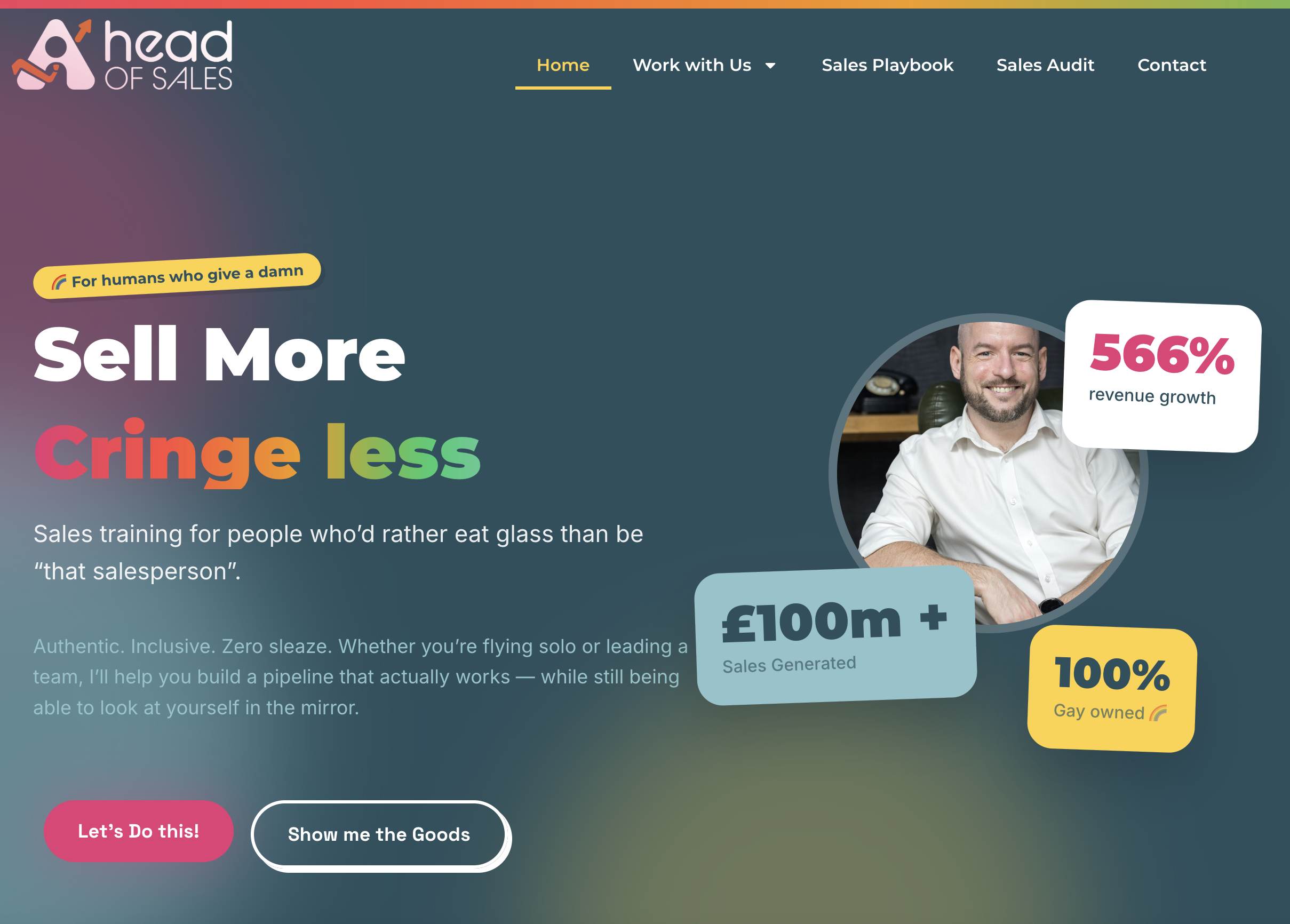
Aheadofsales combines bespoke 1:1 coaching with structured training and consultancy to help businesses generate at least 50% sales growth every year. Every engagement starts with a clear diagnosis of your current strategy, your team’s capability gaps, and the specific models that will produce the fastest results for your market. Whether you lead a team of ten or a hundred, the sales training programmes at Aheadofsales are built around your specific deal types, buyer personas, and revenue targets. Packages start from £4,500, designed for businesses with 50–1,000 staff who are serious about growth.
FAQ
What are the four main types of sales strategies?
The four primary go-to-market sales strategies are Inbound, Outbound, Account-Based Selling, and Channel Sales. Each suits a different combination of deal size, buyer behaviour, and market maturity.
How do I choose the right sales strategy for my business?
Base your choice on four factors: product complexity, buyer persona, sales cycle length, and team capability. Complex, high-value deals with multiple stakeholders suit Account-Based Selling; simpler, high-volume products suit inbound or transactional outbound.
What is the difference between a sales strategy and a sales methodology?
A sales strategy defines which market you will target and why you will win it. A sales methodology defines how your reps conduct conversations and close deals. Strategy comes first; methodology follows.
Can a business use more than one sales strategy at the same time?
Yes, and most high-performing businesses do. Blending inbound and outbound, or combining Account-Based Selling with a channel programme, allows teams to match the right approach to the right opportunity and grow revenue faster.
What should a documented sales strategy include?
A documented sales strategy must include an Ideal Customer Profile, a clear value proposition, a defined sales process, and an aligned pricing model. Without these elements, strategy remains informal and difficult to train or scale.