
Selling to procurement training teaches your sellers to work with the team that tests, scores and negotiates every supplier, rather than treating that team as the obstacle between a verbal yes and a signed contract. Good training covers four things: how procurement actually buys, how to prepare a business case before they ask, how to negotiate without giving away margin, and how the rules change when the buyer is a public body. This guide sets out each one, so you can judge any programme (ours included) against it.
TL;DR
- Procurement runs a structured process with weighted scoring. Training should teach your sellers to win on those criteria, not to charm around them.
- Bring procurement in early with references, insurance details and a business case ready. Late discovery is where deals stall.
- Negotiate on total value (service levels, risk terms, payment terms), not only on unit price, and plan before you enter the room.
- Public-sector buying follows statutory rules: negotiation is usually not permitted, and pass/fail criteria can end a bid before it is read.
- The best training is practised on your own deals. Role-play on real pricing, real contracts and real objections.
Table of Contents
- What procurement actually does (and who else sits at the table)
- How procurement buyers score suppliers
- Prepare before procurement asks
- Negotiating with procurement without giving margin away
- When the buyer is a public body
- What good selling to procurement training should teach
- How we can help
- FAQ
- Sources
What procurement actually does (and who else sits at the table)
I have lost count of the deals I have seen go quiet at the exact moment procurement joined the thread. Nine times out of ten, the seller had never spoken to anyone from that team before.
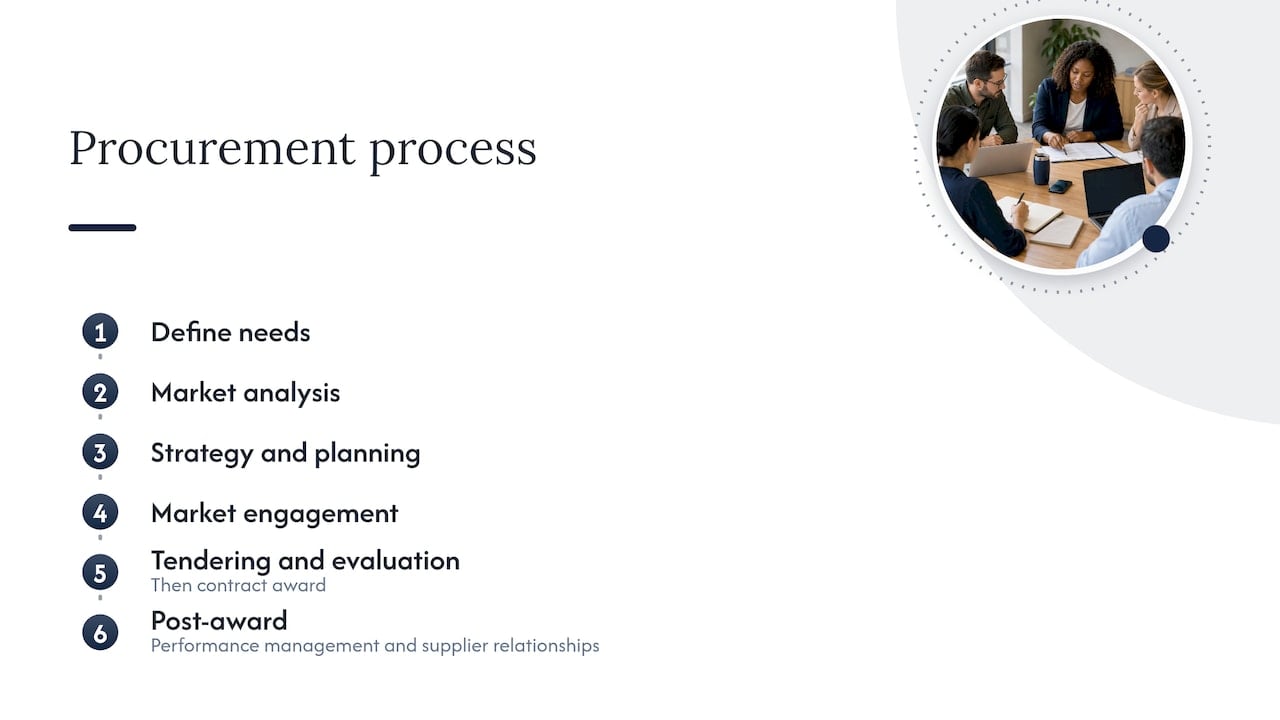
Procurement is not a gatekeeper with a red pen. CIPS describes it as a defined process for acquiring the right products and services: defining needs, market analysis, strategy and planning, market engagement, tendering and evaluation, contract award, then performance management and supplier relationships. CIPS also notes the process differs between organisations depending on size, structure, budget and whether public procurement law applies. So the first lesson for any seller is that “procurement” looks different at a 60-person software firm than at a county council.
The second lesson is that procurement rarely decides alone. The buying centre model, as explained by Learn How to Source, splits the people involved into initiators, users, influencers, deciders, buyers and gatekeepers. The buyer manages the process, but the decision is shaped by everyone who needs, uses, approves or is affected by the purchase. NetSuite’s overview of the procurement process lists the usual cast: senior executives, a procurement officer or manager, finance, IT and security, legal, and end users.
In practice that means your champion in the business is only one voice. Training should teach sellers to map the full group early, and to arm the champion with answers to the questions finance, legal and IT will ask.
How procurement buyers score suppliers
If you take one thing from this article, take this: procurement compares suppliers against criteria set before they read your proposal. Your charm is not a criterion.
The CBA UK practice note on evaluating bids sets out the usual headings: quality and technical merit, ability to deliver (capacity, experience, resources), service levels and support, risk (including financial stability and continuity), sustainability and social value, and total cost. Weightings are fixed in advance to reflect what matters for that purchase. It also describes how each evaluator scores every bid alone against published criteria and records a short justification, then the panel meets to moderate and agree a consensus score. A score changes only by reference to what the bid actually says.
That last point is the one sellers miss. If your proposal does not state the evidence, it does not exist for the panel. SteerLab’s guide describes the same pattern in vendor evaluation: a weighted scoring matrix, percentage weights per category, and scores on a defined scale such as 1 to 5 with anchored descriptors.
Here is what that means for how your people write and present:
| What procurement scores | What a trained seller does |
|---|---|
| Technical fit and quality | Answers the stated requirement in the buyer’s own wording, with evidence |
| Ability to deliver | Shows capacity, named people and relevant experience |
| Service levels and support | Puts measurable commitments in writing |
| Risk and stability | Has insurance, references and financial information ready |
| Total cost | Frames price against the whole cost of ownership, not the headline figure |
A seller who understands this stops writing proposals that read like brochures and starts writing ones a stranger could score in ten minutes.
Prepare before procurement asks
HubSpot’s guidance on procurement negotiation recommends asking for a procurement meeting relatively early and having materials ready: insurance checks, customer references, background checks, due diligence, a business case and the inputs for an ROI calculator. It also advises partnering with procurement and treating them as a key stakeholder rather than a opponent. That matches what I see. Procurement wants the best possible price, yes, but also lower risk, ethical suppliers, financial stability and a return on the investment. If you help them tick those boxes, you become the easy option.
A practical preparation checklist for your team:
- A one-page business case that the champion can forward without you. Cost of the problem, expected outcome, timescale.
- Two or three references from comparable buyers, with permission to be contacted.
- Insurance and compliance documents in one folder, current and ready to send.
- A pricing structure with options, not one take-it-or-leave-it number (more on that below).
- A stakeholder map showing who initiates, uses, influences, decides, buys and blocks.
If you sell software, the business case depends on how clearly you can say who you are for and why you are different. Sharpening your SaaS positioning before procurement gets involved makes every one of those documents easier to write.
This is also where consultative selling earns its keep. If your sellers have already diagnosed the problem properly, the business case writes itself. Our guide to consultative selling step by step covers that groundwork.
Negotiating with procurement without giving margin away
This is what most people mean when they search for procurement negotiation training, and it is where the money is won or lost.
Plan far more than you talk
Barkers Procurement describes supplier negotiation as agreeing every commercial term that affects how a contract performs: price, payment terms, delivery schedules, service levels, warranties and more. It recommends defining your BATNA, your best alternative to a negotiated agreement, before you go in. For a seller, that means knowing exactly what you do if this deal does not close, and which concessions you can afford.
Before any procurement conversation I ask a seller three questions. What would we happily give? What would we never give? What can we trade that costs us little but is worth a lot to them? That last one matters most. Extra reporting, a training session for their team, or a clearer service commitment often costs you little and moves a buyer more than a discount does.
Negotiate beyond the unit price
Shapiro Negotiations Institute points out that procurement negotiates measurable standards such as delivery, response time, uptime, implementation, reporting and issue resolution. Risk terms (warranty scope, indemnity, liability limits, insurance, data obligations and business continuity) decide who bears the cost when something goes wrong. If your seller only talks about price, they are negotiating on the buyer’s ground and handing over the discount lever for free.
A trained seller does three things differently:
- Offers options. Barkers recommends presenting several offers at once rather than a single proposal, which lets the buyer signal what they value most.
- Holds the gives and gets together. Every concession is attached to something in return: a longer term, faster payment, a wider scope.
- Brings legal and risk terms into the conversation early. Shapiro notes that treating risk as paperwork for later can create delay and hide value.
Our sales negotiation training is built on simulations of exactly these moments, because reading about a concession is nothing like holding the line while a buyer sits in silence.
A worked example
Imagine a seller quoting £48,000 for a twelve-month service. Procurement replies: “We need 15% off.” An untrained seller says they will check with their manager and returns with £43,000. A trained one asks what is driving the request (budget cycle? a competing quote? a policy target?), then offers three structures: the full scope at £48,000 paid annually in advance, a reduced scope at a lower figure, or the full scope with a longer term and a lower monthly rate. The buyer now chooses between options instead of pushing on one number, and the seller has traded rather than conceded. The figures are illustrative, not a benchmark, but the pattern is the one we coach.
When the buyer is a public body
Public-sector buying plays by different rules, and sellers who treat it like a private deal waste months.
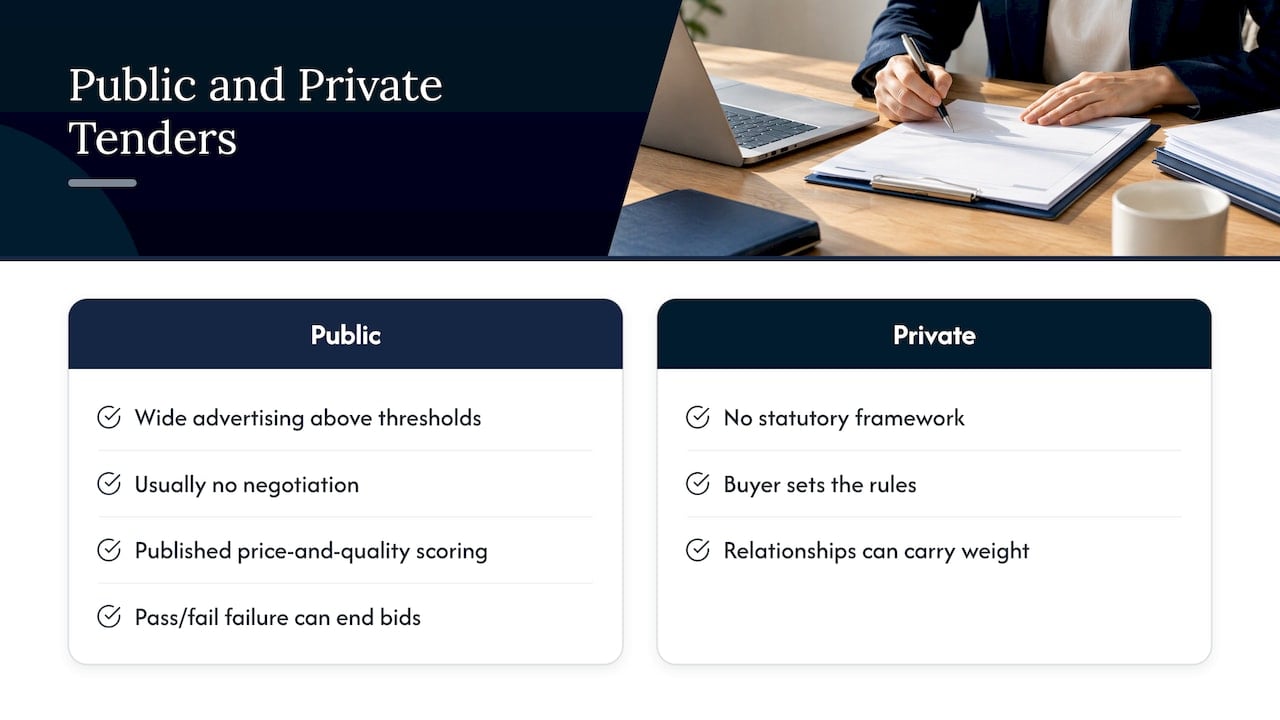
The Procurement Act 2023 came into force on 24 February 2025, and procurements begun under the old rules continue under them. Bath and North East Somerset Council’s procurement overview explains why this is different from private buying: above certain financial thresholds contracts must be advertised widely, negotiation is not permitted in most processes unless specifically stated, and the whole tender process, excluding mobilisation, can take three to six months depending on complexity and value.
Field Motion’s guide to winning commercial contracts adds that opportunities over £25,000 are advertised on Contracts Finder, with higher-value work on Find a Tender. Bids are scored against published criteria, usually a mix of price and quality. It also notes that failing a pass/fail requirement, such as a minimum insurance level or an accreditation, can end a bid before anyone reads it. The upside is that a well-run smaller business can beat a larger rival on quality scores with a better submission.
For private buyers, the logic is similar but looser. CleanTender’s comparison notes that private tenders have no statutory framework, so the buyer sets the rules and can weigh relationship as much as they like.
So your training needs two modes. In public tenders, the skill is compliance and writing to the scoring criteria, with no negotiation to rescue a weak answer. In private buying, the skill is building relationships across the buying centre and negotiating on value.
What good selling to procurement training should teach
The skills are less mysterious than course brochures suggest. When I assess a programme, I look for these:
- Stakeholder mapping. Finding and engaging every role in the buying centre, not only the champion.
- Commercial fluency. Understanding total cost, payment terms, service levels and risk allocation well enough to discuss them without calling legal every time.
- Business case building. Turning a conversation into a document someone else can defend internally.
- Preparation discipline. Setting your BATNA, concessions and trades before the meeting.
- Calm under pressure. Procurement asks for discounts routinely. A trained seller hears it as the start of a conversation, not a verdict.
- Tender writing. Answering published criteria directly, with evidence, for public bids.
That last list is why we prefer practice on live deals to a slide deck. If you want the broader skill base behind it, our guide to training consultative selling explains how to make it stick.
Does the 80/20 rule apply?
It is a fair question, since it appears in what readers ask. Buyers use it on their own side: Fairmarkit’s piece on tail spend describes it as a rule of thumb that around 80% of spend comes from 20% of purchases. For you, the useful flip is this: if your deal is in a buyer’s small, high-spend category, expect scrutiny and a formal process. If it sits in their long tail, expect speed and less attention. Know which one you are in before deciding how much to invest in the pursuit. On your own pipeline, the same idea says to put your best preparation into the few accounts that drive most of your revenue.
Our view: procurement is a skill, not a hurdle
We hear the same story from founders and sales leaders: the deal looked won, then procurement arrived and it fell apart. In our experience that is rarely about the buyer being difficult. It is about the seller meeting procurement for the first time at the worst moment.
That is why we combine bespoke 1:1 coaching with team training and consultancy. A workshop on negotiation helps, but the real change comes when a coach sits with your seller on a live deal, reviews the proposal against the buyer’s criteria, and rehearses the call before it happens. Our approach is designed to help teams hit target every quarter and to drive at least 50% annual sales growth, and handling procurement well is a large part of how we aim to do that.
If your team sells to larger or public-sector buyers, start with the negotiation and the business case. Everything else gets easier.
Jerry
How we can help
We work with UK businesses of roughly 50 to 1,000 staff on bespoke coaching and consultancy engagements, priced from £4,500 to £8,500 one-off. Solo service businesses and consultants can take our sales acceleration track, from £2,995 to £5,995 one-off. Both are tailored to your buyers, your pricing and your real deals, including the procurement conversations that currently stall.
You can see how the packages fit on our sales training cost page. If you need senior leadership rather than training alone, our fractional sales director retainer is £990 a month.
FAQ
Is procurement negotiation training only for large companies?
No. Any business selling to organisations with a formal buying process benefits, including solo consultants whose clients run supplier approvals. The scale differs, but the skills of preparing a business case, trading concessions and handling price pressure are the same.
Can you negotiate with public-sector procurement?
Usually not once a formal tender is live. Bath and North East Somerset Council states that negotiation is not permitted in most processes unless specifically stated. Your leverage comes earlier, in understanding the need and in writing a strong submission against the published criteria.
When should I involve procurement in a deal?
Earlier than feels comfortable. HubSpot’s guidance is to request a procurement meeting relatively early and have references, insurance details and a business case prepared. Waiting until the end tends to add delay.
What should I prepare before a procurement meeting?
Have a one-page business case, references, insurance and compliance documents, a stakeholder map and a set of pricing options. Decide beforehand what you can trade and what you will walk away from.
Sources
- Procurement Process, CIPS
- Purchasing Decisions in Procurement, Learn How to Source
- 8 Steps in the Procurement Process, NetSuite
- Evaluating supplier bids: CBA Practice Note, CBA UK
- How Procurement Teams Evaluate Vendor Proposals, SteerLab
- The 4 Golden Rules of a Successful Procurement Negotiation, HubSpot
- Supplier Contract Negotiation, Barkers Procurement
- Commercial Terms Procurement Should Negotiate, Shapiro Negotiations Institute
- Transforming Public Procurement, GOV.UK
- Overview of the Procurement Process, Bath and North East Somerset Council
- How to Win Commercial Contracts, Field Motion
- What is a Tender?, CleanTender
- Why the 80/20 rule should be the beginning of tail spend, Fairmarkit
- SaaS positioning, Crontent