
The strongest approach to sales training provider selection is a diagnostic-led model built on bespoke coaching, manager enablement and ongoing reinforcement, the kind of structure companies like Ahead of Sales use, combining 1:1 coaching with structured cohort courses. Rather than picking a provider off a glossy brochure, you want one who starts with a proper needs analysis, then builds toward a shortlist, a scored evaluation and a paid pilot. That sequence protects your budget and gives you real evidence before you commit.
TL;DR:
- Prioritize a needs analysis involving sales leaders, top performers, and managers to identify specific pipeline issues before selecting a training provider.
- Demand evidence of customization, including diagnostic outputs and session plans based on your actual sales data, rather than relying on generic templates.
- Ensure the training program includes spaced practice, manager coaching integrated into regular rituals, and technology tools for ongoing reinforcement to promote lasting behavior change.
- Conduct a pilot with clear criteria, a fixed timeline, and observable results, and compare proposals objectively using a weighted scoring template.
- Be cautious of vague promises, one-size-fits-all curricula, lack of manager involvement, no reinforcement plan, and contracts without clear exit points or measurable outcomes.
Table of Contents
- A step-by-step checklist for selecting and contracting a provider
- Detailed selection criteria and red flags
- How to score proposals and estimate ROI
- Design choices that make training stick
- How a diagnostic-led, coaching-first model meets these criteria
- Pricing models and cost considerations for sales training services
- Comparing boutique firms and large consultancies
- What I’d prioritise if I were choosing today
- How Ahead of Sales can help with your next decision
- Sources
- FAQ
A step-by-step checklist for selecting and contracting a provider
Choosing well starts with knowing what’s actually broken, not with browsing course catalogues. Here’s the order that works.
- Run a focused needs analysis. Involve sales leaders, a handful of top and middle performers, and at least one frontline manager. Pull data on conversion rates by stage, average deal size, ramp time for new hires and win rates against your main competitors. Ask reps directly where they lose deals: pricing objections, discovery gaps or poor follow-up are common answers.
- Define outcomes before you talk to any vendor. Tie targets to revenue or observable behaviour rather than vague aspirations. “Reduce new-hire ramp time from five months to three” is usable; “improve sales skills” is not.
- Build a shortlist from your criteria, not from search rankings. Ask each candidate for a diagnostic sample, a session plan and at least one case study relevant to your sector or team size.
- Score every proposal against the same template. Weight outcomes, evidence, delivery model and price consistently across vendors so you’re comparing like with like.
- Design a pilot with clear acceptance criteria and a fixed timeline. A pilot should run with a real team, on real deals, for long enough to observe behaviour change, typically one sales cycle or a full quarter.
When you gather evidence at the shortlist stage, ask specific questions rather than accepting generic marketing claims:
- Can you show us a diagnostic output from a client in a comparable industry?
- What does a typical coaching session plan look like, and who delivers it?
- How do you measure whether a skill has actually transferred to live deals?
- What’s your model for training sales managers, not just reps?
- What happens after the formal programme ends?
Industry guidance on selecting a sales training provider consistently points to the same fundamentals: customised content, manager-specific modules and measurable outcomes, backed by a pilot before any full roll-out. That advice holds regardless of company size, because the failure mode is always the same. Training gets delivered, everyone nods along, and three months later nothing has changed in how deals get worked.
The needs analysis stage is where most companies cut corners, and it’s the one step you genuinely cannot skip. A provider who proposes a programme before understanding your pipeline, your objection patterns or your manager coaching habits is guessing. Insist on a diagnostic conversation, however brief, before you look at a single slide of curriculum.
Detailed selection criteria and red flags
Once you’ve got proposals in hand, the real work is separating providers who can back their claims from those who can’t.
Customisation. Ask for the diagnostic outputs behind any proposal and a sample session plan built from your own sales data, not a generic template with your logo added. A provider who can’t show you how their diagnosis shaped the curriculum probably didn’t do one.
Coach quality and model. Verify the credentials of whoever will actually be in the room, not just the company’s senior leadership. Ask to observe a sample coaching session before signing anything substantial, and favour providers who coach sales managers directly rather than bypassing them to work solely with reps.
Transfer design. Look for spaced practice across several weeks rather than a single intensive workshop, role play built around live deals in your pipeline, and a defined coaching cadence after the initial sessions finish. A meta-analytic review of transfer of training covering 89 studies found that transfer depends heavily on trainee motivation and a supportive work environment, both of which a provider can actively build into a programme or ignore entirely.

Measurement. Agree in advance what you’ll track: behavioural adoption (are reps actually using the new approach in live calls), ramp time for new starters, and pipeline metrics such as conversion rate by stage. Ask for the baseline the provider expects to see before results show up, and over what period.
Scalability and technology. Check whether the provider can sustain the change once the formal engagement ends. Do they leave behind playbooks, coaching prompts or a platform your managers can keep using, or does everything stop the day the contract does?
Some warning signs are worth flagging explicitly:
- Vague promises of “transformational results” with no baseline metrics attached.
- Reluctance to let you observe a coaching session before committing.
- A one-size-fits-all curriculum pitched before any diagnostic conversation.
- No mention of manager coaching or reinforcement after the initial sessions.
- Case studies with no named client, sector or measurable outcome.
Pro Tip: Ask any shortlisted provider to run a 30-minute diagnostic call before they send a proposal. How specific their follow-up questions are tells you more than any brochure.
How to score proposals and estimate ROI
A weighted scoring template keeps the decision objective once you’ve got two or three proposals on the table. Score each vendor out of ten on every category, multiply by the weight, and compare totals rather than gut feel.
Before any engagement starts, capture your baselines:
- Current ramp time for new hires, in weeks or months.
- Conversion rate by pipeline stage over the last two quarters.
- Average deal value and typical sales cycle length.
- Win rate against your primary competitors.
Illustrative ROI example: say a team of ten reps closes deals worth an average of £20,000 each, and training lifts conversion at the proposal stage by five percentage points. On a pipeline of 200 proposals a quarter, that’s ten extra deals, or £200,000 in additional revenue, against a training investment in the low tens of thousands. The maths only works, though, if the baseline conversion rate and deal value are measured accurately before you start, which is why the ramp time and ROI reporting side of any engagement matters as much as the delivery itself.
Industry practice recommends estimating projected return by multiplying expected uplift in conversion and ramp-time reduction by average deal value and team size, giving a rough but usable payback figure. Expect early behavioural signals within the first four to six weeks of a well-designed pilot, with measurable pipeline movement typically visible by the end of one full sales cycle. If neither shows up by then, that’s your signal to renegotiate scope or stop the roll-out rather than extend it on faith.
Watch for commercial red flags too: long contracts with no exit point, pricing based purely on headcount rather than outcomes, or payment terms that require full payment before any pilot results are in.
Design choices that make training stick
The design details separate training that changes behaviour from training that gets forgotten within a month.
Spaced sessions and deliberate practice consistently outperform single intensive workshops. A meta-analysis of leadership training design and delivery found that programmes incorporating feedback, spaced sessions and face-to-face delivery produced stronger results than static, one-off materials. Ask any provider for a schedule that spreads sessions across weeks rather than compressing everything into two days.
Manager coaching needs to sit inside existing rituals, not bolt on as an extra task. A provider worth hiring will show you how coaching gets embedded into weekly pipeline reviews and 1:1s, so managers reinforce the skill rather than leaving it to a quarterly refresher.
Technology for reinforcement matters more than most buyers expect. Coaching apps, call recording playback and short microlearning prompts between live sessions all help skills survive past the workshop. Some AI-driven coaching and productivity tools now support exactly this kind of ongoing reinforcement, and it’s worth asking any provider what, if anything, they use.
Common pitfalls include:
- Treating training as a single event rather than a programme with follow-up built in.
- Leaving managers out of the coaching loop entirely.
- No mechanism to track whether skills are actually used on live calls.
- Contracts with no reinforcement phase after the initial sessions end.
Pro Tip: Before signing, ask the provider to show you exactly what happens in week six of the programme, not just week one. If they can’t answer, reinforcement probably isn’t built in.
How a diagnostic-led, coaching-first model meets these criteria
Ahead of Sales is built around the checklist above rather than around a fixed curriculum. It’s a sales training company offering bespoke 1:1 coaching combined with traditional training and consultancy, aimed at businesses with 50 to 1000 staff working toward at least 50% sales growth every year and consistent achievement of quarterly targets, as the company states.
Against the criteria set out earlier, here’s what that looks like in practice:
- Programmes are built from a diagnostic process rather than a fixed template, so customisation is baked in from the start.
- Coaching sits at the centre of delivery rather than being an add-on to workshop content, addressing the transfer and manager-enablement criteria directly.
- Solo service businesses and consultants get their own acceleration track, distinct from the team-based packages.
- Structured cohort-based courses offer a lower-cost, less bespoke entry point for teams not ready for a fully customised engagement.
Whichever provider you’re evaluating, including this one, the point of the scoring template from earlier is that it travels. Apply the same weighted criteria (outcomes, evidence, delivery model, price) to any shortlisted vendor, and you’ll end up with a genuinely comparable picture rather than a decision based on whoever pitched best.
Pricing models and cost considerations for sales training services
Sales training pricing tends to fall into a few recognisable structures: per-head workshop fees, fixed-price bespoke packages, monthly retainers for ongoing coaching, and project-based consultancy fees. Each suits a different buying situation, and the right one depends on team size and how much customisation you actually need.
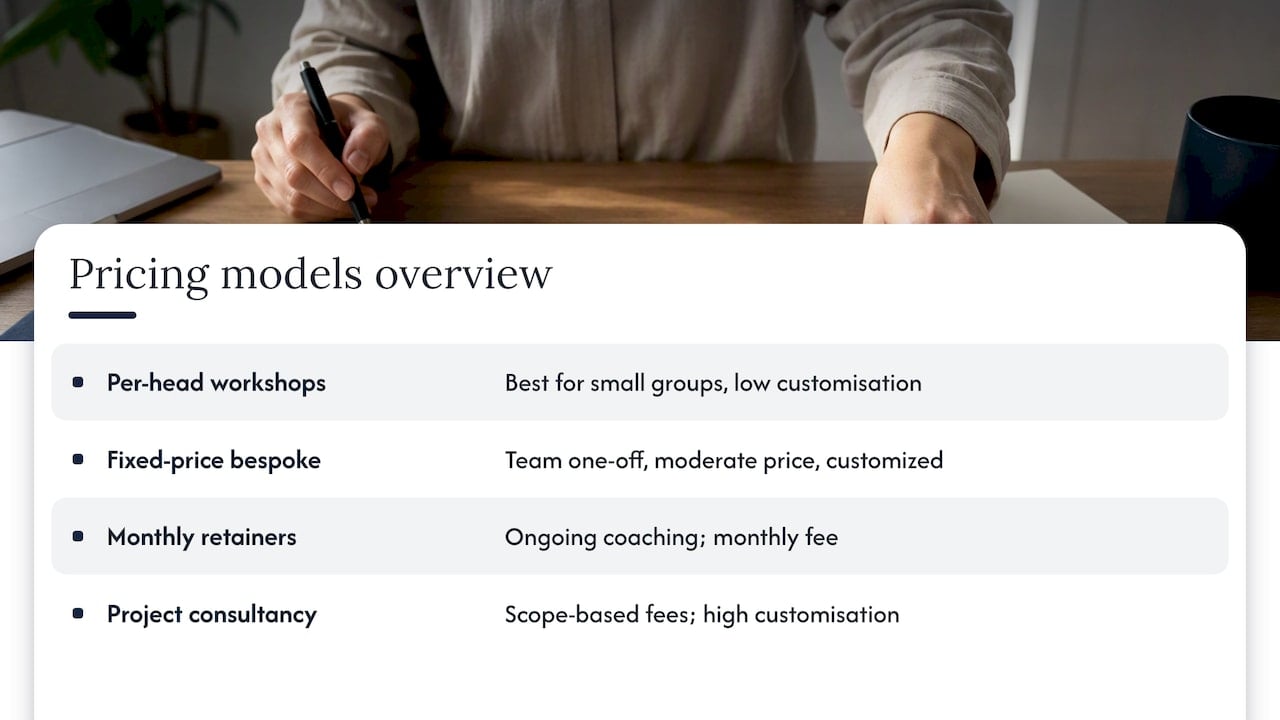
Fixed-price packages combining coaching and consultancy for teams typically fall within a moderate price range as a one-off engagement, covering diagnostic work through to delivery. Solo operators and consultants have a separate acceleration track with pricing distinct from that of teams. For teams wanting a lower-cost, more structured entry point, sales training cohorts offer a course-based format rather than a fully bespoke build.
Ongoing coaching retainers are another common model. One example is The Sage Collective, which offers continued access to structured coaching support for a monthly fee.
Whatever the model, price alone tells you very little. A cheap workshop with no follow-up coaching often costs more in the long run than a properly reinforced programme, simply because the skills never stick. Weigh price against the scoring criteria from earlier, particularly evidence of transfer design and manager coaching, before deciding what represents good value.
Comparing boutique firms and large consultancies
Boutique providers tend to offer closer, more customised attention. You’re often working directly with the person who ran your diagnostic, and programmes can flex around your specific pipeline issues rather than a standardised curriculum. The trade-off is capacity: smaller firms may struggle to support a very large, multi-region roll-out simultaneously.
Large consultancies bring scale, established methodologies and often broader industry benchmarking data. That can suit organisations needing consistent training across many offices or countries at once. The risk is genericism: a fixed methodology applied across hundreds of clients doesn’t always account for your specific objection patterns or sales motion.
There’s also a middle category: specialist coaching-led firms that combine some of the customisation of a boutique with more structured delivery than an individual consultant could offer alone. For a company with 50 to 1000 staff wanting a bespoke diagnostic and ongoing coaching without the overhead of a large consultancy, this middle tier is often the most practical fit. Whichever category you’re drawn to, the same evaluation criteria apply: ask for evidence, insist on a pilot, and score proposals consistently rather than choosing based on brand size alone.
What I’d prioritise if I were choosing today
If I had to pick one thing to get right, it’s manager coaching paired with a properly scoped pilot. Training that skips your managers rarely survives past the first quarter, no matter how good the initial workshop felt. A pilot with clear acceptance criteria, tied to real deals and a fixed timeline, tells you more in six weeks than any case study a vendor hands you.
That’s the habit worth building into every future training decision: insist on proof before scale.
— Jerry
How Ahead of Sales can help with your next decision
If the checklist above has clarified what you need, the next step is matching it to the right package. Teams working toward consistent quarterly growth typically fit the bespoke coaching and consultancy engagements, priced within a moderate one-off range. Solo service businesses and consultants have a dedicated acceleration track priced within a separate range, built for leaner operations without a full sales team behind them.
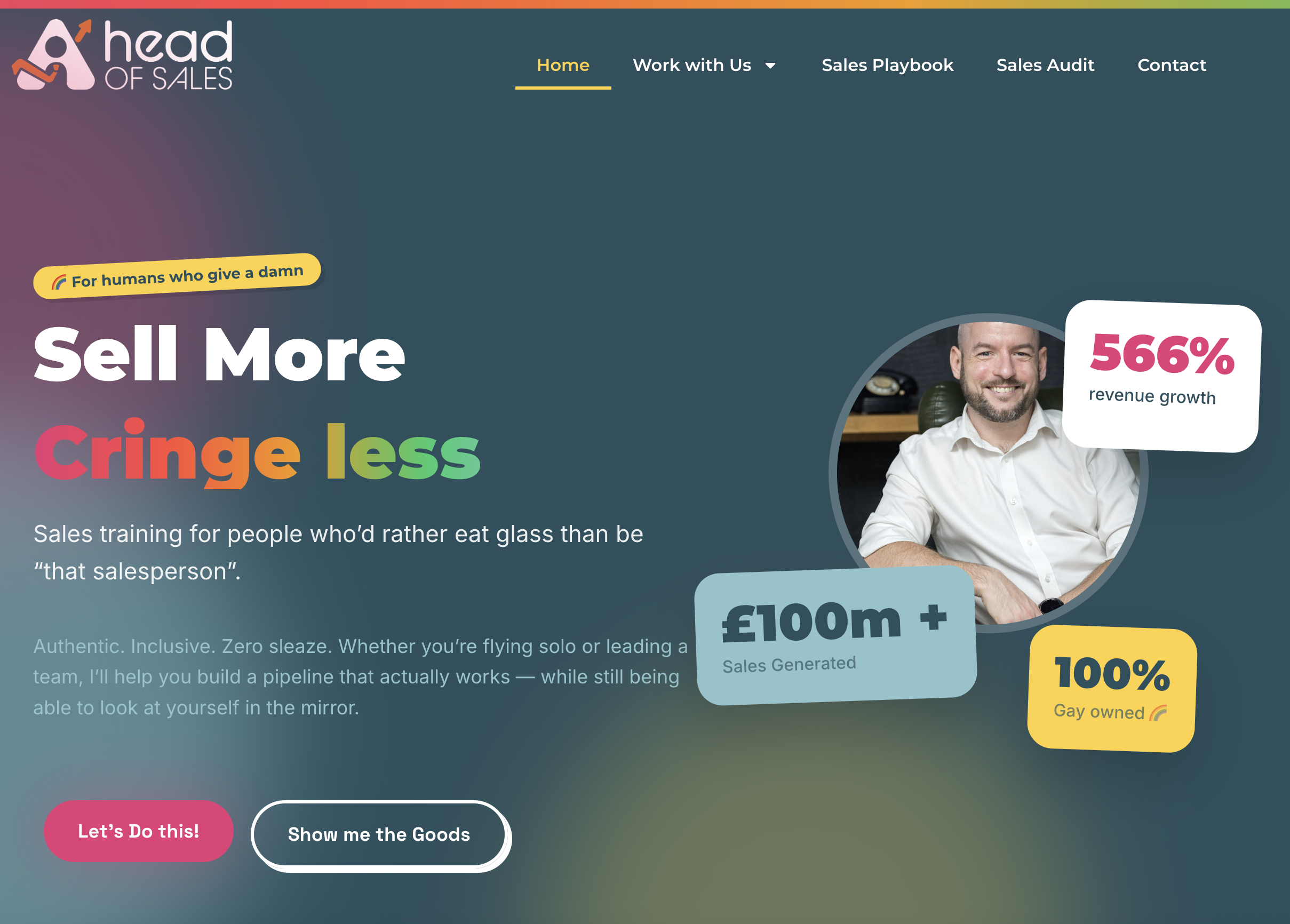
For teams wanting a lower-commitment starting point, structured sales training cohorts offer a course-based format that still keeps coaching at the centre. And for ongoing support after an initial engagement, The Sage Collective runs at £990 per month.
- Book a diagnostic call to identify exactly where your pipeline is losing deals.
- Run a scoped pilot with a single team before committing to a full roll-out.
- Review current packages and pricing to see which fits your team size and budget.
Whichever route fits, apply the same scoring approach from earlier before you commit. Get in touch to talk through a diagnostic and see what a pilot could look like for your team.
Sources
- Leadership Training Design, Delivery, and Implementation: A Meta-Analysis
- Transfer of training: A meta-analytic review
- Quick Guide to Selecting a Sales Training Provider
FAQ
What is the 70/30 rule in sales?
Definitions vary across organisations, so treat it as a rough guideline for time allocation rather than a fixed standard.
What are the 7 golden rules of sales?
There’s no single agreed list of “7 golden rules” across the industry, and different trainers frame them differently. Common themes include understanding the buyer’s needs, listening more than talking, and following up consistently, but specifics vary by source.
What should be included in a sales training program?
A solid programme includes a diagnostic needs analysis, customised content based on your actual pipeline data, manager coaching built into the delivery, and a reinforcement plan with spaced sessions after the initial training ends. Measurement of behavioural adoption and pipeline metrics should also be built in from the start, not added afterwards.
What company has the best sales training program?
There’s no single provider that’s objectively “best”, since the right fit depends on team size, budget and how much customisation you need. Providers like Ahead of Sales focus on diagnostic-led, coaching-first programmes for teams of 50 to 1000 staff and for solo operators, but the checklist in this article is designed to help you evaluate any provider against the same criteria.