
A sales training curriculum is a sequenced, assessed programme that builds observable selling behaviours across five domains: product knowledge, methodology, process, skill, and systems. It is not a slide deck or a “training day” — it is a structured intervention with a start, a middle, and a measurement point.
The immediate next step, before you write a single module, is to design the assessment rubric: who assesses, what they score, where the scoring happens (a live call, a recorded demo, a CRM audit), and how a pass is defined. Content should teach to that rubric, not the other way round.
The five domains you’re building against:
- Product — what reps must know to speak credibly about the offer
- Methodology — the selling framework (SPIN, Challenger, consultative) that shapes conversations
- Process — the stages a deal moves through and what “good” looks like at each one
- Skill — discovery, objection handling, negotiation, closing
- Systems — CRM discipline, forecasting accuracy, tool fluency
Pro Tip: In week one, resist the urge to build content. Spend it writing behaviour statements (“the rep asks three open discovery questions before proposing a solution”) and deciding who will score them.
Key Takeaways
A sales training curriculum only changes behaviour when the assessment rubric is built before the content and reinforced by manager coaching for at least 90 days after launch.
| Point | Details |
|---|---|
| Design assessment first | Write the rubric (who, what, where, scoring) before building any module content. |
| Structure five domains | Cover product, methodology, process, skill, and systems, not just soft skills. |
| Match format to objective | Use async for knowledge, live role-play for skill, call review for reinforcement. |
| Build a 90-day cadence | Schedule manager audits and coaching sprints into the calendar before launch, not after. |
| Consider a bespoke provider | Aheadofsales combines 1:1 coaching with structured training to keep reinforcement built in, not optional. |
Table of Contents
- What should a sales training curriculum include?
- How do you build a sales training curriculum from scratch?
- Which delivery formats actually build lasting skill?
- How do you measure whether the training actually worked?
- What does a 12-week sample syllabus look like?
- What’s on the rollout checklist before you launch?
- What does the evidence say about curriculum design?
- How Aheadofsales builds curricula that stick
- Frequently asked questions
- Sources
What should a sales training curriculum include?
Every functioning curriculum needs a spine of modules that mirrors the deal lifecycle, not a random assortment of “soft skills” workshops. The sales process typically follows four broad stages: research, lead generation, the sales call and close, and relationship building. Your sales training modules should map directly onto them.
- Prospecting and targeting — objective: rep identifies and prioritises accounts matching an ideal customer profile within 20 minutes using CRM filters
- Qualification and pipeline hygiene — objective: rep correctly stages a deal and updates close date and next step within 24 hours of a call
- Discovery — objective: rep uncovers at least two unstated business problems before presenting any solution
- Demo and value messaging — objective: rep ties every feature mentioned to a problem the buyer stated
- Objection handling and negotiation — objective: rep responds to price pushback without discounting inside the first exchange
- Closing — objective: rep proposes a specific next step with a date on every call
- Account growth and expansion — objective: rep identifies one expansion opportunity per quarter per key account
- Sales management coaching — objective: manager runs a structured call review using the same rubric reps are assessed against
Sales managers typically own delivery of qualification, closing, and coaching modules, since these need live judgement calls. L&D usually owns product knowledge and process documentation, which can sit in an LMS. Discovery and negotiation work best built jointly, with L&D structuring the content and managers running the practice sessions. Individual contributors need volume of reps in discovery and objection handling; managers need a parallel module on how to coach those same behaviours, not just perform them.
How do you build a sales training curriculum from scratch?
Building a sales training plan in the wrong order is the single most common mistake: teams write content first, then scramble to work out how to test it. Reverse that.
- Audit behaviour gaps. Pull call recordings, CRM stage conversion rates, and win/loss data. Find where deals actually stall, not where you assume they stall.
- Write behaviour objectives. Every module gets one to two statements describing an observable action, not a knowledge outcome.
- Build the assessment rubric. Rubrics designed before content clarifies expected behaviour and makes scoring more consistent across assessors.
- Choose delivery formats mapped to objectives. Conceptual content goes async; behaviour change needs live practice.
- Sequence modules by deal stage, following the research, lead generation, close, and retention flow reps already work within.
- Schedule reinforcement. Fix the coaching cadence into a calendar before launch, not after adoption stalls.
Checklist items worth confirming at each step: which stakeholder signs off on the rubric, whether your CRM can export the data you need for the audit, whether coaches have calendar capacity, and whether your LMS can host scored assessments rather than just video content.
Pro Tip: The most expensive design mistake is mismatching format to objective, putting negotiation practice into a self-paced video module where nobody actually negotiates anything. If an objective requires judgement under pressure, it needs a human in the room or on the call.
Which delivery formats actually build lasting skill?
Format choice should follow the objective, not convenience. Conceptual and product knowledge content works fine as async microlearning inside an LMS. Skill objectives — discovery, objection handling, negotiation — need live role-play with a coach giving real-time feedback. Reinforcement runs through call review: a manager or peer listens to a live recording and scores it against the same rubric used in training.
- Async modules for product and process knowledge, consumed before live sessions
- Live role-play cohorts of six to eight reps for skill practice
- One-to-one call reviews for individualised coaching
- LMS-hosted microlearning refreshers at 30 and 60 days post-launch
Build a multi-month reinforcement cadence into the calendar from day one, with gradually adjusting manager coaching frequencies spread over the program’s duration. Coaching platforms with call intelligence now make this cadence far easier to track at scale than manual spreadsheets ever did.
Pro Tip: Discovery skill needs time reps often don’t feel they have. Get explicit management permission, in writing if needed, for reps to spend longer on discovery calls during the first 90 days without pipeline velocity being held against them.

How do you measure whether the training actually worked?
A usable rubric names the observable behaviour, the context it’s assessed in (live call, recorded demo, CRM audit), the scoring band (typically a 1 to 4 or 1 to 5 scale), who assesses it, and the score needed to pass. Assessment should measure skill transfer through scored role-play and CRM audits, not a multiple-choice quiz at the end of a slide deck.
- Call quality scores against the rubric
- Pipeline conversion rate by stage
- Deal velocity from first contact to close
- CRM completeness (fields updated within 24 hours)
- Coaching frequency logged per rep per month
| Metric | What it shows | Evaluation cadence |
|---|---|---|
| Call quality score | Whether trained behaviours appear on live calls | Weekly for 90 days, then monthly |
| Pipeline conversion | Whether skills move deals forward | 30/60/90-day checkpoints |
| CRM completeness | Whether process discipline is sticking | Weekly |
| Coaching frequency | Whether managers are reinforcing training | Monthly |
What does a 12-week sample syllabus look like?
A practical sales training schedule example for a B2B team runs across three months, mixing async content, live practice, and scored checkpoints.
- Weeks 1 to 2: Product and process foundations (async), pipeline audit by manager
- Weeks 3 to 4: Prospecting and targeting, live cohort practice, manager reviews call lists
- Weeks 5 to 6: Discovery skills, live role-play, first rubric checkpoint scored
- Weeks 7 to 8: Demo and value messaging, call review sessions begin
- Weeks 9 to 10: Objection handling and negotiation, live practice, manager coaching sprint
- Week 11: Closing and account growth, async plus live drills
- Week 12: Certification checkpoint — full rubric assessment against a live or recorded call
Weeks 5 to 6 and 9 to 10 carry the heaviest live-practice load; the rest lean async with weekly manager touchpoints. For a compressed new hire sales training plan, condense to six weeks by dropping account growth to a later, ongoing module. For an extended sales training roadmap covering senior reps, add a fourth month focused entirely on account growth and a management coaching module. Kellogg’s professional sales training programme structure follows a similar logic: tools and frameworks first, assessed practice throughout.
What’s on the rollout checklist before you launch?
Before launch, confirm your data audit is complete, stakeholders have signed off on the rubric, coaches have calendar slots booked, your LMS is configured, and you’ve chosen a pilot cohort rather than rolling out to the whole team at once.
- Communications plan sent to the wider team before day one
- Manager 1:1s prepped with clear participant expectations
- Certification criteria shared in advance, not sprung on reps
- 90-day reinforcement calendar published alongside the launch date
- Manager audit schedule confirmed and success metrics agreed
Prompt every manager weekly with one question: what will you coach this week, and against which behaviour on the rubric? Without that prompt, coaching cadence quietly evaporates within a month.
What does the evidence say about curriculum design?
Three principles hold up consistently. First, design the rubric before the content so objectives stay measurable. Second, prioritise deep discovery over scripted pitching, since reps default to prescriptive selling unless the curriculum actively enforces curiosity. Third, structured coaching aligned with the learning programme drives adoption far more reliably than the training event itself.
- Rubric-first design improves fairness and clarity of assessment
- Discovery-first modules reduce prescriptive, feature-led selling
- Manager coaching cadence is what converts a workshop into a habit
A practitioner’s note on ROI and buy-in
Getting management to authorise the time investment is usually the harder problem, not the content itself. A pilot cohort with a built-in manager coaching package tends to prove value faster than a full rollout, because you get a measurable result before asking for company-wide budget. Case-study proof follows the pilot; it rarely precedes it.
How Aheadofsales builds curricula that stick
There are self-build routes to a sales training curriculum, and plenty of teams try the LMS-and-template approach first. Aheadofsales takes a different route: bespoke 1:1 coaching layered onto structured training, so the reinforcement cadence is an integral part of the engagement from day one. That combination depends on someone running the coaching calendar consistently rather than just publishing it.
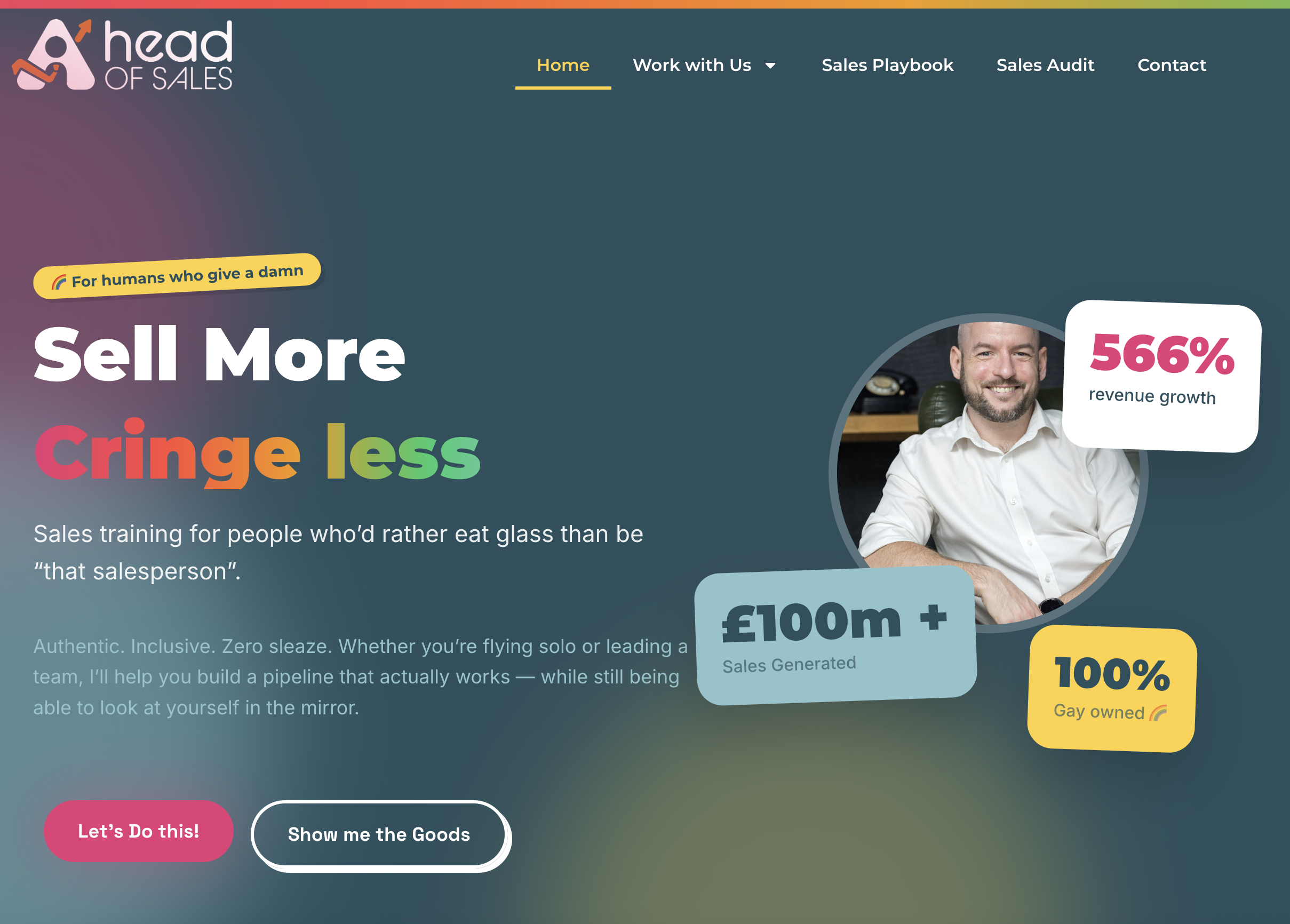
Packages for teams of 50 to 1,000 staff with a growth mindset run from £4,500 to £8,500, while solo service businesses can access sales acceleration packages from £2,995 to £5,995. Explore the full range of sales training services to see how a bespoke curriculum, cohort programme, or fractional sales leadership engagement might fit your team. Next step: book a discovery call to scope a pilot cohort before committing to a full rollout, so the rubric and reinforcement plan get tested on a smaller group first.
Frequently asked questions
What is the difference between a sales training curriculum and a sales training plan?
A curriculum is the full set of modules, objectives, and assessments; a sales training plan is the schedule and logistics for delivering that curriculum to a specific team.
How long should a new hire sales training plan run?
Most effective onboarding programmes run six to twelve weeks, combining product and process foundations early with live skill practice from around week three onward.
How do I assess sales training needs before building a curriculum?
Pull call recordings, CRM conversion data by stage, and win/loss notes to find where deals genuinely stall, then write behaviour objectives against those specific gaps rather than generic skill categories.
Can a curriculum be adapted to a specific sales methodology like SPIN or Challenger?
Yes. The five-domain structure stays the same; the methodology domain simply swaps in SPIN’s four question types or Challenger’s teach-tailor-take-control framework as the content layer.
Who should own the sales training syllabus, sales managers or L&D?
Both. L&D typically structures content and the LMS, while sales managers own live coaching, call review, and the accountability that keeps the reinforcement cadence running.
Sources
- Learn about the sales process — Trailhead (Salesforce)
- Democratising assessment rubrics — King’s College London
- The evolution of sales training and coaching technology — Gartner
- Driving performance development success — Centre for Creative Leadership (CCL)