
A sales messaging framework is a short, practical document that sets out what you say to a specific buyer at each stage of a deal: how you open, what you change for them, the proof behind it, and how you answer the objections that keep coming up. The best ones are built from your buyers’ own words, hold three outcome-based pillars with proof under each, and are practised on live calls rather than filed away. That last part is where most businesses stop, and it is where the money is.
I have seen plenty of beautifully designed messaging documents that changed nothing, because nobody rehearsed them. At Aheadofsales we pair 1:1 coaching with team training and consultancy, so the wording you agree is the wording that actually gets used in conversations. This guide shows you how to build the framework, and how to make it stick.
TL;DR
- A sales messaging framework is the one-page version of what every seller says to a given buyer: opener, value, proof and objection answers.
- Keep it small: one core message, three pillars framed as outcomes, and one proof point behind every claim.
- Build it from real buyer language (recorded calls, win/loss notes, client interviews), not from a brainstorm in a meeting room.
- Service businesses and solo consultants need the same structure, but with empathy and the buyer’s daily pressure at the front.
- The framework only works once it is rehearsed, mapped to your website and deck, and reviewed regularly.
Table of Contents
- What a sales messaging framework is (and what it is not)
- What goes into the framework
- How to build it, step by step
- Adapting it for service businesses and solo consultants
- Running a messaging workshop
- Getting the framework used
- Keeping it alive
- Where we can help
- Our perspective
- FAQ
- Sources
What a sales messaging framework is (and what it is not)
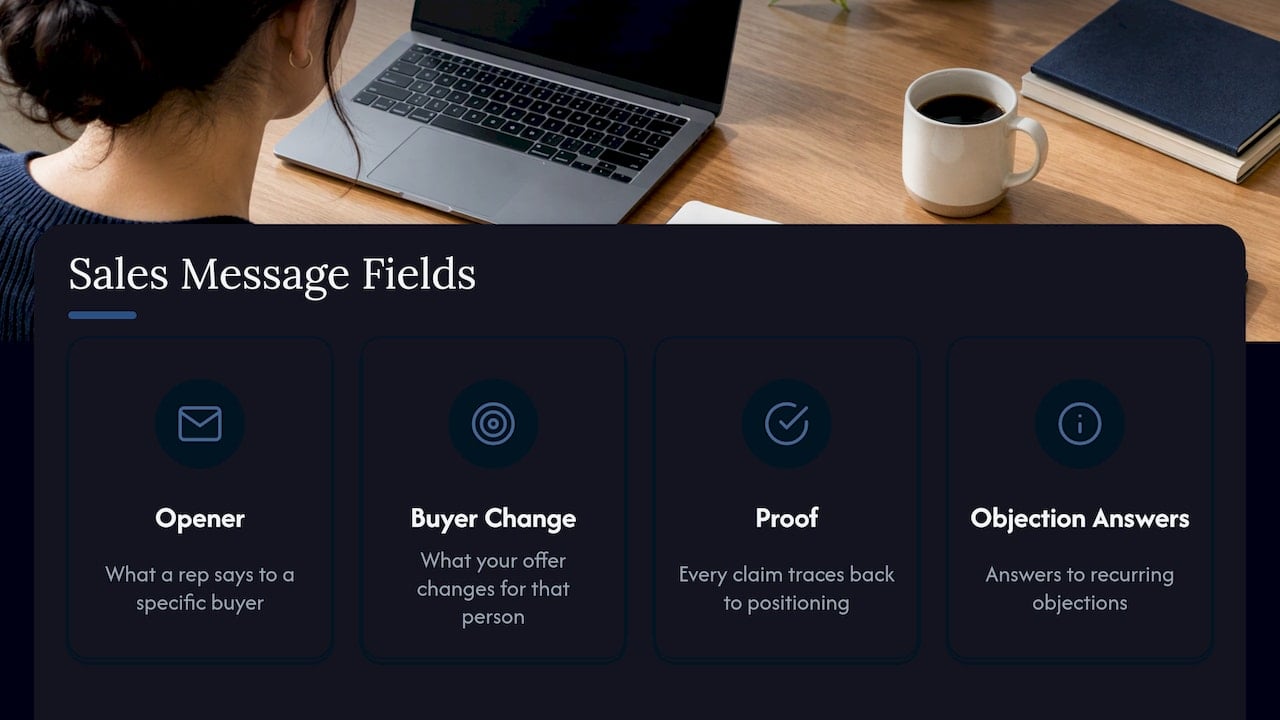
One useful definition describes it as a one-page document holding what a rep says to a specific buyer at each stage of a deal: the opener, what your offer changes for that person, the proof, and answers to recurring objections. Every claim traces back to your positioning, which is simply the place you want to hold in the buyer’s mind compared with the alternatives.
It is not a brand book, a tagline, or a script to be read aloud. Brand messaging covers who you are across the whole company. Sales messaging is narrower and more commercial: it is what a seller says when a real person with a real problem is on the other end of the call or the email.
Why bother? Highspot’s Elyse Fox makes the case that one consistent sales message builds trust, while mixed messages create doubt. If two people in your business describe what you do in two different ways, a careful buyer notices. For a founder selling alone, the same applies across your website, your LinkedIn profile and your discovery calls.
What goes into the framework
Published guides differ in length (some run to 19 sections), but they agree on a core. Revspire’s list of the standard parts is a good reference. For most UK businesses with a small or mid-sized sales team, and for solo consultants, this is the version I would start with:
| Part | What it contains | The test |
|---|---|---|
| Positioning statement | Who you serve, the problem, your category, and the credible difference | Could a competitor sign it? If yes, rewrite it |
| Core message | One or two sentences a buyer could repeat to a colleague | Does it survive being said out loud? |
| Three pillars | The outcomes you deliver, in the buyer’s language | Is each one a result, not a feature? |
| Proof | A case, number, testimonial or qualification under each pillar | Can you show it, not just say it? |
| Buyer variants | How the lead pillar and opening pain change for each decision-maker | Would the finance director recognise herself? |
| Objection answers | Your replies to the five to eight objections you hear most | Does the reply include a question back to the buyer? |
| Language rules | Words you use and words you avoid | Does it sound like a person? |
| Owner and review date | Who maintains it and when it is next checked | Is there a name against it? |
Why three pillars
Three is the practical number: fewer feels thin and more turns into a feature list. The same guidance says pillars should be outcomes (“forecast with confidence”) rather than capabilities (“dashboards”), and that any pillar you cannot yet prove should be flagged, because a sceptical buyer attacks it first. I would go further for a small business: if you cannot attach a proof point to a pillar, cut it until you can.
The two pieces most frameworks miss
One is a map of who is in the buying decision. Pitch Kitchen suggests naming the economic buyer, the champion and the sceptic, plus the ‘villain’, which is usually a way of working the buyer already resents rather than a competitor. For a UK services buyer, that villain is often “another year of inconsistent pipeline” or “a sales team that works hard and still misses quarter”.
The other is an application layer: where each part lands (homepage, deck, cold email, discovery call, case study). Without it, the framework is a document, not a working system.
How to build it, step by step
This is the routine I would follow with a business owner, built on the five-step approach in Articos’ build guide and adjusted for UK businesses.
Step 1: Collect your buyers’ own words
Pull phrases from your last 10 to 15 recorded calls, win/loss notes or client interviews. Highlight how buyers describe the problem before they ever mention your solution. Where it goes wrong: writing the framework from your own vocabulary. “Revenue enablement” means nothing to a managing director who says “my reps are busy but the numbers are flat”.
If you do not record calls, three or four conversations with recent clients about why they chose you will give you enough to start. Ask what was happening in the business just before they looked for help.
Step 2: Choose one buyer to start with
A framework per segment works better than one for everyone. Avair suggests starting with an ideal customer profile and no more than two documents at first. That fits how most owners sell: one lead segment (say, SaaS firms past Series B, or professional-service companies at £2m turnover and above) and a second to test. If you are unsure who the person on the other end really is, building out buyer personas gives you a structured way to describe their role, goals and triggers before you write a word of messaging.
Step 3: Write the core message and three pillars
Start with one value statement for your chosen buyer. A common positioning pattern runs: for [priority audience] that needs [problem], we provide [category], which delivers [value], because [credible difference]. Then choose your three pillars, each framed as an outcome.
A worked example for a sales-training buyer: the core message might be “We help growing B2B teams hit target every quarter by fixing how they sell, not just what they sell.” Pillars could be predictable quarterly delivery, shorter time to productivity for new starters, and consistent conversations across the team. Each is a result a sales director can put a number against.
Step 4: Attach proof to every claim
Case studies, client results, testimonials and qualifications all count, and each should sit directly under the claim it supports. If a claim has no proof yet, it comes out, or you flag it and collect proof. Buyers can smell an unsupported superlative.
Step 5: Write objection answers
Include the ordinary ones (price, timing, “we tried training before”) and the quiet one, “we’ll stay with what we have”. A good answer acknowledges the concern, reframes it, offers proof, and ends with a question. We cover the mechanics in our guide to objection handling in B2B sales.
Step 6: Test it before anyone relies on it
Try the draft on buyers who match your ideal customer profile. Does the core message get a nod or a frown? Do they repeat it back in their own words? Rewrite where they stumble.
Adapting it for service businesses and solo consultants
If you sell tailored services (consulting, coaching, HR advice, professional services), your buyer cannot inspect a product. They are judging you. That changes the emphasis.
The Association of Translation Companies’ 2025 research with UK language-services buyers found their keywords were pressure, urgency, uncertainty and volatility, and that they still wanted human connection. The sector is specific, but the lesson travels: buyers of services are often under strain, inward-focused, and frustrated when a supplier does not understand their daily reality. Your messaging should open with their pressure, not your credentials.
Three practical adjustments:
- Lead with the situation. Open with what is happening in their business (a pipeline that depends on one or two referrers, a team that misses target in the last month of every quarter), then connect it to your outcome.
- Make the proof personal. Where you have few logos, name the specific problem, the work and the change. A short, specific result beats a vague list of clients.
- Say what you will not do. Scope boundaries (what is in, what is out) calm the uncertainty buyers feel when they cannot see a product.
For solo coaches and consultants, the framework can be a single page, because you are the sales team. The risk is inconsistency between your website, your social posts and what you say on a call. Our piece on sales training for coaches goes deeper on selling your own services.
If you want the consultative approach that sits behind good discovery questions, see our guide to consultative selling techniques.
Running a messaging workshop
If several people sell for you, a workshop is the quickest way to agree the framework. The format that works is simple: marketing, sales and leadership in one room, prepared with real evidence.
Before the session
- Gather the website, current sales deck and a handful of recent call recordings or proposals.
- Interview three or four recent clients about why they chose you.
- Look at how your closest alternatives describe themselves, so you can state your difference precisely.
In the session (half a day is plenty for a first pass)
- Agree the buyer and the problem in their words.
- Draft the positioning statement and core message.
- Choose three pillars and match proof to each.
- List the top objections and draft answers.
- Assign owners and dates for what is still missing.
What it should produce
A draft framework with owners and due dates, not a finished masterpiece. The point is alignment: the arguments in the room (“we are a premium service” versus “we are the practical option”) are the useful part, and they are better had before a prospect hears two versions. Publish the decisions within a day or two while memories are fresh, then check adoption a few weeks later.
A neutral facilitator helps when the owner and the sales lead disagree, because someone has to challenge claims that sound impressive but mean little to a buyer.
Getting the framework used
Activation is the step most teams skip. Once the document exists:
- Map its language to your homepage and service descriptions.
- Update the problem and positioning slides in your sales deck. A tool for stress-testing a pitch deck shows the sort of hard questions investors and buyers ask, which is a handy lens for your own slides.
- Role-play the opener and the top five objections in pairs, with feedback, until the words sound like yours.
- Brief whoever runs delivery or client success on the proof points, so promises match what clients experience.
- Review call recordings for the framework language. When sellers drift away from it, that is often a sign the framework needs updating, not that the team is being lazy.
This is where a sales-enablement structure helps. If you want to see how we define it, read our explainer on what sales enablement means in 2026, and our sales enablement charter for assigning owners.
Keeping it alive
A framework is not finished once written. Plan a review every six months, or sooner after a major change to your offer, pricing or market. Add new proof points as client wins arrive. Retire phrases that buyers no longer use. And keep one named owner: documents without an owner go stale within a quarter.
Track something simple: how often the core message appears in first calls, and how many discovery calls move to a proposal. If those improve after rehearsal, the framework is working.
Where we can help
If you would rather have the framework built around your own calls and then practised until it is second nature, this is what our programmes are for. Our team-based bespoke coaching and consultancy engagements are £4,500 to £8,500 one-off, and our sales acceleration track for solo service businesses and consultants is £2,995 to £5,995 one-off. You can see how they are structured on our sales training cost page.
If you prefer ongoing support, The Sage Collective is £990 per month, and you can find it, along with our other programmes, on the Aheadofsales site. For businesses that need senior leadership to embed new messaging, our fractional sales director service is another route.
Our perspective
I have sat through many messaging sessions that ended with a lovely document and no change on the next sales call. The words were fine. The practice was missing.
Our view is simple: messaging is a skill before it is a document. That is why we combine bespoke 1:1 coaching with traditional training and consultancy. Consultancy gets the framework right, training gets the team using it together, and coaching gets each person saying it in their own voice, which is what a buyer hears as confidence.
Our aim is for businesses to grow sales by at least 50% a year and for teams to hit target every quarter. Clear messaging is one of the first things we look at, because everything downstream (objection handling, discovery, closing) depends on what the buyer hears in the first five minutes.
If you take one thing from this article, take this: choose one buyer, write three outcomes, attach proof to each, and rehearse out loud this week.
Jerry
FAQ
What is the difference between a messaging framework and a value proposition?
A value proposition is one part of the framework: the promise of what you deliver and why it is better. The framework wraps it with the core message, pillars, proof, buyer variants and objection answers, so the promise can be said consistently in every conversation.
How long should a sales messaging framework be?
For most UK small and mid-sized businesses, one to two pages per buyer segment is enough. If a new seller could not use each section on their first call, it is too long or too abstract.
Do solo consultants need a messaging framework?
Yes, and it is quicker to build, because you are the only voice. A one-page version (positioning statement, core message, three outcome pillars with proof, and your top objection answers) keeps your website, outreach and calls telling the same story.
How often should I update it?
Review every six months, or after a major change to your offer, market or pricing. Add proof as new wins come in, and revise sooner if your sellers keep drifting away from the wording.
Sources
- Sales Messaging Framework: Turn Messaging Into Conversions
- The Modern Sales Messaging Framework for B2B Sellers
- Sales Messaging Framework: How to Build One
- Messaging Framework checklist
- What Should a B2B Messaging Framework Include?
- Sales Messaging Framework: Build One From Your Website
- Co-Pilots Needed: A Snapshot of Language Services Buyer Sentiment (ATC, 2025)
- How to create buyer personas for targeted marketing success
- Marketplace Pitch Deck Mistakes: Take Rate and Liquidity