
What do sales manager duties actually cover?
A sales manager’s core job is to maximise the revenue output of a sales team while keeping that team motivated, skilled, and focused. The role spans setting sales goals for staff, monitoring progress towards targets, coaching individuals, and coordinating with other departments to remove anything that slows the team down. In smaller businesses, you will often carry a personal sales quota alongside those leadership duties, which makes the balancing act genuinely demanding.
Here is a snapshot of the core responsibilities you can expect in a UK sales manager role.
- Set and communicate sales targets and quotas for the team
- Monitor individual and team performance against those targets
- Coach and develop sales representatives through regular one-to-one sessions
- Recruit, hire, and onboard new sales staff, including product knowledge training
- Prepare budgets, approve expenditures, and manage pricing decisions
- Analyse sales data and present findings to senior leadership
- Coordinate with marketing, finance, and product teams on campaigns and strategy
- Manage CRM systems and maintain accurate pipeline data
- Resolve escalated customer complaints and protect key relationships
- Develop and implement sales strategies aligned with business objectives
- Oversee territory assignments and ensure fair workload distribution
This is not a role you can do well from behind a spreadsheet alone. The best sales managers spend as much time on the floor with their team as they do in planning meetings.
The key managerial functions every sales manager needs to master
The seven managerial functions most commonly cited in sales management are planning, organising, staffing, leading, controlling, coordinating, and communicating. These are not abstract concepts; each one maps directly to something you will do on a given week.
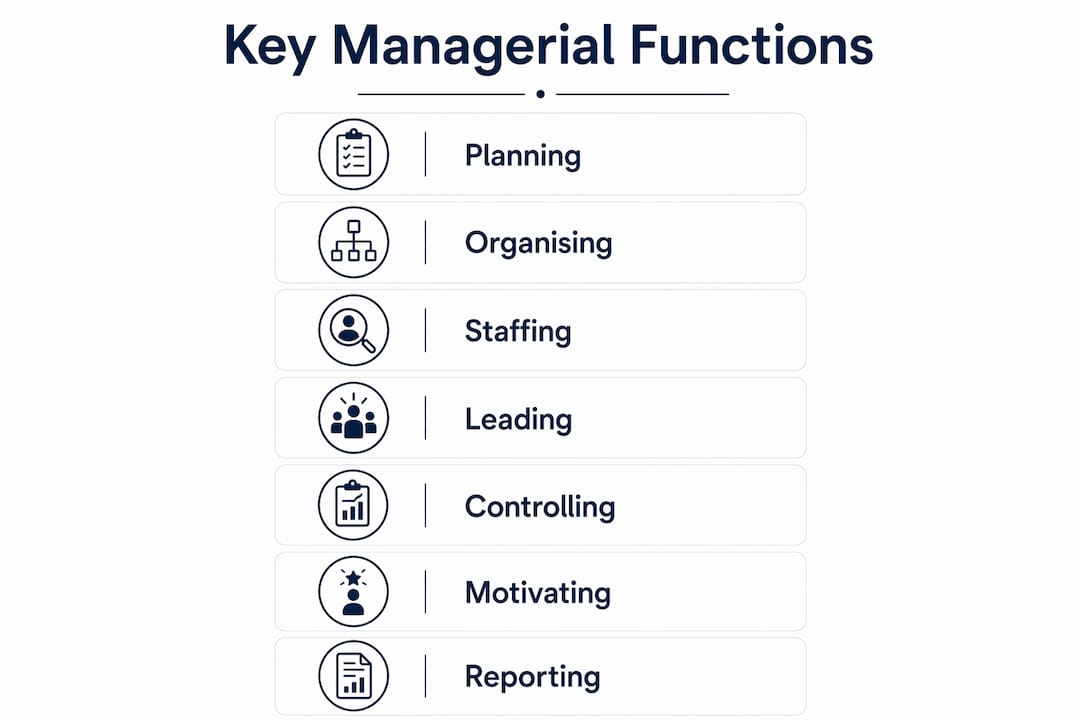
Planning means setting quarterly sales plans, forecasting revenue, and deciding which markets or customer segments to prioritise. Organising covers how you structure the team, assign territories, and allocate resources across campaigns. Staffing is the ongoing work of hiring, onboarding, and developing your people, not just filling vacancies when someone leaves.

Leading is where most managers either earn or lose the respect of their team. It means coaching individuals, running productive sales meetings, and creating an environment where people want to perform. Controlling involves tracking performance data, identifying gaps, and adjusting tactics before a bad month becomes a bad quarter.
Coordinating and communicating are often underestimated. A sales manager who cannot translate business objectives into clear team priorities, or who fails to relay field intelligence back to the leadership team, creates confusion on both sides. These two functions are what keep the whole operation joined up.
Additional responsibilities that sit within these functions include:
- Setting individual and team quotas tied to realistic revenue forecasts
- Running weekly or fortnightly pipeline reviews with each rep
- Designing and delivering training programmes on new products or sales tactics
- Managing promotional campaigns in collaboration with marketing
- Reviewing operational records to identify trends and adjust strategy
- Approving expenditure within agreed budget parameters
What skills and qualifications do sales managers need?
The top skills for sales managers are leadership, analytical thinking, communication, coaching, and strategic planning. These are not soft skills in the dismissive sense. They are the specific competencies that separate a manager who hits target every quarter from one who is always explaining why the team fell short.
Strong analytical skills matter because you will be reading pipeline data, interpreting win/loss patterns, and building forecasts that executives will act on. Communication matters because you are constantly translating between the language of the boardroom and the language of the sales floor. Coaching is its own discipline entirely; knowing how to sell is not the same as knowing how to help someone else improve their selling.
The skills and qualifications most UK employers look for in 2026 include:
- Proven track record in a sales role, typically three or more years before moving into management
- Demonstrated leadership ability, either through a team lead position or measurable mentoring outcomes
- Proficiency in CRM platforms such as Salesforce or HubSpot, including pipeline management and reporting
- Data analysis capability, including the ability to build forecasting models and interpret trends
- Strong interpersonal and communication skills for managing upwards and across departments
- Experience designing or delivering sales training programmes
- Commercial awareness, including an understanding of pricing, margin, and budget management
- A degree in business, marketing, or a related field is common but not always required; relevant experience often carries equal weight
Pro Tip: If you are moving from a senior sales role into management for the first time, invest in your coaching skills before anything else. Most new managers default to telling their team what to do rather than asking the right questions. The shift from seller to coach is the hardest part of the transition, and it is the one that determines whether your team grows or stagnates.
Career progression and salary expectations for UK sales managers
Most sales managers in the UK follow a recognisable path: individual contributor, senior sales executive or team lead, sales manager, senior sales manager, and then head of sales or sales director. The jump from individual contributor to manager is the biggest shift in terms of mindset, not just title.
According to the National Careers Service, salary ranges for sales managers in the UK vary considerably by sector, region, and level of experience. The figures below reflect typical market conditions in 2026.
| Level | Typical UK salary range | Notes |
|---|---|---|
| Junior / first-time sales manager | — | Often includes a team of several reps; may carry a personal quota |
| Mid-level sales manager | — | Manages larger teams; responsible for regional targets |
| Senior sales manager | — | Strategic input; may oversee other managers |
| Head of sales / sales director | — | Full P&L responsibility; board-level reporting |
These figures typically exclude on-target earnings (OTE), which can add 20–50% on top of base salary depending on the sector. Technology and financial services tend to pay at the higher end; retail and public sector roles sit lower. Location plays a significant role too, with London roles commanding a premium of roughly 15–25% over equivalent positions in other UK regions.
Career progression accelerates when you can demonstrate measurable outcomes: team revenue growth, improved conversion rates, or reduced staff turnover. A sales manager career guide can help you map the specific steps from your current position to the next level.
How sales managers collaborate across departments
Revenue growth is listed as one of the five key responsibilities for sales managers, alongside team development, strategy implementation, cross-department collaboration, and customer relationship management. The collaboration piece is the one most job descriptions undersell.
In practice, a sales manager spends a meaningful portion of each week working with people outside the sales team. Marketing needs field intelligence to build campaigns that actually resonate with buyers. Finance needs accurate forecasts to plan cash flow and headcount. Product teams need customer feedback to prioritise the right features. When these relationships work well, the sales team operates with better leads, cleaner pricing, and fewer internal obstacles.
Key collaboration responsibilities include:
- Sharing pipeline data and customer insight with the marketing team to align campaigns with real buyer behaviour
- Working with finance on revenue forecasts, budget requests, and pricing approvals
- Feeding product feedback from customers and prospects into development roadmaps
- Coordinating with operations or logistics to resolve fulfilment issues that affect customer satisfaction
- Removing internal roadblocks such as friction between sales and marketing, so reps can focus on closing deals rather than chasing internal approvals
- Representing the sales team’s needs and performance at leadership level
A well-developed marketing strategy for organic growth can significantly reduce the pressure on a sales team by generating warmer inbound leads, which is why the sales-marketing relationship deserves more attention than it usually gets.
Quota setting, budgeting, and territory management: the advanced side of the role
This is where the job gets genuinely technical, and where many sales managers feel least prepared. Setting quotas that are ambitious enough to drive growth but realistic enough to maintain motivation is one of the hardest calibration exercises in management.
Effective quota setting starts with historical data. You look at what the team has actually achieved, factor in market conditions, new product launches, and headcount changes, and then build a number that stretches without breaking. Quotas set purely from the top down, without reference to ground-level data, tend to demoralise teams within the first quarter.
Budget management is equally demanding. Sales managers typically:
- Prepare annual and quarterly sales budgets aligned with company revenue targets
- Approve expenditure on tools, travel, events, and training within agreed limits
- Monitor spend against budget on a monthly basis and flag variances early
- Work with finance to model the cost of acquiring new customers versus retaining existing ones
- Make the case for additional resource when the data supports it
Territory management is about fairness and efficiency. Poorly designed territories create resentment within teams and leave revenue on the table. Good territory design accounts for account potential, geographic spread, and individual rep capacity.
Pro Tip: CRM data hygiene is one of the most overlooked parts of the job. Inconsistent or incomplete pipeline data is a leading reason why leadership loses confidence in sales forecasts. Build a weekly habit of reviewing data quality in your CRM before you run any report that goes upstairs. It takes 20 minutes and it protects your credibility.
Compliance and ethical sales practices
Sales managers carry direct responsibility for ensuring their team sells within legal and ethical boundaries. This is not a box-ticking exercise. In the UK, relevant frameworks include the Consumer Rights Act 2015, the Financial Conduct Authority (FCA) regulations for any business selling financial products, and GDPR obligations around how customer data is collected and stored.
Beyond legal compliance, ethical sales practice means setting a culture where reps do not overpromise, misrepresent products, or apply pressure tactics that damage long-term customer relationships. The tone comes from the top. If a manager celebrates a deal closed through misleading claims, the team learns that results matter more than method.
Practical compliance responsibilities for sales managers include reviewing sales scripts and collateral for accuracy, ensuring reps complete mandatory compliance training, and maintaining records of customer interactions where required by regulation. Any complaints that escalate beyond the rep level land on the manager’s desk, and how those are handled shapes the organisation’s reputation with that customer for years.
Handling recruitment and onboarding of sales staff
Sales managers recruit, hire, and train new members of the sales team, and the quality of that process directly affects how quickly a new hire becomes productive. A poorly onboarded rep can take six months or more to reach full effectiveness, which is a significant cost in both time and lost revenue.
Good recruitment starts with a clear job brief. You need to know whether you are hiring for a hunter role focused on new business, a farmer role focused on account management, or something in between. Hiring the wrong profile for the role is one of the most common and expensive mistakes in sales management.
Onboarding should cover product knowledge, sales methodology, CRM usage, and an understanding of the ideal customer profile. The first 30 days should include structured shadowing, role-play practice, and a clear ramp plan with defined milestones. Effective sales training methods make a measurable difference to how quickly new hires contribute to team targets.
In smaller organisations, sales managers often act as player-coaches, carrying their own quota while simultaneously managing the team’s development. That dual responsibility requires careful time management and a clear boundary between selling time and coaching time.
Key takeaways
A sales manager’s effectiveness depends on combining strong leadership with disciplined planning, consistent coaching, and cross-functional collaboration to drive sustained revenue growth.
| Point | Details |
|---|---|
| Core duties span leadership and operations | Sales managers set targets, coach teams, manage budgets, and coordinate across departments. |
| Seven managerial functions provide the framework | Planning, organising, staffing, leading, controlling, coordinating, and communicating underpin every key task. |
| Skills and qualifications are both required | CRM proficiency, coaching ability, and analytical skills matter as much as formal qualifications. |
| UK salaries range widely by level | First-time managers typically earn —; senior managers can reach £90,000 or more. |
| CRM data hygiene protects forecasting credibility | Inconsistent pipeline data is a leading cause of leadership distrust in sales reporting. |
Ready to build a sales team that hits target every quarter?

At Aheadofsales, we work with businesses of 50–1,000 staff to build the kind of sales management capability that delivers at least 50% sales growth year on year. Our bespoke 1:1 coaching, combined with structured training and sales consultancy, gives your sales managers the skills, frameworks, and confidence to lead teams that consistently hit target.
If you are a solo service business looking to accelerate your own sales performance, our sales acceleration packages start from £2,995 and are built around your specific goals.
Explore our sales training services and find out what a structured approach to sales management development can do for your business.