
TL;DR:
- Sales enablement involves providing sales teams with content, training, technology, and data to accelerate deal closing and improve buyer engagement. It is a continuous, cross-functional process that integrates marketing, sales, and product efforts, unlike one-time training or operations management. Successful programs rely on measurable benchmarks, strategic content audits, strong cross-team alignment, and ongoing coaching to maximize revenue growth.
Sales enablement is defined as the strategic, cross-functional process of equipping sales teams with the content, training, technology, and data they need to engage buyers effectively and close deals faster. According to ZoomInfo, it functions as a proactive revenue driver that integrates data-driven insights across the full selling process. Where traditional sales training focuses narrowly on skill-building, sales enablement spans the entire buyer journey, connecting marketing, product, and sales into a single, coordinated effort. Salesforce describes the modern challenge as enabling rep productivity for complex buyer engagement, not simply delivering training sessions. That distinction matters enormously for any sales leader trying to build a team that hits target every quarter.
What is the sales enablement definition and why does it matter?
Sales enablement is the organised system that gives your sales team everything they need to have the right conversation with the right buyer at the right time. It covers content, coaching, technology, and analytics working together rather than in isolation. The term is sometimes used interchangeably with “revenue enablement,” which broadens the scope to include marketing and customer success teams alongside sales. Whether you use one label or the other, the core function is identical: remove friction from the selling process and give reps the resources to perform.

The importance of sales enablement becomes clear when you look at what happens without it. Reps waste time hunting for outdated collateral, new starters take months to ramp up, and marketing produces content that sales never uses. A well-structured programme solves all three problems simultaneously. For businesses with 50 to 1,000 staff targeting consistent growth, this is not a nice-to-have. It is the infrastructure that makes sales strategy repeatable and scalable.
What are the key components of a sales enablement programme?
The four pillars of any credible sales enablement programme are content, training, technology, and data. Each one reinforces the others, and weakness in any single pillar undermines the whole.
Content libraries are the most visible component. These include battle cards, case studies, demo scripts, objection-handling guides, and proposal templates. The goal is to give every rep access to the same high-quality materials so that performance does not depend on individual resourcefulness. Battle cards, in particular, are underused by mid-market teams despite being one of the fastest ways to improve competitive win rates.
Training and coaching sit at the heart of long-term enablement. This is not a one-off onboarding event. It is a continuous cycle of skill assessment, targeted coaching, and reinforcement. Sales enablement encompasses training plus content, technology, data, and ongoing coaching, which is precisely what separates it from a standard training programme.
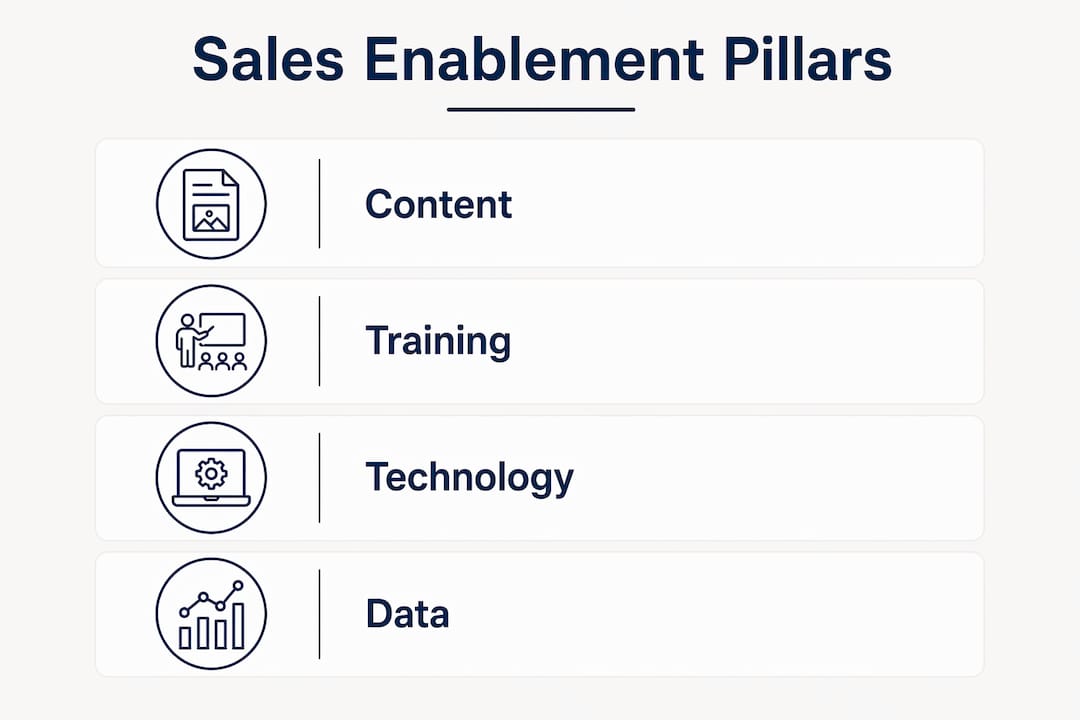
Technology platforms provide the infrastructure. Tools such as Highspot, Seismic, and Showpad centralise content, track usage, and surface the right materials at the right stage of the sales cycle. CRM platforms like Salesforce and HubSpot sit alongside these to capture buyer interaction data that feeds back into coaching decisions.
Data and analytics close the loop. Without measurement, you are guessing. With it, you can identify which content converts, which reps need coaching on specific objections, and where deals stall in the pipeline. This is what makes enablement a driver of sales team effectiveness rather than a support function.
Pro Tip: Conduct a content audit before building anything new. Research from Knowlify confirms that 80% of sales activity typically comes from just 20% of available content. Identify that 20% first and build from there.
How does sales enablement differ from sales training and sales operations?
This is one of the most common points of confusion in sales terminology, and getting it wrong leads to misaligned teams and wasted budget.
Sales enablement focuses on equipping sellers with knowledge and resources for buyer interactions, while sales operations manages the backend systems, CRM configuration, territory planning, and automation that keep the machine running. Enablement faces outward toward the buyer. Operations faces inward toward process efficiency. Both are necessary, and the best organisations treat them as complementary rather than competing functions.
Sales training is a component of enablement, not a synonym for it. Training delivers specific skills at a point in time. Enablement wraps around training with content, technology, and ongoing coaching to make those skills stick and translate into revenue. Think of training as a single course and enablement as the full curriculum, the textbooks, the tutors, and the exam results tracking.
The table below captures the key distinctions clearly.
| Function | Primary focus | Time horizon | Key outputs |
|---|---|---|---|
| Sales enablement | Buyer-facing resources and rep productivity | Ongoing | Content libraries, coaching programmes, playbooks |
| Sales training | Skill development for individual reps | Point in time | Workshops, role-plays, certifications |
| Sales operations | Backend process and system management | Ongoing | CRM configuration, reporting, territory design |
Understanding these boundaries helps sales leaders assign ownership correctly and avoid the common mistake of asking one team to do the job of all three.
What are proven sales enablement best practices and benchmarks for 2026?
The most effective sales enablement programmes are built around measurable targets, not vague intentions. Top-performing sales teams set specific goals such as 70% or more of reps achieving quota by month six and 80% or more of reps using content libraries on a weekly basis. These are not aspirational figures. They are operational standards that signal whether your enablement investment is working.
A frequency benchmark worth tracking is playbook engagement. RevWiser’s 2026 research identifies three or more playbook views per day as the standard for teams that maintain consistent selling discipline. That number tells you whether reps are actually using the system or ignoring it. If views drop below that threshold, it is a coaching signal, not a content problem.
Here is a practical framework for setting your own benchmarks:
- Define your ramp target. How quickly should a new rep reach full productivity? Sixty days is achievable with strong enablement. Ninety days or more usually signals gaps in onboarding content or coaching frequency.
- Set a content adoption rate. Track the percentage of reps accessing your content library each week. Anything below 60% suggests the content is either hard to find or not relevant to live deals.
- Measure quota attainment by cohort. Split your team by tenure and track attainment separately. This reveals whether enablement is working for new hires, mid-tenure reps, or neither.
- Track win rate by content used. Platforms like Highspot and Seismic make this straightforward. Deals where reps used specific case studies or battle cards should show higher close rates if your content is genuinely useful.
- Review coaching frequency. Salesforce research confirms that enablement leaders measure success through quota attainment and faster ramp time. Both metrics improve when coaching is structured and regular, not ad hoc.
Reviewing these sales performance benchmarks quarterly gives you the data to make confident decisions about where to invest next.
How to implement sales enablement effectively
Implementation is where most organisations stumble. They invest in a platform, load it with content, and then wonder why adoption is low and results are flat. The problem is almost always sequencing.
Start with a content audit, not a technology purchase. As Knowlify’s research confirms, targeting core content maximises immediate gains without large upfront costs. Identify the materials your top performers actually use, document them properly, and make them accessible before you spend a penny on new infrastructure.
Build cross-functional alignment early. Sales enablement only works when marketing, sales, and product teams share ownership of the content and the process. Marketing creates the assets, sales uses them in live deals, and product keeps them accurate. Without that triangle of accountability, content goes stale and reps stop trusting the library.
Choose technology that fits your current maturity. A 60-person sales team does not need an enterprise-grade enablement platform on day one. Start with a well-organised shared drive and a clear naming convention. Add dedicated tools like Seismic or Highspot when your content volume and team size justify the investment. Buying too early creates complexity without benefit.
Embed coaching as a non-negotiable. The distinction between enablement and training is that enablement is continuous. Weekly one-to-ones with a coaching agenda, monthly deal reviews, and quarterly skill assessments all count. The format matters less than the consistency.
Monitor your KPIs and adapt. Enablement is not a project with an end date. It is an ongoing function that responds to changes in your market, your buyer, and your team. Set a quarterly review cadence and be prepared to retire content, adjust coaching focus, and update playbooks when the data tells you to.
Pro Tip: Prioritise quality and relevance over volume. A library of 20 genuinely useful assets outperforms a library of 200 that reps cannot navigate. Less is almost always more when it comes to sales content.
Key takeaways
Sales enablement succeeds when content, coaching, technology, and data work together as a single system, measured against clear performance benchmarks and reviewed continuously.
| Point | Details |
|---|---|
| Core definition | Sales enablement equips teams with content, training, technology, and data to close deals faster. |
| Distinct from training | Enablement is continuous and cross-functional; training is a point-in-time skill intervention. |
| Performance benchmarks | Target 70%+ quota attainment by month six and 80%+ weekly content library usage. |
| Start with a content audit | Identify the 20% of content driving 80% of sales activity before investing in new tools. |
| Measure and adapt | Track ramp time, win rates, and playbook engagement quarterly to keep enablement effective. |
Why sales enablement is the discipline most sales leaders underestimate
I have worked with sales teams across a wide range of sectors, and the pattern I see most often is this: a business invests in CRM, runs a two-day training event, and calls it enablement. Six months later, quota attainment is flat and the sales director is looking for a new hire rather than a new approach.
The uncomfortable truth is that most sales underperformance is an enablement problem, not a talent problem. Reps are not failing because they lack ability. They are failing because they do not have the right content for the conversation they are in, they have not been coached on the specific objections they are hearing, and nobody has looked at their pipeline data to understand where deals are actually dying.
What I have found genuinely works is starting small and being ruthlessly focused. Pick the three content assets your best reps use most. Make those perfect. Then build a coaching rhythm around the specific stages where your team loses deals. That combination, done consistently, produces more measurable improvement than any platform purchase.
The other thing I would caution against is treating enablement as a marketing responsibility. Content creation sits with marketing, yes. But the strategy, the coaching, and the measurement must be owned by sales leadership. When enablement is handed off entirely to marketing, it drifts toward brand awareness and away from the practical, deal-level support that reps actually need.
Alignment across functions is not a soft benefit. It is the mechanism by which enablement produces revenue. Get that right, and the benchmarks follow.
— Jerry
How Aheadofsales supports your sales enablement strategy
If you recognise the gaps described in this article, whether that is inconsistent coaching, underused content, or reps who are not hitting target, Aheadofsales can help you close them.
Aheadofsales combines bespoke 1:1 coaching with structured training and consultancy, designed specifically for businesses with 50 to 1,000 staff who are serious about growth. The approach is built around the same principles covered here: content that works, coaching that sticks, and measurement that drives decisions. Explore the full range of sales training services to see how a structured enablement programme can help your team hit target every quarter. For SaaS businesses specifically, the SaaS sales training programme addresses the unique enablement challenges of complex, multi-stakeholder selling.
FAQ
What is the simplest sales enablement definition?
Sales enablement is the process of giving sales teams the content, training, technology, and data they need to engage buyers and close deals more effectively. It is a continuous, cross-functional discipline rather than a one-off programme.
How does sales enablement differ from sales training?
Sales training focuses on developing specific skills at a point in time, while sales enablement is a broader, ongoing system that includes content, coaching, technology, and analytics. Training is one component of enablement, not a replacement for it.
What tools are commonly used in sales enablement?
Platforms such as Highspot, Seismic, and Showpad are widely used to centralise content and track usage. CRM systems like Salesforce and HubSpot complement these by capturing buyer interaction data that informs coaching and content decisions.
What are the most important sales enablement metrics to track?
The key metrics are quota attainment by cohort, content library adoption rate, playbook engagement frequency, and new rep ramp time. Top-performing teams target 70% or more quota attainment by month six as a baseline standard.
Who owns sales enablement in a business?
Sales leadership owns the strategy and measurement, while marketing contributes content creation and product teams keep materials accurate. The Sales Enablement Collective notes that enablement and operations are distinct functions that collaborate rather than overlap.