
A sales enablement charter is a formal, signed agreement between the enablement team and the business that defines mission, scope, and measurable outcomes — giving the team direction and serving as the reference point every other department can consult when they want to know what enablement does and does not do. From this guide, you can produce a 1–3 slide charter and a short launch cadence ready to share with your CRO or VP Sales this week.
Where a sales strategy document describes how the business will win, the charter describes what enablement commits to delivering and who signs off on it. That distinction matters in practice: without a charter, enablement teams spend their time fielding ad-hoc requests rather than driving measurable pipeline outcomes.
Here is a starter template you can paste directly into a slide or document:
- Mission: One sentence stating what enablement exists to achieve and for whom.
- Scope (in/out): Three to five activities explicitly in scope; two or three explicitly excluded.
- Receivers: The sales roles and segments the programme serves (for example, AEs, SDRs, new hires in months 1–6).
- Top objectives: Three measurable outcomes tied to business goals (quota attainment, ramp time, win rate).
- 90-day plan: The first three deliverables with owners and completion dates.
- KPIs: Two leading indicators (training completion rate, content adoption) and two lagging indicators (win rate, average deal size).
Executive sponsors such as the CRO or VP Sales should co-sign the charter. Tools like the HubSpot/Veelo charter template and resources from the Sales Enablement Collective give you slide-ready formats to work from immediately.
Key takeaways
A well-built sales enablement charter is the single most effective mechanism for converting an enablement team from a reactive support function into a strategic business unit with signed commitments, measurable KPIs, and executive accountability.
| Point | Details |
|---|---|
| Start with a diagnosis | Identify whether the gap is capability, data, process, incentives, or capacity before writing a word of the charter. |
| One slide first | Draft a one-slide minimum viable charter for executive sign-off, then expand to three slides for pillar owners. |
| Lead and lag KPIs | Include at least two leading indicators (training completion, content adoption) and two lagging indicators (win rate, quota attainment) with baselines. |
| Governance is non-optional | Schedule a monthly enablement council and a quarterly executive board before the charter is signed, not after. |
| Aheadofsales | Offers charter workshops, bespoke coaching, and fractional sales director support for UK B2B teams from £4,500. |
Table of Contents
- Why your organisation needs a sales enablement charter now
- What are the core pillars every charter must include?
- How do you build a sales enablement charter step by step?
- Where can you find templates and a worked example to copy?
- How do you choose KPIs and measure enablement impact?
- What does good launch governance and review cadence look like?
- What are the most common charter pitfalls and how do you fix them?
- Your one-slide charter checklist
- Why the charter is only as good as the conversation behind it
- Aheadofsales helps you build a charter that actually gets used
- Sources
Why your organisation needs a sales enablement charter now
Most enablement teams operate without a formal charter, which means they operate without a mandate. The consequences are predictable: scope creep, reactive content requests, and difficulty proving ROI at board level. A signed charter converts enablement from a support function into a strategic business unit with defined commitments and measurable outcomes.
Here are the concrete business outcomes a well-built charter enables:
- Faster ramp time. A charter that defines onboarding milestones gives new hires a clear path and managers a measurable standard. Without one, ramp time varies by manager and is rarely tracked consistently.
- Higher quota attainment. When the charter ties enablement activity to quota targets, the team builds programmes around the metrics sales leadership actually cares about rather than training completion for its own sake.
- Clearer SLAs between enablement and sales. A charter specifies what enablement will deliver and by when, which reduces the volume of last-minute requests and sets realistic expectations on both sides.
- Fewer ad-hoc requests. An explicit scope section — listing what is out of scope as clearly as what is in — gives the enablement lead a defensible position when requests arrive that fall outside the agreed remit.
- Executive alignment. A co-signed charter with the CRO or VP Sales signals that enablement is a strategic investment, not a discretionary cost. That positioning matters at budget review time.
The risk of not having one is equally concrete. Without a charter, executive sponsorship and governance remain informal, which means the programme is always one leadership change away from being deprioritised. A signed charter, reviewed quarterly, is the mechanism that keeps enablement visible and accountable at the right level.
What are the core pillars every charter must include?
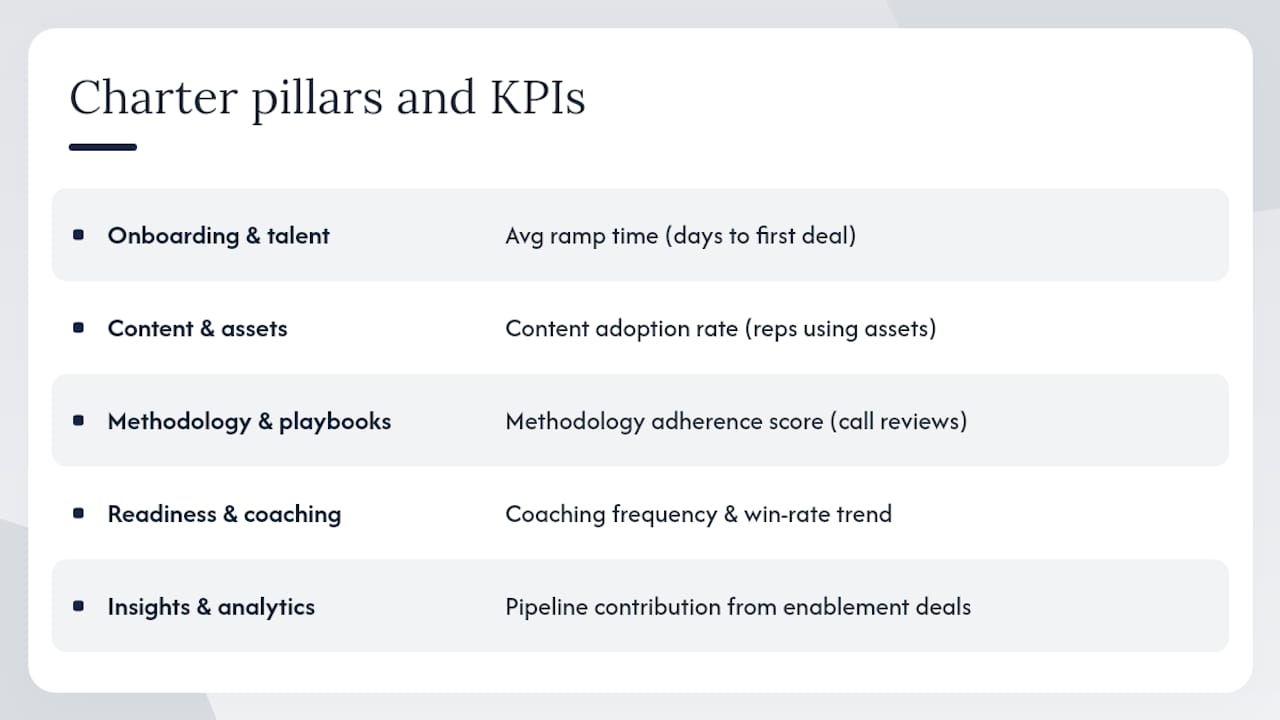
A practical charter organises its commitments around a small number of pillars, each with a clear objective, a quarterly milestone, a KPI, and a named owner. The WeFlow enablement framework identifies five canonical pillars that cover the full scope of a mature enablement function. Here is how to write each one into your charter.
Onboarding and talent development
Objective: Reduce time-to-first-deal for new AEs from the current baseline to a defined target within 12 months. Milestone: Structured 30/60/90 onboarding programme live by end of Q1. KPI: Average ramp time (days to first closed deal). Owner: Head of Enablement.
Content and assets
Objective: Ensure every rep has access to current, stage-appropriate content for each deal stage. Milestone: Content audit completed and CRM-integrated library published by end of Q2. KPI: Content adoption rate (percentage of reps using library assets in active deals). Owner: Enablement Manager, in partnership with Marketing.
Methodology and playbooks
Objective: Standardise the sales methodology across all segments and embed it in CRM workflows. Milestone: Playbooks for the top three deal types published and certified by end of Q2. KPI: Methodology adherence score (from manager call reviews). Owner: Sales Operations.
Readiness and coaching
Objective: Deliver structured coaching to every AE at a minimum cadence of twice per month. Milestone: Coaching tracker live in CRM by end of Q1. KPI: Coaching frequency (sessions per rep per month) and win rate trend. Owner: Sales Managers, supported by Enablement.
Insights and analytics
Objective: Produce a monthly enablement scorecard that links programme activity to pipeline outcomes. Milestone: First scorecard delivered at the end of month two. KPI: Pipeline contribution from enablement-supported deals. Owner: RevOps, in partnership with Enablement.
Cross-functional alignment
Objective: Establish a monthly enablement council with Sales, Marketing, Product, and RevOps. Milestone: First council meeting held in week three of the charter launch. KPI: Number of cross-functional initiatives delivered on schedule. Owner: Head of Enablement.
For a deeper look at how these pillars connect to your sales enablement definition and the roles that own each one, that link covers the full remit in practical terms.
RACI in one paragraph: The CRO or VP Sales approves the charter. The Head of Enablement is accountable for delivery. Pillar owners are responsible for their specific workstreams. Sales managers, Marketing, and RevOps are consulted during drafting and quarterly reviews. The wider sales team is informed at launch and at each review cycle.
Pro Tip: Keep the RACI to one row per pillar in your charter slide. If it takes more than a glance to understand who owns what, the governance model is too complex to survive first contact with a busy sales floor.
How do you build a sales enablement charter step by step?
The Prospeo guide frames the charter as a shared contract between enablement, sales leadership, and cross-functional partners. That framing shapes the build process: you are not writing a document in isolation, you are negotiating a commitment. Here is a reproducible four-stage process.
-
Diagnose the real performance problem (week one, days 1–3). Before you write a single word of the charter, identify whether the gap is a capability problem (reps cannot do the skill), a data problem (no one knows what good looks like), a process problem (the methodology is inconsistent), an incentive problem (the comp plan rewards the wrong behaviour), or a capacity problem (the team is too small for the pipeline target). The diagnosis determines what goes in scope. A charter written from assumptions rather than evidence will commit to solving the wrong problem.
-
Run stakeholder interviews (week one, days 3–5). Speak to the CRO, VP Sales, VP Marketing, a RevOps lead, and two or three frontline sales managers. Sample questions: What does a great quarter look like for your team, and what is currently preventing it? (CRO/VP Sales); Where does content fall short in active deals? (VP Marketing); Which stage of the pipeline has the longest average age and why? (RevOps); What do your best reps do that your average reps do not? (Sales Managers). Record the answers verbatim — the language your stakeholders use should appear in the charter’s mission and objectives.
-
Draft the minimum viable charter (week two). Start with a single page or slide. Write the mission statement in one sentence. List three to five in-scope activities and two or three explicitly out-of-scope ones. Name the receivers, the top three objectives, the 90-day plan, and the KPIs. Share this draft with your executive sponsor before widening the review. Expect two rounds of revision. The HubSpot/Veelo template gives you a slide-ready structure for this stage.
-
Approve and launch (week three to four). Run a final review with all pillar owners present. Confirm that every KPI has a baseline, a target, and a measurement method. Get the CRO or VP Sales to co-sign. Announce the charter at the next all-hands or sales QBR, share a one-slide summary with the full sales team, and schedule the first 30-day check-in. From launch, operate on a 30/60/90 cadence for the first quarter, then move to monthly enablement council reviews and a quarterly executive review.
Timeline at a glance:
- Days 1–3: Diagnostic interviews and performance gap analysis.
- Days 4–5: Stakeholder interviews with CRO, VP Sales, Marketing, RevOps.
- Week 2: Draft minimum viable charter; first review with executive sponsor.
- Week 3: Pillar owner review; KPI baseline confirmation; final approval.
- Week 4: Launch at QBR or all-hands; 30-day check-in scheduled.
- Months 2–3: Monthly enablement council; 60 and 90-day milestone reviews.
- Months 4–6: First quarterly executive review with scorecard and pipeline math.
- Months 7–18: Bi-annual charter refresh; annual full revision with updated baselines.
Where can you find templates and a worked example to copy?
Several trusted sources publish ready-to-use charter templates, and knowing which format suits your situation saves a significant amount of drafting time.
HubSpot/Veelo PDF template is the most widely referenced slide-based format. It structures the charter across one to three slides with fields for mission, pillars, receivers, short-term projects, longer-term deliverables, and KPI examples. Use this when you need a format your executive sponsor can read in under two minutes. It is the right choice for a first charter or for a team that needs quick sign-off.
Sales Enablement Collective publishes a range of charter frameworks and worked examples alongside its broader enablement content library. Their formats tend to be more detailed and suit teams that are formalising an existing programme rather than starting from scratch.
Prospeo’s worked example walks through a complete charter build with KPI formulas and governance cadences, making it particularly useful for the metrics and governance sections of a more mature charter.
The format decision is straightforward: use a one-slide charter when your primary goal is executive sign-off and speed. Move to a three-slide version when you need to communicate pillar-level detail to a wider stakeholder group, and keep a five-slide appendix for the delivery team with full milestone and resource detail.
The ABC company sample charter
Here is a copyable worked example you can transcribe directly into your own slides. “ABC” is a fictional mid-market B2B SaaS company with 80 AEs across two segments.
| Charter field | ABC company entry |
|---|---|
| Vision | Enable every ABC AE to hit quota within 90 days of hire and sustain high quota attainment across the team by Q4. |
| Mission | Provide the skills, content, and coaching that ABC’s sales team needs to win more deals, faster, in both the SMB and mid-market segments. |
| In scope | New hire onboarding; methodology playbooks; content library; coaching programme; monthly enablement scorecard. |
| Out of scope | Demand generation; CRM administration; sales compensation design; product marketing. |
| Receivers | All AEs (SMB and mid-market); SDRs in months 1–3; Sales Managers for coaching enablement. |
| 12-month goals | Reduce ramp time by 25%; increase win rate from 22% to —; achieve — quota attainment across the team. |
| 90-day milestones | Onboarding programme live (day 30); playbooks for top three deal types published (day 60); coaching tracker in CRM (day 90). |
| KPI targets | Ramp time: target 75 days. Win rate: target —. Quota attainment: target —. Training completion: target 90%. |
| Owners | Head of Enablement (overall); Sales Ops (methodology); Marketing (content); RevOps (analytics). |
| Resources | Two enablement managers; content and tooling budget allocated; 2 hours per rep per month for training. |
| Review cadence | Monthly enablement council; quarterly executive review with CRO. |
| Executive co-signer | CRO (primary sponsor); VP Sales (operational sponsor). |
For SaaS-specific onboarding considerations, the sales training for SaaS page covers the readiness elements that tend to differ from a generalist programme.
How do you choose KPIs and measure enablement impact?
The most common mistake in a charter’s metrics section is listing only lagging indicators — win rate, quota attainment, revenue — and then discovering six months later that you cannot explain why those numbers moved or did not. Showpad’s guidance recommends using scorecards for leading indicators and a scoreboard for pipeline and revenue, keeping the two views separate so executive reviews stay focused on business outcomes rather than training activity.
Leading indicators tell you whether the inputs are working before the revenue results arrive. Lagging indicators confirm whether the programme is producing business outcomes. You need both in your charter.
Three practical notes on measurement:
- Set a baseline before you launch. Every KPI in the table above is meaningless without a starting point. Pull the last 12 months of data from your CRM before the charter is signed, and record those baselines in the charter itself.
- Attribution is always partial. Enablement rarely controls every variable that affects win rate. Be honest with executives about what the programme directly influences (training completion, content adoption, coaching frequency) versus what it contributes to alongside other factors (win rate, revenue).
- Link every review to pipeline maths. Connecting enablement metrics to pipeline coverage — for example, showing that reps who completed the playbook certification carry 40% more pipeline than those who did not — makes charter reviews business-relevant and keeps the document from being treated as a training plan.
For a fuller checklist of the metrics that matter at each stage of the sales cycle, the sales performance metrics checklist covers the leading and lagging indicators most relevant to UK sales managers.
What does good launch governance and review cadence look like?
A charter without a governance structure becomes shelfware within 90 days. The governance model does not need to be elaborate, but it does need to be explicit and scheduled before the charter is signed.
Recommended governance bodies:
Executive enablement board meets quarterly. Attendees: CRO, VP Sales, Head of Enablement, RevOps lead. Agenda: scorecard review, pipeline math, charter amendments, budget decisions. This is where lagging indicators are reviewed and where the charter is formally updated.
Monthly enablement council meets monthly. Attendees: Head of Enablement, Sales Managers, Marketing lead, RevOps. Agenda: leading indicator scorecard, programme status, content and tooling updates, blockers. This is the operational heartbeat of the charter.
RACI for governance:
Evidence to bring to each review:
Quarterly executive board: pipeline coverage ratio, win rate trend (last three quarters), quota attainment percentage, ramp time versus baseline, and a one-slide charter amendment proposal if scope needs updating.
Monthly enablement council: training completion rate, content adoption rate, coaching frequency, programme milestone status (RAG rated), and a list of the top three blockers with proposed owners.
The Kayako guide on sales enablement reinforces that executive sponsorship and a clear governance rhythm are the two factors most likely to prevent a charter from being deprioritised when business priorities shift.
What are the most common charter pitfalls and how do you fix them?
Most charters fail not because the content is wrong but because the process around them breaks down. Here are the pitfalls that appear most often, with a direct fix for each.
- No executive sponsor. The charter sits with the enablement team alone and gets ignored at budget time. Fix: Get the CRO or VP Sales to co-sign before launch. If they will not sign, the charter is not ready.
- Activity-only KPIs. The charter measures training sessions delivered and content pieces published, with no link to pipeline or revenue. Fix: Add at least two lagging indicators with baselines and targets before the charter is approved.
- Vague scope. The in-scope list is so broad that every request qualifies. Fix: Write an explicit out-of-scope list with two or three named exclusions. “We do not own demand generation or CRM administration” is a complete sentence that saves hours of negotiation later.
- Poor stakeholder buy-in. The charter is drafted by enablement and handed to sales leadership for rubber-stamping. Fix: Run stakeholder interviews before drafting and use the language your stakeholders gave you in the mission and objectives. People support what they helped create.
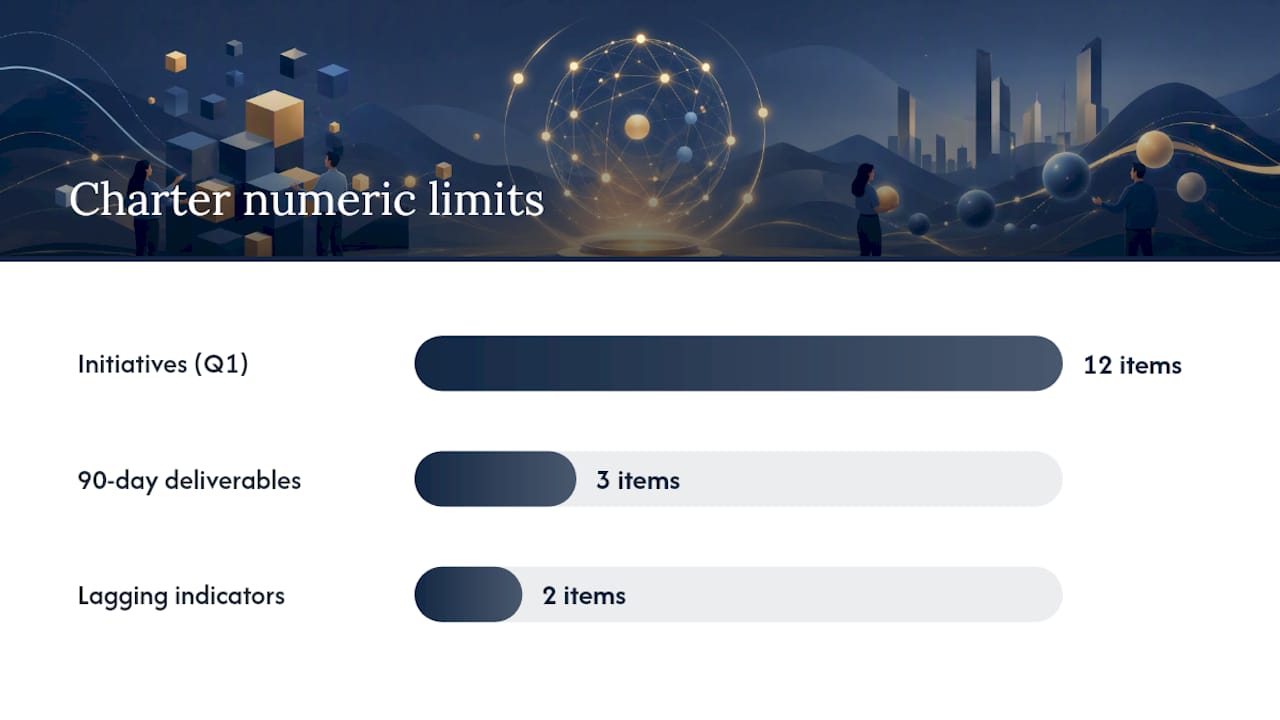
- Overloaded in-scope list. The charter commits to twelve initiatives in the first quarter. Fix: Limit the 90-day plan to three deliverables. Everything else goes into the six-to-eighteen-month view.
- No review cadence. The charter is signed and filed. Fix: Schedule the first 30-day check-in before the launch meeting ends. Put the quarterly executive board date in every sponsor’s calendar on the day of sign-off.
Pro Tip: Treat the charter as a living document that gets inspected, not archived. The Sales Enablement Collective describes it as a “North Star” that internal stakeholders should return to regularly — not a mission statement that sits in a folder. If your charter has not been opened in 60 days, it is already shelfware.
When building the content and multi-channel elements of your charter, lead nurturing strategies that align marketing and sales activity can strengthen the content pillar significantly, particularly for teams where marketing and enablement share ownership of buyer-facing assets.
Your one-slide charter checklist
Use this checklist to draft or audit your charter before sign-off. Every item should be answerable in one sentence or less on the slide.
Block one: mission and scope
- Mission statement written in one sentence, naming the team served and the outcome delivered.
- In-scope list: three to five named activities.
- Out-of-scope list: two to three named exclusions.
- Receivers: named roles and segments.
Block two: top objectives and KPIs
- Three measurable objectives tied to business goals (not activities).
- Two leading KPIs with baselines and 12-month targets.
- Two lagging KPIs with baselines and 12-month targets.
- Measurement method and data source confirmed for each KPI.
Block three: 90-day plan and owners
- Three 90-day deliverables, each with a named owner and a completion date.
- Six-to-eighteen-month view: three to five initiatives listed without detail.
- RACI: one row per pillar, maximum five pillars.
- Review cadence: monthly council date and quarterly executive board date confirmed.
Sign-off line:
Executive co-owner: __________ | Date signed: __________ | Next review date: __________
Why the charter is only as good as the conversation behind it
Here is something I have seen repeatedly when working with enablement teams: the charter that gets signed fastest is rarely the one that works best. The charters that actually shift quota attainment and ramp time are the ones where the Head of Enablement spent two or three days in uncomfortable conversations with the CRO and VP Sales before writing a single word.
Those conversations surface the real performance problem, which is almost never the one the enablement team assumed it was. A team that diagnoses a capability gap and builds a training programme discovers six months later that the real problem was a process gap in the CRM workflow. A charter written from assumptions rather than stakeholder interviews commits to solving the wrong thing, and no amount of governance cadence rescues it.
The other lesson: link every charter review to pipeline maths. When you walk into a quarterly executive board with a slide that shows reps who completed the playbook certification carry measurably more pipeline than those who did not, the charter stops being a training document and becomes a revenue conversation. That shift in framing is what keeps executive sponsors engaged and keeps the programme funded. Review the charter with pipeline maths at every executive cadence, and the document stays alive.
Aheadofsales helps you build a charter that actually gets used
If you have read this far and you are thinking “we need someone to run this process with us, not just hand us a template,” that is exactly where Aheadofsales works best.

Aheadofsales works with B2B sales teams across the UK to build charters that are grounded in a real diagnostic, co-signed by the right executive sponsors, and tied to measurable pipeline outcomes from day one. The engagement typically starts with a structured audit of your current enablement activity, followed by a facilitated workshop with your CRO, VP Sales, and key pillar owners to draft and agree the charter in a single session. From there, the team can support delivery through bespoke 1:1 coaching, in-person or online training programmes, and fractional sales director services that keep the charter accountable between quarterly reviews.
Packages for teams of 50–1,000 staff start from £4,500, with sales acceleration packages available for smaller and solo service businesses from £2,995. To find out whether a charter workshop or a broader sales training engagement is the right starting point for your team, get in touch with Aheadofsales directly at Aheadofsales.
Sources
- What is a sales enablement charter?
- Sales Enablement Charter Template
- Sales Enablement Charter: How to Build One in 2026
- Sales Enablement Framework: Pillars, Onboarding, Playbooks, and Tools
- How to Define and Build Your Sales Enablement Charter – Showpad