
In the UK, a Sales Director and a VP of Sales are often the same job with a different badge. The real difference is scope: a Sales Director runs sales delivery, while a VP owns the wider sales organisation and the strategy behind it. Most businesses under about £10m should stop asking which title to hire and ask which job is missing. Often that job is senior sales leadership for a few days a week, not a full-time executive.
I’m writing this for owners, sales leaders and founders who are trying to decide who should lead sales, or how to describe the role they already do. I’ll explain the titles in plain terms, show where UK practice differs from the US, and then give you a way to decide.
TL;DR
- Sales Director: owns sales delivery. That means the team, the pipeline, the forecast and the revenue number. It is the most common senior sales title in UK firms.
- VP of Sales: a broader remit that can include enablement, operations and the SDR layer. In the UK it is mostly found in US-influenced companies or those with US investors.
- Head of Sales: usually the first dedicated sales leader, often still selling personally. Sales Director is typically the step above.
- Titles flex with company size. Judge a role by what it owns and who it reports to, not by the label.
- Not ready for a full-time executive? A fractional sales director can supply the leadership while you build the repeatable process.
Table of Contents
- The short answer: how the titles compare
- What a Sales Director does
- What a VP of Sales does
- Head of Sales vs Sales Director
- Are Sales Director and VP of Sales the same thing in the UK?
- What does it cost?
- When does a business need which role?
- Fractional CRO vs Sales Director
- How to define a senior sales role in your own company
- Where a fractional sales director fits
- Working with Aheadofsales
- Perspective
- FAQ
- Sources
The short answer: how the titles compare
Titles are not regulated in the UK, so no body decides what “Director” or “VP” means. What follows is how the titles are generally used in recruitment practice.
| Head of Sales | Sales Director | VP of Sales | |
|---|---|---|---|
| Typical stage | First dedicated sales leader | Established sales team, often multiple sub-teams | Scaling company, often venture-backed |
| Focus | Building the function, often still selling | Execution, revenue delivery, pipeline, key customers | Strategy, structure, hiring, whole sales organisation |
| Reports to | Founder or CEO | CEO, or a commercial director in larger firms | CEO, CRO or president |
| Carries a personal number? | Often | Sometimes | Rarely at scale, more likely in a small firm |
| Typical UK usage | Common in SMEs | Most common senior title | Less common, US-linked firms |
The sections below explain each column and the evidence behind it.
What a Sales Director does
A UK Sales Director is the senior leader most directly accountable for the sales function: the pipeline, the sales team, the sales process and deal execution. In practice that is a week of forecasting, coaching managers, reviewing deals that are stuck and agreeing targets.
Another UK description has the Sales Director as responsible for a company or business unit’s revenue target, setting go-to-market strategy and leading Sales Managers and their teams. They run the forecast call with finance, talk to marketing and product about lead quality, and report to the board on revenue, win rate and pipeline health.
A useful way to picture it: the Sales Director turns company strategy into daily operating behaviour. One comparison puts it as hiring and coaching managers, inspecting pipeline, improving deal execution and keeping the forecast honest. If a number is missed, this is the person who explains why and fixes it.
Reporting line. In a company without a Chief Commercial Officer, a Sales Director typically reports to the CEO. In a firm with executive-level commercial leadership, they report to that executive.
What a VP of Sales does
A VP of Sales owns the broader sales result: the number, the leadership bench, the forecast and the plan. One source describes the remit as wider than a Sales Director’s, including enablement, operations and the SDR layer, where an SDR is a sales development rep who generates and qualifies leads before an account executive takes over.
The VP is usually the person who decides how sales is organised: territories, team structure, how much to invest, and which managers to hire. When a company needs executive ownership of the function, including commercial direction, organisational structure and presenting the strategy and forecast to the board, it is thinking about a VP rather than a director.
Reporting lines are higher too. A VP of Sales often reports to a CRO, CEO or president, whereas a Director of Sales typically sits a layer below top leadership. Under a VP you would normally expect Directors, and under Directors, Managers.
How the VP role changes as you grow
At a small company the VP may sell alongside the team and report straight to the founder. At a larger one the role leads a much bigger organisation and is more about leadership, planning and managing other leaders. So two people with the same VP title can have very different days. A VP at a 20-person business may still be on calls every morning. A VP at a 500-person business may barely see a prospect.
In SaaS, the VP is typically brought in when revenue is in the low millions, with a brief to set an ambitious strategy, hire sales talent and multiply revenue over 12 to 24 months. That is a heavy brief, and it is why the hire only suits a business that already has something repeatable to scale.
Head of Sales vs Sales Director
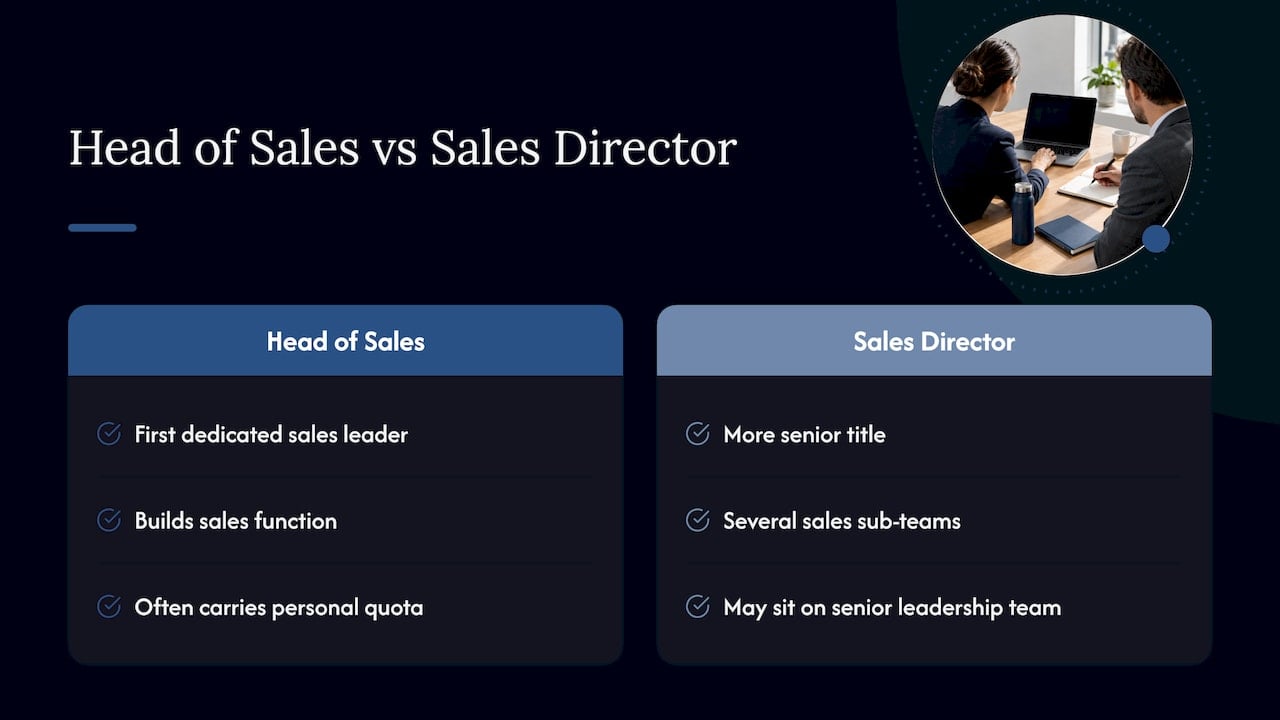
This is the pairing most UK searchers actually mean. In the UK market, a Head of Sales is typically the first dedicated sales leader in a business. They build the sales function and often carry personal quota. Sales Director is the more senior title, used when there are several sales sub-teams or when the person sits on the senior leadership team and reports to the CEO.
So the usual order, from the more hands-on to the more strategic, is Head of Sales, Sales Director, VP of Sales, with a Chief Revenue Officer above. That ladder is a tendency, not a rule. A Head of Sales at a 300-person firm can be more senior than a Sales Director at a 15-person one.
The Head of Sales also has a particular job: it scales what is already working. One guide advises against hiring one before there is a repeatable process and customer signals. Its warning signs include the founder spending more than 30% of their time on sales with no room for anything else, and at least a dozen deals closed through a repeatable process.
Are Sales Director and VP of Sales the same thing in the UK?
Often, yes. In the UK the VP of Sales title is most common in US-influenced businesses or UK companies with US investors, where it is functionally equivalent to Sales Director. Companies sometimes use it because candidates read “VP” as a seniority signal. Another UK source notes it is rare to find both titles in one SME.
That gives you a practical rule. If a business has both, the VP sits above the Director. If it has only one, the title tells you very little, so read the job description.
The US-style distinction is sharper: a VP oversees multiple Directors across a broader area and sets strategy, while a Director owns one function with tactical, execution-focused work. If you are hiring from or selling into American companies, assume that stricter reading.
What does it cost?
Senior sales leadership is a significant fixed commitment. The ONS median salary for marketing, sales and advertising directors is £94,135, the second-highest-paid occupation in the UK. The same report puts B2B senior-leadership base salaries between £70K and £290K, with a SaaS VP or CRO at a £124K base and £216K on-target earnings (June 2026 report).
Base salary is not the full cost. Add commission or bonus, employer National Insurance and pension, recruitment fees, equipment, and the months it takes a new leader to settle in. That is why the question “which title” often gives way to “how much leadership do we need right now, and in what form?”
When does a business need which role?
Size and stage matter more than the label. These are the patterns I see, backed by what the hiring guides say.
Under roughly £1m in recurring revenue (SaaS). A founding account executive is usually more useful than a VP. One UK guide says a VP of Sales “doesn’t make sense” until the business is delivering the late hundreds of thousands to around £1m+ in ARR (annual recurring revenue).
Around £1m ARR and repeatable. The same guide says that once a business reaches about £1m, the company has repeatability and a VP can build the sales motion and team. This is also the point where a Head of Sales or Sales Director begins to pay for themselves.
£2m+ with a team and a missed forecast. You probably need Sales Director-level ownership: someone who runs the forecast, coaches managers and is accountable for the number.
Series B and beyond. Investors will expect a leader who can hire managers, structure territories and present the plan to the board. That is VP territory.
Solo and service businesses at £10k a month. You do not need a title at all. You need a sales process, confidence on calls and a consistent pipeline. That is a coaching and consultancy question, not a recruitment one.
A quick decision test
Ask four questions:
- Who is accountable for the number today? If the answer is “me, in between everything else”, you have a leadership gap.
- Do you have a process that works without you? If not, a senior hire will spend a year discovering what you could have documented.
- Do you need strategy or execution? Structure, hiring plans and board reporting point to a VP. Pipeline discipline, coaching and forecasting point to a Sales Director.
- Can you carry a six-figure fixed cost for 12 months before it pays back? If that is uncomfortable, look at part-time options first.
Fractional CRO vs Sales Director
A fractional executive works with you for part of the week instead of full-time. The two roles differ in reach. A Chief Revenue Officer sits above the VP of Sales in most structures, as the reporting lines above show, and is accountable for the whole revenue picture. A Sales Director is accountable for sales delivery inside it.
For most owners of businesses with a team of 50 to 1,000 people, or smaller service businesses, the gap that hurts is sales leadership: pipeline discipline, forecast accuracy, coaching the managers and a plan the team follows. That is Sales Director work, and it is the work a fractional sales director takes on. A fractional CRO is the better frame when you need one person to pull marketing, sales and customer success into a single revenue plan.
Whichever you choose, write the scope down. Define what the person owns, which number they answer for and who they report to, then judge the title second.
How to define a senior sales role in your own company
Whether you are hiring, promoting or renaming a role, use the same checklist.
- The number. State which revenue target the role owns: company, business unit, region or segment.
- The people. Say whether they lead managers, reps, or both. The more layers of management, the more VP-like the role.
- The decisions. List what they decide alone: hiring, pay plans, pricing discounts, tools, territory design.
- The reporting line. Name the manager and how often they meet.
- The personal quota. Say plainly if the person still sells. A leader who carries a number has less time to build the team.
- The title last. Choose it to match the above and the market you hire from. If you recruit from US-style firms, VP carries weight. For UK mid-market candidates, Sales Director is the familiar label.
This clarity also helps the person in the role. Many sales leaders in the UK hold a title that sounds bigger or smaller than the job they do, and the mismatch causes frustration on both sides. If you are an SVP or Sales Director reading this to benchmark your own role, run your job through the same list.
For the next layer down, our guide to sales team management workflow shows how the leader’s operating rhythm should work, and sales pipeline stages covers the pipeline a Sales Director inspects each week.
Where a fractional sales director fits
For many growing businesses, the sensible middle path is senior sales leadership without the full-time salary. It gives you someone to set the plan, coach the team and own the forecast while you establish what a permanent hire would need to scale. If you want a closer look at the model, read what a fractional sales director’s responsibilities cover and when UK founders hire one.
If you are weighing outside support more broadly, sales training versus consultancy explains which one answers which problem.
Working with Aheadofsales
We offer a Fractional Sales Director service for B2B companies and solo service businesses, alongside bespoke 1:1 coaching, team training and sales consultancy. Our team-based bespoke coaching and consultancy engagements are £4,500 to £8,500 one-off. Our sales acceleration track for solo service businesses and consultants is £2,995 to £5,995 one-off. We built them for growth-minded businesses with roughly 50 to 1,000 staff, and for experienced solo service owners.

You can see how the packages are put together on our sales training cost page.
Perspective
I have sat on both sides of this conversation: as the person hired to lead sales, and as the person advising an owner who is trying to decide what to hire. The title debate usually hides a simpler problem. Nobody in the business is clearly accountable for how sales gets done.
Our view is that most owners of £2m+ companies, and most service businesses past £10k a month, do not need a new executive badge. They need senior sales leadership applied to a specific number, with coaching for the people who deliver it. That is why we combine bespoke 1:1 coaching with traditional training and consultancy, so the leader, the team and the process improve together.
We aim for at least 50% sales growth a year and for teams to hit target every quarter. That is our own ambition for the businesses we work with, and it shapes how we scope an engagement: one number, one owner, one plan.
If you are an SVP of Sales, my advice is to write your own remit down before your next board meeting. If you are a founder, decide what you want the role to own before you decide what to call it.
Jerry
FAQ
What is the difference between a Sales Director and a VP of Sales?
A Sales Director is accountable for sales delivery: the team, pipeline, forecast and revenue number. A VP of Sales usually has a broader remit that can include enablement, operations and strategy, and sits above Directors. In many UK firms, though, the two titles describe the same job.
Is a Head of Sales more senior than a Sales Director?
Usually not. A Head of Sales is typically the first dedicated sales leader and often still sells personally, while Sales Director tends to be used once there are several sub-teams or a seat on the leadership team. The reverse can be true in a large company, so check scope and reporting line.
Which is higher, a VP or a director?
In firms that use both, the VP is higher: Directors typically report to a VP, and Managers report to Directors. In smaller UK businesses that have only one of the two titles, the label alone tells you very little about seniority.
When should a business hire a VP of Sales?
When there is a repeatable sales motion to scale. For SaaS, one UK guide points to around £1m in ARR. Before then, a founding account executive or part-time senior leadership often serves better. If you are unsure, a fractional sales director can bridge the gap.
How is a fractional CRO different from a Sales Director?
A CRO is accountable for revenue across the whole customer journey and sits above sales leadership. A Sales Director is accountable for sales delivery. If sales leadership is your gap, a fractional sales director is the closer match.
Sources
- How to Hire a Sales Director: A Complete UK Guide
- Sales Director job description, pay and skills
- Director of Sales vs VP of Sales: Scope and Pay
- Director or VP of Sales: Choosing the Right Level
- When is the right time to hire a VP of Sales in a SaaS business
- Head of Sales Recruitment UK
- How to Find a Good Head of Sales
- Head of vs. Director vs. VP: What Do These Job Titles Mean
- UK Sales Director Salary Report 2026
- When is the Right Time for a VP of Sales?