
Sales confidence is the steady belief that what you sell is worth buying and that you can have an honest conversation about it. It is not bravado, and it is not something you either have or lack. It comes from preparation, evidence and practice, and it can be built at any stage, whether you are a founder selling your first £3,000 project or a sales leader watching a good rep go quiet before a pitch.
I have coached people who looked fearless in a room and froze at the follow-up email, and people who were quietly brilliant but kept their prices low because they did not feel entitled to ask for more. The pattern is the same. Below, I explain what confidence really is, why it slips, how imposter syndrome shows up in selling, and what to do about it.
TL;DR
- Sales confidence rests on preparation, product knowledge and honest evidence, not on acting fearless.
- Low confidence has a real cost: UK research links it to delayed pitches and unpursued business ideas.
- Imposter feelings in sales show up as procrastination, perfectionism, silence and under-pricing. Naming them and recording your wins is the first fix.
- Practise the hard conversations (objections, price, follow-ups) in role-play before you need them.
- Sales leaders should coach skills and behaviours, not just chase revenue, because confidence and competence are different things.
Table of Contents
- What sales confidence actually means
- Why confidence matters more than most people admit
- Imposter syndrome in sales
- Seven habits that build sales confidence
- A worked example: the under-priced consultant
- When coaching helps
- Our perspective
- Leading a team: confidence is not competence
- Work with us on sales confidence
- FAQ
- Sources
What sales confidence actually means
Most people picture a loud, quick-witted seller. That is a style, not confidence. Real sales confidence is quieter: you know your offer, you know who it helps, and you are comfortable asking questions, hearing “no” and discussing money.
The East Midlands Combined County Authority Growth Hub makes a similar point in its guidance for new or reluctant salespeople: trustworthy selling is built on listening, value specific to the customer, evidence and honesty, not on bluffing. That is good news if you dislike the pushy stereotype. You do not need to become someone else. You need to be well prepared and straight with people.
I break it into three parts:
- Knowledge confidence. You can explain what you sell, who it suits and what it changes for the buyer.
- Conversation confidence. You can ask good questions, handle objections and stay calm in silence.
- Commercial confidence. You can state your price without apologising and walk away from a poor-fit deal.
One can be strong while another is weak. A technical expert often has plenty of knowledge confidence and almost no commercial confidence. Knowing which of the three is wobbling tells you what to work on.
Why confidence matters more than most people admit
When confidence drops, selling activity drops first. You send fewer messages, leave quotes unchased and put off the call that might get a refusal.
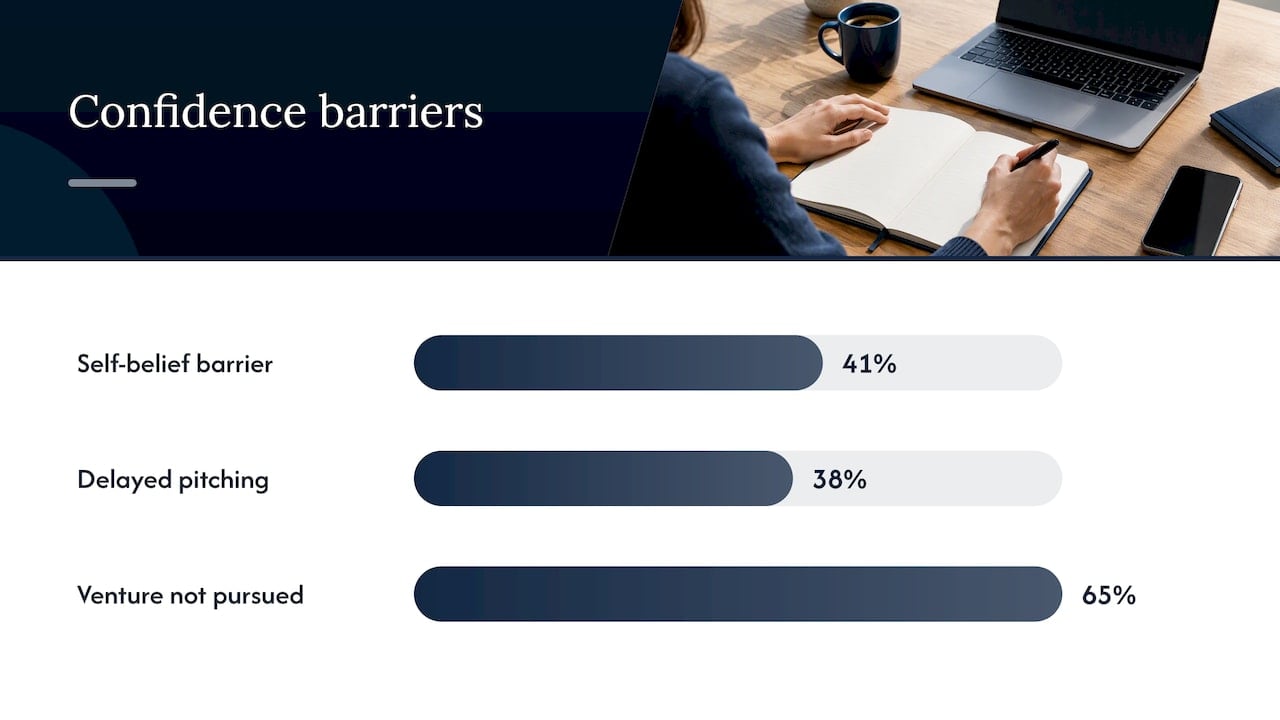
The numbers back this up. In a 2026 study published by Start Up Loans, 41% of UK small business leaders said lack of self-belief was one of the biggest barriers to starting or growing a business, and 38% had delayed pitching to clients or not pitched at all because of confidence issues. The same release reports that 65% of UK small business leaders had not pursued a potential venture for the same reason, in a YouGov study for the British Business Bank.
Think about what that means for revenue. A delayed pitch is a delayed invoice. A pitch never made is revenue that never appears in your forecast, and you will never know it was lost.
Confidence also changes how buyers read you. A seller who hesitates over price invites the buyer to negotiate. A seller who explains the value calmly, then stops talking, gives the buyer room to say yes.
Imposter syndrome in sales
Imposter feelings are common among people who sell, partly because selling is so visible. Your results are measured every month, and rejection is built into the job.
A recent doctoral study of B2B sales professionals, published through Johnson & Wales University, reported that roughly four in five participants experienced moderate-to-intense impostor experiences. The triggers it identified will sound familiar: high-pressure environments, comparison with peers, limited mentorship and constant performance expectations. It also describes how these feelings turn success into “luck” and lead to procrastination, perfectionism, silence, under-pricing and missed opportunities.
Founders are not immune. A 2019 study by weare3Sixty reported that 68% of startup founders show clear signs of imposter syndrome, which can undermine personal performance and contribute to team conflict.
What it looks like day to day
Here is how I see it in practice:
- A consultant rewrites a proposal five times, then sends it two weeks late.
- A founder quotes £1,500 because £2,500 “feels like too much”, though a similar client paid the higher figure last quarter.
- A rep wins a big deal and puts it down to timing, then avoids the next prospect call.
- A sales director stays silent in a board meeting because a colleague with a bigger number seems more credible.
Royal Bank of Scotland’s business insights article on overcoming imposter syndrome lists the same effects, including procrastination, perfectionism and under-pricing, and its experts recommend naming the self-doubt, acknowledging your achievements and reducing unhelpful comparison.
A small point on language: Dr Kate Atkin, a UK-based researcher in this field, notes that the term is often used inaccurately. Not every wobble is imposter syndrome. Sometimes you simply lack practice at a particular conversation, and that is easier to fix.
Four responses that work
The academic study above recommends the same set of responses I use with clients:
- Name it. Say “this is self-doubt, not evidence” before you open the proposal.
- Keep a win file. Record every deal, testimonial and good meeting so your memory cannot rewrite the record.
- Challenge comparison. Compare yourself with your own last quarter, not with the loudest person on LinkedIn.
- Treat rejection as feedback. A “no” tells you about fit, timing or your pitch. It is not a verdict on your ability.
Seven habits that build sales confidence
Confidence follows action. These habits give you the evidence to believe in yourself.
1. Set realistic sales objectives
The Growth Hub advice starts with realistic objectives. If your target is so far from your current pipeline that it feels absurd, your brain files it under “impossible” and you avoid it. Break the number into activities you control: conversations booked, proposals sent, follow-ups made. Hitting a weekly activity target builds confidence long before the revenue shows up. Our guide to setting and tracking personal sales goals shows how.
2. Know your offer in the buyer’s language
Learn the features, then translate each one into a benefit the customer cares about. The same Growth Hub guidance advises learning your offer’s features and customer-relevant benefits and backing up claims with evidence. Write down three results your customers have had, with figures if you have them. If you have none yet, gather them. A specific case study is worth more than any amount of adjectives.
3. Understand who decides
Much of the nervousness in a sales call comes from not knowing who is in the room or how the buyer’s organisation makes decisions. Find out who signs off, what the procurement process looks like and what drives each person. The Growth Hub also recommends understanding customers’ drivers, needs and preferred way of working so you can tailor your approach. A prepared seller is a calmer seller.
4. Role-play the difficult moments
You would not walk onto a stage without rehearsing. Yet people go into price conversations cold. Pick the three moments you dread most (usually a price objection, a “we’ll think about it” and a competitor comparison) and rehearse them aloud with a colleague, coach or mentor until the words feel natural. Our examples of role-playing realistic sales scenarios show how to structure it.
5. Prepare for difficult conversations
Acas describes its conflict management course as teaching preparation, clear communication, trust-building and difficult conversations, and says its evaluation found most managers who completed it significantly improved their confidence and competence in addressing conflict. The lesson transfers to selling: structured preparation for tough exchanges builds confidence.
6. Reframe the follow-up
Follow-ups are where confidence usually collapses. “I don’t want to nag” is the most common reason I hear for a dead pipeline. Enterprise Nation shares the story of a senior consultant who reframed follow-ups as continuing a useful conversation rather than being salesy, which improved the pipeline and the consultant’s confidence. Add something useful each time: a relevant article, an answer to a question they raised, a short idea for their situation.
7. Debrief every conversation
After each call, spend five minutes noting one thing that went well, one thing to change and one thing you learned about the buyer. Over a month this becomes your evidence file. When doubt arrives, you have a record, not a feeling, to look at.
A worked example: the under-priced consultant
Here is a composite scenario, not a named client. A solo HR consultant charges £400 a day and wins about half her proposals. She assumes this proves she is priced right. In fact, she has never tested a higher figure because she dreads the objection.
The fix is not a pep talk. She lists her last six outcomes and what they were worth to the client. She drafts and rehearses her response to “that’s more than we expected”. She then quotes the next three prospects at a higher rate. Whatever the result, she now has real data about her market instead of a story about her worth. That is how confidence is built: with evidence gathered through deliberate, small risks.
When coaching helps
Some confidence work you can do alone. Some of it goes faster with someone who can watch you sell and tell you the truth.
The CIPD describes coaching as a confidential, collaborative and solution-focused approach, distinct from counselling or mentoring, and notes that evidence from three meta-analyses found significant effects on organisational performance, wellbeing and leadership. It also stresses that coaching works best when built on trust, confidentiality and rapport, and when it targets individual needs rather than generic instruction.
That matches what I see. Sales confidence coaching is most useful when:
- you are good at the work but avoid the selling part
- you have recently moved from delivery into leading sales
- you under-price, over-discount or give away free work to avoid awkward conversations
- your team has the skills on paper but hesitates in live conversations
For business owners, consultants and coaches in particular, mindset and skills are tied together. Better objection handling raises mindset, and a steadier mindset makes you willing to practise objection handling. That is why we blend one-to-one coaching with practical sales training rather than offering motivation on its own. You can see how this looks in practice in our sales coaching examples.
Our perspective
We believe confidence is the result of a system, not a personality trait. When someone knows their numbers, has rehearsed their hardest conversations and has a coach who tells them what they did well and what to fix, confidence follows quickly.
That is why our work combines bespoke one-to-one coaching with traditional training and consultancy. Training gives your people the skills and the language. Coaching makes those skills stick under pressure. Consultancy sorts out the process around them, so that nobody has to rely on willpower alone.
For solo service businesses, we build this into a sales acceleration track so owners can price properly and follow up without apology. For teams, we design engagements around the specific moments where reps lose nerve. Our aim is that your team hits its targets every quarter, and we design every engagement towards that goal.
If you take only one thing from this article: do not wait to feel confident before you act. Act in small, prepared steps and let the evidence build the feeling.
Jerry
Leading a team: confidence is not competence
If you manage salespeople, there is a trap. The most confident rep is not always the most skilled, and a quiet rep is not always weak. Revenue alone hides this.
Research from the University of Kent on the million-minute sales truth suggests sales leaders should assess observable skills and behaviours, not rely on revenue as the only measure of capability. It also highlights that teams with manager-led coaching reached 80% quota attainment, against 47% for teams without any coaching.
A multilevel study of 1,246 sales representatives across 136 teams found that managerial coaching skill is directly linked to annual sales goal attainment. It also noted that when a manager’s coaching skill is low, frequent coaching has a negative effect. In other words, how well managers coach matters as much as how often. This is why we put so much into equipping managers first, as covered in our guide to sales management coaching.
Make it safe to practise
Confidence grows where people can try, fail and learn. The CIPD’s discussion of psychological safety at work says people are more willing to speak up, ask questions and learn from mistakes when the workplace feels safe, and that internal competition and aggressive KPI cultures can reduce that safety. A leaderboard that humiliates the bottom three may produce short-term effort and long-term silence.
Practical steps for leaders:
- Run role-plays where the manager goes first and gets it wrong on purpose.
- Review calls against a skills checklist, such as our sales skill checklist, not just the number.
- Ask coaching questions instead of giving answers. Our GROW coaching questions are built for exactly this.
- Celebrate good process, such as a well-handled objection, even when the deal is lost.
For a rep who is struggling, a structured plan helps more than pressure. Our 30-60-90 plan for underperforming reps is one way to give clear steps and checkpoints.
Work with us on sales confidence
If you want support rather than another article, we offer bespoke coaching and training for UK businesses. Team-based coaching and consultancy engagements are priced at £4,500 to £8,500 one-off, and our sales acceleration track for solo service businesses and consultants runs from £2,995 to £5,995 one-off. You can see what each includes on our sales training cost page. The Sage Collective is £990 per month, and you can find it on our home page.
If you are a solo business owner who wants to sell without second-guessing every price, start with our sales coaching programme. If you lead a team, our sales training and fractional sales director services are designed around your targets.
FAQ
How can I build confidence in sales?
Start with preparation. Set realistic objectives, learn your offer in terms of what it does for the buyer, find out who makes the decision, and back your claims with evidence. Then rehearse the conversations you dread, such as pricing and objections, until they feel familiar.
Is imposter syndrome common in sales?
Yes. A doctoral study of B2B sales professionals reported that about four in five experienced moderate-to-intense impostor feelings. Naming the doubt, keeping a record of your wins and seeking mentorship are the responses the research recommends.
What does sales confidence coaching involve?
It is usually one-to-one work focused on your specific selling situations: live call reviews, role-play, pricing conversations and follow-up habits. The CIPD describes good coaching as confidential, collaborative and solution-focused, and effective when it is built on trust and tailored to individual needs.
Can a manager build confidence in a whole team?
Yes, but the quality of coaching matters. Research linking coaching to sales goal attainment found that low coaching skill can make frequent coaching counterproductive. Train managers first, assess behaviours as well as revenue, and keep practice sessions safe enough that people will take risks.
Does confidence mean being pushy?
No. Trustworthy selling is based on listening, specific value and honesty, according to the East Midlands Growth Hub. Confident sellers ask better questions and are comfortable with a “no”, which is usually less pushy than someone who is anxious and over-eager.
Sources
- Start Up Loans: over half a million potential business ventures go unpursued due to lack of confidence
- East Midlands CCA Growth Hub: 10 tips for the new or reluctant salesperson
- Impostor Phenomenon and Its Implications for sales professionals (Johnson & Wales University)
- weare3Sixty: why founder wellbeing is the new metric for startup success
- Royal Bank of Scotland: management strategies for overcoming imposter syndrome
- Dr Kate Atkin: about
- Acas: conflict management skills online course
- Enterprise Nation: seven things first-time founders over 50 should know
- CIPD: is coaching the key to world champion business performance?
- University of Kent: the million-minute sales truth
- Does coaching matter? A multilevel model linking managerial coaching skill and frequency to sales goal attainment
- CIPD: creating a culture of psychological safety at work