
A sales competency framework is a written structure that defines what good selling looks like in your business: the competencies each sales role needs, the proficiency levels within them, and the behaviours a manager can actually observe. Used well, it tells you who to hire, what to coach, and who is ready for promotion. Used badly, it becomes a 40-page document nobody opens after the launch meeting. This guide shows you how to build the useful version.
TL;DR
- A framework is the whole system (competencies, levels, definitions). A model or matrix is that system applied to one role, such as SDR, account executive or sales director.
- Keep it small: 6 to 8 competencies, 3 to 5 proficiency levels, and two or three observable behaviours per level.
- Assess with real tasks (role-plays, call reviews, live deals), not knowledge quizzes.
- Link every level to a training or coaching action, or the framework will not change anyone’s results.
- Review it yearly against your pipeline data and your actual top performers.
Table of Contents
- What a sales competency framework actually is
- Why bother: what a framework changes in a sales team
- The core competencies of an effective salesperson
- How competencies vary by sales role
- How to build the framework in six steps
- How to assess people against the framework
- Turning results into training and qualification pathways
- Common mistakes to avoid
- Our perspective
- How we can help
- FAQ
- Sources
What a sales competency framework actually is
The term gets used loosely, so it helps to separate three things.
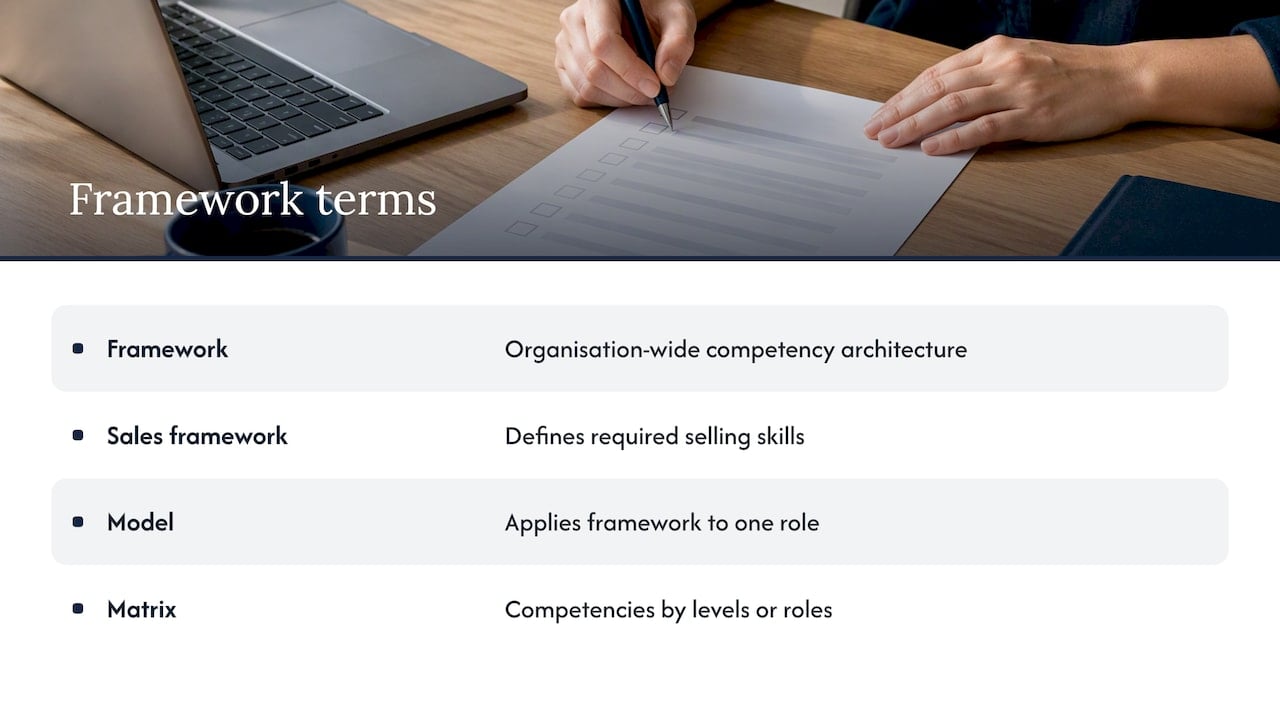
A competency framework in general is a structure that sets out and defines each competency (problem-solving, people management, communication) required by people in an organisation. A sales competency framework does this for selling: discovery, objection handling, negotiation, pipeline management, commercial awareness, and so on.
The difference between a framework, a model and a matrix is mostly about scope. One practitioner’s definition, which I find useful, is that a framework is the organisation-wide architecture while a model applies it to a specific role. A matrix is simply the grid format: competencies down the side, proficiency levels or roles across the top. In practice you will build one framework, then produce a matrix for each role.
If you are searching for a “sales competencies framework”, a “sales competency model” or a “matrix”, you are looking for the same thing at different levels of detail. Do not let the vocabulary slow you down.
Why bother: what a framework changes in a sales team
I have worked with sales teams where every manager had a different idea of what “good” meant. One valued relentless activity. Another valued polished presentations. A third promoted whoever hit quota last quarter, regardless of how the deals were won. Reps picked up on this quickly and optimised for whichever manager they reported to.
A framework fixes that by making expectations explicit. It supports:
- Hiring: you interview against defined behaviours rather than gut feel.
- Onboarding: a new starter knows what “competent” looks like by day 90.
- Coaching: managers coach to a specific gap instead of saying “be more consultative”.
- Promotion: the step from rep to senior rep to team lead has written criteria.
- Training spend: you buy development for the gaps you have found, not the ones a supplier suggests.
Forrester describes the same purposes: a competency map defines observable behaviours by sales role to support hiring, onboarding, learning, development and assessment.
The core competencies of an effective salesperson
Research on sales performance has long grouped selling skills into families. One academic classification, discussed in work from Cranfield University, divides them into salesmanship, technology skills, selling-related knowledge and interpersonal skills. That is a handy way to check you have not built a framework that is all personality and no craft, or the reverse.
Turned into something a B2B team can use, I would start from these eight:
- Prospecting and pipeline creation: building a targeted list, reaching the right buyer, keeping the pipeline healthy.
- Discovery and needs analysis: asking questions that uncover the business problem behind the request.
- Solution positioning: connecting what you sell to the buyer’s stated priorities, not your feature list.
- Objection handling: staying curious, diagnosing the real concern, and responding without becoming defensive.
- Negotiation and commercial judgement: protecting price and value, trading concessions properly.
- Stakeholder and relationship management: mapping the buying group, including the person who signs off.
- Sales process and CRM discipline: accurate forecasts, next steps logged, qualification applied honestly.
- Mindset and resilience: handling rejection, self-coaching, taking ownership of results.
Notice that mindset is on the list. Most frameworks leave it out because it feels soft, yet it is often the competency that explains why two reps with identical training produce very different numbers.
How competencies vary by sales role
The same competency does not carry the same weight in every role. This is where the matrix earns its keep.
| Competency | SDR / BDR | Account executive | Account manager | Sales leader |
|---|---|---|---|---|
| Prospecting | Critical | Important | Moderate | Oversight |
| Discovery | Foundation | Critical | Critical | Coaches others |
| Negotiation | Light | Critical | Important | Approves and advises |
| Stakeholder mapping | Light | Important | Critical | Important |
| Forecasting and CRM | Foundation | Important | Important | Critical |
| Coaching others | Not required | Emerging | Emerging | Critical |
You do not need to score every cell on a ten-point scale. Marking each as “not required”, “foundation”, “important” or “critical” is enough to show where hiring and development should concentrate for each role.
How to build the framework in six steps
1. Start with your best people, not a template
Downloaded templates are a fine source of ideas, but they describe someone else’s business. Pick three or four of your strongest performers and, if you can, a couple of reps who are consistently average. Sit in on calls. Review won and lost deals. Ask what the top performers do in the first meeting that others skip. The gap between them is your framework.
2. Choose a short list of competencies
Six to eight is the sweet spot. Beyond that, managers stop using it. Write a one-sentence definition for each so two people read it the same way.
3. Define proficiency levels
Most frameworks use three to five levels. Forrester’s example labels are foundational, emerging and mastery, and I like that simplicity. Whatever names you choose, each level should describe a different way of behaving, not just “more” of the same thing.
4. Write observable behaviours
This is the step that separates a useful framework from wallpaper. A behaviour is something a manager can see or hear on a call. Take discovery as an example:
| Level | Observable behaviour |
|---|---|
| Foundation | Works through a prepared question list and records the answers accurately in the CRM. |
| Proficient | Asks open follow-up questions to find the business problem behind the request, and confirms the buyer’s priorities before proposing anything. |
| Advanced | Surfaces needs the buyer has not yet recognised, links them to the company’s wider goals, and helps colleagues run better discovery. |
Compare that with “has good questioning skills”, which nobody can rate fairly.
5. Attach evidence and a development action to each level
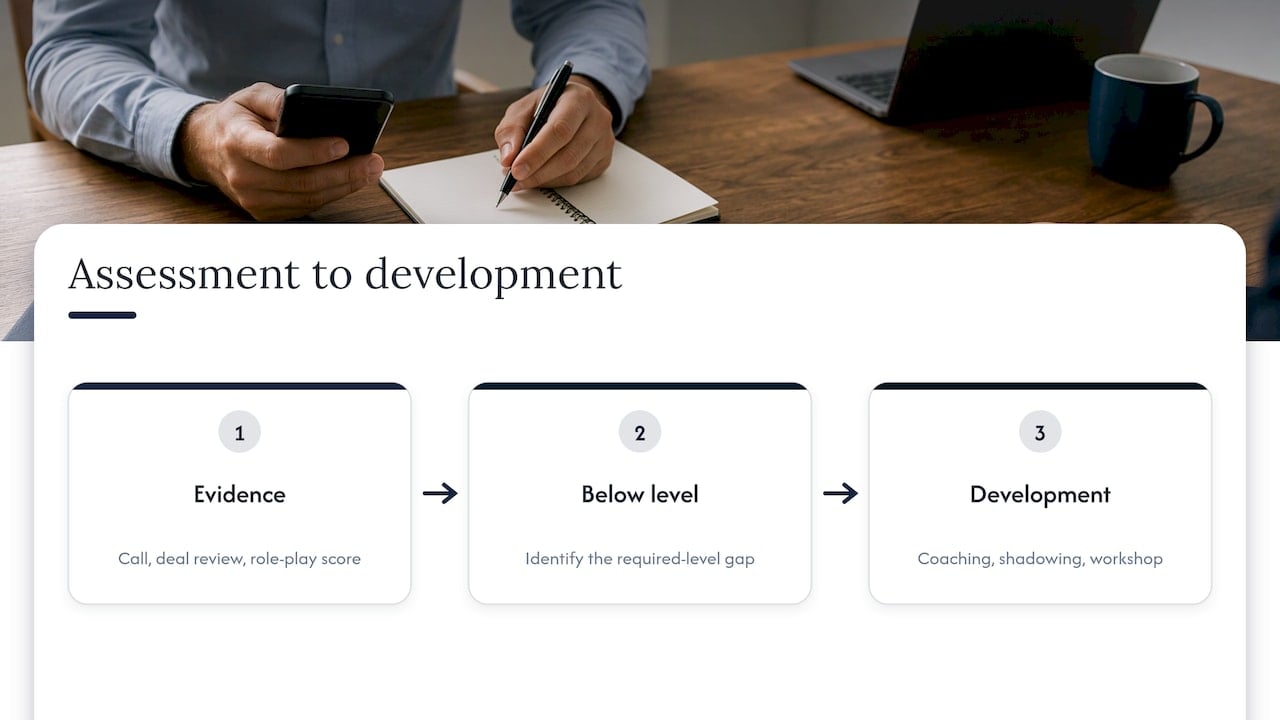
For every competency and level, decide what evidence counts (a recorded call, a deal review, a role-play score) and what happens if someone is below the required level (a coaching block, a shadowing session, a workshop). This is the link to your training and qualification pathway. Without it you have a measurement tool and no way to improve the measurement.
6. Pilot, calibrate, then roll out
Test it with one team for a quarter. Have two managers score the same call independently and compare. If their scores differ by more than a level, the behaviour descriptions are too vague. Fix the wording before it touches a performance review.
How to assess people against the framework
The most common mistake I see is testing selling skill with a multiple-choice quiz. A rep can describe the perfect objection response and still freeze when a procurement director says your price is 20% too high. Forrester makes the same point: a common mistake is using knowledge assessments, when real skill assessment needs task-based simulations or real-world performance.
In practice that means a mix of:
- Live role-plays against a scripted buyer persona, scored on the behaviours you wrote in step 4.
- Call and meeting reviews, using the same scoring sheet each time.
- Deal reviews, looking at how a real opportunity was qualified, progressed and priced.
- Manager observation in the field, particularly for stakeholder management.
If you want to see how a structured, simulation-led diagnostic looks for a mid-market business, this sales consulting audit approach shows how real-world performance can be assessed rather than tested on paper. For a UK team-level view of skills checks, our own piece on why sales skills assessment drives consistent growth covers the same ground, and the sales skill checklist gives you a starting list of behaviours.
Turning results into training and qualification pathways
Once you have scores, plot each person against their role’s required level. You will usually find a pattern: perhaps the whole team is strong on product knowledge and weak on negotiation. That tells you where a group programme pays off. Individual gaps point to 1:1 coaching.
A sensible pathway looks like this:
- Foundation gaps: structured training on the fundamentals (discovery, qualification, basic objection handling), delivered to the group.
- Proficient to advanced: 1:1 coaching, call-by-call, with the framework behaviours as the agenda.
- Advanced to leadership: shadowing a sales leader, running a pipeline review, coaching a junior colleague.
Qualification in this sense is internal: “signed off as proficient in negotiation” is a meaningful milestone when it rests on evidence. If your reps also want external credentials, treat those as a bonus on top of the framework, not a replacement for it. Our guide to sales coaching structure with a one-page skills rubric shows how to turn a scorecard into a 90-day coaching rhythm.
Common mistakes to avoid
- Too many competencies. If a manager cannot remember them, they will not use them.
- Vague language. “Demonstrates strong commercial awareness” cannot be observed. Describe the action.
- One framework for every role. An SDR and a sales director need different weightings.
- Measuring revenue only. Targets matter, but a number alone does not show a rep how to reach it. The framework should describe the how.
- No refresh. Markets, buyers and tools change. Review annually against your win and loss data.
- Using it only for appraisal. If reps only see it at review time, it feels like surveillance. Use it weekly in one-to-ones.
Our perspective
In my experience, businesses rarely fail because they lack a framework. They fail because the framework sits in a folder while the team gets on with selling the way they always have.
That is why we never hand over a document and leave. We combine bespoke 1:1 coaching with team training and consultancy, so the behaviours in the framework are practised on live deals, with feedback, until they become habit. A competency you have only read about is not a competency yet.
We also treat mindset as a first-class competency. Objection handling, resilience and self-belief decide whether a rep applies the skills they have been taught. Our programmes are designed to build all of it together, and our aim for the businesses we work with is at least 50% annual sales growth and a team that hits target every quarter.
If you take one thing from this article: write fewer competencies, describe them as behaviours, and coach to them every week.
Jerry
How we can help
If you would rather not build this alone, we do it with you. For teams, our bespoke coaching and consultancy engagements run from £4,500 to £8,500 one-off, and combine a skills diagnostic, training and 1:1 coaching. For solo service businesses and consultants, our sales acceleration track runs from £2,995 to £5,995 one-off. You can see how the packages fit on our sales training cost page, or explore the Sales Training Cohorts if you want structured group learning. Our ongoing membership, The Sage Collective, is £990 per month; the details are on our home page.
If you lead sales but have no time to build the system yourself, a fractional sales director can own the framework, the assessments and the coaching cadence on a part-time basis. Our sales consultancy service is the right starting point if you want the diagnostic first.
FAQ
What is a competency framework?
It is a structure that defines the skills, knowledge and behaviours people need to perform well in their roles. Each competency is described, usually with levels, so employees know what is expected and managers can assess people consistently. In sales it covers areas such as discovery, negotiation and pipeline management.
What are the 5 qualities of a salesperson?
There is no single official list, but most frameworks include curiosity (good discovery), resilience, communication, commercial judgement and self-discipline. We would add coachability, because the reps who improve fastest are the ones who act on feedback. Treat these as headings, then write the observable behaviours underneath each one.
What is the difference between a sales competency model and a matrix?
The model is the role-specific set of competencies and standards. The matrix is a way of laying them out, usually as a grid of competencies against proficiency levels or roles. Many teams use the words interchangeably, which is fine as long as the behaviours underneath are clear.
How many competencies should a sales framework have?
Six to eight is a practical range. It is enough to cover the whole sales cycle but small enough for managers to remember and use in everyday coaching. If your list is longer, merge related items or move detail into the behaviour descriptions.
Sources
- Sales Competency Model: Definition and Examples
- Role-Based Sales Competency Maps, Forrester
- Reclaiming the contingent nature of the determinants of sales performance, Cranfield University
- 60 Day Sales Consulting Audit for Owners and Mid Market Leaders