
The safest way to raise your consulting fees is to do it on a schedule: review your rate at least once a year, put new work on the new rate from day one, and give existing clients 60 to 90 days’ notice in a short, confident email. The bigger gains come when you stop selling time and start pricing around the outcome the client wants. This guide covers both routes, with the arithmetic and the wording.
TL;DR
- Review your rates every 12 months. If you are fully booked, haven’t raised for a year or charge less than similar providers, you are due.
- A routine rise of 5 to 10 percent is easy to defend. After years of flat rates, phase in 20 percent or more in steps.
- Tell existing clients 60 to 90 days ahead by email, in 150 to 200 words, with the new rate and the date it starts.
- The largest step up comes from value-based pricing: fix the fee to the outcome, not the hours.
- Put an annual fee review into every retainer so you never have to argue for an increase from scratch.
Table of Contents
- When it is time to raise your fees
- How much to raise your fees by
- Telling existing clients
- Moving from hours to value-based pricing
- Pricing retainers so increases are built in
- A simple 90-day plan
- Our perspective
- Work with us on your pricing conversations
- FAQ
- Sources
When it is time to raise your fees
Most consultants raise their prices later than they should. They wait for a gap in the diary, or for a client to complain, or for a moment that feels comfortable. That moment rarely arrives.
The IPSE guidance for UK independents lists the signs clearly. You are fully booked and turning work away. You have won projects at a higher rate. You have added skills, qualifications or services. You haven’t raised your rates in 12 months or more. Or you charge less than comparable providers.
I would add a sharper test, which Ben Matthews puts well: ask what rate you would quote if this client were new to you today. If that number is higher than what you charge now, your current rate is too low. It removes the guilt, because you are no longer “putting prices up”. You are correcting a quote that has gone out of date.
There is a cost to waiting. Fasscale’s UK pricing guide recommends raising prices annually for new work, in line with inflation plus your own growth in value, and points out that every year without a rise is a real-terms pay cut.
A word on the market
You may worry that the market is soft, and it is a fair thing to check. The MCA projects 6% growth in UK consulting revenue in 2026, down from an earlier forecast of nearly 9%, and its chief executive has said businesses are focused on cost efficiencies. The UK consulting industry still generated £21.8 billion in 2025, up 3% on 2024.
What that means for you: buyers are scrutinising spend, so your increase has to be tied to visible value. Vague “my costs have gone up” messages land worse than clear outcomes. That is another reason to move towards value-based pricing, covered below.
How much to raise your fees by
There are two situations, and they need different answers.
| Situation | Typical increase | How to apply it |
|---|---|---|
| Routine annual review | 5 to 10 percent | New rate from the effective date |
| Correction after years of flat rates | 20 percent or more | Phase in over several steps |
| New clients | Your “first-time quote” rate | From day one |
The ranges come from Raoura’s analysis of freelance rate rises: 5 to 10 percent for routine, 20 percent or more in steps for a correction.
The break-even sum that calms nerves
The fear is always the same: “What if I lose a client?” Do the sum first. The loss threshold is the raise divided by (1 + raise). A 10% raise means you can lose up to 9.1% of your billings and still earn the same, according to the same Raoura piece.
Try it with a day rate. Say you charge £500 and work 100 billable days on a single-client basis. That is £50,000. Move to £550 and you earn the same from about 91 days. You could lose nine days, perhaps one small project, and be no worse off. In practice you are likelier to lose nothing at all.
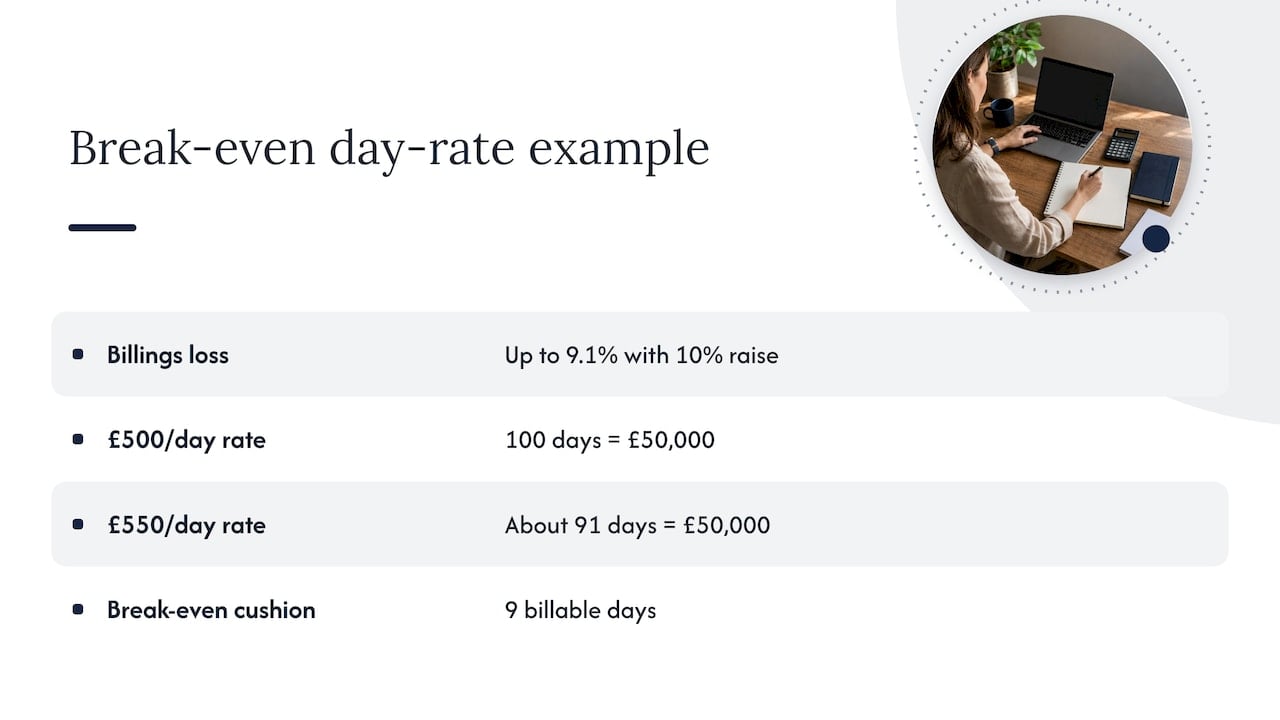
The bigger the rise, the more room you have. MyConsultBase’s worked example shows a 23% increase, from $150 to $185 an hour over 920 billable hours, which lets you lose nearly one in five hours and still match your previous income.
Choosing the number
To pick a defensible figure, work from three points:
- Your cost floor. Take your target income and divide by the billable hours you can realistically sell, not the hours in a working year. Billable utilisation across professional services sits at 66.4%, the lowest in SPI Research’s survey history, so assume you will not bill every hour.
- Market benchmarks. UK contract consultants are paid a median of £500 to £600 a day depending on job title, and the median for a management consultant is £550. The Big Four publish maximum day rates of £1,050 to £2,855 for their consulting grades. Contract benchmarks are a floor for thinking, not a ceiling for what an expert advisor can charge.
- Demand. If you are turning work away, the market is telling you the price is low.
Rate differences are driven by the seniority of the person doing the work, whose name is on the invoice, and how precisely the deliverable is defined. You control the third factor completely, and that is where the rest of this article goes.
Telling existing clients
New clients are easy: quote the new rate and carry on. Existing clients need a plan.
Give notice. IPSE recommends 60 to 90 days. A last-minute message annoys happy clients, while two to three months lets them respond and gives you time to replace anyone who leaves. Ben Matthews suggests three months for long-term clients and less for newer relationships.
Put it in writing. Email works. IPSE suggests keeping it to 150 to 200 words, covering the price change, the details and justification, and a courteous invitation to respond.
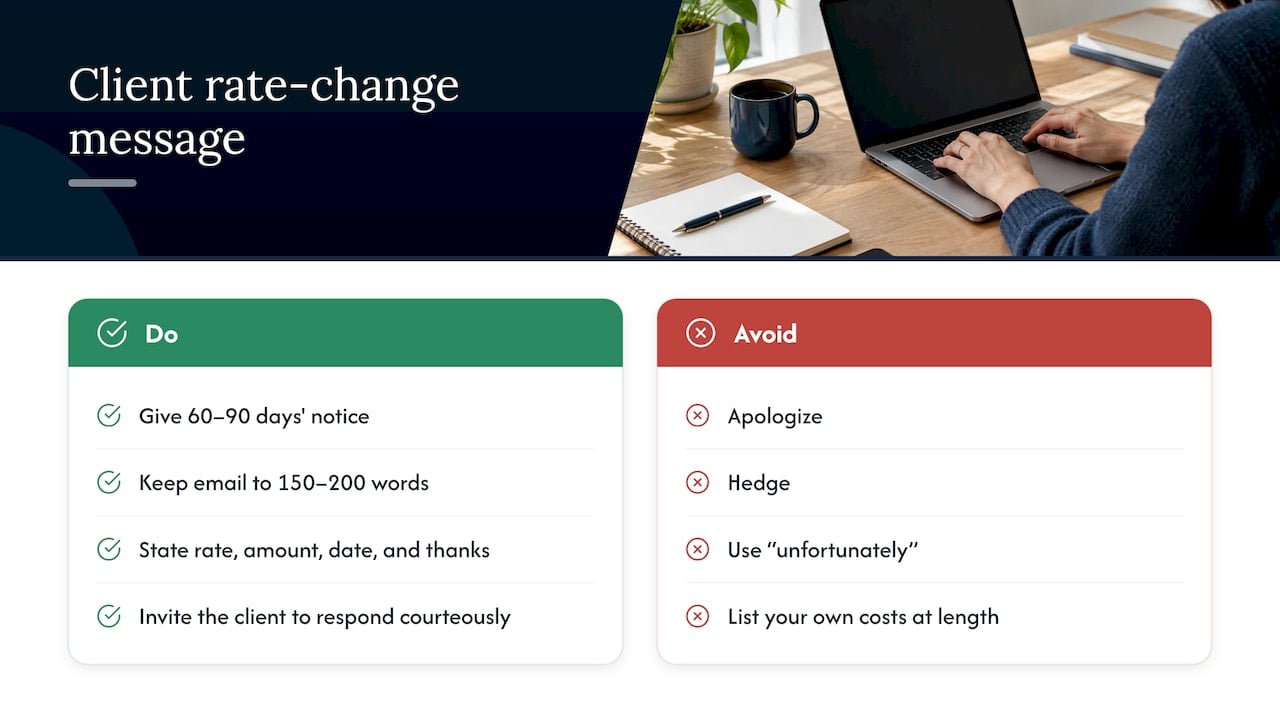
Say four things: the rate is changing, what the new rate is, the date it applies from, and thank you for the work together.
Here is the shape I use with clients I coach:
Hi Sam, thank you for the work over the past year, particularly the pricing review we finished in the spring. From 1 March my day rate will move to £X, reflecting the added scope I now cover and the results we have achieved together. Anything booked before then stays as agreed. Happy to talk it through if useful.
Notice what it leaves out: apology, hedging, “unfortunately”, and a long list of your own costs. A calm email gets a calm reply.
Handling the push-back
Some clients will ask for a discount. Decide in advance what you will trade. A rate freeze is sometimes a sensible concession to a flagship client, but it should be a decision, not the default. If you do hold the rate, trade it for something: a longer commitment, annual payment up front, or a referral. Don’t just give it away.
If a client leaves over a modest, well-signposted rise, the work was probably price-led anyway. Your capacity is now free for a client who values the outcome.
Moving from hours to value-based pricing
A percentage rise gets you to the top of your hourly or daily band. Value-based pricing takes you beyond it, because the fee no longer depends on how long you take.
It works when three things are true, according to Fasscale: there is a clear, measurable business outcome, you are a trusted expert rather than a body shop, and the buyer can say what solving the problem is worth. That guide gives a UK example: a 1% conversion-rate lift on a site turning over £20m a year is worth £200,000 a year, which supports a consulting fee of £20,000 to £40,000.
Three worked examples
- Re-pricing a project. A brand project quoted at roughly £4,000 for eight days was re-priced at £14,000, because the client was winning £5,000 projects that the new brand would help it win at £15,000.
- Advisory fee against hours. If a client expects a market launch to bring in £500,000 of new annual revenue, an advisory fee of £50,000 to £100,000 sits at 10 to 20 percent of first-year value. The alternative, 500 hours at £150, would be £75,000 and leave the client auditing your time.
- Changing the unit. A presentation skills trainer moved from £1,500 a day to £395 per delegate with a minimum of ten, taking £3,950 for the same day, and the client happily accepted.
These are published examples from other practitioners, not guarantees. They show the mechanism: change what the client is buying, and the price conversation changes with it.
How to put it into practice
Michael Pilgram’s outcome-based approach is a useful template. Agree success metrics with the client, take baseline measurements, propose pricing tied to specific improvements, and build in measurement and reporting. It aligns both sides: you are motivated to deliver quickly, and the client gets predictable costs tied to business impact.
In a discovery call, ask these before you ever mention a fee:
- What is the problem costing you each month?
- What would solving it be worth over twelve months?
- Who else needs to agree, and what do they care about?
- What have you tried so far?
Price after you have the answers. Present two or three options (a focused fix, a full programme, a programme with ongoing support), so the client chooses between ways of buying rather than whether to buy.
Pricing power also depends on how credible your public presence looks. If you want to see how the pricing power of B2B firms connects with brand perception, that is worth a read before you reset your fees.
If the real obstacle is the sales conversation itself, we have written about how to sell consulting services without feeling pushy, and the sales training for consultants page explains how we work on closing higher-value deals.
Pricing retainers so increases are built in
A retainer is the easiest place to protect your rate, because you can write the increase into the agreement.
Pricing the retainer. For a deliverable-based retainer, price each deliverable at your standard project rate and apply a 10 to 15 percent discount. For an hour-based one, multiply expected monthly hours by your hourly rate and apply a similar discount. Build in a cushion so it stays profitable if you deliver a little more than planned.
Defining scope. State what is included and excluded, the output of each service, and what a month’s worth of service means. Most retainer disputes are really scope disputes.
Billing. Invoice at the start of each month, before the work is done.
Renewal terms. One published template suggests a three-month minimum term, month-to-month renewal after that on 30 days’ written notice, and an annual fee review with a percentage uplift on 60 days’ notice, with the client free to terminate without penalty if it declines. A retainer left unreviewed for 18 months is almost certainly underpriced, so put the review clause in from day one. Have a solicitor check any contract before you use it.
We look at the same idea from the coaching side in our piece on UK sales coaching retainers, and the way we price coaching by outcome is set out on our coaching packages page.
A simple 90-day plan
- Day 0: calculate your cost floor, check benchmarks, and decide the new rate for new work.
- Day 1: quote every new enquiry at the new rate. Move one or two proposals to outcome-based options.
- Day 7: email existing clients with the effective date at least 60 to 90 days away.
- Day 30: add an annual review clause to every new or renewing agreement.
- Day 90: the new rate applies to everyone. Review who stayed, who left and what you learned.
Our perspective
When I coach consultants on pricing, the rate is almost never the real problem. The problem is the conversation around it. Someone who is nervous about asking for £1,500 a day will quote £1,200 and then discount it, however good the maths looks on paper.
We believe the fix is to sell the outcome with confidence, and that is a sales skill like any other. It can be learned, practised and rehearsed. Our approach combines bespoke 1:1 coaching with training and consultancy, so you rehearse the real conversations you are about to have, with your real numbers, rather than sitting through a generic course.
For solo consultants and coaches, our sales acceleration track is designed to help you price with conviction and close higher-value work. For teams, we build the same skills across the sales function so a rate rise is backed by every person who talks to a client.
Our advice is to raise fees in small, regular steps, switch to outcome pricing wherever the value is measurable, and treat every objection as information, not rejection.
Jerry
Work with us on your pricing conversations
If you want support turning a higher fee into a signed proposal, our sales coaching programme for solo businesses is built for consultants and coaches. Our published pricing for the solo service business and consultant sales acceleration track is £2,995 to £5,995 one-off, and team-based bespoke coaching and consultancy engagements are £4,500 to £8,500 one-off. You can see how the packages compare on our sales training cost page.
If you would rather have ongoing senior input, The Sage Collective is £990 per month, and our sales director retainer page explains how part-time sales leadership works.
FAQ
What is a good consulting fee in the UK?
UK contract consultants are paid a median of £500 to £600 a day depending on job title, and the median for a management consultant is £550, according to ConsultingDemand. Your own fee depends on seniority, specialism and how clearly you define the deliverable. Consultants pricing on outcomes can charge well beyond day-rate benchmarks.
How much notice should I give before a fee increase?
Give existing clients 60 to 90 days, as IPSE advises. Three months suits long-term clients, and newer relationships can have less. New work can go at the new rate straight away.
How often should I raise my consulting fees?
Review them at least once a year. If you haven’t raised your rates in 12 months or more, that is a recognised sign it is time. A routine rise is typically 5 to 10 percent, per Raoura.
When does value-based pricing work best?
It works when the outcome is measurable, you are a trusted expert and the client can say what solving the problem is worth. In those cases, link your fee to a share of the value created instead of the hours you spend. Fasscale’s UK guide sets out the conditions.
Sources
- How to raise your client rates, IPSE
- How to Price Your Consulting Services in the UK (2026), Fasscale
- How to Raise Your Rates, Ben Matthews
- How to Raise Your Freelance Rates, Raoura
- How to Raise Consulting Rates Without Losing Clients, MyConsultBase
- Value-Based Pricing for Agencies, Move at Pace
- Digital Agency Pricing: Shifting to an Advisory Model, Sidekick Accounting
- Selling Outcomes, Not Services, Michael Pilgram
- Value Pricing for Consultants, Peter Thomson
- Free Retainer Agreement Template, Dochives
- Monthly Retainer Agreement Template, Gatilab
- How to Price Freelance Work Without Undercharging, Lilach Bullock
- UK Consulting Day Rates 2026: Benchmark Guide, ConsultingDemand
- Consulting Industry Statistics (2026 Data), ConsultingDemand
- British consultants face slowdown, City AM
- B2B Pricing Power and Brand Health Metrics