
A good objection handling workshop does three things. It teaches your team to find the real concern behind what a buyer says. It gives them a repeatable way to respond. And it makes them rehearse until the response sounds like them rather than a script. A talk about objections, however clever, does none of that. Practice does.
This guide covers what to put in the room, how to structure a day, which exercises work, how to adapt the session for complex B2B deals, and how to check afterwards that real conversations improved. I wrote it for business owners, sales directors and sales managers who are deciding whether to run a workshop in-house or bring someone in.
TL;DR
- An objection handling workshop should be mostly live practice: short input, then role-play, feedback and repetition.
- Teach one simple sequence (listen, acknowledge, explore, respond, check) and make everyone use it before they improvise.
- Build the practice scenarios from objections your own team heard in the last quarter, not from a generic list.
- For complex B2B deals, rehearse the objections that come from procurement, security, finance and other stakeholders, not only the person you are speaking to.
- Measure the result in call reviews and stalled-deal data within 60 to 90 days, not in the post-workshop feedback form.
Table of Contents
- What an objection handling workshop is for
- Start with the concern behind the objection
- A simple sequence your team can remember
- Which objections to practise
- Objection handling exercises that work in a workshop
- Sample workshop agenda
- Advanced objection handling for complex B2B deals
- How to tell whether the workshop worked
- Running it yourself or bringing someone in
- Our perspective
- Work with us on objection handling
- FAQ
- Sources
What an objection handling workshop is for
An objection handling workshop is a structured session, usually half a day to a full day, where a sales team learns to deal with buyer resistance and then practises doing it under realistic pressure. The output you want is behaviour change on live calls.
That sounds obvious, but it is where many workshops fail. People leave with a handout of “rebuttals” and a pleasant afternoon behind them, then go back to the same habits within a fortnight. The ones that stick share a few features:
- They separate objections from excuses. A real objection is a buyer telling you something about their situation. A brush-off is a way of ending the call politely. Reps need to recognise which is which, because the right response to each is completely different.
- They treat objections as information. An objection is the buyer showing you where their risk sits. Reps who see it that way stop defending and start asking.
- They give reps a sequence. Nobody thinks clearly with a hot face and a silent buyer on the line. A simple order of steps gives people something to hold onto.
- They use the team’s own deals. Role-play built from real calls feels uncomfortable in the right way. Role-play built from invented “Bob from Acme” scenarios feels like theatre.
By the end of the day, each participant should be able to do five things: name the type of objection they have just heard, ask a question that uncovers what sits underneath it, respond in a way that fits that specific buyer, check whether the concern is resolved, and move the conversation to a next step.
Start with the concern behind the objection
The single biggest shift a workshop can create is getting reps to stop answering the words and start exploring the meaning. “It’s too expensive” rarely means the price is the issue in isolation. It may mean the buyer cannot see the return, cannot get budget signed off, has been burned before, or is comparing you with something that is not like for like.
If a rep answers the stated objection, they are guessing. If they ask a question first, they know. That is why every credible framework I have seen puts questions before answers. In its four-step objection process, HubSpot advises asking open questions before presenting ROI, restating the concern, tailoring the response, and then checking whether any reservations remain. The LAER model described by Salesloft (Listen, Acknowledge, Explore, Respond) recommends open follow-up questions to bring out underlying concerns, trust issues and doubts before you restate your value. And Salesforce’s Trailhead module boils it down to Defuse, Discover, Deliver: acknowledge the objection and the emotion behind it, ask questions to understand what is really going on, then respond.
The labels differ. The logic is the same. In a workshop, I would pick one version and drill it until it is automatic, rather than teaching three models and leaving people confused.
A drill for finding the real concern
Take a single objection, for example “We’re happy with our current supplier.” Ask the group to write down five different things the buyer might actually mean. Typical answers include: switching looks like a lot of work, I have a personal relationship with them, I do not understand how you differ, I am not the decision maker, and I have no budget this year.
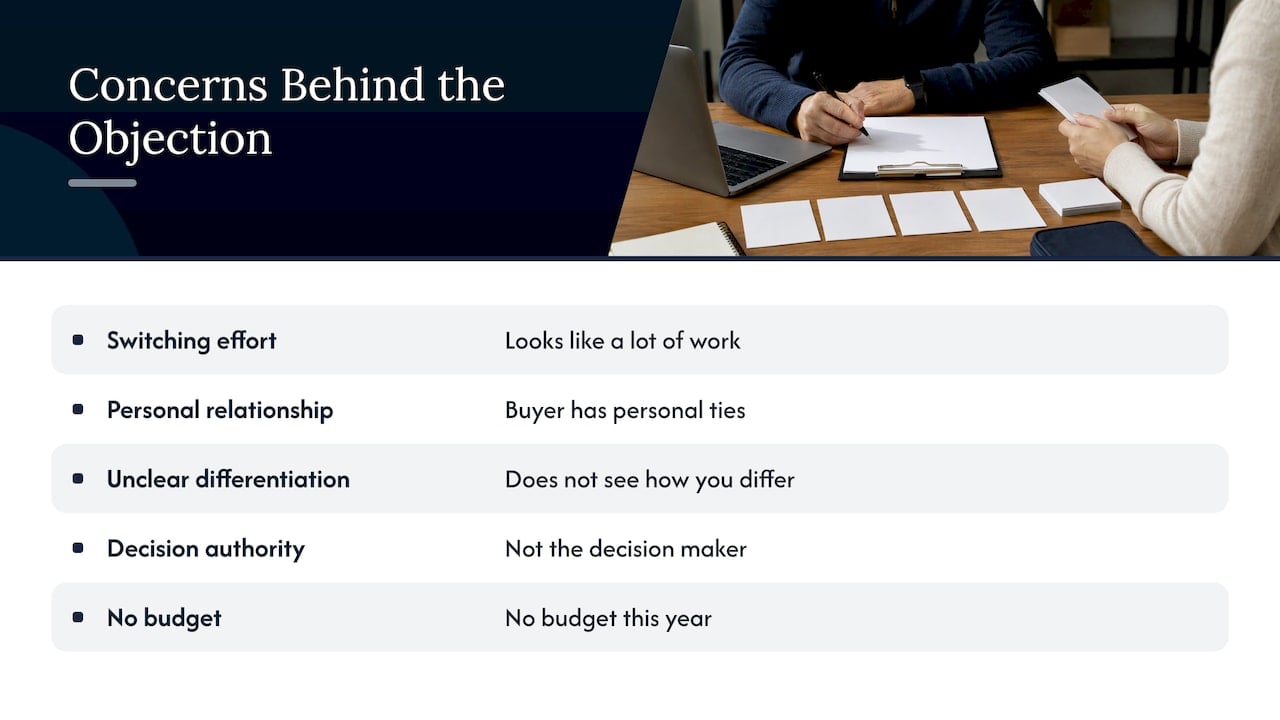
Now ask which question would help the rep tell those five apart. Reps usually discover that one well-chosen question, such as “What would need to be true for you to look at an alternative?”, does the job better than any rebuttal. Run this with six or seven common objections and the room quickly learns that diagnosis is the skill.
A simple sequence your team can remember
I recommend a five-part sequence for the workshop, built on the models above:
- Listen. Let the buyer finish. Pause for a beat before you speak. Silence feels long to the rep and almost never to the buyer.
- Acknowledge. Show you have heard both the point and the feeling. “That’s a fair concern, and I’d want to be sure of that too.”
- Explore. Ask one or two open questions to understand the concern. Resist the urge to ask five.
- Respond. Answer the concern you have now uncovered, using a relevant example, evidence or a reframe. Keep it short.
- Check. Ask whether that deals with it. “Does that answer the question, or is there something else behind it?”
The check step is the one reps skip, and it is the one that stops the same objection coming back three calls later. It also surfaces the second objection, which is often the real one.
In the workshop, I would not allow reps to freestyle on the first pass. Make them use the sequence word for word, even if it feels stilted. Naturalness comes on the third and fourth round, once the structure is in their heads.
Which objections to practise
Most objections fall into a handful of families. Ours are price and value, timing, need, trust, competitor or incumbent, and authority. Cover those six and you have covered the large majority of what your team hears.
But the exact wording matters more than the category. A buyer at a 200-person logistics firm does not say “I have a timing objection.” They say “Come back in the new year, we’re tied up with the warehouse move.” So before the workshop:
- Ask each rep to bring their three most common objections, in the buyer’s actual words.
- Pull a handful of lost-deal notes from your CRM and look for the last thing the buyer said.
- Group the results. You will usually find eight to twelve phrasings that account for most of the pain.
That list becomes your workshop script. It is also why a generic off-the-shelf course feels weaker than one built around your own pipeline.
Price deserves its own block because it is the objection most often misdiagnosed. If your team tends to discount at the first sign of resistance, read our guide to price objection responses that diagnose the root cause and add a price round to the day.
Objection handling exercises that work in a workshop
The format of the exercise decides whether people learn or just perform. These are the ones I would use.
Rapid-fire rounds in threes
Split the room into groups of three: a seller, a buyer and an observer. The buyer gives a real objection from your list. The seller has 60 seconds to respond using the five-part sequence. The observer scores clarity, empathy and how well the seller explored before answering, then gives two sentences of feedback. Rotate roles after each round so everyone plays all three parts at least twice.
Keep the rounds short. Fast repetition builds fluency, and short rounds leave less time for people to feel self-conscious.
Replay a real call
Play a short extract of a recorded call (with the rep’s permission, and within your call-recording and data-protection policies) where an objection landed badly. Ask the group what the buyer actually meant, what the rep said, and what they would ask instead. Then have two people re-run that exact moment live. This is uncomfortable, and it is the most useful forty minutes of the day.
The “second objection” round
The buyer gives an objection. The seller handles it and checks. The buyer then reveals a second, deeper concern, which the seller has to discover. This teaches reps that the first objection is often a doorway, and that the check question is what opens it.
Write the answer, then cut it in half
Each rep writes their best response to a given objection, then cuts it to half the length, then half again. Most answers improve at every cut. Reps who ramble under pressure learn what a tight response sounds like.
Sample workshop agenda
Here is a full-day structure that keeps practice at the centre. For a half-day, keep rows 1, 2, 4 and 6 and shorten each.
| Time | Session | Purpose |
|---|---|---|
| 09:00 | Why buyers object, and what they are really saying | Reframe objections as information |
| 09:45 | The five-part sequence, demonstrated live | Give the team one shared structure |
| 10:30 | Diagnosis drill: five meanings, one objection | Practise asking before answering |
| 11:30 | Rapid-fire rounds in threes (price, timing, need) | Build fluency |
| 13:30 | Trust, incumbent and authority objections | Cover the harder families |
| 14:30 | Real-call replay and the second-objection round | Move from practice to realism |
| 15:45 | Personal action plan and manager follow-up agreement | Make it stick after the day |
The last session is the one most workshops forget. Each rep leaves with two objections they will work on over the next month, and their manager agrees when and how they will review calls together.
Advanced objection handling for complex B2B deals
Once the basics are fluent, the real difficulty in B2B is that the person you are talking to is rarely the only person with a say. Your champion can say yes and the deal still stalls, because a different person raises an objection you never heard.
The evidence from UK buyers points the same way. The Reality Department’s survey of 250 UK B2B buyers found that security or procurement review was the biggest source of delay for 45%, followed by finance or ROI justification (23%), and executive sign-off and functional fit (16% each). The same research found that 74% of purchases went through at least three rounds of internal scrutiny. These are objections your buyer may never voice on a call with you, because they come from people who are not on it.
That changes what an advanced workshop should rehearse:
- Finding out early who reviews security, legal and procurement. Reps should practise asking, in the first or second meeting, who else needs to be comfortable and when they usually get involved. The same research advises supplying the security and legal pack before the demo and equipping your champion to speak for you.
- Arming the champion. Role-play a conversation in which the rep helps the champion answer a finance director’s challenge, rather than answering it themselves.
- Rehearsing the objection you will hear second-hand. “Finance wants to know why this costs more than what we have” arrives through a third party. Reps need to practise questions that reach the real concern even when they cannot speak to the person who has it.
This is closely linked to how many stakeholders you have engaged. In Salesloft’s 2026 UK benchmark of 406 revenue leaders at organisations with 200 or more employees, 22.7% chose multithreading across stakeholders as the strongest predictor of a close, just ahead of a strong business case and validated ROI at 22.2%. The same report found 21.6% of pipeline was affected by stalled deals, slipped close dates or other execution breakdowns. Our article on multithreading in sales explains how to build that coverage, and it pairs naturally with an advanced objection session.
Buyers arrive more informed
Buyers also come to the conversation with their minds half made up. A 2025 UK and Ireland study of 754 buyers by MarketOne and 6sense found that buyers controlled 57% of their journey before contacting a vendor. Gartner reported in May 2026 that 69% of B2B buyers preferred to validate AI-generated insights with sales representatives, with 45% having used generative AI in a recent purchase.
The practical consequence for a workshop is that objections now often arrive pre-formed. A buyer may quote a comparison, a benchmark or a summary they have asked an AI tool to produce. Reps should practise the question “Where did you come across that, and what stood out?” and treat the buyer’s research as something to explore, not to correct.
For negotiation-heavy deals, where objections turn into trade-offs, a separate simulation-led session works better than a single day trying to cover everything. Our page on sales negotiation training explains how that fits.
How to tell whether the workshop worked
The feedback form tells you whether people enjoyed the day. It does not tell you whether they changed. To check, look at behaviour and outcomes over the following three months.
Before the workshop, record a baseline. Listen to five to eight calls per rep and note how often they ask a question before responding to an objection, how often they check that the concern is resolved, and how often they discount or defer when challenged.
In the weeks after, review the same number of calls and look for the same behaviours. This is the cleanest test, because it measures what the team does and not what they say they will do. A short, specific coaching note after each review keeps the habit alive. If you want a structure for that, see our guide to sales team coaching techniques.
In the pipeline, watch for fewer deals stuck at the same stage, a shorter gap between a stated objection and a next step, and fewer discounts given early in the conversation. Compare against the same period before the workshop and be honest about other factors, such as seasonality and changes in lead quality.
A realistic expectation is that skill improves in stages. Reps usually become better at asking questions within a couple of weeks, and the pipeline effect shows later, once more conversations have gone through the new approach.
Running it yourself or bringing someone in
If your sales manager is a strong coach and has the time to prepare, an in-house workshop built from your own call data can be effective. Use this guide as the plan. Where it tends to go wrong is when the same person who sets targets also runs the role-play, because reps play safe in front of the person who rates them.
An outside facilitator removes that tension, brings fresh scenarios and can push harder on the uncomfortable rounds. It also frees your manager to watch, take notes and plan the follow-up, which is where the lasting change comes from.
If your team is still building fundamentals, our sales training explained page sets out how tailored training and coaching fit together, and our wider look at objection handling in sales goes deeper on the theory. For more ideas on formats beyond objections, see our sales workshop ideas for UK sales managers.
Our perspective
We have come to one firm view about objection handling: it is a coaching problem as much as a training problem.
A single workshop gives a team a shared language and a safe place to practise. That matters, and it is where we start. But the habit of asking before answering only becomes permanent when someone reviews real calls with each rep, week after week, and gives specific feedback. That is why we combine bespoke 1:1 coaching with team training and consultancy, rather than treating a workshop as a one-off event.
It is also why we build every session around the objections your own buyers raise. Your sales cycle, your price points and your stakeholders are different from anyone else’s, and the practice should reflect that.
Our aim is for teams to hit target every quarter and grow sales by at least 50% a year. We design our engagements to get there, and objection handling is one of the first places we look, because a few fixed habits on live calls can change a lot.
Jerry
Work with us on objection handling
If you would like your team to practise on your own objections, with coaching that continues after the session, we can build that into a team engagement. Our team-based bespoke coaching and consultancy packages are priced from £4,500 to £8,500 one-off, and our sales acceleration track for solo service businesses and consultants runs from £2,995 to £5,995 one-off. You can see how the options fit together on our sales training cost page.
If you would rather start smaller, The Sage Collective is £990 a month, and you can see it on our home page. Whichever route suits, we will begin with the objections your team hears most.
FAQ
How long should an objection handling workshop be?
A full day gives you time for input, several rounds of role-play and a real-call replay. A half-day works if you narrow it to two or three objection families, such as price and timing. Anything shorter tends to become a talk, with little time for practice.
How many people should be in the room?
Six to twelve works well, because it splits cleanly into groups of three for role-play and leaves room for individual feedback. Larger teams are better split into two sessions so that everyone gets enough turns.
What is the best framework for handling objections?
The best one is the one your team will actually use. The common models, such as LAER or Defuse, Discover, Deliver, all rest on the same idea: listen, acknowledge, ask questions to find the real concern, respond, then check. Choose one, teach it clearly and drill it until it is automatic.
Should managers attend the workshop?
Yes, but as participants and coaches, not as judges. Managers who take part understand the sequence and can reinforce it in call reviews afterwards. That follow-up does more for results than the day itself.
Sources
- A Proven 4-Step Process for Handling Sales Objections
- Guide to Objection Handling
- Master Objection Handling in Sales Processes
- What Slows Down B2B Deals? Survey of 250 Buyers
- 2026 Revenue Benchmark: UK Edition
- Lighting the Dark Funnel: 2025 UK & Ireland B2B Buyer Study
- Gartner Survey Finds 69% of B2B Buyers Turn to Sales Reps to Validate AI-Generated Insights