
The objection handling framework most B2B teams start with is LAER: Listen, Acknowledge, Explore, Respond. The version I coach is LAERC, which adds a fifth step, Confirm, so you never walk past a concern that hasn’t really been settled. This guide shows you how each step works in a live conversation, how to sort objections into three types, and how to adapt the model if you sell professional services where the buyer is really buying you.
TL;DR
- An objection handling framework gives you a repeatable order of play: hear it, show you’ve heard it, find the real concern, answer it, then check the buyer agrees.
- LAERC (Listen, Acknowledge, Explore, Respond, Confirm) is the model I recommend because the last step stops “yes, fine” from hiding an unresolved doubt.
- Nearly every objection falls into one of three buckets: money, trust or timing. Name the bucket before you answer.
- In professional services, the objection is rarely about the fee. It is about scope, your expertise and whether the return is believable.
- A framework only works once it is rehearsed. Drill it on real objections from your own pipeline, not generic ones.
Table of Contents
- What an objection handling framework actually does
- Where LAER comes from
- The LAERC framework, step by step
- Why the UK standard points the same way
- The three types of objection (and the 3 F’s question)
- Adapting the framework for professional services
- A worked example with all five steps
- Five mistakes that undo a good framework
- Making it stick in a team
- Our perspective on objection handling
- Getting help embedding it
- FAQ
- Sources
What an objection handling framework actually does
Objection handling means identifying, understanding and resolving a prospect’s concerns so the deal can keep moving. A framework (you will also see it called a model) is simply the sequence you follow so you don’t improvise under pressure. LAER is a widely used pattern for diagnosing the real source of hesitation and responding with evidence rather than pressure.
Without a framework, most salespeople do one of two things. They defend straight away (“actually, we’re very competitive on price”) or they cave (“I could probably do 10% off”). Both skip the one thing that matters: finding out what the buyer is really worried about.
A good model does three jobs:
- It slows you down at exactly the moment you feel most pressure to speak.
- It makes the buyer feel heard, which lowers their guard.
- It gives your manager, or your coach, a shared language to review calls with.
If you want the wider picture on what counts as an objection and why they appear, our complete guide to objection handling covers the groundwork. Here I want to stay on the framework itself.
Where LAER comes from
LAER is a foundational part of Jack Carew’s sales training, which he pioneered in 1976. The idea has lasted nearly fifty years because it is built around exploring the customer’s concern rather than arguing against it. That principle is what you should hold on to when you meet other models with different acronyms.
The common variations are worth knowing so you can recognise them in the wild:
| Model | Steps | Where it helps most |
|---|---|---|
| LAER | Listen, Acknowledge, Explore, Respond | Everyday B2B calls and meetings |
| LAERC | Listen, Acknowledge, Explore, Respond, Confirm | Longer, multi-stakeholder deals where a vague “okay” is common |
| DISARM | Treats the objection as a request for more confidence | Defensive or sceptical buyers |
DISARM treats the stated objection as a request for more confidence rather than a wall to break down, and it shares the discipline of diagnosing before responding. In practice I find the differences matter far less than the habit they all teach: don’t answer until you understand.
The LAERC framework, step by step
Here is how I run it. I’ll use a realistic example throughout: you sell a six-month sales training programme to the managing director of a 120-person software company, and she says, “This looks like a lot of money for something we can’t measure.”
Step 1: Listen
Listening means hearing the objection in full without interrupting, and making a genuine effort to understand it. That sounds obvious. It is also where most reps fail, because they are already composing their reply while the buyer is still talking.
Practical habits: let there be a two-second pause after the buyer stops speaking, keep your notes open, and resist the urge to say “I understand” before you actually do.
Step 2: Acknowledge
Acknowledging is repeating back what you heard, in your own words, without defending. It does not mean agreeing the buyer is right. It means confirming you understood.
In our example: “So the concern is less the figure itself and more that you can’t see how you’d know it was working. Is that fair?”
Notice the question at the end. It earns you a “yes, exactly” or a correction, and either is useful.
Step 3: Explore
This is the step that separates good from average. Open-ended questions uncover the root cause, and that cause often differs from the surface-level symptom the prospect first presented.
In our example you might ask:
- “What would you want to see after three months to feel it was paying for itself?”
- “Have you tried training before? What happened?”
- “Who else would need to be convinced that the result is measurable?”
The answers might reveal that the last training programme produced nothing, that the finance director is the real sceptic, or that she has no baseline conversion data. Each of those needs a completely different response. That is why responding before exploring is risky: it can produce generic answers that miss the buyer’s actual concern.
Step 4: Respond
Only now do you answer, and you answer the concern you have discovered, not the one you assumed. Tie your response to their goals and to evidence: a comparable client outcome, a measurement plan, a pilot, a different scope.
If the real issue is that she has no baseline, your response might be: “Let’s agree three numbers before we start: win rate, average deal size and sales cycle length. We’ll report against those monthly, so you’re never taking it on trust.”
Step 5: Confirm
The fifth step is what makes this LAERC. Confirm ensures the prospect explicitly accepts the solution before you move forward, so you don’t carry an unresolved issue into the next stage. You may also see this step called check, test or close.
Simple confirmations: “Does that answer the measurement question for you?” or “If we set that up, what else would need to be true for you to feel comfortable going ahead?”
That second question is powerful because it flushes out the next objection while you are still in the room.
Why the UK standard points the same way
This isn’t only a trainer’s preference. The UK national occupational standard for selling, INSSAL008, developed by Instructus, expects sales professionals to anticipate objections, explore them with questioning techniques to prioritise concerns, answer with empathy before resolving, and make sure the customer agrees with the solution before closing. That maps almost exactly onto LAERC, with “anticipate” as the preparation you do beforehand.
The same standard emphasises ethical selling: a close should be a mutually beneficial outcome for the customer and the business. I agree with that completely. A framework used to pressure someone into a purchase they will regret is not objection handling, it is a short route to a refund request and a bad review.
The three types of objection (and the 3 F’s question)
People often ask about “the 3 F’s” in sales. Different trainers use that label for different things, so I won’t pretend there is one official definition. What I can give you is the simplest sorting system I have found useful in the field: almost every objection is about money, trust or timing.
| Type | What the buyer says | What is usually underneath |
|---|---|---|
| Money | “Too expensive”, “No budget” | An unclear return case, or the wrong comparison point |
| Trust | “We’re happy with our current supplier”, “Not sure you understand our market” | Doubt about your credibility, or fear of switching |
| Timing | “Not right now”, “Come back in Q1” | A real constraint, or a lack of urgency |
The value of sorting is speed. If you know you are in a trust conversation, you reach for proof and references, not a discount.
On money, price objections are frequently signals of an unclear ROI case or a mismatched comparison point, not a literal inability to pay. We’ve written a whole piece on price objection responses that diagnose the root cause if that is your sticking point.
On timing, “not right now” may signal a genuine external constraint such as a fiscal year-end or a competing priority. If it is real, adjust your approach: agree a specific date to reconnect, and what you will have done by then. If it isn’t real, exploring will show that too.
Adapting the framework for professional services
If you sell consultancy, coaching, HR advice, legal or accountancy-type services, the buyer cannot try the product first. They are judging you. That changes which objections come up and how you handle them.
Scope: “What exactly am I getting?”
Intangible services breed scope anxiety. The buyer fears an open-ended bill or a vague deliverable. In the Explore step, ask what “done” would look like to them, then Respond with a written scope, milestones and what is explicitly excluded. Clear edges build trust faster than enthusiasm does.
Expertise: “Have you done this for someone like us?”
This is a trust objection wearing a question mark. Don’t list credentials. Explore which part of their situation worries them (their sector, their size, their team) and respond with the most relevant example you can honestly share. If you haven’t worked with a company exactly like theirs, say so, and show how the underlying problem is the same.
Return on investment: “How do I know it will pay back?”
Be careful here. Never promise an outcome you can’t control. Instead, agree upfront which measures will move and over what period, and what the buyer needs to do for that to happen. Then Confirm that these are the right measures. For a solo consultant selling to a small business owner, this single conversation often decides the sale.
The “we’ll do it ourselves” objection
Common in smaller firms. Explore what doing it themselves would cost in time and opportunity, without belittling the idea. Sometimes they are right, and saying so makes you more credible for the times you aren’t. For larger deals where the team’s workload is the real issue, some buyers weigh in-house effort against outsourced sales support, and it helps to have a view on that comparison before they raise it.
We also see a lot of people unsure whether they need training, coaching or consultancy at all, which is its own objection to your offer. Our guide on sales training versus consultancy helps you answer it honestly.
A worked example with all five steps
Here is a compressed conversation between a fractional HR consultant and a founder of a 40-person agency.
Founder: “I like it, but a monthly retainer feels heavy right now.”
Consultant (Listen, Acknowledge): [pause] “So the retainer format is the concern, rather than whether the work is needed. Have I got that right?”
Founder: “Mostly. We’ve been burned by retainers where nothing much happened.”
Consultant (Explore): “What did you expect to get from those that you didn’t?”
Founder: “Decisions. We just got reports.”
Consultant (Respond): “Then let’s not start with a retainer. We could do a fixed three-month project with two decisions agreed at the start: the pay structure and the promotion framework. If you’re happy, we talk about ongoing support.”
Consultant (Confirm): “Does a fixed project with named decisions solve the worry you had?”
Nothing was discounted. The offer was reshaped around the real concern, and the founder explicitly agreed. That is the whole method.
Five mistakes that undo a good framework
- Reciting the steps like a script. Buyers can hear it. Use the order, not the phrases.
- Acknowledging with “I understand” and nothing more. Paraphrase specifically instead.
- Asking leading questions in Explore. “Wouldn’t you agree it’s worth it?” is not exploring.
- Skipping Confirm because the buyer sounded positive. Politeness is not agreement.
- Handling objections only when they appear. Anticipate the top five in your pipeline and prepare your answers in advance. Our cold call objection handling scripts show how to do that at the earliest stage.
Making it stick in a team
The hardest part is not understanding the framework. It is using it when a prospect says something unexpected. Teams that improve do three things: they collect real objections from lost and stalled deals, they role-play them weekly, and a manager or coach reviews real calls against the five steps.
If you want to see how negotiation and objection skills work together under pressure, our negotiation training simulations are built around exactly that.
Our perspective on objection handling
We have sat in a lot of sales calls, and the pattern is consistent: the reps who struggle with objections are rarely short of clever answers. They are short of curiosity. They treat an objection as the start of a fight when it is the buyer telling you, for free, what stands between you and a decision.
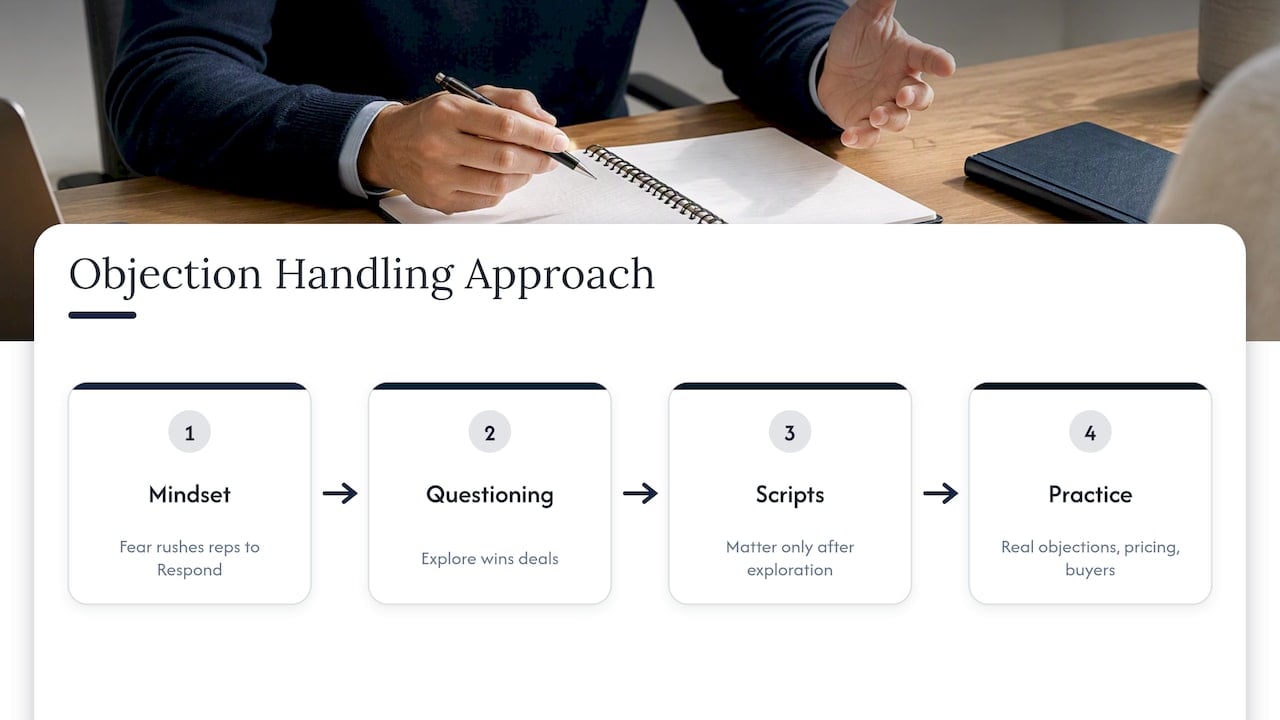
That is why we teach objection handling as part of a bigger picture, not as a bag of tricks. Mindset comes first: if a rep fears “no”, they rush to Respond. Questioning skill comes second, because Explore is where deals are won. Only then do scripts matter. And because every business sells differently, we build the practice around your real objections, your real pricing conversations and your real buyers, combining 1:1 coaching with team training and consultancy so the habits survive past the workshop.
My honest advice: pick one framework, LAERC is a sound choice, and use it consistently for 90 days before you judge it. Frameworks fail from inconsistency far more often than from design.
— Jerry
Getting help embedding it
If you would like your team, or you as a solo operator, to build this skill with a coach beside you, we offer bespoke packages. Team-based coaching and consultancy engagements run from £4,500 to £8,500 one-off, and the sales acceleration track for solo service businesses and consultants runs from £2,995 to £5,995 one-off. You can see how they work on our sales training cost page, or look at the Sage Collective at £990 per month.
FAQ
How do you handle objections?
Listen to the whole objection, acknowledge it in your own words, ask open questions to find the real concern, respond to that concern with evidence, then confirm the buyer is satisfied. The order matters more than the wording. Never answer before you have explored.
What are the 5 steps to effective objection handling?
The commonly taught five are Listen, Acknowledge, Explore, Respond and Confirm (LAERC). UK sales standard INSSAL008 describes a very similar flow: anticipate, explore, answer with empathy, and secure the customer’s agreement before closing.
What are the three main categories of sales objection?
There is no single official list, but a practical grouping is money, trust and timing. Sorting an objection into one of these tells you whether to build a return case, offer proof, or agree a realistic follow-up.
What is the difference between LAER and LAERC?
LAERC adds a fifth step, Confirm, to the four LAER steps. It makes the buyer explicitly accept your answer, so unresolved concerns do not resurface later in the deal.
Sources
- What is Objection Handling? Definition & Framework
- How to Handle Customer Objections: A Roadmap
- Stop Selling, Start Listening: Handling Objections The LAER Way
- The LAER Model | Think Insights
- Using the LAERC B2B Sales Objection Handling Framework
- Negotiate, handle objections and close sales (INSSAL008)